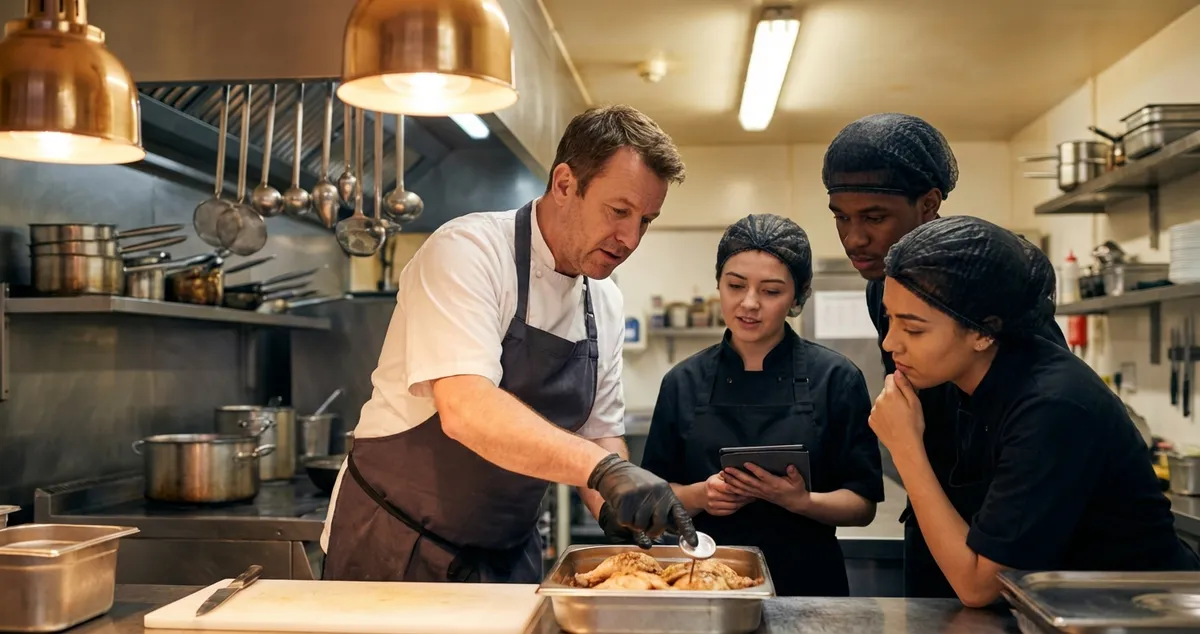
Restaurant staff training costs UK restaurants thousands when done poorly. Build a system that cuts turnover, meets allergen laws, and boosts service fast.
You've just lost another server. Three weeks in, barely trained, gone. You're covering their shifts yourself, scrambling to find a replacement, and wondering why this keeps happening. The answer is almost always the same: your restaurant staff training isn't working.
What You'll Learn
- Why undertrained staff cost UK restaurants far more than proper training ever would
- The legal requirements for allergen training you can't afford to ignore
- What training kitchen, front-of-house, and temporary staff actually need
- How to build a restaurant staff training programme without a massive budget
- Where to find free and affordable online training courses
Why Restaurant Staff Training Matters More Than Ever
First, let's talk numbers. You know staff turnover is bad. But here's what the figures actually look like: undertrained staff cost restaurants roughly $193,806 annually in excess costs from turnover, low productivity, and service errors (Escoffier Global, 2025). That's not a typo. It's nearly 40% of average annual restaurant revenue.
The hospitality industry is going through a training reckoning. 61% of restaurant operators prioritised basic job skills training in 2025, a 25% increase from the previous year (QSR Magazine, 2025). The industry tried quick fixes: marketing promotions, tech tools, price increases. The focus is circling back to the fundamentals.
Here's the reality that matters to you: properly trained employees are 76% more likely to stay (Opus Training, 2025). When the average cost of replacing a single restaurant worker sits close to $6,000, that's not a training expense. That's an insurance policy.
Restaurant staff training isn't about ticking boxes. It's about building a team that doesn't leave.
If you're thinking "I already train my staff," ask yourself this: is your training systematic, or is it whatever happens during someone's first chaotic week? There's a difference. A big one.
Your restaurant staff training manual should codify everything, not leave it to chance.
The Time Crunch Reality
Ongoing training for hourly restaurant employees has dropped to just one hour per month in 2025, a 40-58% year-over-year decline (QSR Magazine, 2025). Meanwhile, operators want new hires proficient in 12 days, but the current average sits at 19 (CrunchTime, 2025).
If you're only training staff when problems arise, you'll always lose to competitors who treat training as an ongoing system.
That compression means every minute of training needs to count. You need a plan, not improvisation.
What Training Should Kitchen Staff Have?
Now that you understand the stakes, let's get specific. Kitchen staff require comprehensive training covering food safety, workplace safety, compliance, and operational skills. The majority of restaurant accidents happen in the kitchen, making proper training on knife safety, proper cooking procedures, and safe lifting techniques genuinely critical (ServiceThatSells, 2025).
Here's what your kitchen training should cover:
Core Kitchen Training Areas
| Training Area | What It Covers | Priority |
|---|---|---|
| Food safety | Temperatures, cooling, cross-contamination, allergens | Critical |
| Knife and equipment safety | Proper handling, maintenance, storage | Critical |
| Station-specific skills | Mise en place, recipe standards, plating | High |
| Workflow and communication | Ticket flow, verbal calls, priority management | High |
| Prep and waste control | FIFO rotation, portion control, date labelling | Medium |
Priority levels are a rule of thumb based on common UK restaurant operations. Adjust to your specific setup.
Did You Know?
A foodborne illness outbreak costs roughly £60,000 per incident (ServiceThatSells, 2025). Proper kitchen training isn't just about efficiency. It's about survival.
For instance, a gastropub kitchen team might structure training by station: grill, pass, prep, and pastry. Each station has its own setup checklist, recipe standards, and quality benchmarks. New starters shadow each station for two days before taking any responsibility.
Micro-learning (short, focused training sessions) can improve information retention by up to 30% compared to marathon training days (KTCHN Rebel, 2025). This matters because your kitchen staff can't disappear for hours of training. Break it into 10-minute daily sessions and you'll see better results.
Pro Tip
Print a laminated one-page allergen quick-reference card for each kitchen station. It takes 15 minutes to create and saves hours of repeated questions during service.
For deeper guidance on structuring kitchen training, see our guide on how to train restaurant staff.
Is Allergen Training a Legal Requirement?
Here's the short answer: yes, in the UK, allergen training is a legal requirement. Under retained EU food information regulations and the Food Information Regulations, all food businesses must provide allergen information to consumers. The Food Standards Agency requires that staff handling food understand the 14 major allergens and how to prevent cross-contamination.
This isn't optional. It's the law.
What UK Restaurants Must Do
- Ensure all staff who handle food or take orders are trained on the 14 major allergens
- Provide accurate allergen information to customers on request
- Have documented allergen procedures in place
- Keep training records as evidence of compliance
For instance, a pub serving fish and chips might assume their team knows about fish allergies, but allergen training covers far more than the obvious. Celery in stock cubes, sulphites in wine, and lupin in flour blends all catch untrained staff off guard.
If you're thinking "my team already knows about allergies", that's usually a sign your training isn't formalised. Knowing is different from being trained, documented, and audit-ready.
Natasha's Law further tightened requirements for prepacked-for-direct-sale foods, requiring full ingredient listing with allergens emphasised. If you do any takeaway or grab-and-go items, this applies to you directly.
Your restaurant onboarding checklist should include allergen training as a day-one requirement, not something that gets covered "eventually."
Do Temporary Staff Need Allergen Training?
Next, a question every restaurant with agency or seasonal staff asks. Yes. There is no exemption for temporary, agency, or casual staff. The Food Standards Agency's guidance uses broad language requiring that all "food handlers" are adequately trained, without distinguishing between permanent and temporary employees (Food Standards Agency, 2025).
The Conference for Food Protection recommends that food establishments "designate at least one staff member per shift to address customer inquiries about food allergens" (Food-Safety.com, 2025). That language covers anyone working any shift, including temps.
Practical Steps for Temporary Staff
For example, a busy restaurant bringing on agency staff for a bank holiday weekend might use this realistic approach:
- Before their first shift: Complete a 10-minute allergen awareness briefing
- On arrival: Walk them through your allergen matrix and point out where it's displayed
- During service: Pair them with a permanent team member who handles allergen queries
- Documentation: Have them sign a simple allergen acknowledgement form
This doesn't require hours of training. It requires a system. If you're only relying on verbal briefings without documentation, you'll always lose to competitors who have proper systems in place.
For more on structuring onboarding for all staff types, check our restaurant onboarding checklist.
Is There a Free Food Allergen Course?
However, none of this needs to cost a fortune. Yes, several free food allergen courses exist. In the UK, the Food Standards Agency provides free allergen guidance resources. SC Training (formerly EdApp) offers free courses with 5-10 minute lessons for up to 10 users, covering allergen recognition and cross-contamination prevention (SafetyCulture, 2025).
FARE (Food Allergy Research and Education) provides a free 10-minute video course covering allergen fundamentals, safety measures, and emergency protocols (SafetyCulture, 2025).
Free vs. Paid: What Makes Sense?
| Option | Cost | Duration | Certificate |
|---|---|---|---|
| FSA free resources | Free | Self-paced | No formal certificate |
| SC Training (EdApp) | Free (up to 10 users) | 5-10 min per module | Yes |
| FARE video course | Free | 10 minutes | Basic |
| Highfield e-learning | From ~£25/person | 1-3 hours | Accredited |
| ServSafe Allergens | ~£40-60/person | 1-3 hours | Industry-recognised |
For most independent UK restaurants, starting with the free FSA resources for all staff and investing in accredited training for your kitchen manager and head chef strikes the right balance between compliance and budget.
Ask yourself: when did your team last complete any formal allergen training? If you can't remember, that's your answer.
For comprehensive restaurant server training that includes allergen awareness, see our dedicated guide.
How to Get a Food Allergen Certificate
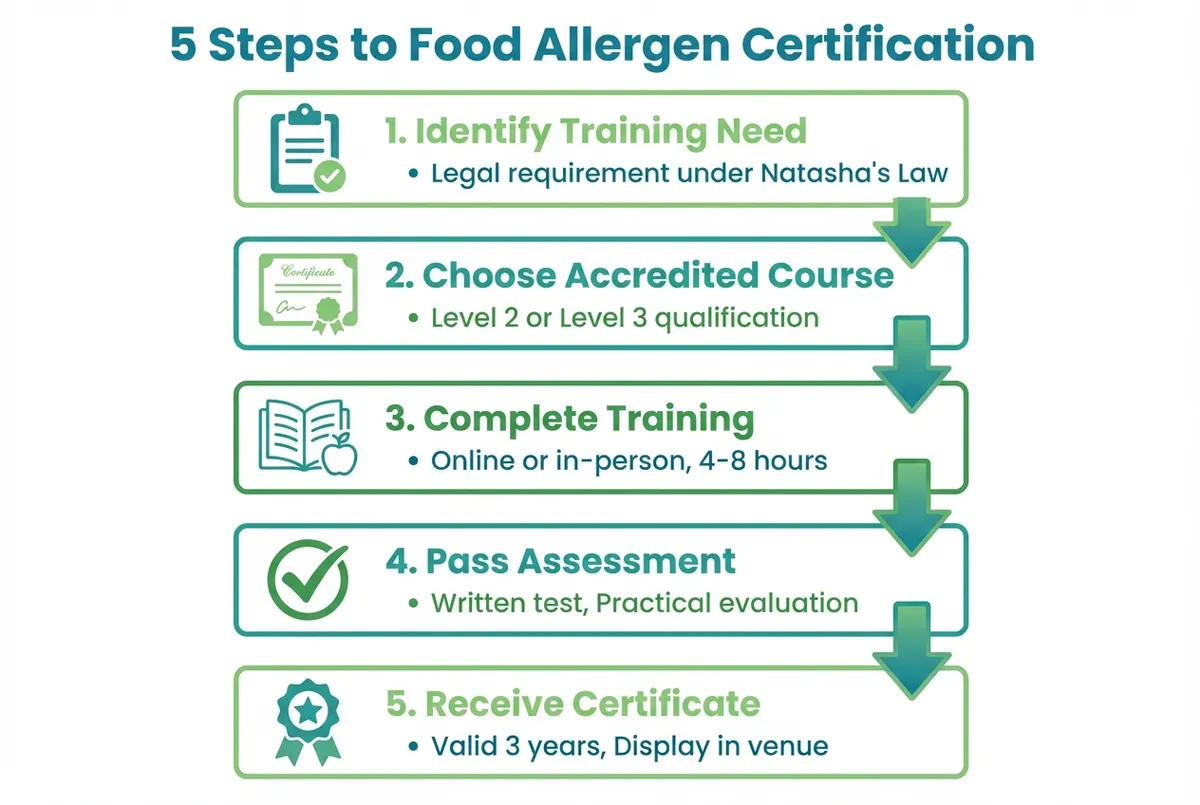
When it comes to formal certification, getting a food allergen certificate is straightforward. In the UK, the most common route is through an accredited online course from providers like Highfield, CPL Learning, or Virtual College. Most courses take 1-3 hours and can be completed during a quiet shift.
Step-by-Step Process
- Choose an accredited provider: Look for courses accredited by Highfield, RSPH, or similar UK bodies
- Complete the online training: Typically 1-3 hours, covering the 14 major allergens, cross-contamination, and customer communication
- Pass the assessment: Usually a multiple-choice test at the end
- Download your certificate: Keep it on file for EHO inspections
- Schedule renewal: Most certificates are valid for three years
For instance, a small Italian restaurant might have their head chef complete a Level 3 allergen management course (around £60), while all front-of-house staff complete the free FSA allergen awareness modules. That covers both depth and breadth without breaking the budget.
Your restaurant manager training should include overseeing allergen compliance as a core responsibility.
Building Your Training System on a Budget
Here's how to make this work without breaking the bank. If you're running an independent restaurant, you likely don't have a dedicated training manager or a £10,000 training budget. You don't need one.
The restaurant training technology landscape is shifting fast. 56% of full-service restaurants are adding or upgrading training technology, with smaller organisations (10-20 employees) leading adoption at 60% (CrunchTime, 2025). Smaller operators are actually ahead of the curve here.
Budget-Friendly Training Framework
Here's a framework that works without spending thousands:
Free tier (£0):
- FSA allergen guidance materials
- Your own restaurant staff training manual (write it once, use it forever)
- Buddy system pairing new starters with experienced staff
- Daily 10-minute pre-shift briefings
Low-cost tier (£100-500/year):
- Online training platforms with short module formats
- Restaurant training videos for consistent messaging
- Simple digital checklists for opening, closing, and changeover
Investment tier (£500-2,000/year):
- Accredited food safety and allergen certifications for key staff
- Structured restaurant staff training programme with progression pathways
- Cross-training schedules to build operational resilience
For example, a small neighbourhood pizzeria might start with the free tier: write a training manual over one weekend, pair new starters with their strongest team member, and run 10-minute pre-shift briefings. Once that's running smoothly, they invest in accredited allergen training for the head chef and kitchen manager.
55% of restaurant employees prefer condensed training programmes lasting 1-2 weeks so they can start contributing quickly (7shifts, 2025). Your training system should respect that preference.
The best training system isn't the most expensive one. It's the one your team actually completes.
For structured restaurant team building exercises that reinforce training, see our dedicated guide.
If You Only Have 30 Minutes This Week
Finally, let's be realistic. If you're reading this thinking "I don't have time for this", you're not alone. Here's your minimum viable starting point:
This Week's Action Plan
- Day 1-2: Write down the three biggest training gaps you've noticed this month. Be specific: "servers don't know the allergen menu" is better than "service needs improving"
- Day 3-4: Download the FSA allergen guidance and send it to your team WhatsApp group with a simple message: "Read this before your next shift"
- Day 5-7: Create a one-page checklist of what every new starter must know before their first solo shift. Keep it to 10 items maximum
That's 30 minutes total. Next week, build on it.
Weekly Action
- Pick one training gap from the checklist below and spend 15 minutes documenting the correct procedure
- Share it with your team before their next shift via your staff WhatsApp group or printed in the kitchen
Actionable Checklist
Use this to audit your current restaurant staff training:
- Written training manual exists and is accessible to all staff
- Every staff member has completed allergen awareness training
- Allergen training records are on file for each employee
- New starters have a structured first-week training plan
- Kitchen staff have documented food safety training
- Front-of-house staff know how to handle allergen queries
- Temporary/agency staff receive allergen briefing before their first shift
- Training is reviewed and updated at least every six months
- Pre-shift briefings happen regularly (daily or per-shift)
- At least one team member per shift can handle allergen emergencies
Frequently Asked Questions
What training do you need to work in a restaurant?
At minimum, UK restaurant workers need food hygiene awareness training and allergen awareness training. Front-of-house staff should understand customer service basics, menu knowledge, and POS systems. Kitchen staff need food safety certification (Level 2 as a minimum), knife skills training, and station-specific competency. Managers typically need Level 3 food safety and first aid certification. Beyond legal requirements, 61% of operators prioritise basic job skills training above all else (QSR Magazine, 2025).
How long should restaurant staff training take?
Most employees prefer 1-2 weeks of initial training before working independently (7shifts, 2025). Industry data shows new restaurant employees take an average of 19 days to become fully proficient, though the goal should be closer to 12 days (CrunchTime, 2025). Ongoing training should continue with brief, regular sessions rather than one-off marathons.
How much does restaurant staff training cost in the UK?
Training budgets range from roughly £1,000 for hourly roles to £5,000 for general managers annually (Opus Training, 2025). However, free resources cover much of the essential compliance training. The real cost isn't the training itself. It's the turnover that happens without it.
What is allergen training and why does it matter?
Allergen training is a method that teaches staff to identify, manage, and communicate about the 14 major allergens recognised in UK law. It matters because allergic reactions can be fatal, and failure to provide accurate allergen information is a criminal offence under UK food safety legislation. The Food Standards Agency requires all food businesses to have trained staff and documented procedures.
Do I need a restaurant training manual?
Yes. A restaurant staff training manual turns your training from ad-hoc knowledge sharing into a repeatable system. It ensures consistency, makes onboarding faster, and provides documentation if anything goes wrong. It doesn't need to be elaborate. Even a well-structured 10-page document is better than nothing.
Key Takeaways
If you run a restaurant and want to see how Local Brand Hub can support your marketing, explore our restaurant marketing tools, or take a tour of the platform.
Key Takeaway
- Undertrained staff cost more than trained ones: roughly $193,806 annually in turnover, errors, and lost productivity per restaurant (Escoffier Global, 2025)
- Allergen training is legally required in the UK for all staff handling food, including temporary and agency workers
- Free resources exist: the FSA provides guidance, and platforms like SC Training offer free courses for small teams
- Training doesn't require massive budgets: a buddy system, written manual, and 10-minute pre-shift briefings cover the essentials
- Properly trained employees are 76% more likely to stay (Opus Training, 2025), making training the most cost-effective retention tool you have
This article is for general guidance only. For specific legal advice on food safety compliance in your area, consult your local Environmental Health Officer or visit food.gov.uk. Information accurate as of February 2026.
For UK restaurant owners
Build a Training System That Works
LocalBrandHub helps UK restaurants create structured training programmes, track staff development, and reduce turnover, without manual spreadsheets.
Start FreeGet More Marketing Tips
Practical marketing tips for UK business owners, straight to your inbox. No spam, unsubscribe anytime.
About the Author
Local Brand Hub
Empowering UK Businesses
Local Brand Hub provides comprehensive business management tools designed specifically for UK local businesses to streamline operations, automate marketing, and grow revenue.
More articlesRelated Articles
 Business Growth
How to Train Restaurant Staff: A Practical UK Guide
How to train restaurant staff effectively with proven frameworks, the 7 steps of service, and budget-friendly methods. Practical guide for UK operators.
 Business Growth
Restaurant Staff Onboarding Checklist: Complete UK Template
Use this restaurant onboarding checklist to boost new hire retention by 82%. Covers the 5 C's of onboarding, stage-by-stage process and printable template.
 Business Growth
Restaurant Team Building: Activities That Work
Restaurant team building activities that improve staff retention and service quality. Budget-friendly exercises for UK operators with real examples.