
Learn what restaurant manager training covers, from qualifications to salary benchmarks. UK guide with training checklist and course comparison.
Your best server just got promoted to manager. They were brilliant on the floor: fast, sharp, great with guests. Three months in, they're lost. The team's frustrated. Complaints are creeping up. And you're wondering whether that promotion was actually a mistake.
What You'll Learn About Restaurant Manager Training
Restaurant manager training builds the leadership, operational, and commercial skills that turn good floor staff into strong managers. It covers people management, money, compliance, and coaching for the UK hospitality sector.
It wasn't a mistake. Nobody taught them to manage. Nine in ten restaurant managers started in entry-level roles (National Restaurant Association, 2025) (US data). Many learn by trial and error, not through training.
In this guide, you'll learn:
- The core responsibilities of a restaurant training manager and what the role involves
- Which UK qualifications are worth pursuing and which ones you can skip
- Realistic salary benchmarks by restaurant type and location
- A practical training checklist you can use to audit and develop your managers
- How to choose the right course based on specific skill gaps
Use this guide to build your own restaurant staff training programme for managers.
Info
What Are the Responsibilities of a Training Manager?
First, let's clarify what a training manager does. They design, deliver, and maintain training across the operation. The goal is simple: make sure every team member (from new starters to shift leads) has the skills to meet service standards.
Core responsibilities include:
- Training delivery: running sessions on product knowledge, service, and safety (CHART, 2025)
- Ongoing development: tracking performance and coaching managers on leadership
- Standards enforcement: site visits and audits to keep quality steady across shifts
- Material development: creating training guides, SOPs, and checklists
- Curriculum updates: keeping materials current with menu and compliance changes
For example, a multi-site group in London might have a training manager at different sites three days a week. They watch service, run refreshers, and update the restaurant staff training manual when menus change.
If you run a single-site restaurant, you probably don't have a dedicated training manager. That's fine. But someone needs to own training, even if it's you. If you're only handing new managers a set of keys and a rota template you'll always lose to competitors who invest in proper development.
Pro Tip
Ask your strongest shift leader to own a 15-minute weekly training topic. It builds their skills and grows your team at the same time.
What Qualifications Does a Restaurant Manager Need?
Now that you know what the role involves, here's what qualifications matter. Managers need hands-on experience, education, and industry certifications. But formal qualifications aren't always essential. Around 36% of restaurant management candidates don't have a degree (Gecko Hospitality, 2025).
UK-Specific Qualifications
| Qualification | Level | Provider | Suited To |
|---|---|---|---|
| Level 2 Food Safety in Catering | Mandatory | CIEH, Highfield | All managers |
| Level 3 Food Safety (Supervisors) | Recommended | CIEH, RSPH | Senior managers |
| Personal Licence Holder | Required for alcohol | Local authority | Licenced premises |
| Level 3 Hospitality Supervision | Optional | City & Guilds | Career progression |
Experience Pathways
The typical routes into restaurant management in the UK:
- Server to shift supervisor to manager: the traditional path, typically 3-5 years
- Hospitality management degree: university route via courses across the UK
- Apprenticeship: Level 4 Hospitality Manager combines work and study
- Internal promotion: fast-tracked in groups with structured development plans
For instance, a head chef stepping into a GM role might need finance and employment law training. Their kitchen skills are strong, but that's usually a sign that cross-role training matters more than one cert.
Strong restaurant managers aren't the ones with the most certificates on the wall. They're the ones who never stopped learning after their first promotion.
When did your managers last get structured training? If the answer is "during onboarding," that's usually a sign your development plan needs work.
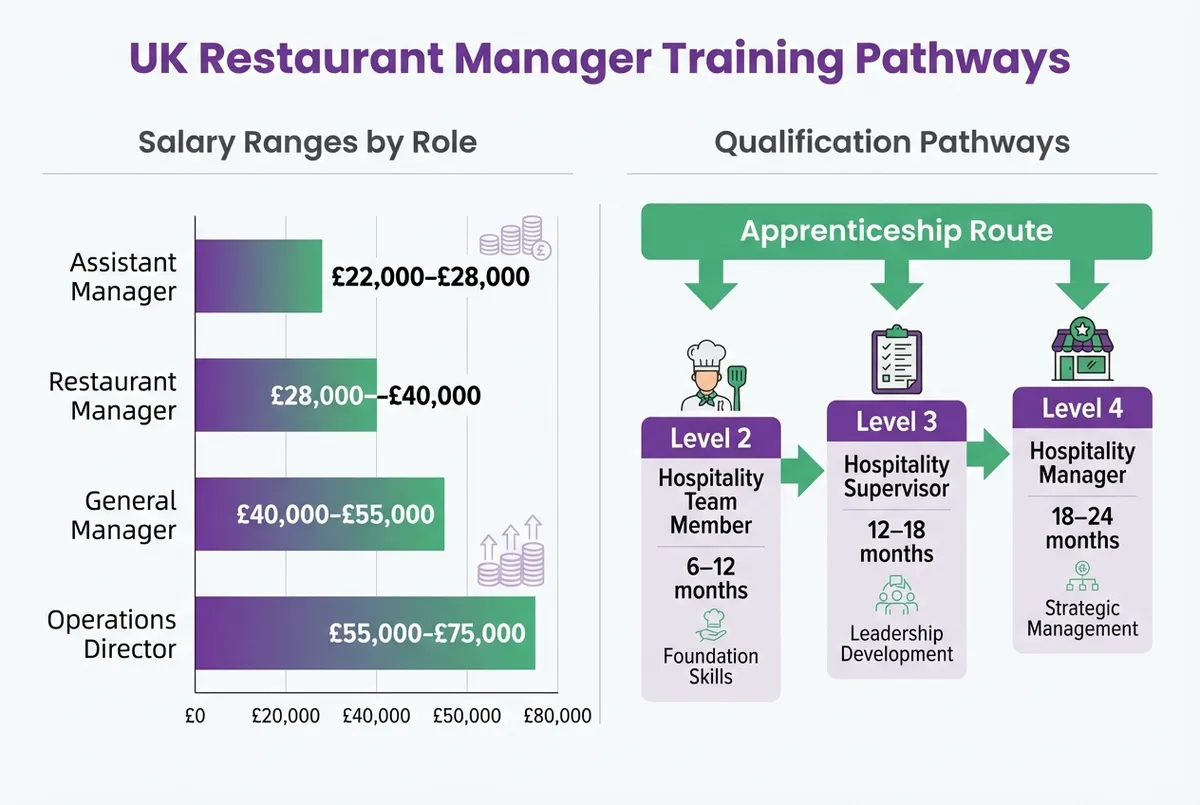
UK restaurant manager training salary ranges and qualification pathways
What Is the Average Salary for a Restaurant Manager?
When it comes to pay, here's what you should expect. Restaurant manager salaries in the UK vary by location, restaurant type, and experience level. Here's what the data shows.
UK Salary Benchmarks
| Restaurant Type | Typical Salary Range | Notes |
|---|---|---|
| Quick-service / fast food | £22,000 - £28,000 | Often includes performance bonuses |
| Casual dining | £26,000 - £35,000 | Higher in London and the South East |
| Fine dining | £35,000 - £50,000+ | Often includes tips and service charge |
| Hotel restaurant | £30,000 - £45,000 | May include accommodation and benefits |
| Multi-site / area manager | £40,000 - £60,000+ | Requires strong track record |
Manager pay has risen steadily over the past five years (Escoffier Global, 2025).
What Affects Pay?
Three factors matter most:
- Location: London managers typically earn 15-25% more than equivalent roles outside the capital
- Restaurant type: fine dining and hotel restaurants command premiums over casual chains
- Commercial responsibility: managers who control P&L, hiring, and marketing earn more than those focused on operations alone
If you're thinking "these seem low for the hours," you're right. Pay needs to match how hard the role is. Underpay and they'll leave. Replacing a GM costs thousands in hiring and training (Black Box Intelligence, 2025).
Which Courses Work for Restaurant Managers?
With that salary context in mind, let's look at courses. There's no single right one. It depends on where your manager needs to grow. Here's a practical comparison.
Course Comparison
| Course | Focus | Format | Suited To |
|---|---|---|---|
| Level 4 Hospitality Manager Apprenticeship | All-round management | Work + study (12-18 months) | New managers wanting formal quals |
| WSET Level 2 in Wines | Drinks knowledge | Classroom + exam | Managers in wine-focused restaurants |
| CIEH Level 3 Food Safety | Food safety leadership | Online or classroom | Legal compliance |
| CPD leadership courses | People management | Short courses (1-5 days) | Experienced managers needing soft skills |
| Online platforms (Coursera, Typsy) | Flexible learning | Self-paced | Budget-friendly option |
For example, a casual dining manager who's great at operations but struggles with staff retention would gain more from a short leadership course than a full qualification.
72% of restaurant L&D professionals say AI tools improve their training quality (QSR Magazine, 2025).
Digital learning now works for UK restaurants that can't send managers away for weeks.
For most UK restaurant managers, a combination of the Level 3 Food Safety certification plus a short leadership development course often provides the best return on investment.
Pick based on gaps. A manager who can lead a team but doesn't understand food margins needs financial training, not another leadership workshop.
Restaurant Manager Training Checklist
Now let's put this into practice. If you're reading this thinking "I don't have time for training," this checklist is your shortcut. Use it to check whether your managers have the skills they need. It works as both an audit and a training plan for new managers in your restaurant staff training programme.
Operational Competence
- Can open and close the restaurant independently
- Manages stock ordering, deliveries, and waste tracking
- Understands food cost percentages and GP targets
- Runs a smooth service across front and back of house
- Handles equipment failures and supplier issues calmly
People Management
- Conducts effective staff briefings (pre-shift and monthly)
- Manages rotas fairly, balancing preferences and legal needs
- Handles disciplinary talks with care
- Runs team training sessions (at least monthly)
- Provides regular, constructive feedback to all staff
Financial Awareness
- Reads and interprets weekly P&L reports
- Manages labour costs within target percentages
- Tracks covers, average spend, and revenue per head
- Controls wastage and monitors portion sizes
Compliance and Legal
- Holds valid Level 2 (minimum) Food Safety certification
- Knows UK employment law basics (working time, breaks, dismissal)
- Keeps allergen records up to date (Natasha's Law)
- Ensures fire safety and health and safety compliance
- Handles licensing needs if applicable
Leadership and Development
- Can motivate a team during difficult shifts
- Identifies and develops potential supervisors
- Handles customer complaints without escalation (most of the time)
- Helps with marketing and local outreach, using an all-in-one marketing platform to keep it manageable
- Joins menu development and pricing talks
70% of restaurant employees want more hands-on training with managers (American Recruiters, 2025). Your managers aren't just running operations. They're your main training tool.
Restaurant manager training isn't about sending someone on a course. It's about closing the gap between "great server" and "great leader" before the team pays for it.
If You Only Have 30 Minutes This Week
Here's the reality: you probably can't send your manager on a course this week. That's understandable. Here's what you can do with the time you have.
This Week's Action Plan
- Day 1-2: Print the checklist above. Sit with your manager for 10 minutes and tick off what they can already do.
- Day 3-4: Spot the three biggest gaps. Are they in operations, people, or finance? That tells you what training to focus on.
- Day 5-7: Find one free resource (YouTube, Typsy, or a CIEH webinar) that covers the top gap. Book 20 minutes for your manager to do it next week.
This won't fix everything overnight. But it starts a habit that grows over time. Teams that track turnover and guest scores are twice as likely to get budget increases (QSR Magazine, 2025). Small wins build the case for more investment.
Frequently Asked Questions
How do I become a manager at a restaurant?
The typical path is working your way up from an entry-level role such as server, host, or kitchen porter. This typically takes 3-5 years. You take on extra duties like shift supervision and training new staff.
For instance, a server who runs pre-shift briefings and trains new hires shows exactly the drive that leads to promotion. A degree or Level 4 can speed things up, but they aren't always needed.
What training should a manager have?
At minimum, UK managers need Level 2 Food Safety and a grasp of employment law. Beyond compliance, training in people skills, finance, and coaching makes the biggest difference. Learn more in our guide to how to train restaurant staff.
How much does restaurant manager training cost in the UK?
Costs range widely. Level 2 Food Safety starts from around £25 online. Level 3 costs £150-£300. Short leadership courses run £200-£500 per day.
Apprenticeships are levy-funded for larger employers or 95% government-funded for smaller ones. Free options include online platforms and peer mentoring.
What's the difference between a restaurant manager and a training manager?
A restaurant manager runs the day-to-day operation: service, staff, finances, compliance. A training manager focuses on developing programmes, materials, and delivery across locations. In smaller independents, these roles overlap. See our restaurant team building guide for team leadership skills.
Key Takeaways
If you run a restaurant and want to see how Local Brand Hub can support your marketing, explore our restaurant marketing tools.
Key Takeaway
Finally, here's what matters most from this guide.
- Promotion without training fails. Nine in ten managers started in entry-level roles, but many never get formal management training.
- Experience beats certificates. Focus on filling specific skill gaps rather than collecting qualifications.
- Salary reflects responsibility. Managers who control P&L and people development earn more. Invest in those skills.
- Start with the checklist. Audit your manager's current capabilities before spending money on courses.
- Small steps compound. Even 30 minutes a week of structured development builds a stronger operation.
Read our full restaurant staff training guide, or use our restaurant onboarding checklist templates to improve your new hire process.
This article is for general informational purposes. Salary data reflects industry benchmarks at the time of writing and will vary by region and restaurant type. Always check current UK regulations for your situation.
For UK restaurant owners
Develop Managers Who Lead
LocalBrandHub helps UK restaurants build management training programmes that develop leaders, reduce turnover, and improve team performance.
Start FreeGet More Marketing Tips
Practical marketing tips for UK business owners, straight to your inbox. No spam, unsubscribe anytime.
About the Author
Local Brand Hub
Empowering UK Businesses
Local Brand Hub provides comprehensive business management tools designed specifically for UK local businesses to streamline operations, automate marketing, and grow revenue.
More articlesRelated Articles
 Business Growth
How to Train Restaurant Staff: A Practical UK Guide
How to train restaurant staff effectively with proven frameworks, the 7 steps of service, and budget-friendly methods. Practical guide for UK operators.
 Business Growth
Restaurant Staff Onboarding Checklist: Complete UK Template
Use this restaurant onboarding checklist to boost new hire retention by 82%. Covers the 5 C's of onboarding, stage-by-stage process and printable template.
 Business Growth
Restaurant Team Building: Activities That Work
Restaurant team building activities that improve staff retention and service quality. Budget-friendly exercises for UK operators with real examples.