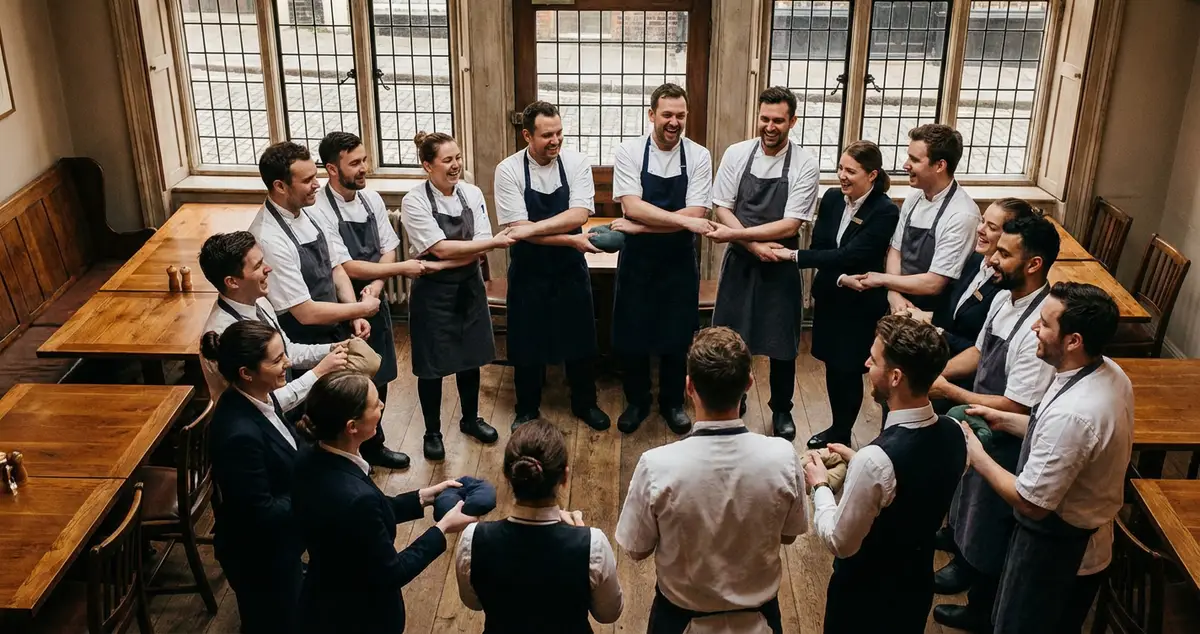
Restaurant team building activities that improve staff retention and service quality. Budget-friendly exercises for UK operators with real examples.
You've spent the week watching your front-of-house and kitchen argue about ticket times. Two servers are barely on speaking terms after a shift swap gone wrong. You know you should "do something about team morale" but the thought of organising trust falls in the car park makes you want to hand in your own notice.
What You'll Learn
- Why restaurant team building has shifted from a perk to a retention strategy backed by data
- The 5 P's and 7 C's frameworks adapted specifically for restaurant teams
- Practical, budget-friendly team building exercises you can run during a quiet Tuesday
- How to build teamwork into daily operations without scheduling separate "team building days"
Info
Related: Restaurant Staff Training: your complete hub for building a high-performing hospitality team.
Why Restaurant Team Building Matters More Than You Think
Here's the reality of restaurant team building. 72% of restaurant employees rank team communication as essential for work satisfaction (ZoomShift, 2025). That's nearly three-quarters of your staff saying that how they communicate with each other matters more than you might expect.
Put that alongside this: 65% of UK restaurant operators describe the labour market as "tight" or "very tight" (Modern Restaurant Management, 2025). You can't afford to lose people. And when employees feel they can't collaborate effectively with their colleagues, one in three will look for work elsewhere (TeamStage, 2025).
Restaurant team building isn't about awkward icebreakers or expensive away days. It's about creating a working environment where your restaurant staff training actually sticks because people want to be there, want to help each other, and want the shift to go well.
68% of employees are more likely to stay with a company if they receive regular feedback and feel recognised for their hard work (7shifts, 2025). That's not a team building exercise. That's a five-minute conversation at the end of a shift. And it costs you nothing.
The 5 P's of Team Building for Restaurants
Now that you understand why this matters, let's get structured. The 5 P's of team building are Purpose, Participation, Placement, Process, and Plan: a framework that ensures your team building efforts serve a clear strategic goal rather than existing as one-off events (Brasero, 2025; Drake International, 2025).
Here's how each P applies to restaurant operations:
Purpose
Why are you doing this? "Because morale is low" isn't specific enough. A better purpose: "Our front-of-house and kitchen teams aren't communicating during service, leading to order errors." That tells you exactly what to fix.
Participation
Who needs to be involved? If the problem is between FOH and BOH, running a team building exercise with just the servers won't help. For instance, a busy Italian restaurant might pair each server with a kitchen team member for a "walk in their shoes" exercise during a quiet midweek shift.
Placement
Where and when? Running team building activities during your busiest shift is a recipe for resentment. Schedule during naturally quieter periods: Tuesday afternoons, early Wednesday evenings, or before a planned closure.
Process
How will it work? Keep it simple. Over-complicated activities create confusion, not connection. Based on our experience with UK hospitality teams, the best restaurant team building exercises feel natural, not forced.
Plan
What's the outcome you're measuring? Track something concrete: fewer order errors, faster ticket times, or reduced complaints about team communication over the following month.
If you're thinking "this sounds like a lot of planning for something that's supposed to be fun", fair point. But that's usually a sign that previous team building efforts didn't deliver because they lacked structure. Fun without purpose is just a nice afternoon. Fun with purpose builds a better team.
How to Build Teamwork in a Restaurant
With that framework in mind, let's get practical. Building teamwork in a restaurant starts with prioritising core skills training, establishing clear career paths, and strengthening manager relationships (QSR Magazine, 2025). But let's be honest: most of the advice out there reads like it was written by someone who's never worked a double.
Here's what actually moves the needle:
Daily Micro-Actions
These cost nothing and take minutes:
- Pre-shift huddles (5 minutes): cover the plan for service, acknowledge yesterday's wins, flag potential problems
- Post-shift recognition (2 minutes): name one person who did something well, in front of the team
- Cross-team introductions: when a new starter joins, have the head chef personally welcome them. Not just the front-of-house manager.
Weekly Investments
- Shared staff meals: 82% of operators plan to spend the same or more on employee meals (Feeding the Workplace Report, 2025). Sitting down together before service builds connection more effectively than any structured exercise.
- Skill swaps: let a server spend 30 minutes in the kitchen. Let a kitchen porter shadow the host stand. Understanding breeds empathy.
Monthly Commitments
- One-to-one conversations: not performance reviews, just check-ins. "How are you finding things? What would make your shifts better?"
- Team feedback sessions: ask the team what's working and what isn't. Then actually act on what they say.
27% of restaurant operators cite retention as their top challenge (Running Restaurants, 2025). For example, a family-run Italian restaurant reduced turnover simply by introducing weekly shared staff meals and end-of-shift recognition, without increasing wages. If you're only addressing retention through pay rises you'll always lose to competitors who build cultures people don't want to leave. Read our full guide to restaurant manager training for more on building leadership skills that support team cohesion.
Restaurant Team Building Exercises That Actually Work
Next, here's what actually works in practice. Forget trust falls. Here are restaurant team building exercises designed for hospitality teams, tested in real kitchens and dining rooms.
The Menu Challenge
Time: 45 minutes | Cost: Ingredients only | Team size: 4-8
Split into teams of 2-3. Each team creates a starter, main, and dessert using only ingredients from your current stock. Teams present and taste each other's dishes. This builds creative collaboration, menu knowledge, and cross-team respect.
For example, a restaurant server training team paired with kitchen staff might discover the servers have brilliant flavour ideas they've never shared, while the chefs learn what customers actually request.
Speed Service Drill
Time: 20 minutes | Cost: None | Team size: Full team
Set up a mock service scenario. Kitchen sends tickets, servers relay orders, bar prepares drinks. Time the whole sequence. Then debrief: where did communication break down?
Run it again. Beat your time. This isn't just a game: it directly improves real service performance.
The Complaint Role-Play
Time: 15 minutes | Cost: None | Team size: 3-6
One person plays a difficult customer with a specific complaint (food cold, long wait, wrong order). The server handles it while the team observes. Debrief together: what worked, what could improve? This builds confidence and reduces manager call-outs during actual service.
Blind Tasting Tournament
Time: 30 minutes | Cost: Minimal | Team size: Any
Use existing stock to create a blind tasting challenge. Staff taste ingredients, sauces, or wines and try to identify them. Great for building product knowledge while having a laugh. The winner gets bragging rights (or first pick of shifts next week).
Community Bites
Time: 2 hours | Cost: Ingredients | Team size: Full team
Cook a meal together for a local cause: a community group, food bank, or charity. Working toward something meaningful outside of daily service builds bonds that last far longer than any in-house exercise.
79% of employees report that team building activities strengthen workplace relationships, and teams using regular team building activities experience a 14% increase in productivity and a 23% rise in profitability (HIGH5 Test, 2025). Those aren't small numbers.
The 7 C's of Team Building Applied to Restaurants
Additionally, here's a framework for assessing where your team stands. The 7 C's of team effectiveness are Capability, Cooperation, Coordination, Communication, Cognition, Coaching, and Conditions (Kaizenko, 2025).
How Each C Applies to Your Restaurant
| C | What It Means | Restaurant Example |
|---|---|---|
| Capability | Diverse skills covering all needs | Cross-trained staff who can flex between roles |
| Cooperation | Supporting each other's success | Kitchen running food when servers are slammed |
| Coordination | Synchronised effort | Smooth handoffs between courses during service |
| Communication | Open, honest dialogue | Pre-shift briefings where everyone can speak up |
| Cognition | Shared understanding | Everyone knowing tonight's specials, allergens, and VIP guests |
| Coaching | Continuous improvement | Managers giving specific, actionable feedback after each shift |
| Conditions | Right environment for success | Fair rotas, adequate breaks, proper equipment |
Results vary by team: use this as a rule of thumb for capability, cooperation, coordination, communication, cognition, coaching, and conditions.
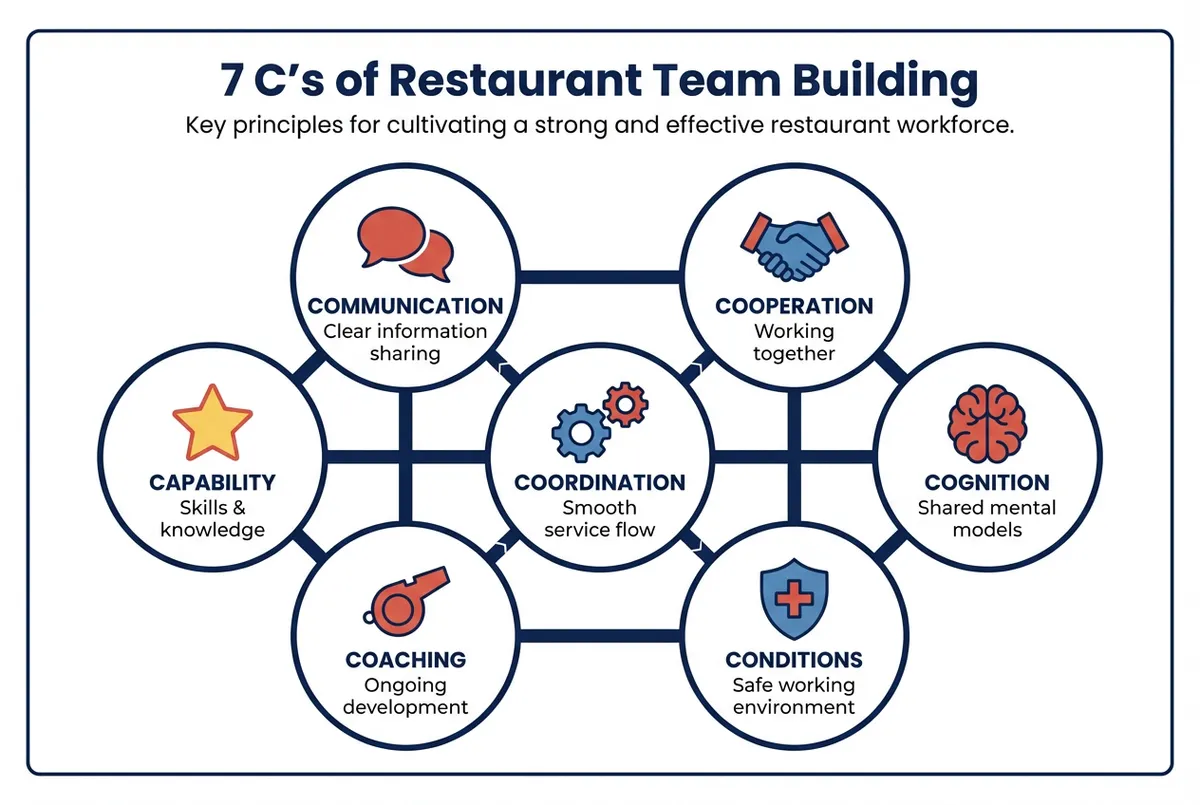
The 7 C's of restaurant team building
Pro Tip
Start by rating your team 1-5 on each C. The lowest score reveals where to focus your next team building effort.
Ask yourself: which of these seven areas is weakest in your team? For instance, a gastropub might score high on Cooperation but low on Coaching, meaning the team helps each other during service but managers rarely give specific feedback afterwards. If you can't tell whether your team struggles more with communication or coordination, that's usually a sign you need to observe a few shifts before jumping into exercises.
Team Building Food Ideas for Restaurant Staff
Furthermore, you work in food. Use it. Team building exercises that involve cooking together tap into what your team already knows and loves.
Staff Menu Development
Let your team create one dish for next month's specials menu. Give them a brief (seasonal, under £X food cost, uses existing suppliers) and let them develop it. The winning dish goes on the menu with their name credited. This builds ownership and pride.
Cultural Food Swap
If your team is diverse (and most UK restaurant teams are), ask each person to bring or prepare a dish from their background. Share and discuss over a team meal. This builds understanding and often surfaces brilliant menu ideas you'd never have found otherwise.
Sous Chef for a Day
Let a front-of-house team member spend a shift as kitchen assistant. Let a kitchen team member shadow the host stand. Film the highlights (with permission) for your socials, then let our AI social post generator turn them into ready-to-share captions. This builds cross-team empathy and creates content.
Pre-Shift Tasting Rota
Rotate who leads the pre-shift tasting each week. The person presenting must explain the dish, suggest pairings, and answer questions. This builds confidence, product knowledge, and public speaking skills simultaneously. As part of your broader restaurant staff training programme, this embeds ongoing development into daily operations.
Actionable Checklist
Here's your step-by-step plan for better restaurant team building:
- Identify your biggest team communication gap (FOH-BOH, shifts, management-staff)
- Introduce a 5-minute pre-shift huddle before your busiest three services this week
- Schedule one shared staff meal this month
- Choose one team building exercise from this list and schedule it for a quiet shift
- Set up a monthly one-to-one conversation with each team member
- Create a simple feedback form asking staff what would improve their shifts
- Track team-related complaints or errors for 30 days as a baseline
- Recognise one team member publicly at the end of each shift this week
- Review your restaurant onboarding checklist to ensure new starters feel welcomed into the team from day one
- Revisit this checklist in 30 days and measure what's changed
If You Only Have 30 Minutes This Week
This Week's Action Plan
- Day 1-2: Before your busiest service, run a 5-minute pre-shift huddle. Cover tonight's plan, mention one thing the team did well this week, and ask if anyone needs support. Note how it affects the shift.
- Day 3-4: At the end of a shift, publicly thank one team member for something specific they did well. Not "great job" but "Sarah, the way you handled that complaint at table 12 was brilliant: the customer left smiling."
- Day 5-7: Ask your three newest team members one question: "What's one thing that would make your shifts better?" Write down their answers. You'll learn more from this than any engagement survey.
Three small restaurant team building actions. No budget required. Start here.
Frequently Asked Questions
How often should restaurants do team building activities?
Formal restaurant team building activities like the ones described above work well monthly or bi-monthly. But the most effective restaurant team building happens daily through pre-shift huddles, end-of-shift recognition, and shared meals. Think of formal exercises as supplements to a daily culture of communication and respect, not replacements for it.
What team building activities work for small restaurant teams?
Small teams (under 10) benefit most from activities that build cross-functional understanding. The menu challenge, blind tasting, and speed service drill all work with small groups. The key is choosing exercises where everyone participates equally: avoid activities that leave quieter team members on the sidelines.
How do you build teamwork between FOH and BOH?
The biggest barrier is usually physical separation and different work rhythms. Bridge this with skill swaps (servers spend time in the kitchen, chefs spend time on the floor), shared pre-shift briefings where both teams attend, and shared staff meals where everyone sits together. A team that eats together tends to work together.
Do team building activities actually improve restaurant performance?
Yes. Restaurant team building delivers measurable results. Teams using regular team building activities experience a 14% increase in productivity and a 23% rise in profitability (HIGH5 Test, 2025). Additionally, 62% of hotel chains recorded a 7% increase in guest satisfaction scores after hospitality-focused team building programmes (HIGH5 Test, 2025). The impact is measurable when activities are structured around specific operational goals.
What's the cheapest effective team building for restaurants?
Pre-shift huddles (free), end-of-shift recognition (free), and shared staff meals (cost of ingredients you already have). These three restaurant team building practices, done consistently, build stronger teams than any expensive away day. For more structured approaches, see our guide to restaurant staff training.
Key Takeaways
If you run a restaurant and want to see how Local Brand Hub can support your marketing, explore our restaurant marketing tools.
Key Takeaway
- Team building is a retention strategy, not a perk: with 65% of operators describing the labour market as "tight" or "very tight," building a team culture people don't want to leave is a competitive advantage
- Daily micro-actions beat quarterly events: pre-shift huddles, end-of-shift recognition, and shared meals build stronger teams than any annual away day
- Use food as your team building tool: you work in hospitality, so menu challenges, blind tastings, and cultural food swaps tap into what your team already loves
- Focus on your weakest C: assess your team against the 7 C's (Capability, Cooperation, Coordination, Communication, Cognition, Coaching, Conditions) and target the gap
- Measure what matters: track team-related metrics like order errors, complaint rates, and retention over 30-90 days to prove that restaurant team building delivers results
For UK restaurant owners
Build a Stronger Restaurant Team
LocalBrandHub helps UK restaurants develop team culture, track engagement, and create activities that reduce turnover and boost morale.
Start FreeDisclaimer: This restaurant team building article is for informational purposes only and does not constitute professional advice. Always consult your HR team and ensure your team building activities comply with current UK employment and health and safety regulations.
Get More Marketing Tips
Practical marketing tips for UK business owners, straight to your inbox. No spam, unsubscribe anytime.
About the Author
Local Brand Hub
Empowering UK Businesses
Local Brand Hub provides comprehensive business management tools designed specifically for UK local businesses to streamline operations, automate marketing, and grow revenue.
More articlesRelated Articles
 Business Growth
How to Train Restaurant Staff: A Practical UK Guide
How to train restaurant staff effectively with proven frameworks, the 7 steps of service, and budget-friendly methods. Practical guide for UK operators.
 Business Growth
Restaurant Staff Onboarding Checklist: Complete UK Template
Use this restaurant onboarding checklist to boost new hire retention by 82%. Covers the 5 C's of onboarding, stage-by-stage process and printable template.
 Business Growth
Restaurant Manager Training: Your Practical UK Guide
Learn what restaurant manager training covers, from qualifications to salary benchmarks. UK guide with training checklist and course comparison.