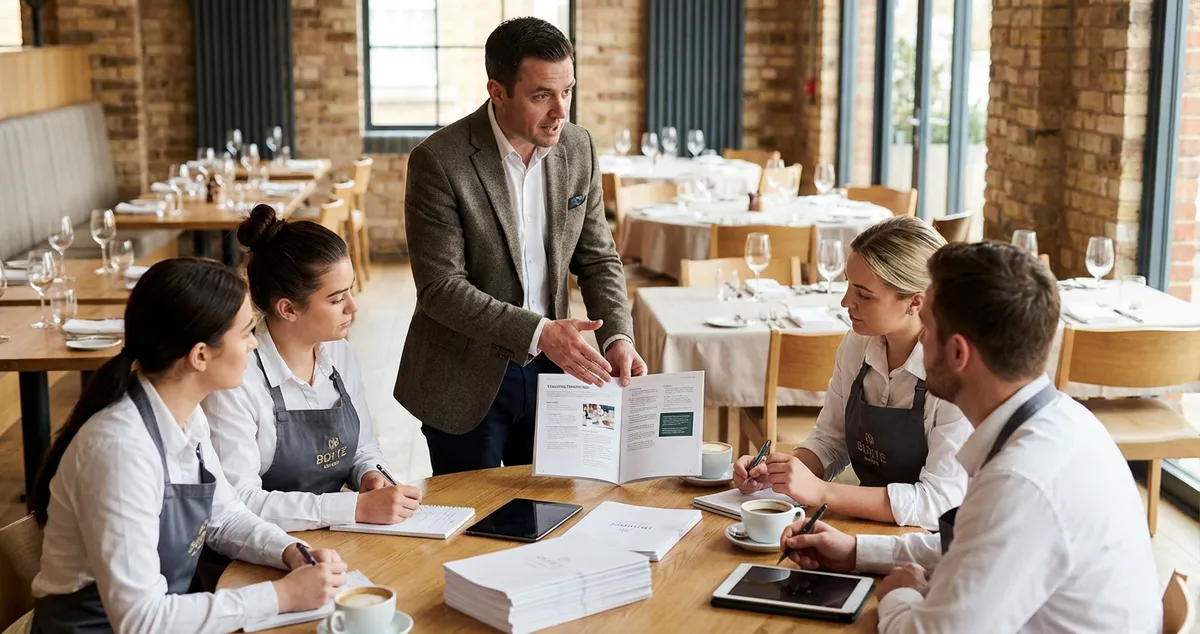
Build a restaurant staff training programme that works for UK restaurants. Structured onboarding, skills training, and budget-friendly methods covered.
You've just hired someone promising. They're keen, they show up on time, and they genuinely want to learn. Two weeks later, they're overwhelmed, making mistakes, and starting to check out. Not because they're bad, because your restaurant staff training programme is a few handwritten notes and a hope for the best.
What You'll Learn
- How to build a structured training programme for restaurant staff on any budget
- The 5 P's of restaurant service and how they shape your training
- Which training methods actually work (and which waste everyone's time)
- The three C's framework for restaurant excellence
- Real examples of training programmes you can adapt straight away
Info
Related: Restaurant Staff Training (hub guide)
Why You Need a Structured Training Programme
First, let's start with the number that should change how you think about training: the average cost of turnover for a single restaurant worker is nearly £5,000 (Opus Training, 2025). Properly trained employees are 76% more likely to stay. Do the maths. A decent training programme for restaurant staff pays for itself after keeping just one person.
The hospitality industry is in a recruitment crisis (Escoffier Global, 2025). You can't afford to keep losing people you've already found. Yet most independent restaurants run training the same way they always have: shadow someone for a shift, figure the rest out as you go.
That's not a training programme. That's survival.
If you're only winging training with new starters you'll always lose to competitors who have documented systems.
The industry is waking up to this. 61% of restaurant operators prioritised basic job skills training in 2025, a 25% jump from the previous year (QSR Magazine, 2025). After years of chasing technology fixes and pricing strategies, operators are returning to fundamentals. The question isn't whether you need a restaurant staff training programme. It's whether you'll build one before your next good hire walks out.
Pro Tip
Training isn't what you do to staff. It's what you build for them.
If you're thinking "I can't afford a training programme," consider this: undertrained staff cost restaurants roughly £150,000 annually in turnover, low productivity, and errors (Escoffier Global, 2025). You can't afford not to have one.
What Are the 5 P's of Service in Restaurants?
Now that you understand why structured training matters, let's look at the framework. The 5 P's of service in restaurants are Product, Price, Place, Promotion, and People, a framework adapted from hospitality marketing that shapes how guests experience your restaurant (Preno, 2025). Understanding these gives your training programme a strategic backbone.
Each P shapes a different aspect of your training:
- Product: Your food, drinks, and the overall dining experience. Training should cover menu knowledge, preparation standards, and presentation
- Price: Your pricing strategy and how staff communicate value. Staff need to confidently explain why your dishes are worth what you charge
- Place: The physical environment and service channels. Training covers table setup, ambience maintenance, and takeaway procedures
- Promotion: How your team represents the restaurant. Every interaction is marketing, from greetings to social media mentions
- People: The critical one. Having the right staff, correctly trained, directly impacts everything else
For instance, a neighbourhood bistro might train front-of-house staff to confidently describe their locally sourced ingredients (Product), explain the prix fixe value compared to ordering a la carte (Price), maintain the intimate atmosphere by managing table spacing (Place), and naturally mention the Sunday special to departing guests (Promotion). All of that hinges on People, trained people.
The success of the other four P's depends entirely on the People element. That's why your training programme exists.
What Training Should Kitchen Staff Have?
Next, let's get specific about the kitchen. Kitchen staff need training across food safety, workplace safety, station-specific skills, and communication protocols. The kitchen is where most restaurant accidents happen, making structured training on knife safety, cooking procedures, and safe lifting techniques non-negotiable (ServiceThatSells, 2025).
Essential Kitchen Training Breakdown
Food safety and sanitation:
- Cooking temperatures and cooling procedures
- Cross-contamination prevention
- Allergen awareness and the 14 major allergens
- FIFO stock rotation and date labelling
- Cleaning versus sanitising procedures
Station-based competencies:
- Mise en place standards for each position
- Recipe standards including cook times and plating specs
- Ticket flow and order communication
- Quality checks at every stage
Safety and compliance:
- Knife handling and storage
- Equipment operation
- Manual handling and lifting
- Fire safety and emergency procedures
For example, a curry house kitchen team might structure their training programme around three stations: tandoor, main course, and prep. Each new kitchen porter spends two days shadowing each station, completing a competency checklist before moving on. After six days, they're assessed on basic tasks and assigned their primary station.
Did You Know?
Bite-sized training sessions can improve information retention by up to 30% compared to lengthy all-day sessions (KTCHN Rebel, 2025). Your kitchen team can't disappear for hours. Ten minutes before service, every day, works better than a monthly training marathon.
Restaurant industry experts estimate the average cost of a foodborne illness outbreak reaches roughly £60,000 per incident (ServiceThatSells, 2025). Proper kitchen training isn't just about efficiency; it's about survival.
For a complete breakdown, see our guide on restaurant server training and how to train restaurant staff.
Which Method of Training Do Most Restaurants Use?
When it comes to delivery methods, in-person, hands-on training remains the most common method, with 46.6% of restaurant employees preferring 1-2 weeks of in-person onboarding (7shifts, 2025). But the industry is shifting toward blended approaches that combine traditional methods with technology.
Training Methods Compared
| Method | Adoption | Ideal For | Limitation |
|---|---|---|---|
| Shoulder-to-shoulder mentoring | Common | Practical skills, culture | Inconsistent quality |
| Digital/online platforms | Growing | Compliance, theory | Less hands-on practice |
| Cross-training | Widespread | Flexibility, retention | Takes longer initially |
| Pre-shift briefings | Widespread | Quick updates, reminders | Limited depth |
| AI-assisted tools | Emerging | Content creation, quizzes | Early adoption stage |
Did You Know?
72% of restaurant L&D professionals report that AI improves their work quality, with proficient users completing projects up to four times faster (QSR Magazine, 2025). But only 8% consider themselves advanced users.
For instance, a fish and chip shop with six staff might use a simple blended approach: a written restaurant staff training manual for procedures and standards, shoulder-to-shoulder training for the first week, and a five-minute pre-shift huddle each day to reinforce one specific skill. No expensive platform needed.
For most UK independent restaurants, the shoulder-to-shoulder method combined with a written training manual often offers the strongest balance of quality and practicality.
Pro Tip
Start with the simplest blended approach: a written manual plus daily five-minute pre-shift huddles. Add technology only when the basics are running smoothly.
Many restaurants have adopted new technology to improve efficiency, but plenty still rely on paper or whiteboards for scheduling (Modern Restaurant Management, 2025). Start where you are and build up.
What Are the Three C's in a Restaurant?
Here's another framework worth building into your programme. The three C's in a restaurant are Convenience, Consistency, and Connection, a customer experience framework that directly shapes how you train your staff (Food Truck Operator, 2025).
How Each C Shapes Your Training
Convenience: Train staff to minimise friction. That means efficient table turns, smooth payment processes, and clear communication about wait times. Over 65% of customers say convenient service features would encourage more frequent visits (3S POS, 2025).
Consistency: This is where training manuals earn their keep. Every service, every shift, every staff member should deliver the same standard. If the quality drops when your head chef takes a night off, that's usually a sign your training depends too much on individual knowledge rather than documented systems.
Connection: Train staff to build genuine relationships with guests. Restaurant loyalty programme members visit 20% more frequently and spend 20% more than non-members (3S POS, 2025). Connection starts with how your team greets, serves, and remembers regulars.
Why This Matters
If you're reading this thinking "we already do most of this," ask yourself whether it's documented or just in people's heads. That's the difference between a system and luck.
For example, a family-run Italian restaurant might train new servers using the 3 C's framework: demonstrate how to process orders efficiently through the POS (Convenience), follow the standardised greeting and table-check routine regardless of who's working (Consistency), and learn regular customers' names and usual orders within their first month (Connection).
Ask yourself: if your strongest server called in sick tomorrow, would the guest experience stay the same? If not, your training programme needs more Consistency built in.
What Are Some Examples of Training Programmes?
Let's look at what this all means in practice. Restaurant training programmes in 2025 typically fall into several categories, from hands-on mentoring to technology-driven platforms. Here are the most common approaches with practical applications for UK independents.
1. Structured Onboarding Programme
A phased approach over 2-4 weeks:
- Week 1: Orientation, culture, policies, shadowing
- Week 2: Supervised shifts with increasing responsibility
- Week 3: Solo shifts with check-ins
- Week 4: 30-day review and competency sign-off
2. Cross-Training and Micro-Learning
Over 50% of restaurants cross-train employees across multiple roles (Restaurant Dive, 2025). This builds flexibility and helps during staff shortages. For instance, a tapas bar might cross-train all front-of-house staff to handle basic bar service. When the bartender is overwhelmed on a Saturday night, servers can step in to pour drinks without the bar becoming a bottleneck.
Micro-learning complements cross-training well. Short daily sessions (5-10 minutes) focusing on one specific skill keep everyone sharp without eating into service time.
3. Mentorship Programme
Pair new starters with experienced team members. 70% of restaurant employees want more hands-on training with managers (American Recruiters, 2025), suggesting this approach aligns with what staff actually value.
62% of hospitality employees stay longer at jobs that regularly invest in skill development (Sunday App, 2025). Whatever programme structure you choose, consistency matters more than complexity.
If you're thinking "this sounds like a lot of work," remember, you don't need all four types. Pick the one that fits your team size and build from there. For a complete restaurant staff training overview, see our hub guide.
Building Your Programme Step by Step
Finally, here's how to put it all together.
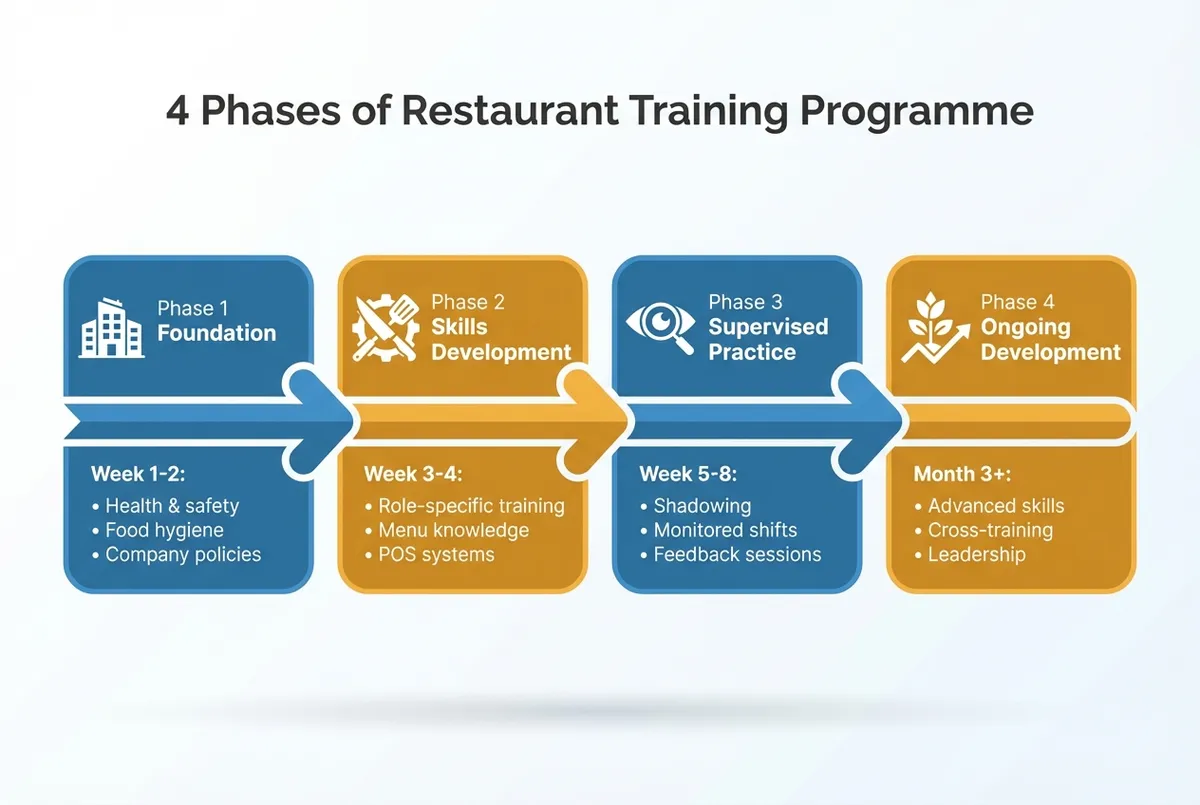
The four phases of building a restaurant staff training programme
Here's how to build a training programme for restaurant staff from scratch, without a training department or a big budget.
Phase 1-2: Foundation and Documentation (Weeks 1-3)
- Write down your restaurant's top 10 "must-know" items for new staff
- Create a simple one-page restaurant onboarding checklist
- Identify your strongest team member as a training buddy
- Draft your restaurant staff training manual covering core procedures
- Create role-specific task lists for each position
- Document your allergen procedures and emergency protocols
Phase 3-4: Implementation and Ongoing Development (Week 4+)
- Run your first structured onboarding with the next new starter
- Schedule daily 5-minute pre-shift briefings
- Set up a simple tracking system (even a spreadsheet works)
- Monthly skill-building sessions (one topic per month)
- Quarterly reviews of training materials
- Annual allergen and food safety refresher training
Training teams that track operational metrics like turnover and guest satisfaction are twice as likely to receive budget increases (QSR Magazine, 2025). Even simple tracking proves value.
If You Only Have 30 Minutes This Week
However, the reality for most independent restaurants is that there's never enough time. If you're reading this after a 12-hour shift thinking "I barely have time to eat, let alone build a training programme," you're not alone. Here's your minimum viable starting point:
This Week's Action Plan
- Day 1-2: Write your top 10 "things every new starter must know" on a single piece of paper. Pin it in the staff area
- Day 3-4: Ask your longest-serving team member to list the three things they wish they'd been taught on day one. Add those to your list
- Day 5-7: Run a 5-minute pre-shift huddle before your busiest service. Cover one thing from your list. That's your training programme started
Weekly Action
- Identify one role in your restaurant that has no written training procedure and document its top five tasks
- Share it with the team member in that role and ask what's missing
Actionable Checklist
- Top 10 "must-know" items documented for each role
- Written training manual covering core procedures
- Structured first-week plan for new starters
- Allergen training completed and recorded for all staff
- Training buddy assigned for each new hire
- Pre-shift briefing schedule established
- Cross-training plan for key positions
- 30-day review process for new starters
- Quarterly training update schedule set
- Basic tracking of training completion in place
Frequently Asked Questions
How long does it take to create a restaurant training programme?
You can build a functional training programme in 2-4 weeks. Start with a basic onboarding checklist (day 1), add a training manual over the first two weeks, and refine based on feedback. It takes an average of 19 days for new restaurant employees to become proficient (CrunchTime, 2025), so your programme should span at least that period.
How much should a restaurant spend on training?
Training budgets typically range from £1,000 for hourly roles to £5,000 for general managers annually (Opus Training, 2025). But many effective training elements are free: written procedures, buddy systems, and pre-shift briefings cost nothing beyond your time. Focus on making free methods work before investing in paid platforms.
What makes a training programme effective?
Three things: consistency, documentation, and follow-through. A simple programme that's actually used beats a sophisticated one that gathers dust. Companies with up-to-date training programmes are significantly more productive and experience fewer safety incidents (Trust20, 2025). The key is regular reinforcement, not one-off sessions.
Can small restaurants afford structured training?
Yes. Smaller restaurants are actually leading technology adoption for training (CrunchTime, 2025). Start with free resources and build incrementally. The cost of not training, in turnover and errors alone, far exceeds any training investment.
Key Takeaway
If you run a restaurant and want to see how Local Brand Hub can support your marketing, explore our restaurant marketing tools, or browse the full feature set.
Key Takeaway
- Structured training pays for itself: properly trained employees are 76% more likely to stay, saving roughly £5,000 per avoided turnover (Opus Training, 2025)
- Start simple, not perfect: a one-page checklist and daily 5-minute briefings beats an elaborate system nobody uses
- Use blended methods: combine hands-on mentoring with a written manual for the best results on a budget
- Track what you do: training teams that measure outcomes are twice as likely to receive budget increases (QSR Magazine, 2025)
- 61% of operators prioritise basic skills (QSR Magazine, 2025): foundational training matters more than fancy tools
Read more in our complete Restaurant Staff Training hub guide.
For UK restaurant owners
Build a Training Programme That Works
LocalBrandHub helps UK restaurants create structured training programmes, track staff progress, and reduce turnover, without manual spreadsheets.
Start FreeThis article is for general guidance only. Training requirements vary by role, location, and business type. For specific food safety training requirements in your area, consult your local Environmental Health Officer or visit food.gov.uk. Information accurate as of February 2026.
Get More Marketing Tips
Practical marketing tips for UK business owners, straight to your inbox. No spam, unsubscribe anytime.
About the Author
Local Brand Hub
Empowering UK Businesses
Local Brand Hub provides comprehensive business management tools designed specifically for UK local businesses to streamline operations, automate marketing, and grow revenue.
More articlesRelated Articles
 Business Growth
Restaurant Staff Training Manual: What to Include
Create a restaurant staff training manual that cuts onboarding time in half. Free template included, plus the 7 steps of service and the three C's covered.
 Business Growth
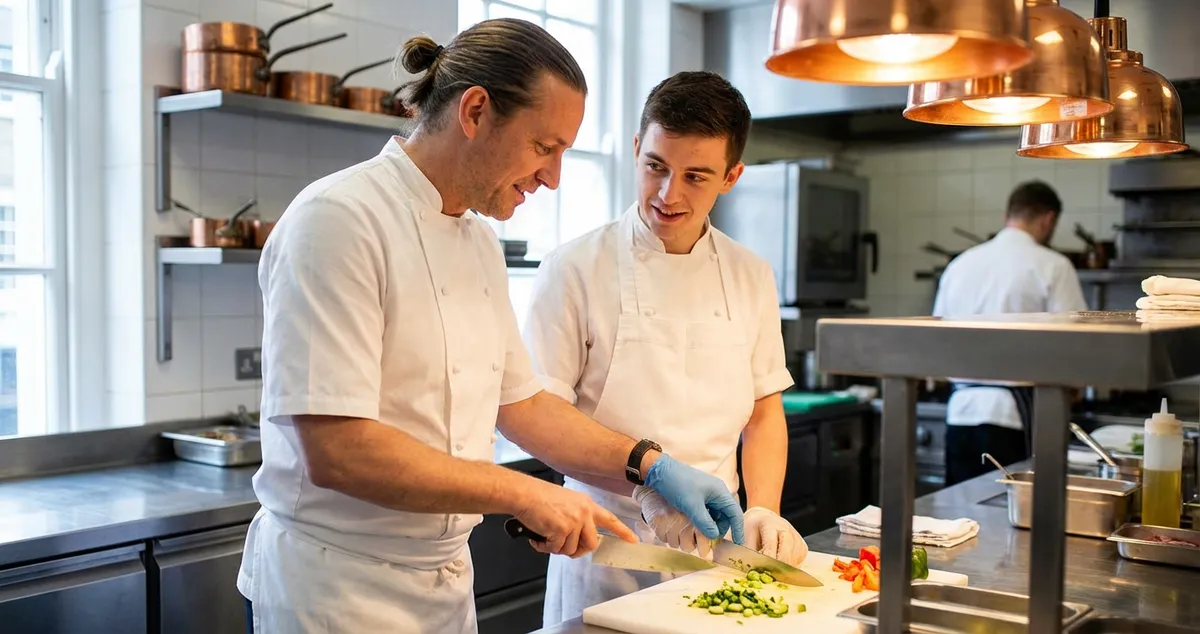
How to Train Restaurant Staff: A Practical UK Guide
How to train restaurant staff effectively with proven frameworks, the 7 steps of service, and budget-friendly methods. Practical guide for UK operators.
 Business Growth
Restaurant Staff Onboarding Checklist: Complete UK Template
Use this restaurant onboarding checklist to boost new hire retention by 82%. Covers the 5 C's of onboarding, stage-by-stage process and printable template.