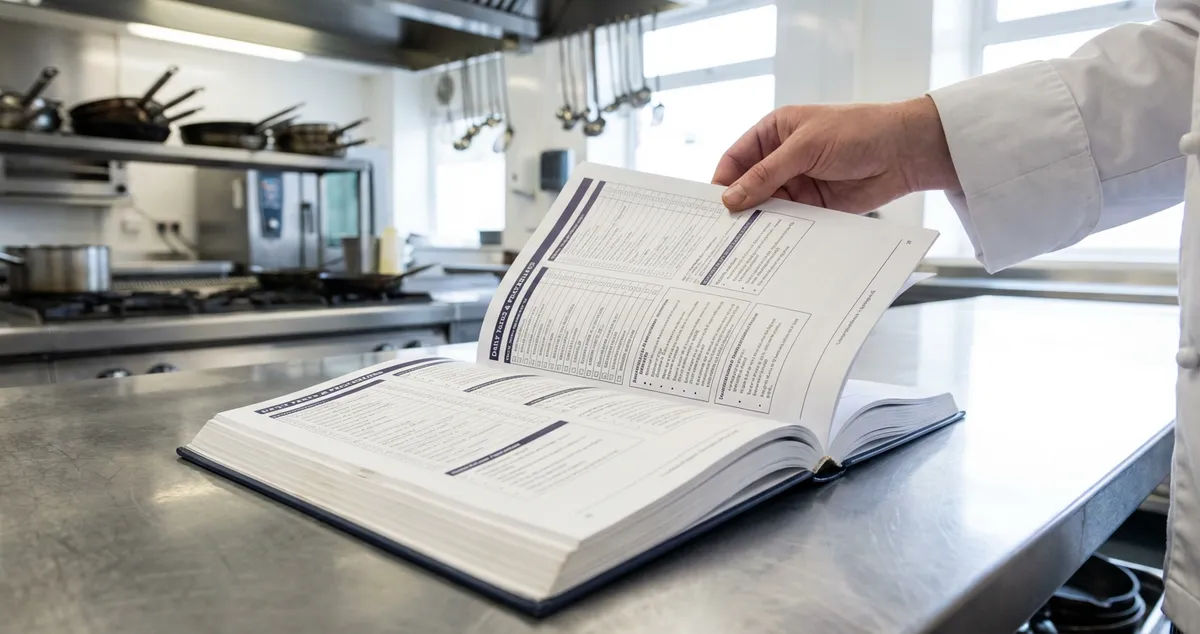
Create a restaurant staff training manual that cuts onboarding time in half. Free template included, plus the 7 steps of service and the three C's covered.
Your best server just gave notice. Now you're staring at two weeks of training a replacement using the same method as always: follow Sarah around, pick it up as you go, hope for the best. Except Sarah's the one leaving. Your restaurant staff training manual shouldn't live inside one person's head.
What You'll Learn
- Exactly what to include in a restaurant training manual (with template structure)
- The 7 steps of service every front-of-house team needs to know
- How the three C's framework builds consistency across your restaurant
- What training new restaurant staff actually need before their first shift
- How to create a manual that gets used, not ignored
Info
Related: Restaurant Staff Training (hub guide)
What to Include in an Employee Training Manual
First, let's cover the essentials. A restaurant training manual should include standard operating procedures, company policies, role-specific job descriptions, and training checklists covering food safety, customer service, POS systems, and opening/closing procedures (EatApp, 2025). Think of it as the single document that makes your restaurant run the same way whether you're there or not.
Here's what belongs in yours:
Core Manual Sections
1. Restaurant identity and culture
- Your restaurant's story and values
- Guest service principles
- Dress code and personal presentation standards
- What makes your place different
2. Role-specific procedures
- Detailed task lists for each position (server, kitchen, bar, host)
- Opening and closing checklists
- Shift changeover procedures
- Side-work assignments
3. Food safety and compliance
- The 14 major allergens and your allergen matrix
- Temperature control procedures
- Cleaning and sanitising schedules
- Health and safety requirements under UK law
4. Customer service standards
- The 7 steps of service for front-of-house
- Complaint handling procedures
- Upselling guidance (without being pushy)
- Accessibility and dietary requirement protocols
5. Systems and technology
- POS system walkthrough
- Booking system procedures
- Time tracking and payroll basics
- Communication tools (WhatsApp groups, staff apps)
6. HR essentials
- Absence and lateness policies
- Holiday booking process
- Tipping and service charge policy
- Disciplinary and grievance basics
For instance, a cafe might keep their training manual to 15 pages covering just the essentials: opening procedure, coffee machine operation, food safety, allergen awareness, and closing checklist. A fine-dining restaurant might need 40+ pages with detailed wine service protocols, tableside procedures, and VIP guest handling.
The right length depends on your operation. But every restaurant needs something written down. No exceptions.
If you're thinking "this sounds like a lot of work when I'm already stretched thin", it is, once. After that, it saves you hours every time you hire someone new. Your restaurant staff training programme is only as good as the documentation behind it.
What Are the Three C's in a Restaurant?
Now that you know what goes in the manual, let's look at the frameworks that shape it. The three C's in a restaurant are Concept, Customers, and Change: a framework for building a restaurant that stays relevant and profitable (RestoConnection, 2025). For your training manual, this framework helps staff understand why your restaurant operates the way it does.
How Each C Applies to Training
Concept is your restaurant's identity. What makes you different from the three other places on the same street? Staff need to articulate this confidently. If your concept is "modern British using seasonal ingredients from local farms," every team member should be able to say that naturally when a guest asks.
Customers means understanding who actually walks through your door. Your training manual should describe your typical customer, not the one you wish you had, but the one who actually books a table. A burger joint near a university has different customers than a gastro pub in a market town. Train accordingly. Know your audience.
Change is about continuous improvement. Leading restaurants vary menus seasonally and introduce new dishes regularly (RestoConnection, 2025). Your training manual should include a process for updating staff on menu changes, new procedures, and seasonal adjustments.
Pro Tip
If you're reading this thinking "we don't really have a defined concept", writing your training manual will force you to create one. That's a feature, not a bug.
For example, a seaside fish restaurant might train staff around these three C's like this: "Our concept is fresh, simply cooked seafood (Concept). Our customers are families on holiday and local regulars who come weekly (Customers). We change our specials board daily based on what the boats bring in (Change), and you need to know what's on it before every shift."
That's usually a sign of a strong training culture: when staff can explain what you do, who you serve, and how you keep things fresh.
What Are the 7 Steps of Service in a Restaurant?
Next, the framework your front-of-house team needs most. The 7 steps of service are: greeting the guest, offering beverages and menus, taking orders, delivering food and beverages, checking in, clearing plates and offering dessert, and presenting the check (Restroworks, 2025). This framework creates a consistent, repeatable guest experience across every shift.
The Seven Steps in Detail
| Step | Action | Timing Benchmark |
|---|---|---|
| 1. Greet | Acknowledge guests, introduce yourself | Within 60 seconds of seating |
| 2. Beverages and menus | Present menus, ask about drinks | Within 2 minutes |
| 3. Take orders | Confirm allergies, repeat orders back | When guests are ready |
| 4. Deliver food | All plates for each course simultaneously | As soon as ready |
| 5. Check back | Verify meal quality and satisfaction | Within 2 minutes of food delivery |
| 6. Clear and offer | Remove plates, suggest dessert/coffee | When guests finish |
| 7. Present check | Bring bill, thank the guest | Within 1 minute of request |
40% of the restaurant experience depends on just three factors: how quickly guests are greeted, whether drinks are kept full, and how quickly guests receive the check (Overproof, 2025).
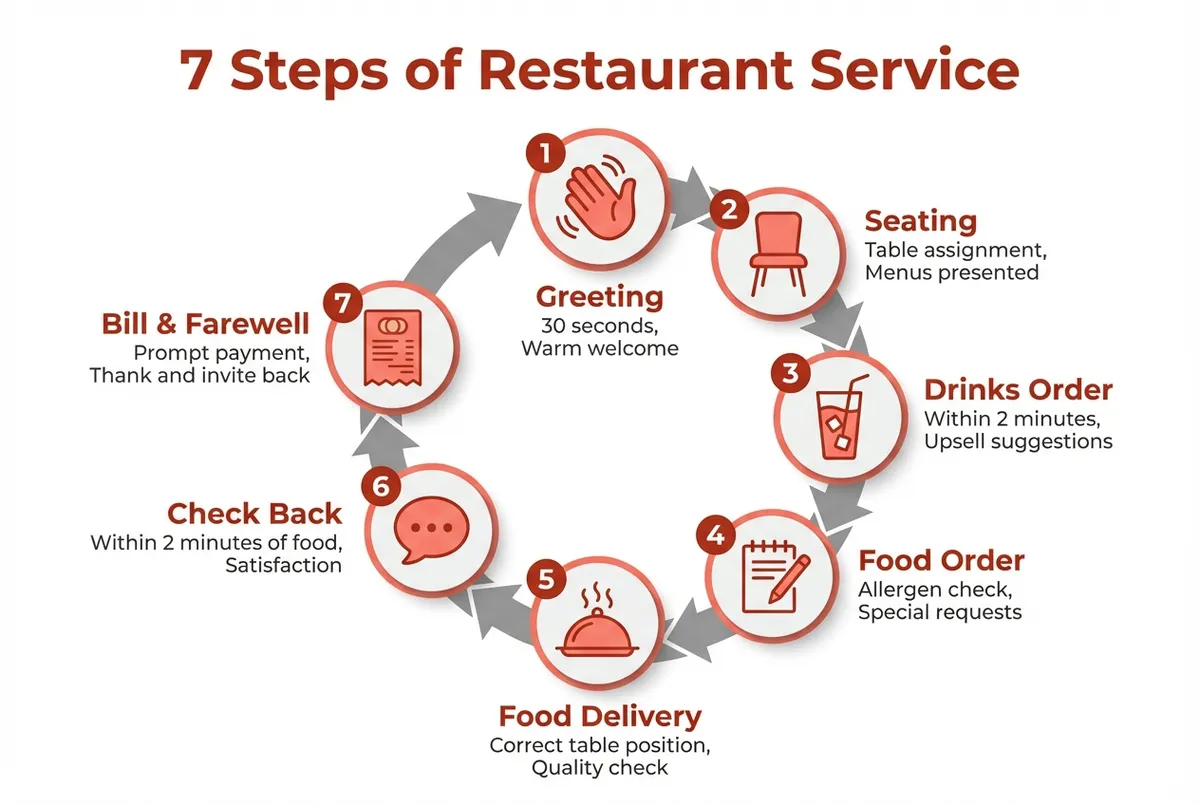
The 7 steps of service framework for consistent front-of-house training
Three of your seven steps carry nearly half the weight. That matters.
For instance, a brasserie training their front-of-house team might focus heavily on Steps 1, 5, and 7 during the first training week. Get those right and you've covered the biggest drivers of guest satisfaction.
The other steps matter, but these three are where most restaurants lose or gain points.
Ask yourself: does your team follow these steps consistently, or does service quality depend on who's working? If it changes by shift, that's usually a sign your training manual needs these steps documented with specific timing benchmarks.
For comprehensive restaurant server training including practice scenarios, see our dedicated guide.
What Training Do You Need to Work in a Restaurant?
Moving on to the broader picture, restaurant training requirements depend on your role, but the industry is experiencing a significant back-to-basics movement. 61% of restaurant operators prioritised basic job skills training in 2025, a 25% increase from the previous year (QSR Magazine, 2025).
Training Requirements by Role
All staff (minimum):
- Food hygiene awareness (Level 1 or 2)
- Allergen awareness training
- Health and safety basics
- Fire safety and evacuation procedures
Front-of-house:
- Customer service skills
- POS system operation
- Menu and drinks knowledge
- The 7 steps of service
- Complaint handling
Kitchen staff:
- Food safety certification (Level 2 minimum)
- Knife skills and equipment safety
- Station-specific competencies
- HACCP awareness
Management:
- Level 3 food safety
- First aid certification
- HR basics (disciplinary, grievance)
- Financial controls and stock management
70% of restaurant employees want more hands-on training with managers (American Recruiters, 2025). Your training manual should include practical exercises and shadowing schedules, not just written procedures.
New restaurant employees take an average of 19 days to become proficient, though operators ideally want this down to 12 days (CrunchTime, 2025). A well-structured training manual with clear daily milestones is the fastest way to close that gap.
Read more about building complete programmes in our restaurant staff training hub guide. For manager-specific training, see our restaurant manager training guide.
Training Manual for Restaurant Staff Template
Finally, here's a practical template structure you can adapt for your own restaurant. This is designed to be customised, not copied word-for-word.
Template Outline
SECTION 1: Welcome
- Owner/manager welcome message
- Restaurant history and concept
- Team structure and who to ask for help
- First week schedule

SECTION 2: Standards and Expectations
- Dress code and grooming
- Punctuality and attendance
- Phone and personal device policy
- Professional behaviour expectations

SECTION 3: Role-Specific Procedures
- [Server section]
- [Kitchen section]
- [Bar section]
- [Host section]

SECTION 4: Food Safety and Allergens
- The 14 major allergens
- Your allergen matrix
- Cross-contamination prevention
- What to do if a guest reports an allergic reaction

SECTION 5: Service Standards
- The 7 steps of service
- Table setup and restaurant presentation
- Upselling guidelines
- Handling complaints (the LAST method)

SECTION 6: Systems
- POS system guide (with screenshots)
- Booking system guide
- Opening checklist
- Closing checklist

SECTION 7: HR and Admin
- Pay and tipping policy
- Holiday booking
- Sickness absence procedure
- Who to contact in an emergency

APPENDIX: Quick Reference Cards
- Allergen chart (laminated for kitchen)
- Daily cleaning schedule
- Wine and drinks list with descriptions
- Speed of service benchmarks
A training manual that nobody reads is just paper. Keep it short, visual, and easy to find.
Only 19% of restaurants offer online training (Opus Training, 2025), despite growing preference from younger employees. Consider making your manual digitally accessible. Even a shared Google Doc is better than a folder that lives in the office.
29% of operators use enhanced training programmes as their second-most common retention strategy after pay increases (Apicbase, 2025). Your manual is a retention tool, not just an onboarding document.
Training budgets typically range from £1,000 for hourly roles to £5,000 for managers annually (Opus Training, 2025). Creating a manual costs nothing but your time and dramatically reduces those ongoing training costs.
If You Only Have 30 Minutes This Week
However, let's be realistic. If you're reading this after a 12-hour shift and the idea of writing a training manual feels impossible, you're not alone. Most restaurant owners feel exactly the same way. Here's where to start:
This Week's Action Plan
Create the skeleton of your restaurant staff training manual:
- Day 1-2: Open a blank document. Write your restaurant name at the top and list the six section headings from the template above. Save it somewhere your team can access
- Day 3-4: Write your opening and closing checklists. These are the procedures you repeat every single day. You already know them by heart. Getting them on paper takes 10 minutes
- Day 5-7: Write your allergen procedure. What happens when a guest says they have an allergy? Document the three steps your team should follow. Print it and put it behind the bar
That's a start. Not a finished manual: a foundation you can build on week by week.
Weekly Action
- Write one procedure from your manual this week: start with your busiest shift's opening checklist
- Ask your newest team member to read it and flag anything unclear
Actionable Checklist
Here's a quick audit of your current training manual status:
- Restaurant identity and values section written
- Role-specific procedure sections for each position
- Opening and closing checklists documented
- The 14 major allergens listed with your restaurant's allergen matrix
- The 7 steps of service documented with timing benchmarks
- POS system guide with basic instructions
- Complaint handling procedure (e.g. the LAST method)
- HR essentials: pay, holidays, absence, dress code
- Manual stored digitally and accessible to all staff
- Review date set (minimum every 6 months)
Frequently Asked Questions
How long should a restaurant training manual be?
There's no perfect length. It depends on your operation. A small cafe might need 10-15 pages, while a full-service restaurant could require 30-50 pages. The key is comprehensiveness without waffle.
Each section works best when it answers a practical question your staff actually face. If a page doesn't help someone do their job better, cut it.
Should I create separate manuals for each role?
For most independent restaurants, a single manual with role-specific sections works better than separate documents. It's easier to maintain and ensures everyone understands the broader operation, not just their corner. Larger restaurants with 30+ staff might benefit from separate front-of-house and back-of-house manuals.
How often should I update the training manual?
Review it every six months minimum, and update it immediately when procedures change. Menu changes, new equipment, updated allergen information, and regulatory changes should all trigger an update. New hires are your best feedback source: if they're consistently confused about something, the manual needs improving.
Can I use a free template instead of writing from scratch?
Yes, but customise it heavily. Generic templates won't cover your specific menu, your POS system, or your house rules. Use a template as a starting framework, then replace every generic section with your restaurant's actual procedures. A customised 10-page manual beats a generic 50-page template that nobody reads.
What's the biggest mistake restaurants make with training manuals?
Writing one and never using it. 72% of training professionals report AI improves their work quality (QSR Magazine, 2025), and tools are available to help maintain and update documents. But the real issue isn't technology. It's commitment. If you're only referring to your manual during onboarding and ignoring it the rest of the year, it becomes irrelevant. Build in quarterly refresher sessions that reference the manual directly.
Key Takeaways
If you run a restaurant and want to see how Local Brand Hub can support your marketing, explore our restaurant marketing tools, or see what the platform includes.
Key Takeaway
- A training manual turns tribal knowledge into a system: so your restaurant doesn't fall apart when key staff leave
- Include six core sections: identity, role procedures, food safety, service standards, systems, and HR essentials
- The 7 steps of service provide a consistent framework, and 40% of the guest experience depends on just three of those steps (Overproof, 2025)
- Keep it accessible and alive: a digitally shared document that's updated regularly beats a pristine binder that gathers dust
- Proper training makes employees 76% more likely to stay (Opus Training, 2025), making your manual one of the most cost-effective retention tools you have
Read more in our complete Restaurant Staff Training hub guide, or see how to build a full restaurant staff training programme.
For UK restaurant owners
Create Your Training Manual Today
LocalBrandHub helps UK restaurants build structured training manuals, track staff development, and maintain consistent service standards.
Start FreeThis article is for general guidance only. Food safety and employment requirements vary across the UK. For specific compliance guidance, consult your local Environmental Health Officer or visit food.gov.uk. Information accurate as of February 2026.
Get More Marketing Tips
Practical marketing tips for UK business owners, straight to your inbox. No spam, unsubscribe anytime.
About the Author
Local Brand Hub
Empowering UK Businesses
Local Brand Hub provides comprehensive business management tools designed specifically for UK local businesses to streamline operations, automate marketing, and grow revenue.
More articlesRelated Articles
 Business Growth
Restaurant Staff Training Programme: Build Yours
Build a restaurant staff training programme that works for UK restaurants. Structured onboarding, skills training, and budget-friendly methods covered.
 Business Growth
How to Train Restaurant Staff: A Practical UK Guide
How to train restaurant staff effectively with proven frameworks, the 7 steps of service, and budget-friendly methods. Practical guide for UK operators.
 Business Growth
Restaurant Staff Onboarding Checklist: Complete UK Template
Use this restaurant onboarding checklist to boost new hire retention by 82%. Covers the 5 C's of onboarding, stage-by-stage process and printable template.