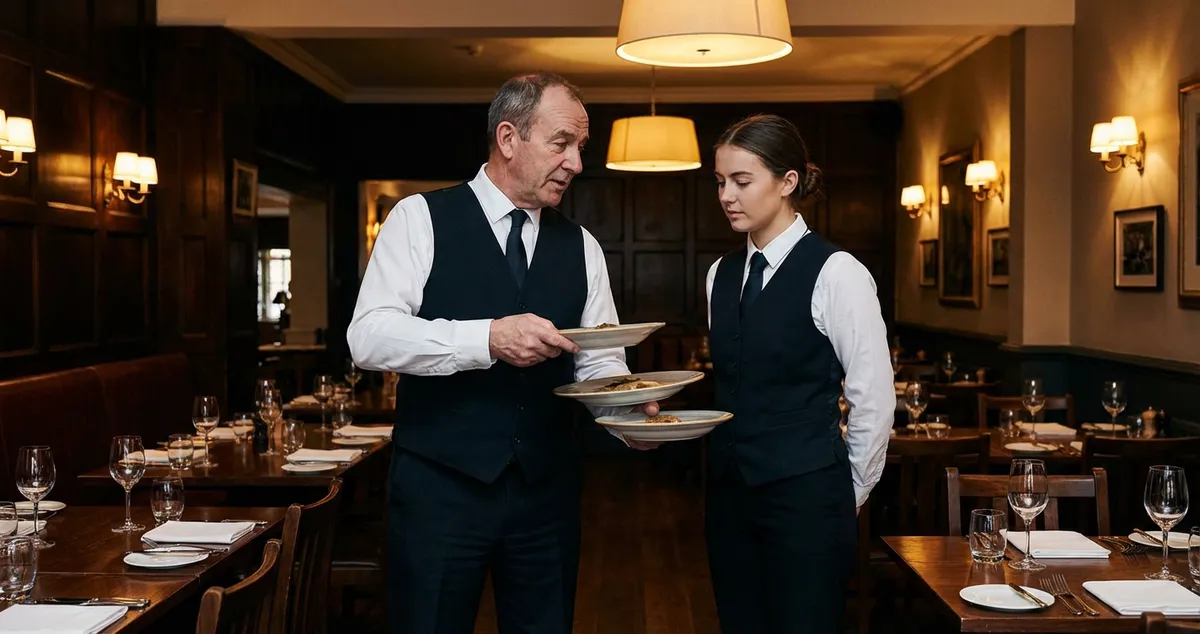
Build a restaurant server training programme that cuts new hire time to 12 days. Covers the 7 steps of service, the 2-minute rule, and practical checklist.
You've just hired a new server. They seem keen, they showed up on time, and they smiled through the interview. Two weeks later, they're gone, and you're back to covering tables yourself after a 12-hour shift, wondering what went wrong.
What You'll Learn About Restaurant Server Training
Restaurant server training is a structured programme that equips front-of-house staff with the skills, product knowledge, and service standards they need to deliver consistent guest experiences. Done well, it reduces turnover, increases revenue per table, and saves you from constantly firefighting.
Training makes employees 76% more likely to stay with a restaurant (Opus Training, 2025). That single statistic should tell you everything about why it matters. The average cost to replace an hourly restaurant employee is roughly equivalent to several weeks of wages (Black Box Intelligence, 2025), so every server who walks out the door takes your investment with them.
In this guide, you'll learn:
- The 7 steps of service framework and how to train your team on each one
- A practical training timeline from day one to independent service
- The 2 minute 2 bite rule and why it prevents complaints before they happen
- A ready-to-use server training checklist you can print and adapt today
This guide covers the core frameworks, practical steps, and a ready-to-use training checklist you can adapt for your own restaurant staff training programme.
Info
What Are the 7 Steps of Service?
The 7 steps of service are a standardised framework that guides servers through the complete guest experience, from arrival to departure. They provide a repeatable structure so every table gets the same level of care, regardless of who's serving.
Here are the seven steps:
- Warm welcome and seating: greet guests within 30 seconds of arrival
- Drink orders: take beverage orders within 2 minutes of seating
- Food order: capture the full order within 8 minutes
- Food delivery: serve appetisers within 10 minutes, mains within 15-20
- Check-back: visit the table after 2 minutes or 2 bites
- Bill presentation: deliver the bill promptly and accurately
- Table reset: clear and prepare for the next service
For example, a busy bistro in central London might train new servers by shadowing an experienced team member through all seven steps during a quiet Tuesday lunch service before letting them handle tables solo during a busier shift.
These timing benchmarks come from industry-standard service training (The Waiters Academy, 2025). They aren't arbitrary. Each gap exists because that's usually a sign that your guest's experience is about to tip from "pleasant" to "where's our waiter?"
The real test isn't whether your servers know these steps. It's whether they can execute them during a Saturday rush without thinking about it.
If you're thinking "my team already knows this stuff," ask yourself: do they follow these steps consistently on every table, every shift? If not, that's usually a sign the training wasn't structured enough.
How to Train a Server in a Restaurant
Now that you understand the service framework, let's look at what the actual training process looks like day by day. Here's the reality: 61% of restaurant operators prioritised basic job skills training in 2025 (QSR Magazine, 2025). The industry is going back to basics because it works.
The Training Timeline
Full-service restaurant servers typically receive around 37 hours of new hire training (Opus Training, 2025). That's roughly a week of focused development. The goal is proficiency within 12-19 days, depending on your operation's complexity.
Here's a practical breakdown:
Days 1-3: Foundation
- Restaurant tour and safety briefing
- Menu knowledge (ingredients, allergens, preparation methods)
- POS system basics
- Shadow an experienced server
Days 4-7: Supervised Service
- Handle tables with a mentor nearby
- Practise taking orders and running food
- Learn wine and drinks list
- Complete food safety training
Days 8-14: Gradual Independence
- Manage a small section independently
- Handle complaints with manager support
- Cross-train with host and bar roles
| Training Phase | Timeline | Key Focus |
|---|---|---|
| Foundation | Days 1-3 | Menu, safety, POS, shadowing |
| Supervised service | Days 4-7 | Live tables with mentor, drinks knowledge |
| Independence | Days 8-14 | Own section, complaints, cross-training |
Restaurant server training isn't about teaching people to carry plates. It's about building confidence before the Saturday rush tests it.
If you're only training servers when it's quiet in the restaurant, your training will always lose to competitors who treat it as part of operations, not an afterthought.
For instance, a gastropub running a restaurant staff training programme might assign each new server a "training buddy" who earns a small bonus for each successful sign-off. It creates accountability without adding management overhead.
Pro Tip
Schedule your training during quieter shifts (Tuesday or Wednesday lunch). Your new server gets real practice without the pressure of a packed Saturday evening.
Ongoing Development
Ongoing training for hourly restaurant employees has decreased to roughly 1 hour per month in 2025, a 40-58% year-over-year decline (QSR Magazine, 2025). That means every minute counts.
Use that hour wisely:
- 15-minute pre-shift briefings on specials and focus areas
- Monthly menu tastings
- Quarterly service standard refreshers
- Peer feedback sessions
What Is the 2 Minute 2 Bite Rule?
With the training timeline in place, here's one specific technique worth mastering first. The 2 minute 2 bite rule is a framework that ensures servers check back with guests approximately two minutes after food delivery, or after guests have taken roughly two bites of their meal. It catches problems before they become complaints.
Without this check-back, guests who dislike their meal may refuse a replacement, feeling it's "too late" in the dining experience (Service That Sells, 2025). That's a lost customer and a lost chance to make it right.
The guideline is sometimes extended to "two bites, two sips, or two minutes," recognising that different courses need different timing (STL Magazine, 2025).
How to Get It Right
The check-back itself matters as much as the timing. Most servers default to "How is everything?" which gets a polite nod and nothing useful.
Better approaches:
- "How's the lamb, is it cooked how you like it?"
- "Has everything come out as you expected?"
- "Can I get you anything else to go with that?"
For example, a fine dining restaurant might train servers to reference the specific dish by name during check-backs, which shows attentiveness and encourages genuine feedback rather than automatic "fine, thanks" responses.
If you're thinking "this seems like a small detail," consider this: one thoughtful check-back can turn a mediocre experience into a memorable one. And memorable experiences are what fill tables on a quiet Wednesday night.
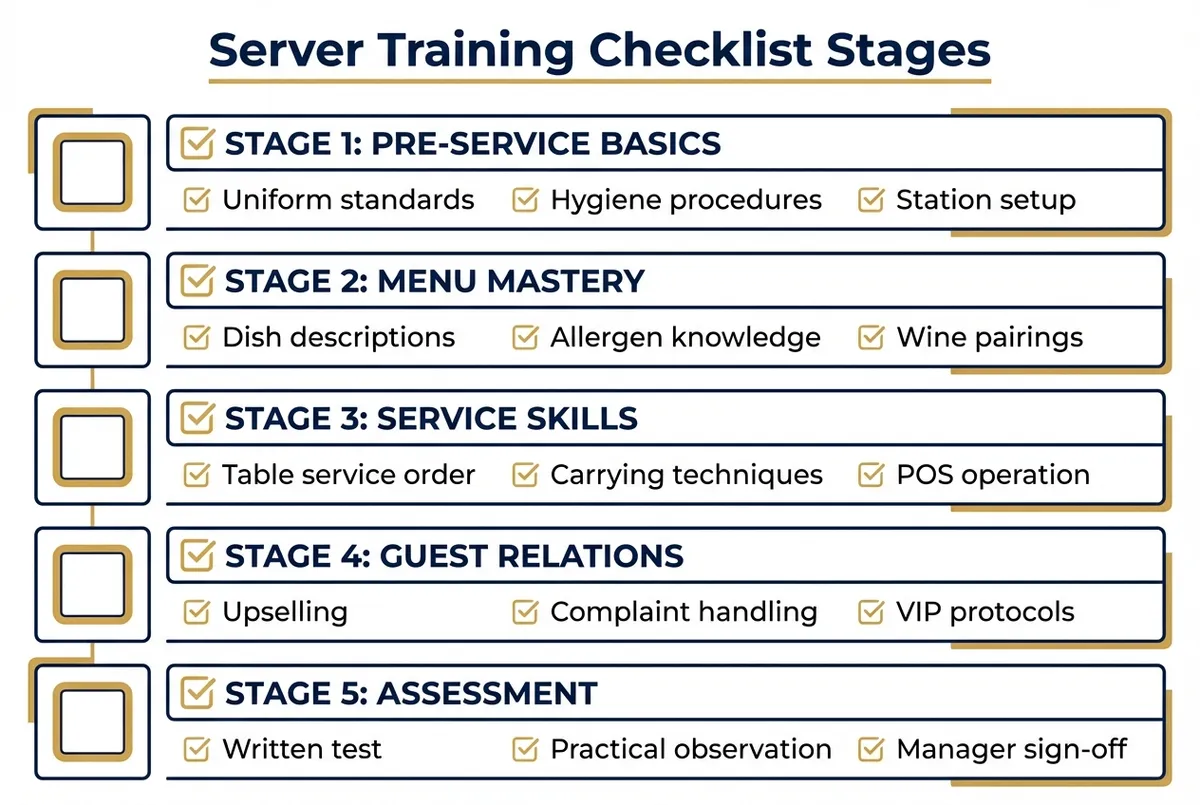
Key stages of a restaurant server training checklist
Your Restaurant Server Training Checklist
Now let's turn the frameworks above into something you can actually use on the floor. Here's a practical server training checklist you can print, adapt, and use as part of your restaurant staff training manual. This isn't theory. It's what your new hire should be able to do before they fly solo.
For example, a neighbourhood Italian restaurant might print this checklist, laminate it, and have each new server work through it with their training buddy during their first two weeks, ticking off items as they demonstrate competence rather than just reading about it.
Pre-Service Knowledge
- Can name every dish on the menu and describe key ingredients
- Knows the top 3 allergens for each section (starters, mains, desserts)
- Can recommend at least 2 wine pairings
- Understands the restaurant's story and values
Technical Skills
- Operates the POS system without assistance
- Processes card payments and splits bills correctly
- Follows opening and closing procedures
- Handles cash float and end-of-shift reconciliation
Service Standards
- Greets every table within 30 seconds
- Takes drink orders within 2 minutes of seating
- Performs the 2 minute / 2 bite check-back
- Handles a customer complaint calmly and escalates when needed
Food Safety and Compliance
- Completed Level 2 Food Hygiene certificate (or equivalent)
- Understands Natasha's Law allergen requirements
- Follows correct handwashing and hygiene protocols
- Knows fire exit locations and emergency procedures
Soft Skills
- Makes eye contact and uses the guest's name when possible
- Reads table energy (celebratory vs. business lunch vs. quick bite)
- Upsells naturally without feeling pushy
- Works collaboratively with kitchen and bar teams
Ask yourself: if a mystery diner visited tonight, would your newest server pass every item on this checklist?
If You Only Have 30 Minutes This Week
When it comes to building a training programme, here's the honest truth: you don't need a spare week to get started. If you're thinking "I don't have time for this", you're not alone. Here's the minimum viable version.
If you only have 30 minutes a week, do this:
- Day 1-2: Write down your 7 steps of service with specific timing expectations. Pin it in the staff area.
- Day 3-4: Create a one-page menu cheat sheet covering allergens, dietary options, and your three best-selling dishes.
- Day 5-7: Sit down with your strongest server for 10 minutes. Ask them: "What do you wish you'd known on day one?" Write down their answers. That's the start of your training manual.
This sounds great in theory. In practice, when you're down two staff and the kitchen's backed up, even 30 minutes feels like a luxury. But here's the thing: every minute you spend on training now saves you hours of firefighting later.
Frequently Asked Questions
What training do waiters need?
Waiters need a combination of product knowledge (menu, allergens, drinks list), technical skills (POS system, payment handling), service standards (the 7 steps of service, complaint handling), and food safety compliance (Level 2 Food Hygiene in the UK). Beyond the basics, interpersonal skills like reading table mood and upselling naturally separate good servers from great ones.
How long does it take to train a new restaurant server?
Most full-service restaurants allocate around 37 hours of new hire training, with servers typically reaching basic proficiency in 12-19 days (Opus Training, 2025). Quick-service restaurants may train in as few as 25 hours. The key is structured training with clear milestones rather than simply "following someone around for a week."
What are the three C's in a restaurant?
The three C's in restaurant service typically refer to Cleanliness, Courtesy, and Consistency. These three principles underpin every successful training programme: a clean environment builds trust, courteous service creates loyalty, and consistency ensures guests know what to expect every visit.
How do I create a restaurant server training manual?
Start with your service standards (the 7 steps), add your menu knowledge requirements, include food safety protocols, and finish with your complaint-handling procedures. Keep it practical, not theoretical. A good training manual reads like a field guide, not a textbook. You can build on the checklist in this article as a starting point for your restaurant onboarding checklist.
Key Takeaways
If you run a restaurant and want to see how Local Brand Hub can support your marketing, explore our restaurant marketing tools, or see how the features fit together.
Key Takeaway
Finally, here's what matters most from this guide.
- Structure beats shadowing. A 37-hour structured programme outperforms "follow Sarah around for a week" every time.
- The 7 steps of service provide a repeatable framework that ensures consistent guest experiences across every shift.
- The 2 minute 2 bite rule catches problems before they become complaints, but only if your servers ask the right questions.
- Training protects your investment. Staff who receive proper training are 76% more likely to stay (Opus Training, 2025).
- Start small. Even 30 minutes this week can begin building a training system that reduces turnover and improves service.
Discover our full guide to restaurant staff training for the complete framework, or start with how to train restaurant staff to improve your team today.
For UK restaurant owners
Train Servers Who Drive Revenue
LocalBrandHub helps UK restaurants build server training programmes that improve service quality and increase average spend per table.
Start FreeThis article is for general informational purposes. Always consult current UK regulations, including food safety and employment law, for your specific circumstances. Statistics cited reflect available industry data at the time of publication and may vary by region.
Get More Marketing Tips
Practical marketing tips for UK business owners, straight to your inbox. No spam, unsubscribe anytime.
About the Author
Local Brand Hub
Empowering UK Businesses
Local Brand Hub provides comprehensive business management tools designed specifically for UK local businesses to streamline operations, automate marketing, and grow revenue.
More articlesRelated Articles
 Business Growth
Restaurant Staff Training Manual: What to Include
Create a restaurant staff training manual that cuts onboarding time in half. Free template included, plus the 7 steps of service and the three C's covered.
 Business Growth
Restaurant Staff Training Programme: Build Yours
Build a restaurant staff training programme that works for UK restaurants. Structured onboarding, skills training, and budget-friendly methods covered.
 Business Growth
How to Train Restaurant Staff: A Practical UK Guide
How to train restaurant staff effectively with proven frameworks, the 7 steps of service, and budget-friendly methods. Practical guide for UK operators.