
Use this restaurant onboarding checklist to boost new hire retention by 82%. Covers the 5 C's of onboarding, stage-by-stage process and printable template.
You've just hired someone who aced the trial shift, got along with the team, and seemed genuinely excited to start. Two weeks later, they've ghosted you: no call, no message, just an empty rota slot and another weekend scrambling to cover shifts.
What You'll Learn About Your Restaurant Onboarding Checklist
A restaurant onboarding checklist is a guide that ensures every new hire (server, chef, host, or kitchen porter) completes the same training and integration steps during their first days and weeks. It turns chaos into a repeatable process.
Structured onboarding can improve new hire retention by 82% and boost productivity by over 70% (Altametrics, 2025). Yet only 12% of employees believe their company does onboarding well (BambooHR, 2025). In restaurants, where more than half of new hires don't complete their first 90 days (Restaurant Dive, 2025), that gap costs you real money.
In this guide, you'll learn:
- The 5 C's of onboarding and how each one applies to restaurants
- What restaurant onboarding actually covers beyond the first day
- The 5 stages of the onboarding process from pre-boarding to ongoing support
- A complete printable checklist template you can adapt for any role
This guide covers the proven frameworks behind effective onboarding, a stage-by-stage walkthrough, and a ready-to-use checklist you can adapt for your restaurant staff training programme.
What Are the 5 C's of Onboarding?
First, let's start with the framework. The 5 C's of onboarding are Compliance, Clarification, Confidence, Connection, and Culture. This research-backed framework by Dr. Talya Bauer guides how you bring new staff into the team (Preppio, 2025).
Here's how each applies to restaurants:
1. Compliance
The legal and regulatory basics. In UK restaurants, this includes:
- Right-to-work verification
- HMRC tax documents
- Food safety and hygiene briefing
- Fire safety and emergency procedures
- Allergen awareness (Natasha's Law)
2. Clarification
Setting clear expectations about the role. Your new server needs to know their section, shift patterns, break entitlements, and what "good" looks like from day one.
For example, a casual dining restaurant might create a one-page role card for each position that lists the top five responsibilities, the reporting structure, and specific performance expectations for the first 30 days.
3. Confidence
Building a sense of competence. This happens through structured training with milestones, not by throwing someone into a Saturday rush and hoping they swim.
4. Connection
Building relationships with the team. Assign a buddy. Introduce them to the kitchen as well as the floor. Make sure they know at least three names before their first shift ends.
5. Culture
Helping them understand your restaurant's identity: your story, values, and how things are done here. This is the layer most restaurants skip, and that's usually a sign the onboarding is treated as a box-ticking exercise rather than a genuine integration process.
Pro Tip
Have your new hire eat a meal at your restaurant as a guest before their first shift. They'll understand the experience they're creating, and it costs less than replacing them when they quit.
Strong workplace culture leads to 30% higher retention rates (Altametrics, 2025). Culture isn't a poster on the wall. It's how your team treats each other when the kitchen printer jams on a bank holiday weekend.
Onboarding isn't paperwork. It's the difference between a new hire who stays 90 days and one who stays 3 years.
What Is Onboarding in a Restaurant?
Now that you understand the framework, here's how it works in practice. Restaurant onboarding is a method that brings new employees into their roles through training, clear goals, and ongoing support over 30-90 days. It goes beyond the first shift: it covers everything from pre-hire prep to when a new hire can work on their own.
The numbers tell the story. 77% of restaurant operators say hiring and retention are their top concerns (Escoffier Global, 2025). New staff take an average of 19 days to get up to speed, though operators want to cut this to 12 days (CrunchTime, 2025).
What Makes Restaurant Onboarding Different?
| Factor | Office Onboarding | Restaurant Onboarding |
|---|---|---|
| Time to floor | 1-2 weeks of training first | Often within hours |
| Learning style | Presentations and workshops | Hands-on shadowing |
| Pace | Gradual ramp-up | Fast, during live service |
| Key risk | Slow start | Overwhelmed new hire quits |
These are general comparisons as a rule of thumb: your experience may vary by role and restaurant type.
Restaurant onboarding isn't like office onboarding. You can't spend three days on HR talks and values workshops. Your new hire needs to be on the floor, serving real guests, often within hours.
That creates a tension between speed and depth. The strongest onboarding processes resolve this by:
- Pre-boarding before day one: sending paperwork, uniform information, and a welcome message before they arrive
- Structured shadowing: pairing new hires with experienced staff for their first 3-5 shifts
- Daily check-ins: a quick 5-minute conversation at the end of each shift during week one
- Clear milestones: specific skills to demonstrate by day 7, day 14, and day 30
If you're thinking "we already do something like this," ask yourself: is it written down? Is it the same every time you hire? If not, you're relying on whoever's working that day to set the tone, and that's a gamble.
For instance, a restaurant with a proper restaurant staff training programme might send new hires a short welcome video and the menu before day one. When they arrive, they already know the dishes and feel less lost. That small effort pays for itself in faster learning.
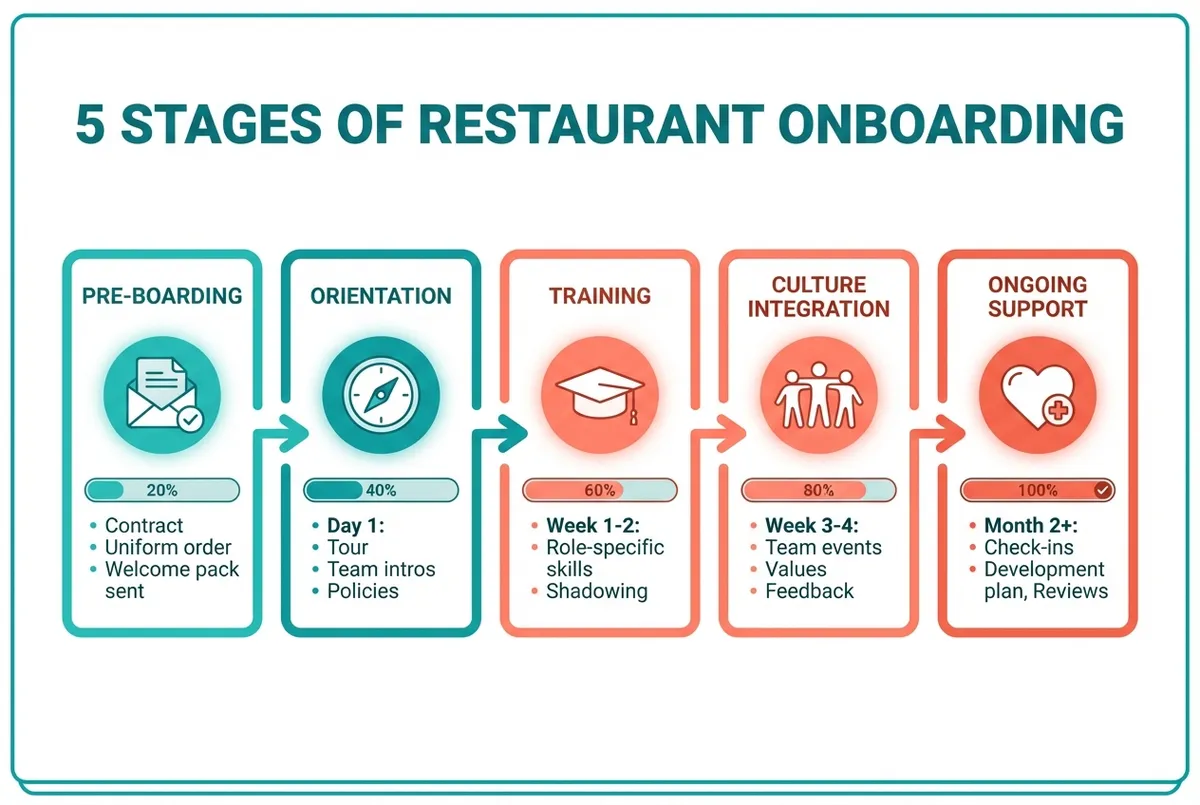
The 5 stages of a restaurant onboarding checklist
What Are the 5 Stages of the Onboarding Process?
Building on the 5 C's, here's how the process breaks down into stages. The five stages are pre-boarding, first-day orientation, role training, cultural integration, and ongoing support. Each stage builds on the last to turn a new hire into a confident team member.
Stage 1: Pre-Boarding
This starts the moment they accept the offer. Send:
- Welcome email with start date, arrival time, and parking/transport info
- Paperwork (contract, right-to-work documents, bank details form)
- Uniform details and dress code
- A brief overview of what day one looks like
Pre-boarding (about 60 minutes of role context plus a 20-30 minute manager intro) raises 90-day stay rates by roughly 25-30% (Key-G, 2025).
For example, a casual dining chain might send a two-minute welcome video from the general manager alongside the paperwork, so the new hire already feels part of the team before arriving.
Stage 2: First-Day Orientation
Make their first day count:
- Personal greeting from the manager (not a random team member)
- Full restaurant tour: kitchen, walk-in, staff room, fire exits, recycling
- Team introductions (names, roles, one fun fact each)
- Review of the employee handbook essentials
- Lunch with the team or at least a cup of tea
Stage 3: Role-Specific Training
Tailor training to the role:
- Servers: Menu knowledge, POS training, service steps, allergen awareness
- Kitchen staff: Prep procedures, food safety, station set-up, equipment use
- Hosts: Booking system, phone manner, table management, complaint escalation
Each role should have a clear training checklist with sign-off points. This is where a restaurant staff training manual becomes essential.
Stage 4: Cultural Integration
Share your restaurant's story:
- Why you opened, what makes you different
- How you want guests to feel
- Team traditions (staff meals, celebrations, ways of working)
- What behaviours get recognised and rewarded
If you're only telling new hires the rules you'll always lose to competitors who also tell them the reasons behind those rules. If your new starters can recite the menu but can't explain why you source locally, that's usually a sign your cultural onboarding needs work.
Stage 5: Ongoing Support
The onboarding doesn't end after week one:
- Day 7: Quick check-in: how are they feeling, what questions do they have?
- Day 14: Skills review against the training checklist
- Day 30: Formal one-to-one with the manager to discuss progress and goals
- Day 60-90: Performance review and discussion about development
Staff who get regular feedback are three times more engaged (Gallup, cited in Altametrics, 2025). A 5-minute chat at the right moment can stop a quiet resignation.
Your Complete Restaurant Onboarding Checklist Template
Now let's put everything into a checklist you can actually use. Here's a practical, printable template you can adapt for any role. For instance, a gastropub might print this and laminate it, keeping copies in the office for each new hire's first day. Use it alongside your broader restaurant staff training framework.
Before Day One (Pre-Boarding)
- Contract and offer letter sent and signed
- Right-to-work documents collected
- Bank details and tax information received
- Uniform ordered or prepared
- Welcome email sent with day-one details
- Training schedule prepared for first two weeks
- Buddy or mentor assigned
Day One
- Manager personally greets the new hire
- Full restaurant tour completed
- Team introductions made
- Employee handbook reviewed and signed
- Health and safety briefing completed
- Fire exits and emergency procedures explained
- First-shift shadow arranged with buddy
Week One
- POS system training (basic transactions)
- Menu knowledge session (dishes, allergens, specials)
- Food safety and hygiene briefing
- Allergen awareness training (Natasha's Law)
- Opening and closing procedures demonstrated
- Customer service standards reviewed
- End-of-week check-in with manager (5-10 minutes)
Week Two
- Independent practice under supervision
- Complaint-handling procedures reviewed
- Cross-training exposure (e.g., server shadows host, or vice versa)
- POS system advanced functions (bill splitting, discounts)
- Day 14 skills review against checklist
First Month
- Formal 30-day review with manager
- Performance against role expectations discussed
- Development goals set for next 60 days
- Employee satisfaction check (are they happy? engaged? struggling?)
- Probationary period progress noted
Ongoing (60-90 Days)
- 60-day informal check-in
- 90-day formal review and probation decision
- Career development conversation (if applicable)
- Feedback on the onboarding process itself (what worked, what didn't)
Ask yourself: would a new hire at your restaurant describe their first week as "welcoming and organised" or "chaotic and confusing"?
74% of employees say poor training is the biggest barrier to their success (Altametrics, 2025). Every unchecked box on this list is a small crack that could become a reason to leave.
This Week's Action Plan
- Day 1-2: Write a simple welcome email template. Include: start time, what to wear, where to park, who to ask for. Save it so you can reuse it for every hire.
- Day 3-4: Create a one-page "Day One Essentials" sheet: tour stops, key introductions, safety briefing, and the buddy assignment. Print five copies and keep them in your office.
- Day 5-7: Schedule a 5-minute end-of-shift check-in with your most recent hire. Ask: "What's one thing that would have made your first week easier?" Write down the answer.
This sounds great in theory. In practice, when you're down two staff on a Saturday rush, onboarding feels like a luxury. But every hire who quits within a month costs you more time than the 30 minutes you'd spend getting it right.
Frequently Asked Questions
What are the 5 pillars of onboarding?
The 5 pillars of onboarding align closely with the 5 C's framework: Compliance (legal requirements), Clarification (role expectations), Culture (mission and values), Connection (relationships and belonging), and Check-back (feedback loops and progress reviews). For example, a fine dining restaurant might focus heavily on the Culture pillar by having new hires dine as guests before their first shift, so they understand the experience they're creating. See our guide to how to train restaurant staff for more detail.
How long should restaurant onboarding take?
Effective restaurant onboarding spans 30-90 days, with the heaviest training in the first two weeks. New employees typically reach basic proficiency in 12-19 days (CrunchTime, 2025), but full integration, where they're confident, autonomous, and culturally embedded, takes closer to three months. Currently, 25% of companies spend less than a day on onboarding (Deel, 2025), which is far too short for hospitality roles.
What should be included in a kitchen orientation checklist?
A kitchen orientation checklist should cover food safety and hygiene protocols, station set-up and breakdown procedures, equipment operation and safety, allergen awareness and Natasha's Law compliance, waste management and recycling, fire safety and first aid locations, and an introduction to the head chef and kitchen hierarchy. Link this to your broader restaurant onboarding checklist for consistency.
How do I measure onboarding success?
Track three metrics: 90-day retention rate (how many new hires stay past probation), time to proficiency (how many shifts before they work independently), and new hire satisfaction (ask them directly at the 30-day mark). Structured onboarding boosts retention by 50% in the first 90 days (Barmetrix, 2025), so if your numbers aren't improving, revisit your process.
Can I create a free restaurant onboarding checklist?
Yes. Use the checklist template in this article as a starting point. Copy it into a simple document, customise it for your restaurant's specific requirements, and print copies for each new hire. Digital options include free checklist tools and shared documents that managers and new hires can both access and update in real time. Explore our restaurant team building guide for ideas on making onboarding more engaging.
Key Takeaway
If you run a restaurant and want to see how Local Brand Hub can support your marketing, explore our restaurant marketing tools or browse the full marketing platform.
Key Takeaway
- Structured onboarding improves retention by 82%, yet only 12% of employees say their company does it well. The gap is your opportunity.
- The 5 C's framework (Compliance, Clarification, Confidence, Connection, Culture) gives you a research-backed structure to follow.
- Onboarding spans 30-90 days, not just day one. The most critical checkpoints are at day 7, day 14, and day 30.
- Pre-boarding matters. A simple welcome email before their start date raises 90-day retention by 25-30%.
- Start small, iterate. Even a one-page checklist and a 5-minute daily check-in transforms the new hire experience.
Read our full restaurant staff training guide for the complete framework, or review our restaurant server training checklist for role-specific training details.
For UK restaurant owners
Streamline Your Onboarding Process
LocalBrandHub helps UK restaurants create structured onboarding checklists, track new hire progress, and reduce early turnover.
Start FreeThis article is for general informational purposes. Always consult current UK employment law and food safety regulations for your specific circumstances. Statistics cited reflect available industry data at the time of publication and may vary by region and restaurant type.
Get More Marketing Tips
Practical marketing tips for UK business owners, straight to your inbox. No spam, unsubscribe anytime.
About the Author
Local Brand Hub
Empowering UK Businesses
Local Brand Hub provides comprehensive business management tools designed specifically for UK local businesses to streamline operations, automate marketing, and grow revenue.
More articlesRelated Articles
 Business Growth
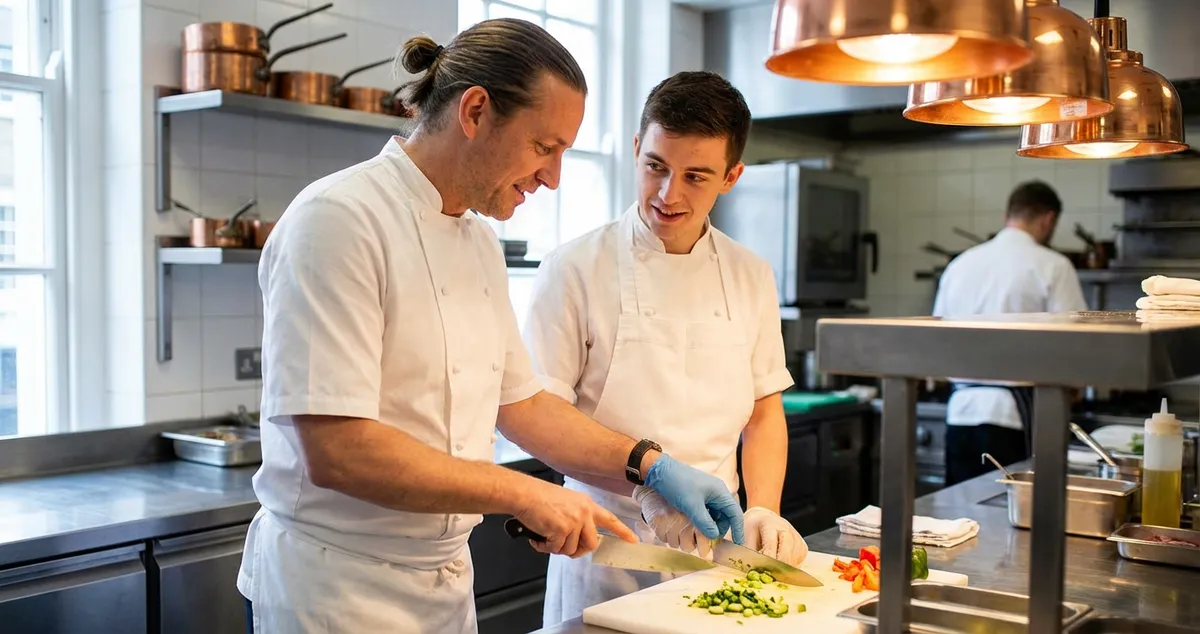
How to Train Restaurant Staff: A Practical UK Guide
How to train restaurant staff effectively with proven frameworks, the 7 steps of service, and budget-friendly methods. Practical guide for UK operators.
 Business Growth
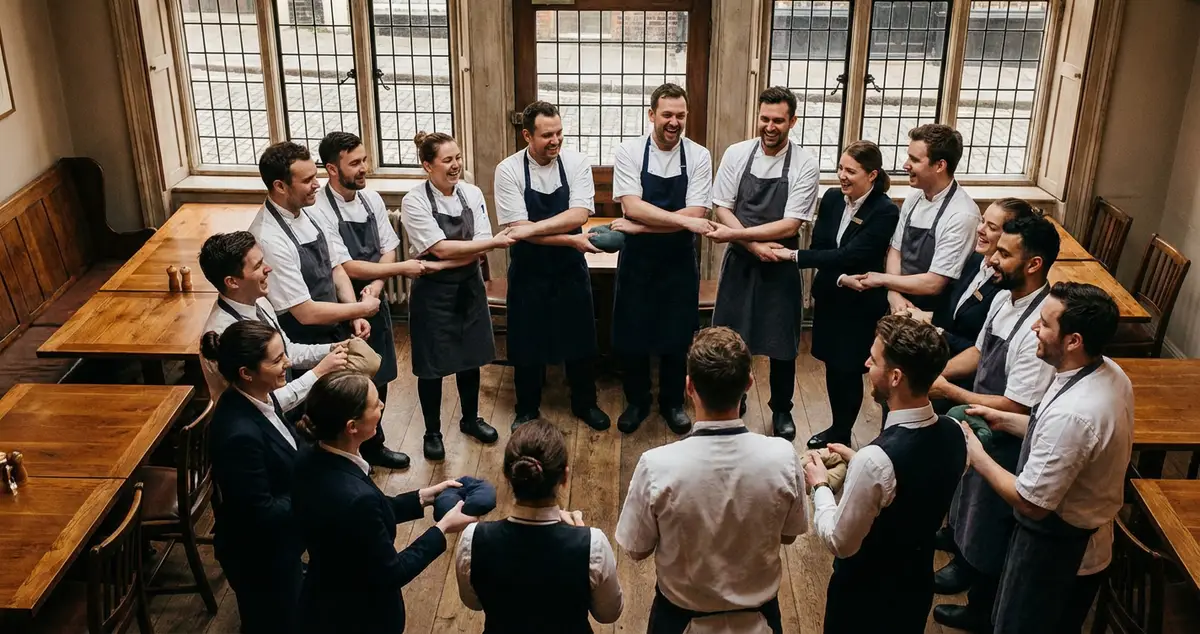
Restaurant Team Building: Activities That Work
Restaurant team building activities that improve staff retention and service quality. Budget-friendly exercises for UK operators with real examples.
 Business Growth
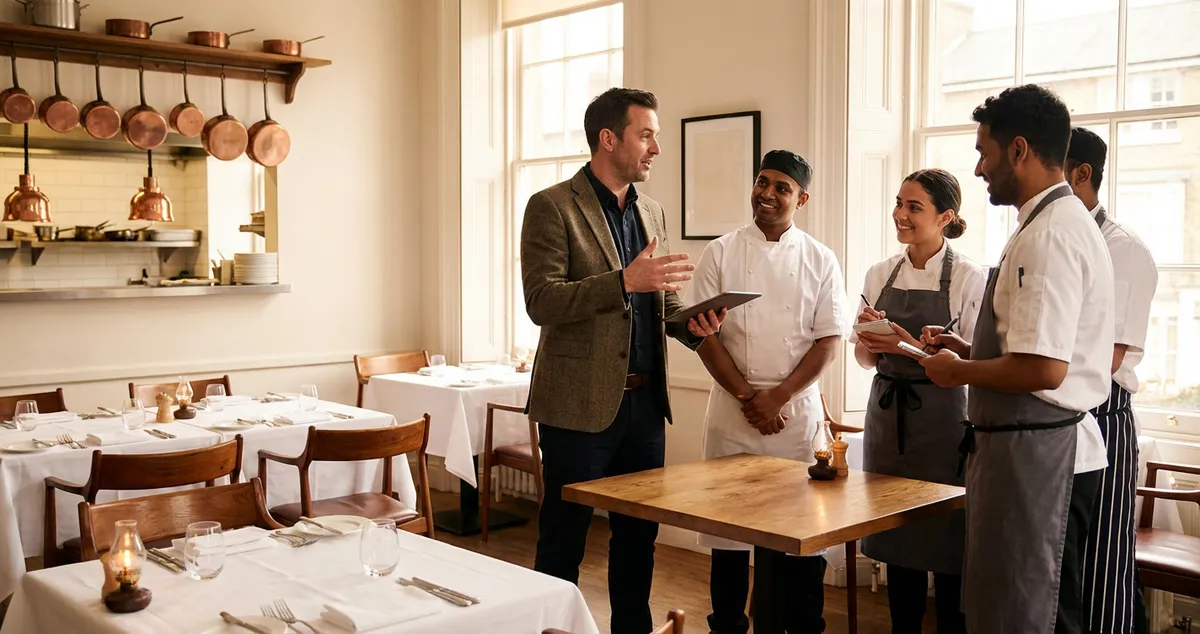
Restaurant Manager Training: Your Practical UK Guide
Learn what restaurant manager training covers, from qualifications to salary benchmarks. UK guide with training checklist and course comparison.