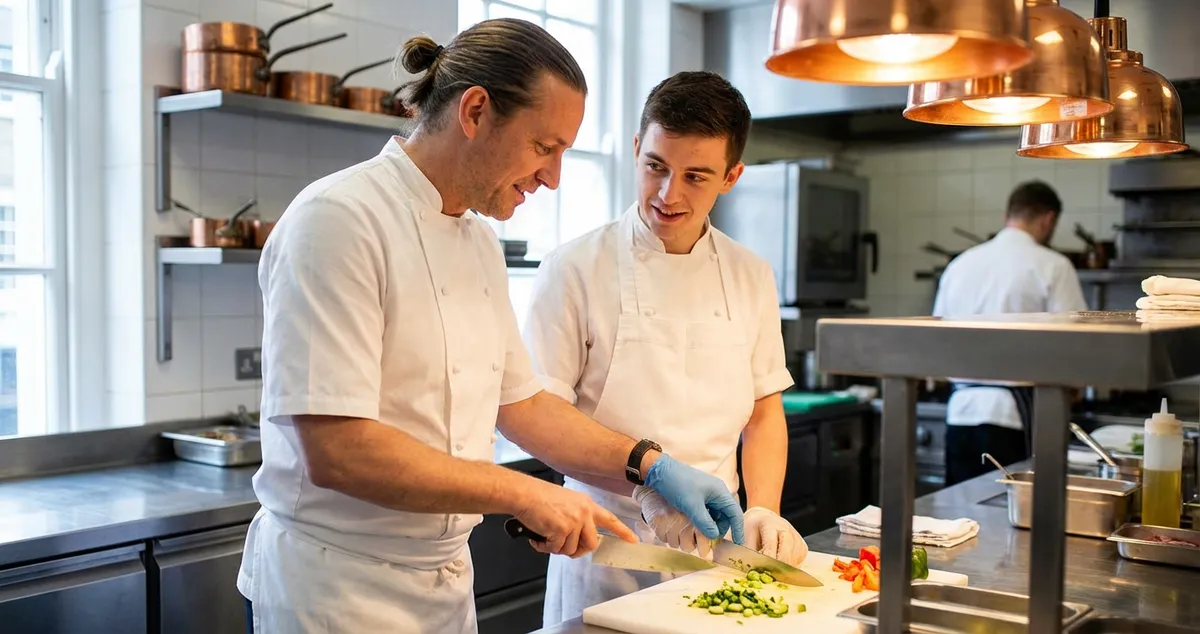
How to train restaurant staff effectively with proven frameworks, the 7 steps of service, and budget-friendly methods. Practical guide for UK operators.
You've just hired two new starters. One's never worked in hospitality before. The other lasted three weeks at their last place because "the training was rubbish." You've got a fully booked Saturday in four days and a training manual that's three years out of date. The question isn't whether to train them. It's how.
What You'll Learn
- Why structured training directly reduces turnover costs and protects your bottom line
- The 5 P's of restaurant service and how to train staff around each one
- A step-by-step framework for training restaurant staff on a limited budget
- The 7 steps of service every front-of-house team member should master
- Which training methods actually work for time-poor UK operators
Info
Related: Restaurant Staff Training: your complete hub for building a high-performing hospitality team.
Why Training Restaurant Staff Properly Matters
Here's the number that should keep every UK restaurant owner awake: 90% of restaurant operators identify employee recruitment and retention as a significant challenge (Opus Training, 2025). That's not a distant industry problem. It's your problem. Mine too.
But here's what makes it worse. Undertrained staff can cost a restaurant approximately £155,000 in annual excess costs through turnover, low productivity, and errors (Escoffier Global, 2025). And 41% of restaurant workers say they'll leave if their job doesn't provide adequate training (Escoffier Global, 2025).
So you're losing staff because you're not training them well enough, and you're not training them well enough because you keep losing staff. Sound familiar?
The vicious cycle of undertrained staff leaving creates more pressure on the people who stay, and then they leave too.
The way out starts with understanding that how to train restaurant staff isn't about creating a perfect 200-page manual. It's about building a simple, repeatable system that works even when you're down two staff on a Friday night. For example, a neighbourhood bistro might create a one-page "first shift" card covering the five things every new starter needs to know immediately. Your restaurant staff training programme doesn't need to be complicated. It needs to be consistent.
If you're thinking "I can barely keep up with the shifts, let alone training", that's exactly why a structured approach matters. Because at this moment, you're training by accident. Every bad habit a new starter picks up from watching the wrong person is training. Just not the kind you want.
The 5 P's of Service in Restaurants
Now that you understand why training matters, let's start with frameworks. The 5 P's of service in restaurants are Product, Price, Place, Promotion, and People, a framework adapted from marketing that helps structure how you think about every touchpoint your customer experiences (Factors.ai, 2025).
For training purposes, the "People" element is where everything comes together. Understanding how to train restaurant staff around each P gives you a practical framework. You can have brilliant food, a beautiful space, and competitive prices, but if your team can't deliver consistent service, none of it matters.
How to Train Staff Around Each P
- Product: Ensure every team member can describe every dish, including allergens, cooking methods, and recommended pairings. Run a weekly taste test of specials.
- Price: Staff should understand your pricing rationale. If someone asks "why is this £18?", your team should confidently explain the quality, sourcing, or preparation involved.
- Place: Train staff on the entire customer journey, from arrival to departure. Where do they wait? How do they find the toilet? What's the flow?
- Promotion: Brief staff on current offers, loyalty schemes, and social media campaigns (our all-in-one marketing tools help you plan and run these) so they can mention them naturally.
- People: This is the big one. For instance, a neighbourhood bistro might train their team to remember regulars' names and drink preferences, turning a good meal into a personal experience.
Proper staffing balance is critical too: too many servers on one shift reduces individual tips and morale, while understaffing overwhelms your team and diminishes service quality (GGB Magazine, 2025).
The 3 C's Every Restaurant Team Needs
Building on the 5 P's, the three C's in a restaurant are Care, Competence, and Consistency, the foundation of service that keeps customers coming back (Fresh Technology, 2025).
Care means genuine concern for the guest's experience. For example, it's the difference between a server who asks "is everything alright?" because they're supposed to and one who notices a customer looking uncomfortable and acts on it.
Competence covers product knowledge, operational skills, and the ability to handle problems without escalating to a manager. If a customer asks about gluten-free options and your server has to "go and check," that's a competence gap.
Consistency is the hardest one. One brilliant experience followed by a mediocre one creates disappointed customers, not loyal ones. This is where your restaurant staff training programme earns its value, by ensuring Tuesday night's service matches Saturday night's.
Ask yourself: if you sent a mystery diner in on your worst-staffed shift, would the experience meet your standards?
An alternative framework uses Convenience, Consistency, and Connection, where connection means staff know customers by name and details about their lives. As one industry expert noted, "people like food. People love people" (Food Truck Operator, 2025). That's usually a sign your team is doing something right.
If you're thinking "my team already cares", that's great. But caring without competence leads to well-meaning chaos, and competence without consistency means your standards depend on who's working.
The 7 Steps of Service in a Restaurant
With that framework in place, let's get specific about how to train restaurant staff on service delivery. The 7 steps of service form a structured framework guiding guests through the entire dining experience. Here's how to train your team on each one, with realistic timing benchmarks (Restroworks, 2025; SpotOn, 2025):
- Greet the guest: Acknowledge within 30 seconds. Make eye contact, smile, and use a genuine welcome rather than a scripted line.
- Offer water, menus, and initial service: Within 1 minute. Set the pace. A confident start puts guests at ease.
- Take orders accurately: Within 8 minutes of seating. Record modifications and allergies carefully. Repeat back to confirm.
- Deliver food and drinks efficiently: Appetisers within 10 minutes, mains within 15-20 minutes. Call out dish names, don't auction food.
- Check back after the first few bites: This is your chance to catch problems early. Not "is everything okay?" but "how's the steak?"
- Clear plates and offer next steps: Anticipate needs. Offer dessert menus, coffee, or additional drinks without being pushy.
- Present the bill and thank the guest: End memorably. A genuine "hope to see you again" beats a generic "thanks, bye."
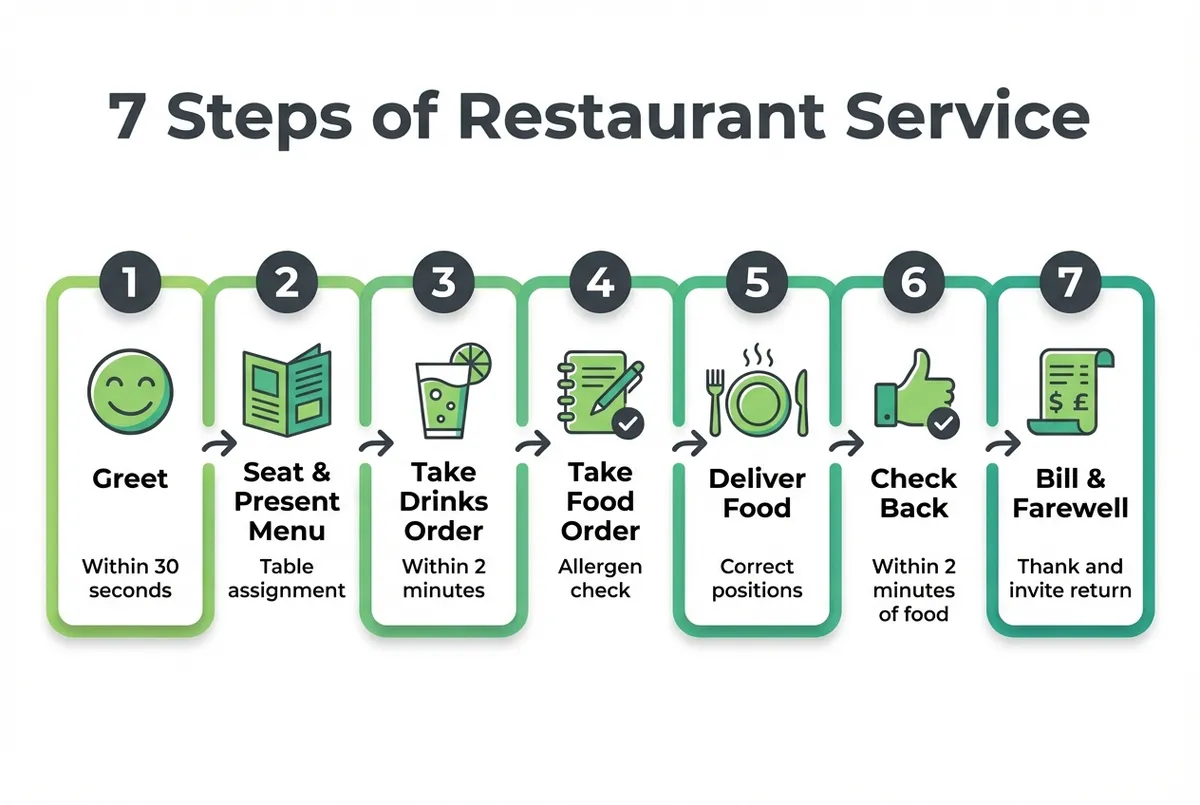
The 7 steps of restaurant service from greeting to farewell
Training Implementation Tips
For restaurant server training, focus on three areas:
- Create visual service guides with bullet points or photos demonstrating ideal behaviours at each step
- Build recovery protocols into each step so servers can independently resolve issues like incorrect dishes or long waits
- Use role-play and shadowing during onboarding to practise each step before going live
For example, a fine-dining restaurant might add a sub-step between steps 3 and 4 where the server brings an amuse-bouche. A casual cafe might combine steps 5 and 6. Adapt the framework to your service style.
Which Training Method Works for Restaurants
Next, let's look at how to deliver this training. Most restaurants combine hands-on practice with short, focused learning modules. The 2025 Hospitality Training 360 Report, compiled from over 120 hospitality training leaders (78% from restaurant operations), shows clear trends (QSR Magazine, 2025):
Training Method Comparison
| Method | Effectiveness | Ideal For | Time Investment |
|---|---|---|---|
| Hands-on shadowing | High | Service skills, kitchen techniques | 2-5 days |
| Micro-learning modules | High | Procedures, compliance, till training | 10-15 mins per session |
| Group huddles/pre-shift briefs | Medium-High | Daily specials, service reminders | 5-10 mins daily |
| Video training | Medium-High | Standardising across shifts/locations | 2-5 mins per video |
| Written manuals | Low-Medium | Reference material, compliance records | Varies |
Ongoing training for hourly employees has decreased to just one hour per month, a 40-58% year-over-year drop (QSR Magazine, 2025). This means every minute counts. For example, a cafe might replace a 30-minute end-of-week training session with three 5-minute micro-learning videos staff watch on their phones before shifts.
Pro Tip
72% of restaurant L&D professionals report that AI improves their work quality, with proficient users completing projects up to four times faster (QSR Magazine, 2025). However, only 8% consider themselves advanced AI users. Starting with AI tools for training content creation puts you ahead of most operators.
For most UK independent restaurants, a blend of pre-shift huddles and hands-on shadowing typically delivers the strongest results for the least time investment.
The Best Way to Train Restaurant Staff on a Budget
Finally, let's talk money. Training doesn't require a massive budget. What it requires is structure. Here's a practical framework for UK operators who need to train staff effectively without spending thousands on external courses.
Week 1: Foundations (Days 1-3)
- Building tour and orientation (30 minutes)
- Health and safety essentials, including allergen awareness (1 hour)
- POS system basics using your restaurant onboarding checklist (1 hour)
- Shadow an experienced team member for two full shifts
Week 2: Service Skills (Days 4-7)
- 7 steps of service walkthrough with role-play (1 hour)
- Menu knowledge session: taste key dishes, discuss ingredients (1 hour)
- Supervised shifts with feedback at the end of each one
- Complete initial assessment against your standards
Ongoing: Monthly Development
- Monthly one-to-one feedback sessions (15 minutes)
- Quarterly menu knowledge refreshers
- Annual food safety recertification
Current industry data shows operators want new employees proficient and shift-ready in 12 days, though the average is actually 19 days (CrunchTime, 2025). For instance, a gastropub using this framework found their new starters were confidently working solo shifts by day 10 rather than the previous three weeks. A structured approach like this helps close that gap.
55% of employees prefer condensed training programmes so they can start work quickly (Supy, 2025). If you're reading this thinking "I barely have time for my own lunch break, let alone structured training", that's exactly the point. Don't drag onboarding out over three weeks when you could concentrate the essentials into the first few days and let them learn by doing.
The best restaurant training doesn't happen in a classroom. It happens between the pass and the floor, when someone shows you how it's really done.
If you're only training reactively you'll always lose to competitors who build training into daily operations. Read our guide to creating a restaurant staff training manual for templates you can adapt.
Actionable Checklist
Here's a step-by-step checklist covering how to train restaurant staff effectively:
- Write down the five things you explain to every new starter (these become your training priorities)
- Create a one-page "first day" guide covering building tour, key contacts, and safety essentials
- Build a simple menu quiz covering allergens, ingredients, and cooking methods
- Set up a shadowing rota pairing new starters with your best team members
- Introduce a 5-minute pre-shift huddle covering daily specials and service reminders
- Schedule monthly one-to-ones with every team member
- Track time-to-competency for each new hire
- Review training approach quarterly based on customer feedback and retention data
- Cross-reference training content with your restaurant manager training programme for alignment
- Celebrate when a new starter completes their first independent shift
If You Only Have 30 Minutes a Week
This Week's Action Plan
If you only have 30 minutes a week, audit your current restaurant staff training approach:
- Day 1-2: Ask your three newest team members: "What did you wish someone had told you on day one?" Write down their answers.
- Day 3-4: Create a one-page "first shift survival guide" covering the top five things new starters need to know immediately. Keep it to bullet points.
- Day 5-7: Run a 5-minute pre-shift huddle before your busiest service. Cover one specific service standard (e.g., "tonight, we're greeting every table within 30 seconds"). Note how it goes.
Three actions. Thirty minutes total. For example, one restaurant owner discovered from this exercise that every new starter asked the same question: "where do I put the dirty aprons?" That's a 30-second fix to your orientation process.
Frequently Asked Questions
How long does it take to fully train a restaurant staff member?
Industry benchmarks show it takes an average of 19 days for new restaurant employees to become proficient, though operators want this reduced to 12 days (CrunchTime, 2025). Front-of-house roles tend to reach competency faster than kitchen positions, which require more technical skill development. A structured training programme with clear milestones can significantly shorten this timeline.
What's the biggest mistake restaurants make when training staff?
Treating training as a one-time event rather than an ongoing process. New hire onboarding hours have increased approximately 40% across roles over the past five years (Opus Training, 2025), but ongoing development often gets neglected. The most effective restaurants build training into daily operations through pre-shift briefings, regular feedback, and quarterly skills refreshers.
How do you motivate staff during training?
94% of employees are more likely to stay with companies that invest in their development (CrunchTime, 2025). Show new starters that training leads somewhere, whether that's more responsibility, better shifts, or a clear path to a restaurant manager training role. Set small, achievable goals and celebrate progress. Nobody stays motivated if training feels like an endless to-do list with no payoff.
Should I use online training or in-person training?
Both. The strongest approach combines hands-on practice (you can't learn to carry three plates from a screen) with digital tools for procedures and compliance. Short video modules work brilliantly for POS training, allergen awareness, and health and safety content. See our guide to restaurant training videos for practical tips on creating your own.
How much should a UK restaurant spend on staff training?
Industry data suggests restaurants allocate between £1,000 for hourly workers and £5,000 for general managers annually (Opus Training, 2025). However, many effective training methods cost nothing. For example, pre-shift huddles, shadowing rotas, and menu tastings use existing resources. Focus on structure before spending money.
If you run a restaurant and want to see how Local Brand Hub can support your marketing, explore our restaurant marketing tools.
Key Takeaway
Key Takeaways
- Training pays for itself: undertrained staff can cost a restaurant approximately £155,000 annually through turnover, errors, and low productivity, making structured training one of your highest-ROI investments
- Start with the 7 steps of service: this framework creates consistent guest experiences regardless of which team members are working, and it adapts to any service style
- Keep it short and focused: with ongoing training time down to one hour per month, micro-learning modules and pre-shift huddles deliver more impact than lengthy classroom sessions
- Track one metric: measure time-to-competency for new hires as your starting benchmark, then connect training to turnover rates and customer satisfaction over time
- Build training into daily operations: the best restaurants don't schedule training separately; they embed it into pre-shift briefings, feedback sessions, and team culture
For UK restaurant owners
Train Your Team With Confidence
LocalBrandHub helps UK restaurants build effective training systems that improve service quality and reduce staff turnover.
Start FreeThis article is for informational purposes only and does not constitute professional training, legal, or employment advice. Always ensure your staff training meets current UK food safety, health and safety, and employment regulations.
Get More Marketing Tips
Practical marketing tips for UK business owners, straight to your inbox. No spam, unsubscribe anytime.
About the Author
Local Brand Hub
Empowering UK Businesses
Local Brand Hub provides comprehensive business management tools designed specifically for UK local businesses to streamline operations, automate marketing, and grow revenue.
More articlesRelated Articles
 Business Growth
Restaurant Staff Onboarding Checklist: Complete UK Template
Use this restaurant onboarding checklist to boost new hire retention by 82%. Covers the 5 C's of onboarding, stage-by-stage process and printable template.
 Business Growth
Restaurant Team Building: Activities That Work
Restaurant team building activities that improve staff retention and service quality. Budget-friendly exercises for UK operators with real examples.
 Business Growth
Restaurant Manager Training: Your Practical UK Guide
Learn what restaurant manager training covers, from qualifications to salary benchmarks. UK guide with training checklist and course comparison.