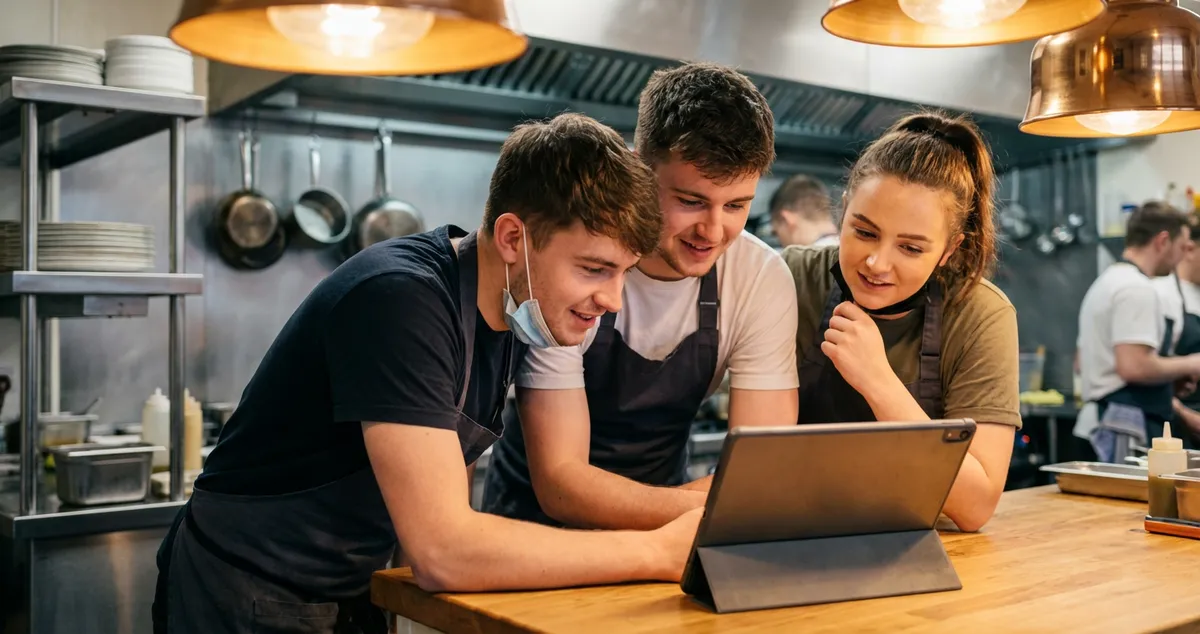
How restaurant training videos cut onboarding time and boost service consistency. Practical UK guide with platform comparisons and budget advice.
You've spent three hours this week showing the new starter how to use the till. Again. Tables are going uncleared, your best server is covering two sections, and nobody reads your training notes. Restaurant training videos offer a better way to train your team without losing your evenings.
What You'll Learn
- Why restaurant training videos have become essential for UK operators facing compressed training schedules
- How to choose between free and paid video training platforms on a real budget
- The types of training videos that deliver measurable results for service consistency
- A practical framework for creating your own training video library from scratch
Info
Related: Restaurant Staff Training, your complete hub for building a high-performing team.
Why Restaurant Training Videos Matter in 2025
Here's the situation. You've hired someone new. You need them on the floor yesterday. But the reality of restaurant staff training in 2025 looks nothing like it did even two years ago.
Ongoing training for hourly restaurant employees has dropped to just one hour per month, a 40-58% year-over-year decrease from previous years (QSR Magazine, 2025). That's not a typo. One hour. Yet at the same time, 61% of restaurant operators increased their focus on basic job skills training in 2025, a 25% increase year on year (QSR Magazine, 2025).
This creates an impossible tension. You need better-trained staff. You have less time to train them.
Training videos aren't about replacing hands-on learning. They're about making sure nobody has to explain how to fold a napkin for the fifteenth time.
Restaurant training videos solve this by letting your team learn on their own schedule, watch demonstrations repeatedly, and absorb information at their own pace. For example, a new hire can watch a three-minute video on your allergen procedures at home the night before their first shift, rather than trying to absorb it during a hectic Saturday service.
If you're thinking "I don't have time to set up video training", you're not alone. But consider this: restaurant training teams that track operational metrics like turnover rates and guest satisfaction are twice as likely to receive budget increases (CHART/Opus Training, 2025). That means investing in structured training pays for itself.
Types of Restaurant Training Videos That Actually Work
Now that you understand why video matters, let's look at what actually works. Not all restaurant training videos are created equal. The ones that actually change behaviour fall into distinct categories, and knowing which to prioritise saves you from creating content nobody watches.
Onboarding and Orientation Videos
These cover the basics every new starter needs: fire exits, uniform standards, clocking-in procedures, health and safety protocols. For instance, a gastropub might create a five-minute walkthrough of the building showing where everything is stored, so new starters aren't asking "where's the salt?" on their first shift.
Service Standards Videos
These demonstrate your specific service steps: how you greet tables, take orders, handle complaints. They're particularly valuable because 61% of operators are refocusing on basic job skills training (QSR Magazine, 2025). A short video showing your exact table-clearing sequence creates consistency across every shift.
Till and POS System Training
Software-specific training videos reduce the time managers spend explaining till functions. If you're using Lightspeed Restaurant or a similar POS, video walkthroughs of common tasks (splitting bills, processing refunds, applying discounts) let new staff practise before touching the live system.
Food Safety and Allergen Training
These aren't optional in the UK. Natasha's Law requires clear allergen labelling, and restaurant training videos on allergen procedures ensure every team member understands your specific protocols, not just the theory from a generic course.
Cross-Training Videos
Short clips showing restaurant server training tasks help back-of-house staff understand front-of-house operations and vice versa. This builds empathy between teams and creates flexibility during busy periods.
How to Choose a Video Training Platform
With that foundation of video types covered, the next step is choosing where to host them. If you're only choosing platforms based on price you'll always lose to competitors who invest in the right features for their team's actual learning needs.
Platform Comparison
| Platform Type | Cost | Ideal For | Limitations |
|---|---|---|---|
| YouTube (private/unlisted) | Free | Small independents, basic training | No tracking, no quizzes |
| Google Drive/Dropbox | Free | Storing training videos | No engagement features |
| Dedicated LMS (e.g., Flow, Opus) | From £30/month | Multi-site, compliance tracking | Setup time required |
| POS-integrated training | Varies | System-specific training | Limited to POS content |
For most UK restaurants with fewer than three sites, a combination of YouTube (unlisted videos) and a shared Google Drive folder is perfectly adequate. If you're running multiple locations, that's usually a sign you need a dedicated platform with completion tracking and quiz features.
Pro Tip
72% of restaurant L&D professionals report that AI improves their work quality, with proficient users completing projects up to four times faster than basic users (QSR Magazine, 2025). However, only 8% consider themselves advanced AI users. For instance, a neighbourhood bistro might use an AI tool to generate quiz questions from their training videos, saving hours of manual work.
For most UK independent restaurants, start with free tools and upgrade only when you have more than 10 training videos to manage.
Creating Your Own Restaurant Training Videos
Let's get practical. If you're thinking "I can't afford professional video production", good news. You don't need it. Your phone camera and natural lighting are enough for effective training content.
Equipment You Already Have
- A smartphone with a decent camera (anything from the last three years works)
- Natural lighting from a window, or your restaurant's existing lights
- A quiet corner during closed hours
The 3-Minute Rule
Keep each video under three minutes. Research shows that 55% of employees prefer condensed training so they can start work quickly (Supy, 2025). A three-minute video on "how we plate our signature dish" is far more effective than a 20-minute lecture covering everything at once.
Recording Tips for Restaurant Owners
- Film during closed hours: no background noise, no interruptions
- Show, don't tell: demonstrate the action rather than just explaining it
- Include common mistakes: show what wrong looks like, then what right looks like
- Use your actual equipment: film on your actual till, with your actual plates
For example, a restaurant manager training video on end-of-day cash-up procedures should show your specific till, your specific float amount, and your specific paperwork. Generic content doesn't stick.
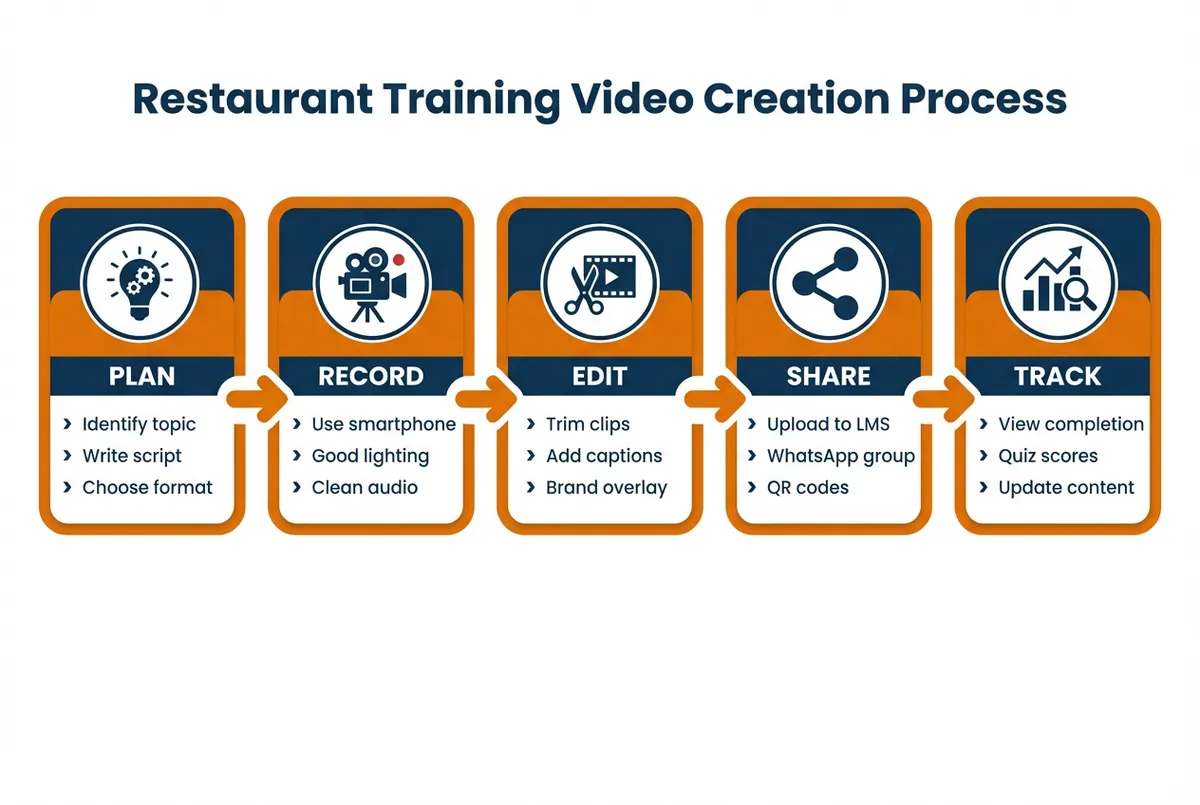
A simple framework for creating restaurant training videos from scratch.
Building a Video Library
Start with these five essential videos:
- Welcome and orientation: building tour, key contacts, uniform standards
- Health and safety essentials: fire procedures, first aid, allergen protocols
- POS basics: taking an order, processing payments, handling refunds
- Service standards: your greeting, table approach, complaint handling
- Closing procedures: cleaning checklists, cash-up, locking up
This gives you a complete restaurant staff training programme foundation. Ask yourself: if a new starter joined tomorrow, could they find everything they need in your video library? Add specialist videos as needed for menu changes, seasonal procedures, or new equipment.
Measuring Training Video Effectiveness
Finally, let's talk about proving this is worth it. You can't improve what you don't measure. If you're only making videos without tracking whether they change anything you'll always lose to competitors who connect training to results. If you can't tell whether your videos are improving service or just filling a shared folder, that's usually a sign you need better metrics.
What to Track
| Metric | How to Measure | Target |
|---|---|---|
| Completion rate | LMS platform or simple sign-off sheet | 90%+ within first week |
| Time to competency | Days until new starter works independently | Under 12 days |
| Service consistency | Mystery diner scores or complaint rates | Improvement within 30 days |
| Staff retention | Monthly turnover tracking | Reduction within 90 days |
Training teams that track operational metrics are twice as likely to receive budget increases (CHART/Opus Training, 2025). Even a simple spreadsheet tracking new hire completion dates and first-month performance creates the data you need to justify continued investment.
Start With One Metric
If you're reading this thinking "this sounds like a lot of admin", start with just one metric. Track how many days it takes your new starters to work a shift independently. For example, a busy brasserie might find their new hires take 18 days to work independently without videos, dropping to 11 days after introducing a basic video library. That single number tells you whether it's working.
Actionable Checklist
Here's a step-by-step checklist to build your restaurant training video programme:
- Audit your current training process: what do you explain repeatedly?
- List the five questions new starters ask most often
- Record your first video (orientation or POS basics)
- Store videos in an organised, accessible location
- Create a simple sign-off sheet for new starters
- Track time-to-competency for your next three hires
- Review and update videos quarterly for accuracy
- Gather feedback from new starters on video usefulness
- Cross-reference with your restaurant onboarding checklist for completeness
- Share results with your team to build buy-in
If You Only Have 30 Minutes a Week
If you only have 30 minutes a week, start your restaurant training video library:
- Day 1-2: Write a list of the five things you explain to every new starter. Pick the one you find yourself repeating the most.
- Day 3-4: Record a 2-3 minute video of that task during a quiet period. Use your phone. Don't aim for perfection; aim for clarity.
- Day 5-7: Upload the video to a shared folder (Google Drive or YouTube unlisted). Share the link with your team and ask one person to watch it and give feedback.
That's it. One restaurant training video. Thirty minutes total. You've started.
Frequently Asked Questions
How long should restaurant training videos be?
Keep training videos between two and four minutes. Research suggests employees prefer condensed training that lets them get to work quickly (Supy, 2025). If a topic needs more time, break it into a series of short clips rather than one long video. A new starter is more likely to watch three two-minute videos than one six-minute video.
Do I need professional equipment to make training videos?
No. A recent smartphone, decent lighting, and a quiet room are enough to get started. The content matters more than production quality. Your team needs to see your actual kitchen, your actual till, and your actual service flow, not a polished studio production that doesn't reflect their workplace.
How do training videos compare to shadowing?
Training videos complement shadowing rather than replacing it. Videos handle the "what" (procedures, standards, safety protocols), while shadowing handles the "how it feels" (pace, teamwork, customer interactions). Typically the most effective approach uses videos before a new starter's first shift and shadowing during their first few days (Supy, 2025). Check our restaurant staff training manual for a structured approach.
Can training videos help with staff retention?
Structured training directly impacts retention. Employees who receive adequate training are significantly more likely to stay, and 41% of restaurant workers say they'll leave their job if it doesn't provide adequate training opportunities (Escoffier Global, 2025). Training videos demonstrate investment in your team's development.
How often should I update restaurant training videos?
Review videos quarterly and update whenever procedures change. For example, a seasonal menu launch or new equipment installation should trigger an immediate video update. A quick monthly check ensures nothing is outdated. Mark each video with a "last reviewed" date so staff know the content is current.
If you run a restaurant and want to see how Local Brand Hub can support your marketing, explore our restaurant marketing tools, or explore the platform features.
Key Takeaway
Key Takeaways
- Training time is shrinking: hourly restaurant staff receive just one hour of ongoing training per month, making video-based learning essential for covering fundamentals efficiently
- You don't need a budget to start: a smartphone and free storage tools like Google Drive or YouTube (unlisted) are enough for most independent UK restaurants
- Consistency beats production quality: a clear three-minute restaurant training video of your actual procedures beats a polished generic course every time
- Tracking matters: training teams connecting video completion to operational metrics like turnover and guest satisfaction are twice as likely to receive budget increases
- Start with five core restaurant training videos covering orientation, health and safety, POS, service standards, and closing procedures, then expand based on team feedback
For UK restaurant owners
Build a Video Training Library
LocalBrandHub helps UK restaurants create and organise training content that keeps standards consistent across every shift.
Start FreeGet More Marketing Tips
Practical marketing tips for UK business owners, straight to your inbox. No spam, unsubscribe anytime.
About the Author
Local Brand Hub
Empowering UK Businesses
Local Brand Hub provides comprehensive business management tools designed specifically for UK local businesses to streamline operations, automate marketing, and grow revenue.
More articlesRelated Articles
 Business Growth
How to Train Restaurant Staff: A Practical UK Guide
How to train restaurant staff effectively with proven frameworks, the 7 steps of service, and budget-friendly methods. Practical guide for UK operators.
 Business Growth
Restaurant Staff Onboarding Checklist: Complete UK Template
Use this restaurant onboarding checklist to boost new hire retention by 82%. Covers the 5 C's of onboarding, stage-by-stage process and printable template.
 Business Growth
Restaurant Team Building: Activities That Work
Restaurant team building activities that improve staff retention and service quality. Budget-friendly exercises for UK operators with real examples.