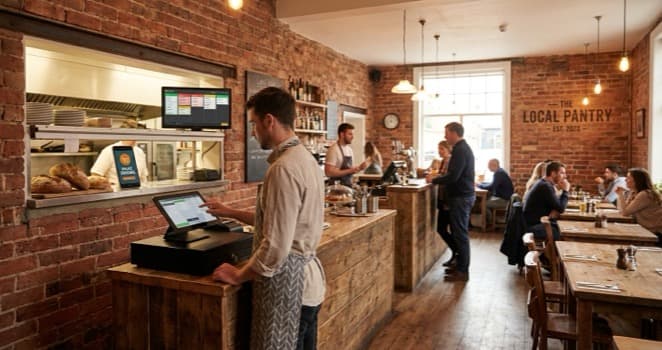
Discover every restaurant technology category from EPOS to AI automation. Practical UK guide with costs, examples and advice on choosing the right systems.
Restaurant technology is the set of digital tools that help restaurants run smoother, serve customers faster, and grow revenue. From EPOS tills and kitchen displays to AI inventory tools and online ordering, the right tech stack turns daily chaos into something you can manage and build on.
You've just finished another 12-hour shift. The ticket printer jammed twice during Saturday rush. A guest moaned about waiting twenty minutes for a bill. And somewhere between the 3pm lull and the evening push, you wondered: is there a better way to run all of this?
There is a better way. But the market is flooded with options. With 85% of UK restaurant leaders planning new tech buys in 2026 (Square, 2025), choosing between them when you barely have time to eat your own food feels hard.
This guide is based on our work helping UK restaurant owners pick the right tools. We use data from UKHospitality, Square, and ResDiary. Research shows most owners waste money on tools that don't link up. Every tip is backed by published data, last updated February 2026. If you need help for your setup, consult a restaurant technology professional.
What You'll Learn
- The six core categories of restaurant technology and what each one does
- UK cost ranges so you can budget without guessing
- How AI and automation are changing restaurant operations in 2026
- Which systems to pick first based on your restaurant type
- The 30/30/30 rule for splitting your technology budget
- How to build a tech stack where every tool connects properly
How Is Technology Used in Restaurants?
Technology touches every part of how a restaurant runs. From the moment a guest finds you online to the second their bill is paid, there is a tool built to make it easier. Here are the six core types:
| Category | What It Covers |
|---|---|
| EPOS/POS | Orders, payments, sales reporting |
| Kitchen displays | Order routing, prep timing, ticket management |
| Online ordering | Delivery, click-and-collect, QR menus |
| Reservations | Table booking, waitlist management, guest data |
| AI and automation | Chatbots, predictive inventory, dynamic staffing |
| Management software | Scheduling, accounting, stock tracking |
Info
Related: Restaurant technology trends covers 2026 innovations and where the industry is heading.
Most UK operators are upgrading their systems. The question is no longer whether to invest but which tools deserve your money first.
If you're thinking "I barely have time to learn the till I've got," that is normal. Start with whatever solves your biggest daily pain point.
For example, a chip shop losing orders to phone mix-ups gets more value from online ordering than from a CRM tool. A fine-dining spot with a no-show problem benefits more from a booking platform than a kitchen display upgrade.
EPOS and Point-of-Sale Systems
Now that you have the full picture, let's start with the category that matters most. For nearly every restaurant, the answer is your EPOS.
Your EPOS system is the heartbeat of your restaurant technology. It is a framework that links your front-of-house orders to the kitchen, payments, and reports. Every other tool plugs into it.
What to Look For in a Restaurant EPOS
A solid restaurant EPOS handles more than transactions. Core features to expect:
- Menu and modifier management: update prices and 86 items without calling a technician
- Table and floor planning: visual layouts matching your dining room
- Real-time reporting: sales by item, hour, and server
- Kitchen order routing: send starters to one station, mains to another
- Payment integration: contactless, chip-and-PIN, split bills, tips
UK Cost Ranges
Pricing depends on the provider and your setup:
- Budget cloud-based (cafes, small takeaways): lower monthly fees with affordable hardware
- Mid-range (independent restaurants): moderate subscription with solid hardware
- Full-featured (multi-site, fine dining): higher subscription fees with robust hardware
Budget options start from around £30 per month, while full-featured systems can reach £200 or more. Hardware ranges from simple card readers to multi-terminal setups with kitchen screens.
For instance, a single-site bistro might pay around £70 per month for a mid-range cloud EPOS with one terminal and a card reader. A busier spot needing three terminals and a kitchen display could reach £150 per month plus about £1,200 in hardware.
Save on EPOS costs
The UK POS market is growing fast, which means more competition and better deals for buyers. Always ask about annual payment discounts: many providers offer 10 to 20% off when you pay yearly.
For a detailed comparison of UK systems, see our restaurant POS system guide.
Kitchen Display Systems and Back-of-House Tech
With your EPOS in place, the next step is behind the pass. If you've ever watched a ticket printer jam during Saturday rush, you get the appeal of a kitchen display system. Moving from paper to screens pays for itself in fewer mistakes alone.
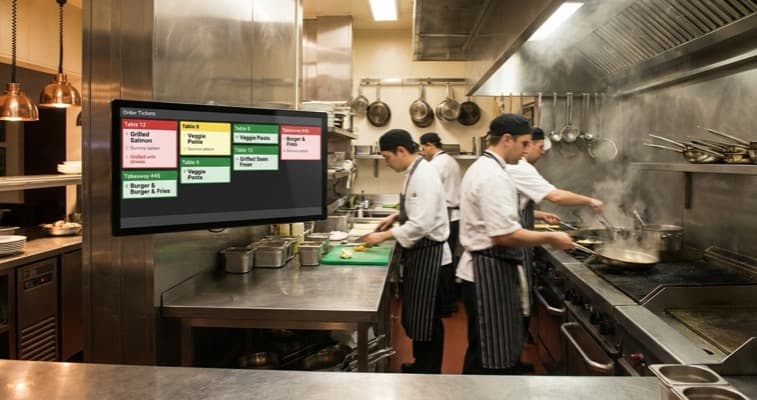
A KDS replaces paper tickets with a screen showing orders in real time. It colour-codes by priority and tracks prep times.
Why KDS Matters
- Fewer errors: no misread handwriting or lost tickets
- Better timing: coordinate courses so starters and mains land together
- Speed tracking: spot bottlenecks before they ruin service
- Less waste: smart kitchen automation reduces cooking errors by roughly 25%, according to Restroworks' 2025 data
For example, a busy curry house with three sections might use a KDS to show each station only its own items, colour-coded red when an order waits too long. That alone can shave minutes off ticket times on a Friday night.
Beyond the Screen
Back-of-house restaurant technology extends past displays. Kitchen tech in 2026 includes:
- Temperature monitoring: automated HACCP logging for Food Standards Agency compliance
- Prep management: digital prep lists linked to reservation forecasts
- Inventory tie-ins: automatic stock deductions as orders fire
If you're only posting handwritten prep lists on the kitchen wall you'll always lose to competitors who use digital prep tools linked to their booking data. That's usually a sign your back-of-house needs a rethink.
A standalone KDS costs a few hundred pounds per screen. Most restaurants need one to three displays. Many EPOS providers include KDS in their higher plans, so check what you already have before buying extra.
Online Ordering and Reservation Platforms
With kitchen operations covered, the next question is how customers find and order from you. That's where online ordering and reservation tools come in.
Per Square's 2025 UK data, most UK diners prefer contactless and digital ordering. Meeting that is no longer optional.
Online Ordering Options
You have three main routes:
- Third-party marketplaces: Deliveroo, Just Eat, Uber Eats. High visibility, but commission fees eat into margins
- Branded ordering platforms: Flipdish, Slerp, or your own site. Lower fees, but you drive the traffic yourself
- QR code table ordering: guests scan, browse, and pay from their phone, reducing front-of-house pressure
For example, a gastropub with its own branded app alongside Just Eat might find direct orders cost far less in fees. Over a year, that gap can mean thousands of pounds back in your pocket.
Online ordering often pays for itself faster than any other restaurant technology, sometimes in just a few months (UK Hospitality, 2025).
Reservation and Table Management
Digital reservation systems are another essential piece of restaurant technology that does more than replace the paper diary:
- Capture guest data for repeat marketing
- Send automated reminders to reduce no-shows
- Track waitlists during peak periods
- Forecast busy nights based on booking patterns
For a full overview of digital ordering and menu tools, see our digital menu for restaurants guide.
AI and Automation for Restaurants
This is where restaurant technology gets really interesting. And no, we are not talking about robot waiters. Per ResDiary's 2025 report, most UK hospitality businesses have either adopted or are actively looking at AI tools.
Where AI Actually Helps
Practical AI for restaurants looks like this:
- Predictive inventory: tools that forecast how much chicken you need on Thursday based on weather, events, and past sales
- Dynamic staffing: shift plans based on predicted covers, not guesswork
- Chatbot bookings: auto-replies that handle "is there a table for four on Saturday?" without staff input
- Personal marketing: emails and texts triggered by guest habits
For instance, a mid-range Italian place using AI inventory could cut food waste within months just by ordering more correctly. That saving alone can cover the cost of the tool.
The real goal of restaurant technology is not to replace your team. It is to remove the boring, repetitive tasks so they can focus on being great hosts.
Info
If you're thinking "we tried that and it didn't work," the issue is often bad linking between tools, not the tools themselves. When systems don't share data, even smart software struggles.
For a deep dive, see our guide on AI for restaurants. If booking automation interests you, our restaurant chatbot article covers what works.
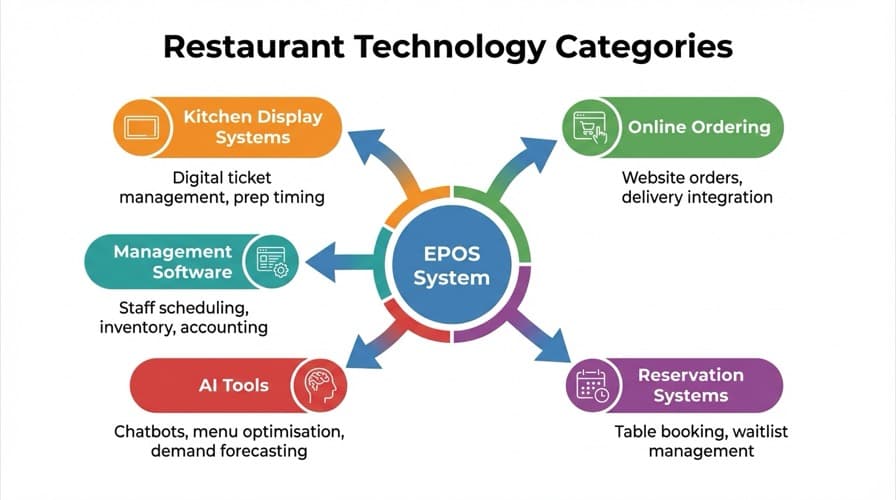
How the six restaurant technology categories connect, with EPOS at the centre
Restaurant Management Software
Now that we've covered the customer-facing and kitchen systems, the final piece is pulling your admin together. Restaurant management software is a framework that handles staff, stock, suppliers, and finances. It ties daily tasks together so you stop juggling spreadsheets and WhatsApp groups.
Core Management Areas
The main types of management software break down into four groups:
- Inventory management: track stock, automate supplier orders, and reduce waste
- Staff scheduling: rota planning, shift swaps, and labour cost tracking
- Accounting integration: sync sales data with platforms like Xero or QuickBooks
- CRM and guest management: customer profiles, visit history, and marketing segments
Most of these tools range from £25 to £150 per month each, depending on features and restaurant size.
For example, a pub group with three sites might use central inventory software to spot that one site always over-orders chicken wings. Fixing that one insight could save hundreds of pounds per month.
Integration Is Everything
The biggest mistake with management software is buying tools that don't talk to each other. Your EPOS should feed data into your inventory tool. That tool should trigger orders. Those orders should sync with your accounts.
Hospitality Tech360 found that a large share of daily spending is wasted through unlinked systems. The message is clear: disconnected technology costs more than no technology at all.
For a deeper look at management platforms, our restaurant management software guide compares leading UK options.
The 30/30/30 Rule for Restaurant Technology Budgets
Now that you know the core categories, here's how to split your budget. The 30/30/30 rule is a framework that divides your restaurant technology budget into three equal portions, with a small buffer:
- 30% customer-facing: EPOS, ordering, payments, reservations. These directly affect guest experience.
- 30% operational: kitchen displays, inventory, scheduling. These cut waste and boost efficiency.
- 30% growth: marketing tools, CRM, loyalty, analytics. These bring customers back.
- 10% buffer: maintenance, training, upgrades, and the unexpected.
What This Looks Like in Practice
UK Hospitality says competitive restaurants typically spend one to three percent of annual revenue on technology. For a site turning over £500,000, that is roughly £400 to £1,250 per month.
For example, a casual dining spot spending £600 per month on tech might split it as:
- Customer-facing: EPOS subscription, reservation platform, and payment processing
- Operational: KDS add-on, inventory tool, and staff scheduling software
- Growth: CRM, email marketing, review management, and analytics
- Buffer: Training sessions, software upgrades, troubleshooting
For most UK independent restaurants, starting with a solid EPOS and one operational tool often offers the best return before expanding into growth-focused systems. When you reach those growth systems, marketing platforms start from budget-friendly monthly plans, compare what each tier includes before you commit.
How to Build Your Restaurant Tech Stack
With that budget framework in place, let's look at how to actually choose and connect tools. Here is how to build your restaurant technology stack without making it too complex.
Step 1: Audit What You Already Have
Before buying anything, write down every tool you use:
- What EPOS or till system do you use?
- How do you take reservations?
- How do you manage stock and suppliers?
- What do you use for staff scheduling?
- Do you have any online ordering channels?
If you're reading this thinking "I don't even know where to start," pick whatever annoys you most during service. That is where technology makes the biggest difference.
Step 2: Pick by Pain Point
Different restaurant types need different starting points:
- Quick-service or takeaway: Start with cloud EPOS plus online ordering. Add KDS and inventory later.
- Casual dining: Start with EPOS plus a reservation system. Add KDS and staff scheduling next.
- Fine dining: Start with EPOS plus CRM for guest profiles. Add reservation management and analytics.
- Multi-site: Start with centralised EPOS and reporting. Add inventory and labour management next.
For example, a casual dining spot losing money to no-shows would get the fastest return from a booking system with auto reminders, not from a fancier EPOS.
Step 3: Check Integration Before Committing
Ask every vendor these three questions:
- Does your system integrate with my current EPOS?
- Can I export my data if I switch providers?
- What does onboarding and training include?
If you're only picking restaurant technology based on features without checking how systems link up you'll always lose to competitors who build connected setups from day one.
For a step-by-step guide, see our restaurant tech stack article. For help with restaurant automation software, we cover the top UK options.
If You Only Have 30 Minutes a Week
Let's be honest: all of the above might sound like a massive project. You don't need to do it all at once. Here is your minimum viable plan:
This week, audit your restaurant technology setup
- Day 1-2: Write down every system you currently use: till, booking platform, ordering apps, spreadsheets, WhatsApp groups. Note what frustrates you most.
- Day 3-4: Research one replacement for your biggest pain point. Check two providers, compare pricing, and read one review each.
- Day 5-7: Book a free demo or trial for your top choice. Most UK providers offer 14-day free trials. Test it during a quiet service.
The reality for most independent restaurants is that restaurant technology adoption happens bit by bit. One new system per quarter works well. That pace avoids chaos, especially when you're already down two staff and running on fumes by closing time.
Weekly Action
- List every tool and system in your restaurant right now
- Pick the one daily task that wastes the most time
- Search for two UK providers that solve that specific problem
- Book a free demo or trial before Friday
If you run a restaurant and want to see how Local Brand Hub can support your marketing, explore our restaurant marketing tools.
Key Takeaway
Key Takeaways
- Restaurant technology covers six core areas: EPOS, kitchen displays, online ordering, reservations, AI, and management software
- Your EPOS system is the foundation: get that right before adding other tools
- The 30/30/30 rule helps balance spending across customer-facing, operational, and growth systems
- Integration matters more than features: disconnected systems waste money and create data gaps
- AI is practical, not futuristic: most UK hospitality businesses are already exploring it
- Start with your biggest pain point, not the shiniest product demo
- One system per quarter is a sustainable adoption pace for independent restaurants
Frequently Asked Questions
How is technology used in restaurants?
Restaurant technology covers six areas: EPOS for orders and payments, kitchen displays for order management, online ordering for delivery and click-and-collect, reservation systems for bookings, AI tools for forecasting and marketing, and management software for scheduling and accounts.
What does Restaurant Technologies do?
Restaurant Technologies (the company) provides automated cooking oil management and hood cleaning for commercial kitchens. The broader term "restaurant technology" refers to all digital systems used to run a restaurant, from POS and kitchen displays to online ordering and AI.
Is there a fully automated restaurant?
Fully automated restaurants exist in parts of Asia and the US. They remain rare in the UK and mostly limited to quick-service concepts. Most UK restaurants benefit more from partial automation, using tech for ordering, payments, and inventory while keeping human service for hospitality.
How much does restaurant technology cost in the UK?
Costs vary based on the systems you choose. A basic cloud EPOS plus online ordering starts at a couple of hundred pounds per month. A comprehensive stack could reach several hundred. UK Hospitality recommends budgeting one to three percent of annual revenue for technology (UK Hospitality, 2025).
What restaurant technology should you invest in first?
A cloud-based EPOS offers the strongest starting point because it connects to nearly every other system. From there, add whatever addresses your biggest pain point: online ordering if you do takeaway, a reservation platform for sit-down service, or a kitchen display if order accuracy is the bottleneck.
For restaurants, salons, and local businesses
Need help with your marketing?
We help UK businesses turn social media into real results, not busywork.
Start freeGet More Marketing Tips
Practical marketing tips for UK business owners, straight to your inbox. No spam, unsubscribe anytime.
About the Author
Local Brand Hub
Empowering UK Businesses
Local Brand Hub provides comprehensive business management tools designed specifically for UK local businesses to streamline operations, automate marketing, and grow revenue.
More articlesRelated Articles
 Industry Insights
All-in-One Restaurant Software: UK Comparison
Compare all-in-one restaurant software for UK venues. See top platforms, UK pricing, and what to look for when choosing an integrated system.
 Industry Insights
Cloud Restaurant Management Software: Complete UK Guide
Cloud restaurant management software accounts for 60% of the market. Cut costs and streamline UK restaurant operations with our complete guide.
 Industry Insights
Restaurant Kitchen Display System: UK Buyer's Guide
72% of venues use POS-to-KDS systems. Compare UK kitchen display system pricing from £300 and cut order errors by 40%. Full buyer's guide.