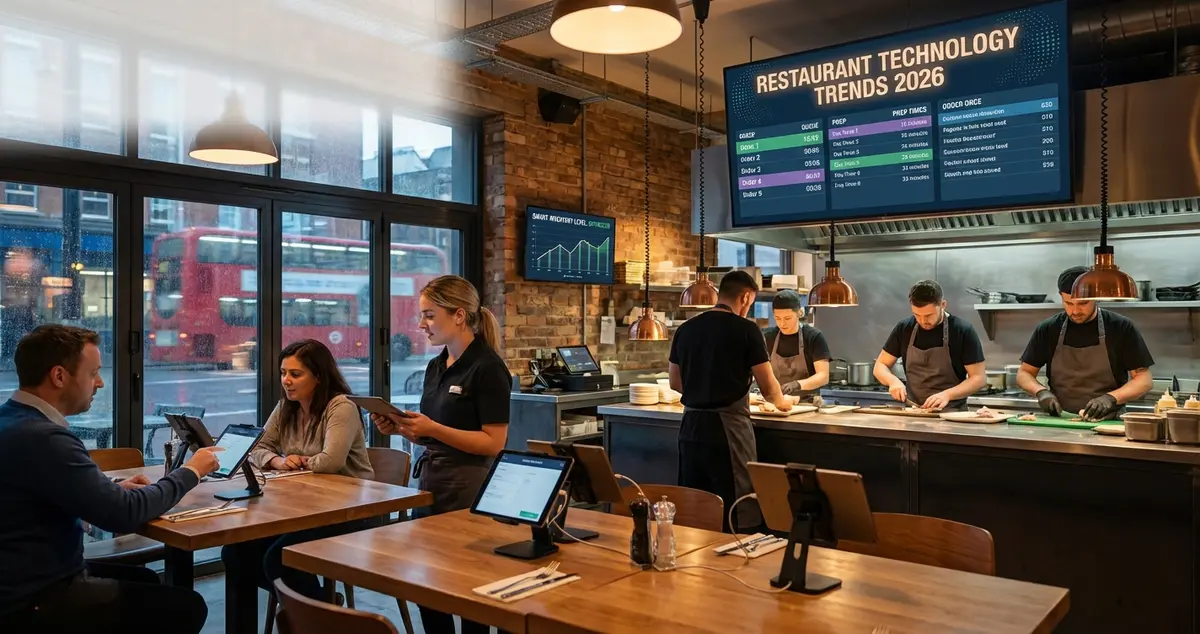
7 restaurant technology trends for 2026: AI ordering, smart kitchens, unified POS. Learn which tech investments deliver real ROI for UK venues.
Your card machine is three years old. Your booking system is a paper diary. Meanwhile, the chain down the road has AI answering their phones and tablets on every table. You know you should upgrade. You just don't know where to start. Restaurant technology trends are moving faster than most independent operators can track.
The good news? You don't need to adopt every restaurant technology trend: 85% of UK restaurant leaders are planning new technology investments in 2026, but ignoring the right investments could cost you customers, staff time, and money you cannot afford to lose.
In this guide, you will learn:
- Which restaurant industry technology trends are actually worth your investment
- How AI and automation are helping UK restaurants cut costs by 15%
- The specific technologies driving 20% sales increases for early adopters
- What you can realistically implement without a massive budget
The State of Restaurant Technology Trends in 2026
First, let's look at where UK restaurant technology stands today. The restaurant industry has changed more in the past five years than in the previous twenty. UK restaurants saw restaurant technology shift from optional upgrade to essential infrastructure, driven by staff shortages and rising costs.
That investment is paying off. Restaurants using integrated automation have seen labour costs drop by 15% while monthly sales rise 20%, according to Hospitality Tech360. Government support schemes have also made restaurant technology adoption more accessible for small businesses, with the GOV.UK business support finder listing current grants and funding options.
If you're thinking "that's great for the big chains, but I'm running a 40-cover restaurant with three staff," you're not alone. The key is understanding which restaurant trends and restaurant technology trends actually apply to independent operators and which are enterprise-only solutions dressed up as accessible tools.
Info
Related: Future of Restaurants
1. AI-Powered Operations: The Biggest Restaurant Technology Trend
So where should you start? For most operators, AI offers the biggest leap in efficiency and represents the defining restaurant technology trend of 2026.
Artificial intelligence crossed a threshold this year. It's no longer experimental technology for Silicon Valley restaurants. According to SevenRooms research cited by UKHospitality, 74% of UK operators use AI in some capacity, with nearly all reporting clear benefits.
What AI Actually Does for Restaurants
Why this matters
AI isn't just about efficiency. It's about capturing revenue you're losing right this moment to missed calls, food waste, and scheduling mismatches.
Voice AI for Phone Orders: With skeleton crews, restaurants miss a significant portion of inbound calls. That's lost revenue walking out the door. Voice AI captures those orders while understaffed teams focus on the dining room, according to Modern Restaurant Management.
Demand Forecasting: AI algorithms analyse historical sales, weather patterns, and local events to predict demand. Restaurants using these systems report significantly less food waste and lower labour costs through optimised scheduling, according to Restolabs.
Menu Personalisation: AI-driven systems suggest menu items based on customer preferences and ordering history. This isn't just for apps. Smart POS systems offer this at the table level.
The Reality Check
AI tools require good data to work properly. If you're only tracking sales at month end, you'll always struggle to get value from AI forecasting tools. Start with consistent digital ordering and a proper POS system that tracks customer preferences and sales patterns in real time first.
2. Unified POS Systems: A Critical Restaurant Technology Trend
Once you have got AI handling customer interactions, you will want all that data flowing into one system. This unification is among the most practical restaurant technology trends for independent operators.
After years of piecing together separate solutions for ordering, kitchen displays, and inventory, 2026 marks the shift toward unified restaurant technology ecosystems. Half of restaurant executives say centralised, real-time data is critical for improving performance, according to Modern Restaurant Management.
What Unified Systems Actually Mean
Your POS no longer just processes payments. 2026 systems integrate:
| Function | Traditional Approach | Unified Approach |
|---|---|---|
| Orders | Paper tickets to kitchen | Direct to kitchen display |
| Inventory | Manual counts weekly | Real-time stock tracking |
| Staff scheduling | Spreadsheets | AI-optimised rotas |
| Customer data | Separate loyalty app | Integrated profiles |
| Reporting | End-of-week spreadsheets | Live dashboards |
Cost Consideration
Entry-level integrated systems like Square start around £69 per year. More comprehensive options like Lightspeed run higher but include features that previously required multiple subscriptions.
For example, a café in Manchester using three separate systems for ordering, inventory, and loyalty might spend £150 monthly across subscriptions. A unified system at £120 monthly reduces admin time by hours each week while giving better data. Before you commit to anything, it is worth taking a few minutes to work out how much time and money the right tools could save you.
If you're only tracking sales at month end you'll always lose to competitors who have real-time data informing their decisions daily.
3. Self-Service Kiosks: Restaurant Technology Goes Customer-Facing
Additionally, with your systems unified, the next question becomes how customers interact with them. Self-service kiosks represent one of the most visible restaurant technology trends.
Self-service kiosks have moved beyond McDonald's and into independent restaurants. The technology has become affordable enough for smaller operators to consider.
Research shows implementing self-service kiosks leads to higher average order values, according to Restroworks. Customers spend more when they don't feel rushed and can explore the full menu.
Know Your Customers
Younger consumers are significantly more likely to return to restaurants using automation, according to The Food Institute. If your customer base skews under 40, kiosks aren't just efficient. They're expected.
However, if you are running a 12-hour shift with personal service as your differentiator, a kiosk might undermine your brand. This relates to restaurant design trends as much as technology. Consider your customer journey before the ROI spreadsheet.
If you can't tell whether a kiosk would help or hurt your customer experience, that's usually a sign you need to observe your current ordering flow more closely first.
4. QR Code Ordering: The Most Accessible Restaurant Technology Trend
However, not ready for kiosks? QR ordering offers many of the same benefits at a fraction of the cost.
QR menus started as a pandemic safety measure. They have evolved into something more powerful. According to UKHospitality, roughly 72% of UK restaurants offer QR ordering and payment systems.
Modern QR systems offer:
- Dynamic menus (update items and prices instantly without reprinting)
- Integrated payments
- Customer data collection for personalised marketing
- Allergen filtering so customers can filter by dietary requirements
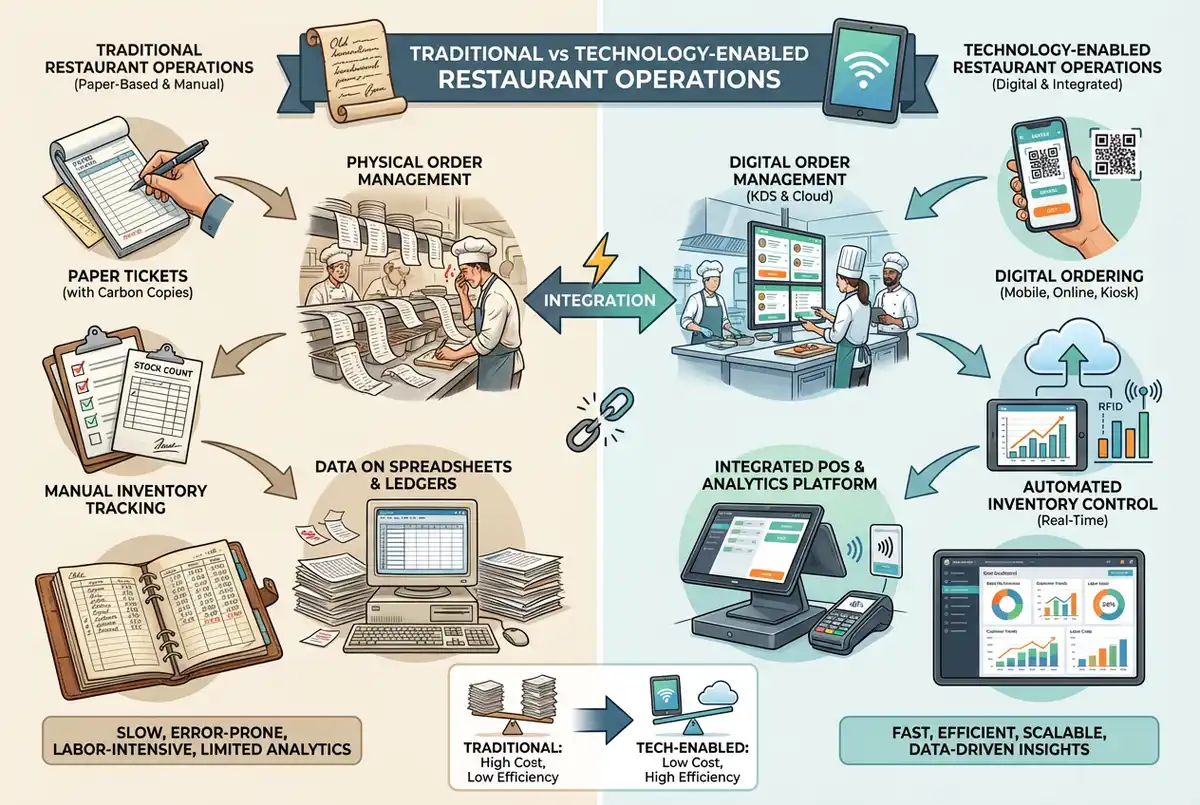
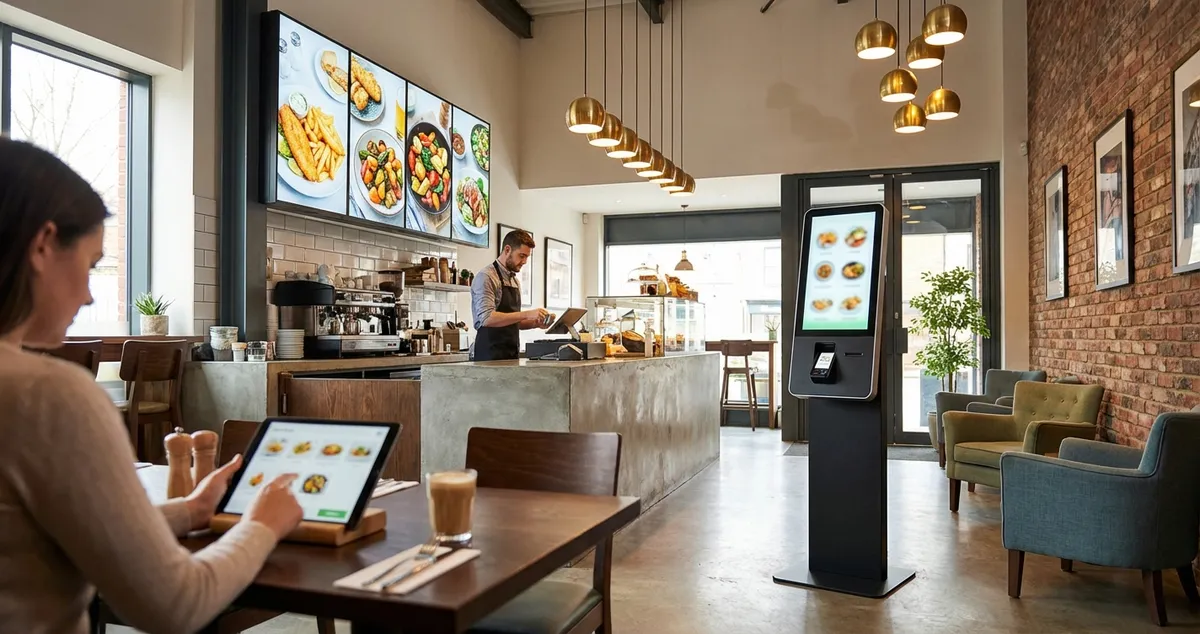
How technology transforms restaurant operations from ordering to payment
Keep physical menus available. Some customers, particularly older demographics, still prefer paper. Offering both creates flexibility without alienating anyone.
For instance, a bistro in Bristol might use QR codes at the bar for quick drinks orders while keeping printed menus for the dining room. Different touchpoints, same system.
5. Kitchen Display Systems: The Paper Ticket is Dead
When it comes to operations, customer-facing tech only helps if your kitchen can keep up. Here's where display systems come in.
Kitchen display systems replace paper order tickets with digital screens. It sounds simple, but the impact is significant. Orders are automatically arranged and ranked by preparation time, reducing errors and coordinating multi-course meals. No more misreading handwriting or misplacing tickets during the Saturday rush.
KDS systems in 2026 integrate with:
- POS for automatic order transmission
- Inventory management for real-time stock alerts
- Delivery apps for consolidated order flow
- Staff scheduling for kitchen workload balancing
Entry-level options start around £15 per month per device. For a two-screen kitchen setup, that's a modest monthly cost to eliminate paper tickets and reduce order errors.
Info
Related: Restaurant Trends 2025
Info
Related: Restaurant Design Trends
6. Dark Kitchens and Delivery Technology
Moving beyond your dine-in operations, delivery technology opens entirely new revenue streams.
The UK food delivery market has nearly doubled in value over the past five years, worth over £14 billion according to Dephna market analysis. Over 750 dark kitchens operate in the UK.
Running multiple brands from one kitchen reduces costs while reaching different customer segments. Deliveroo Editions facilities house dozens of virtual brands under one roof.
For existing restaurants: Adding a virtual brand means extra revenue from your existing kitchen during slow periods. A gastropub running a virtual fried chicken brand for delivery doesn't cannibalise dine-in customers. It captures a completely different market.
If you're handling delivery, integrated systems matter more than ever. Managing orders across multiple delivery apps without a unified dashboard creates chaos during peak hours. Solutions like Deliverect consolidate orders from Uber Eats, Deliveroo, and Just Eat into a single interface.
7. Inventory and Waste Management: Restaurant Technology for Margins
Finally, all these front-of-house improvements mean nothing if food costs eat your margins. Inventory technology is a quieter restaurant technology trend, but potentially the most profitable.
Food waste costs money. Smart inventory systems are finally making waste reduction practical for independent operators. Restaurants using analytics platforms report 15% lower food costs and improved forecast accuracy, according to Restolabs.
Where to start: You don't need smart refrigerators. Begin with:
- Digital inventory tracking (replace clipboard counts with tablet-based systems)
- Waste logging
- Par level automation with automatic reorder alerts
- Recipe costing integration
The technology is becoming accessible to independent restaurants through cloud-based subscription models.
What to Implement First: A Practical Priority List
Now that you have seen what is available, where do you actually start? Let's look at a practical approach.
If you are reading this thinking "I don't have time for this" after a 12-hour shift, you are not alone. Here is a realistic starting point.
If you only have 30 minutes this week
- Day 1-2: Audit your current tech stack. What are you paying for separately that could be unified?
- Day 3-4: Get quotes for integrated POS systems. Compare against your current costs
- Day 5-7: Test one QR code menu solution on a few tables. Monitor customer reactions
For example, a fish and chip shop in Leeds spent three months researching options before choosing Square. Within two weeks, they had consolidated four separate systems into one.
High-impact, lower-cost investments:
- Unified POS system
- QR ordering with integrated payments (often included with POS)
- Kitchen display system
- Digital inventory tracking
Higher investment, proven returns:
- Self-service kiosks
- AI demand forecasting
- Multi-platform delivery integration
For UK restaurants
Need help staying visible while you implement these changes?
LocalBrandHub automates your restaurant's marketing, keeping your social presence consistent while you focus on operations.
Try it freeKey Takeaways: Restaurant Technology Trends for UK Operators
If you run a restaurant and want to see how Local Brand Hub can support your marketing, explore our restaurant marketing tools.
Key Takeaways: Restaurant Technology Trends for UK Operators
In summary, restaurant technology trends in 2026 aren't about chasing every innovation. They're about choosing investments that solve real problems for your specific operation.
The evidence is clear: restaurants using integrated technology are seeing measurable improvements in labour costs, sales, and food waste. These aren't theoretical benefits for enterprise chains. They're achievable results for operators who invest strategically.
Start with the fundamentals. A unified POS system that connects your ordering, kitchen, and payments eliminates friction you might not realise exists. Add QR ordering and a kitchen display system. These relatively affordable changes create the data foundation for more advanced AI tools later.
Know what you're solving for. If staff shortages are your biggest pain point, prioritise self-service options and AI phone ordering. If food costs are eating your margins, start with inventory management technology. If you're missing customers because you can't answer every call, voice AI pays for itself quickly.
Ask yourself: would your restaurant run more smoothly with better technology, or do you have a people problem that no software can fix?
The competitive divide will widen between restaurants that use restaurant technology to protect their margins and those tethered to manual inefficiencies. The question isn't whether to invest in restaurant technology trends. It's which investments make sense for where you are and where you want to be.
Weekly Action
Take action on restaurant technology trends this week:
- Audit your current tech stack. List every system you pay for separately: POS, booking, delivery apps, accounting. Calculate the total monthly cost.
- Request one demo. Contact Square, Lightspeed, or your current POS provider about unified options. Compare features against your current setup.
- Test QR ordering. Print five QR codes linking to your online menu. Place them on tables during one service and note customer reactions.
These three actions take under two hours combined and give you the information needed to make an informed technology investment decision.
Last updated: February 2026
Get More Marketing Tips
Practical marketing tips for UK business owners, straight to your inbox. No spam, unsubscribe anytime.
About the Author
Local Brand Hub
Empowering UK Businesses
Local Brand Hub provides comprehensive business management tools designed specifically for UK local businesses to streamline operations, automate marketing, and grow revenue.
More articlesRelated Articles
 Marketing Tips
Digital Menu Boards for Restaurants: UK Costs and Guide
Compare digital menu board costs from £499-£7,000, see 38% sales uplift stats, and learn setup requirements. UK pricing and supplier guide for restaurants.
 Marketing Tips
Digital Menu Screens: A Practical Guide for UK Restaurants
Learn how digital menu screens can boost UK restaurant sales by 3-10%. Get realistic costs from £2,000, ROI timelines, and honest UK supplier advice.
 Marketing Tips
Digital Menu Technology: Guide for UK Restaurants
Digital menu technology boosts sales by 3-9% for UK restaurants. Compare QR codes, digital boards, screens and kiosks with costs and ROI.