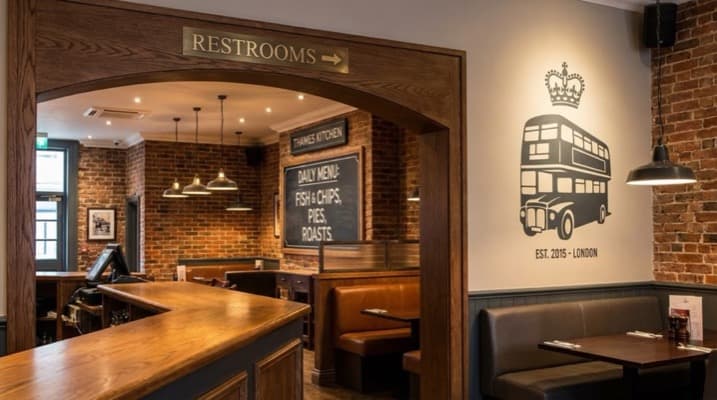
Plan your restaurant interior signage strategy. Compare menu boards, wayfinding signs, hygiene displays and upselling signage with UK costs and rules.
If you're a UK restaurant owner planning your interior signs, restaurant interior signage covers five key categories: menu boards, wayfinding signs, compliance displays, promotional upselling signs and branded decor. Together these categories guide customers through your venue, meet UK legal requirements and help increase average spend per visit.
What You'll Learn:
- The five categories of restaurant interior signage and what each achieves
- UK legal requirements for hygiene, allergen and safety displays
- Menu board options with realistic cost comparisons
- How wayfinding signs improve customer flow
- Upselling signage techniques that increase average spend per head
- A decision framework for choosing the right signs for your venue
If you're a UK restaurant owner who has invested in great food and welcoming staff, your customers found you. They walked through the door. And then they stand there, slightly lost, unsure where to queue, where to sit, or where the toilets are. Restaurant interior signage is the invisible infrastructure that turns a confusing dining experience into a smooth one. Get it right and customers typically order more, stay longer and come back.
Info
Related: Restaurant Signage Marketing, our complete hub guide covering all signage strategy for UK restaurants
This guide covers every type of restaurant interior signage, from legally required hygiene displays to upselling signs that often pay for themselves within a week. Whether you run a 20-cover bistro or a 200-seat family restaurant, you will find practical ideas with realistic UK costs.
Types of Interior Restaurant Signs
First, restaurant interior signage breaks down into five categories. Each serves a distinct purpose, and the strongest venues tend to cover all five.
1. Menu Boards and Displays
Your menu board is a key piece of restaurant interior signage. It communicates your offer, your prices and your brand personality. Options range from a handwritten chalkboard to digital screens that rotate content automatically. Traditional boards remain effective for sit-down restaurants, while digital options suit fast-paced venues.
2. Wayfinding and Directional Signs
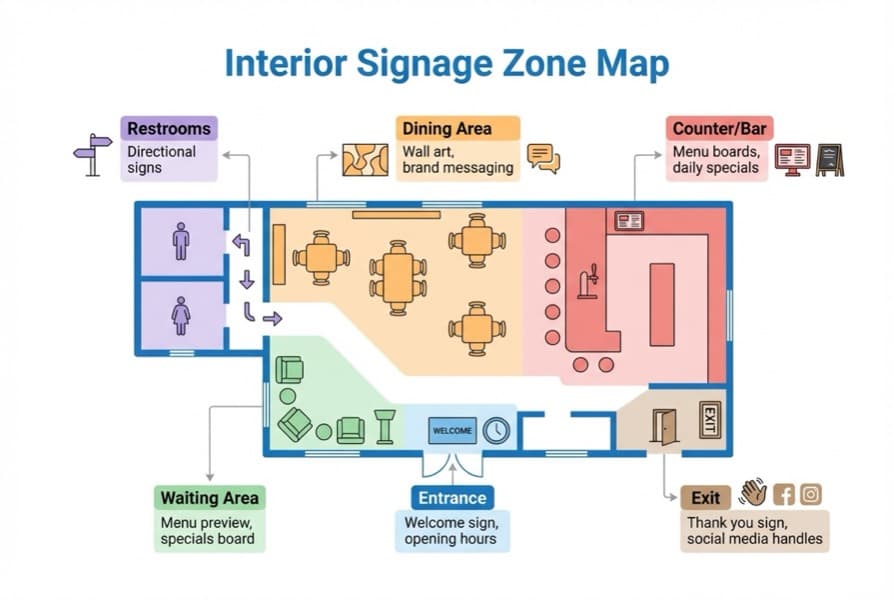
Wayfinding signs guide customers through your space: entrance, seating areas, toilets, exit, accessible routes and outdoor seating. Good restaurant interior signage for wayfinding removes hesitation. Customers should not need to ask "where are the toilets?" or "do we seat ourselves?"
3. Hygiene and Compliance Displays
UK restaurants are legally required to display certain signs, including food hygiene ratings, allergen information and fire safety notices. These are not optional. They are regulatory requirements that also build customer trust when displayed clearly.
4. Promotional and Upselling Signs
Specials boards, dessert displays, drinks menus and loyalty programme signs encourage customers to spend more per visit. Placing promotional restaurant interior signage in the right spots can directly lift order values.
5. Decorative and Branded Signs
Branded wall art, murals, neon name signs and framed prints create mood and reinforce your identity. These signs do not sell directly, but they shape how customers feel about your venue. For example, a coastal fish restaurant might hang vintage harbour photography alongside rope-and-timber signage, reinforcing the seaside theme without a word of selling copy.
Info
Related: Restaurant Customer Service, how signage supports the overall customer experience
Quick Signage Audit
Walk through your restaurant as a first-time customer and count how many of these five categories you actually cover. If you can only tick two, the gaps represent your biggest quick wins.
UK Legal Requirements for Restaurant Interior Signs
Building on those five categories, here are the legal essentials you must have in place. Non-compliance can result in fines, poor hygiene ratings, or worse.
Food Hygiene Rating Display
In Wales and Northern Ireland, displaying your Food Hygiene Rating Scheme (FHRS) sticker is a legal requirement. In England, it is voluntary but strongly encouraged. The Food Standards Agency provides the sticker after inspection. Display it prominently at your entrance.
Allergen Information (Natasha's Law)
Under Natasha's Law, UK food businesses must provide full ingredient and allergen labelling for pre-packed for direct sale (PPDS) food. For other food, you must tell customers about the 14 major allergens. You can do this through restaurant interior signage, menu labels, or verbal communication with a written backup.
A clear allergen notice board near the counter or at each table is the easiest way to comply. Include the statement: "Please speak to a member of staff about the ingredients in your food if you have a food allergy or intolerance."
Fire Safety Signage
UK fire safety rules require all venues to display:
- Fire exit signs (illuminated or photoluminescent)
- Fire action notices near each fire alarm call point
- Fire extinguisher location signs
- Assembly point signage (if applicable)
These must meet BS 5499 Safety Signs standards. Green and white exit signs are the UK norm.
No Smoking Signs
UK smoke-free laws require all enclosed public spaces to show no-smoking signs. Scotland, Wales and Northern Ireland have similar rules for restaurant interior signage.
Accessibility
The Equality Act requires fair adjustments for disabled customers. While specific signage rules are not set, clear wayfinding for wheelchair users, visual cues for hearing-impaired customers, and accessible toilet signs are good practice. They also reduce your risk of discrimination claims. For example, a restaurant with a mezzanine level might add a clear "Step-free access via rear entrance" sign to prevent wheelchair users from having to ask.
Menu Board Options and Costs
With the legal essentials covered, let's look at the centrepiece of your restaurant interior signage: the menu board.
Restaurant interior signage menu board comparison
| Menu Board Type | Budget Tier | Update Speed | Suits | Lifespan |
|---|---|---|---|---|
| Chalkboard | Low | Minutes (manual) | Pubs, cafes, bistros | Several years |
| Printed poster frame | Low-Mid | Hours (reprint needed) | Fast casual, takeaways | Frame: many years |
| Magnetic letter board | Low-Mid | Minutes (manual) | Cafes, delis | Many years |
| Backlit lightbox | Mid | Hours (reprint insert) | Takeaways, QSRs | Long-lasting |
| Digital screen | Mid-High | Instant (remote) | QSRs, fast casual, chains | Several years |
| LED backlit menu panel | Mid | Hours (reprint insert) | Restaurants, bars | Long-lasting |
If customers regularly ask "what's on the specials?" when a board is right behind them, that's usually a sign your menu board placement needs rethinking.
Which Should You Choose?
- If your menu changes often (soups, specials, market-fresh dishes): chalkboard or digital screen
- If your menu is mostly fixed with occasional changes: printed poster frame or backlit lightbox
- If you have multiple locations or want remote updates: digital screen
- If atmosphere matters most: chalkboard for rustic warmth, LED panels for clean lines
Digital menu boards can lift sales through smart visual displays. But a well-kept chalkboard in the right setting has its own charm and costs far less. The right restaurant interior signage depends on your venue type, not on trends.
Wayfinding and Customer Flow
Moreover, restaurant wayfinding is the category many independent restaurants overlook completely. The wayfinding framework is a system that guides customers from entrance to exit without confusion. Without it, customers hesitate, interrupt staff with basic questions, and leave feeling slightly awkward about the experience.
Essential Wayfinding Signs
| Sign | Purpose | Placement |
|---|---|---|
| "Please wait to be seated" | Manages expectations | Inside entrance |
| Toilet directional | Prevents the most common question | Visible from seating area |
| Accessible toilet | Legal and inclusive | On/near accessible facilities |
| Outdoor seating this way | Guides to garden/terrace | Near entrance or bar |
| Exit signs | Fire safety (legally required) | Above all exits |
| Collection point | Separates takeaway from dine-in | Near counter |
| Table numbers | Order delivery efficiency | On each table |
For example, a two-storey pub might place a clear "Dining upstairs, bar food ground floor" sign at the entrance, eliminating the confusion that otherwise sends diners wandering between floors.
Designing Effective Wayfinding
If you're only using generic plastic signs from a wholesaler you'll always lose to competitors who brand their restaurant interior signage to match their decor. Custom-branded directional signs are not costly, and they show attention to detail.
Three principles for effective restaurant wayfinding:
- Visibility: Signs must be readable from where the customer stands when they need the information, not from where the sign fits conveniently
- Consistency: All wayfinding signs should use the same colours, fonts and style
- Simplicity: An arrow and one or two words. Wayfinding is not the place for creativity
When did you last walk through your own restaurant and try to find the toilets using only the signs?
Info
Related: Menu Design Principles, designing menus that complement your signage strategy
Using Interior Signs to Increase Spend
This is where restaurant interior signage stops being a cost and starts being an investment. Signs that encourage upselling often pay for themselves quickly. Decide which dishes and offers to spotlight by keeping your menu and promotions in one organised place, then build your signage around your best margins.
Specials Boards
A specials board positioned where customers can see it while deciding their order is one of the simplest upselling tools. Place it:
- Near the entrance (catch them while they are browsing)
- Behind the bar (visible during drinks ordering)
- On the wall opposite popular tables (constant exposure)
For instance, a gastropub might write: "Tonight's special: 28-day aged ribeye with triple-cooked chips and peppercorn sauce." That concrete description does more than a generic "Ask about specials" sign.
Dessert and Drinks Prompts
Table-top tent cards or counter displays featuring your highest-margin items can increase add-on orders. Focus on:
- Desserts: "Save room for our homemade sticky toffee pudding"
- Cocktails or wines by the glass: "Try our Aperol Spritz, the perfect start"
- Coffee and after-dinner drinks: "Finish with a flat white from our single-origin beans"
The key is specificity. Name the dish, describe it briefly, and let the customer imagine it.
Digital Promotional Displays
If you have invested in a digital screen, use it for more than just your static menu. Rotate between:
- Specials with food photography
- Customer review quotes
- Event announcements (quiz night, live music)
- Social media handles and QR codes
Loyalty Programme Visibility
A clearly visible loyalty sign at the till point encourages sign-ups and repeat visits. Keep the message simple and the sign permanent. "Collect stamps for a free bottle of wine" works because the value is immediately obvious.
The question isn't "do customers read signs?" It's "are your signs saying anything worth acting on?"
Small Restaurant Interior Signage
Furthermore, small restaurants face a unique challenge: limited wall and counter space. Each piece of restaurant interior signage needs to earn its place.
Prioritise these five signs for venues under 40 covers:
- Menu board: One well-placed board beats three competing signs
- Allergen notice: Legal requirement, non-negotiable
- Toilet directional: The question you want to eliminate
- One specials/upselling sign: Positioned at eye level from the most popular table
- Fire exit signs: Legal requirement
For small restaurants, consider dual-purpose signs. A chalkboard that shows the menu on one side and specials on the other. A toilet sign with your branding. An allergen notice that doubles as a brand trust signal with your logo and a personal message from the chef. For example, a 25-cover Thai restaurant might combine its allergen notice with a branded card reading "Our chef uses fresh ingredients, please tell us about any allergies" in a style that matches the rest of its restaurant interior signage.
If you're thinking "I don't want signs everywhere making it look cluttered," that instinct is right. Five well-designed, consistently branded signs typically outperform fifteen mismatched ones. If you're only treating interior signs as an afterthought you'll always lose to competitors who treat them as part of the customer experience.
Weekly Action Plan
Additionally, here is a structured plan to get your restaurant interior signage working harder this week.
If you only have 30 minutes a week, do this:
- Day 1-2: Walk through your restaurant as a first-time customer. Can you find the toilets without asking? Do you know the specials before being told? Note every moment of confusion
- Day 3-4: Check your legally required signs. Do you have allergen information, fire exit signs, and no-smoking signs? Are they visible and in good condition?
- Day 5-7: Choose one upselling sign to add: a specials board, a dessert tent card, or a loyalty programme sign. Start with whatever has the highest margin impact
Restaurant Interior Signage Checklist
- Allergen information displayed clearly (legal requirement)
- Fire exit signs illuminated and visible (legal requirement)
- No-smoking signs in place (legal requirement)
- Menu board positioned where customers look when ordering
- Toilet directional sign visible from the main seating area
- At least one upselling sign at a decision point (bar, table, till)
- All signs use consistent brand colours and fonts
- Hygiene rating sticker displayed at entrance (required in Wales/NI)
If you run a restaurant and want to see how Local Brand Hub can support your marketing, explore our restaurant marketing tools.
Key Takeaway
Key Takeaway
Restaurant interior signage isn't about decoration. It's about making every moment between the door and the table work in your favour.
- Restaurant interior signage covers five categories: menu boards, wayfinding, compliance, promotional and decorative. Many venues only cover two or three
- UK legal requirements include allergen information, fire safety signs and no-smoking notices. Non-compliance risks fines and poor ratings
- Menu board choice depends on your restaurant type: chalkboards for changing menus, digital screens for remote updates and upselling
- Branded wayfinding signs eliminate the most common customer questions and signal attention to detail
- Upselling signs positioned at decision points can measurably increase average spend
- If you're thinking "interior signage is a low priority," consider that every confusing moment a customer experiences is a moment they are not enjoying your food
Frequently Asked Questions
What interior signs are legally required in UK restaurants?
UK restaurants must display fire exit signs (illuminated or photoluminescent), fire action notices, no-smoking signs, and allergen information. In Wales and Northern Ireland, food hygiene rating stickers must be displayed prominently. England encourages but does not mandate hygiene rating display. For example, a cafe in Cardiff would need the hygiene rating sticker on display, while the same cafe in Manchester could choose whether to show it.
How do I choose the right restaurant menu board?
Your menu board choice depends on how frequently your offerings change and what atmosphere you want to create. Chalkboards suit venues with rotating specials. Digital screens suit multi-location chains needing remote updates. Printed poster frames suit fixed menus. For most independent restaurants, a quality chalkboard often offers the strongest balance of flexibility, cost and personality.
What is restaurant wayfinding signage?
The restaurant wayfinding signage system is a framework that uses directional signs to help customers navigate your space. This covers toilet directions, entrance and exit markers, collection point indicators, outdoor seating directions, table numbers and accessible route signs. Effective restaurant interior signage for wayfinding reduces customer confusion and frees staff from answering repetitive questions.
Do digital menu boards increase restaurant sales?
Signage industry data suggests digital menu boards can boost sales, mainly through visual displays and rotating content by time of day. The best setups combine food photos, smart item placement and content that changes to push the right dishes at the right time.
How can restaurant interior signage help with upselling?
Restaurant interior signage lifts average spend through specials boards at order points, table-top tent cards pushing high-margin desserts and drinks, digital screens showing deals, and loyalty signs that bring people back. For instance, a burger restaurant might place a counter sign reading "Add loaded fries for just a small extra" and see add-on orders rise noticeably. The key is placing persuasive signs where customers are actively deciding what to order.
For restaurants, salons, and local businesses
Need help with your marketing?
We help UK businesses turn social media into real results, not busywork.
Start freeGet More Marketing Tips
Practical marketing tips for UK business owners, straight to your inbox. No spam, unsubscribe anytime.
About the Author
Local Brand Hub
Empowering UK Businesses
Local Brand Hub provides comprehensive business management tools designed specifically for UK local businesses to streamline operations, automate marketing, and grow revenue.
More articlesRelated Articles
 Marketing Tips
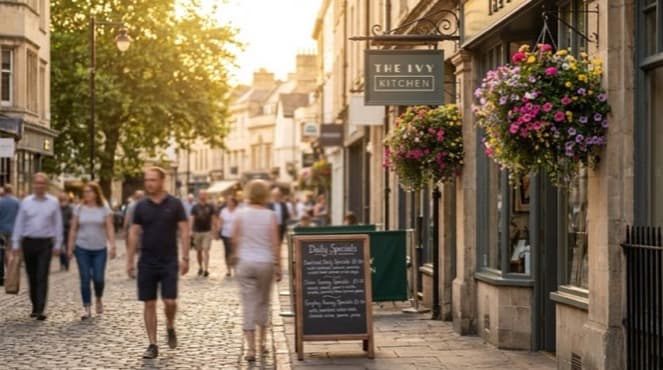
Restaurant Outdoor Signage: A-Boards & More
Choose the right restaurant outdoor signage for your UK venue. Compare A-boards, projecting signs, fascia options, costs and planning permission rules.
 Marketing Tips
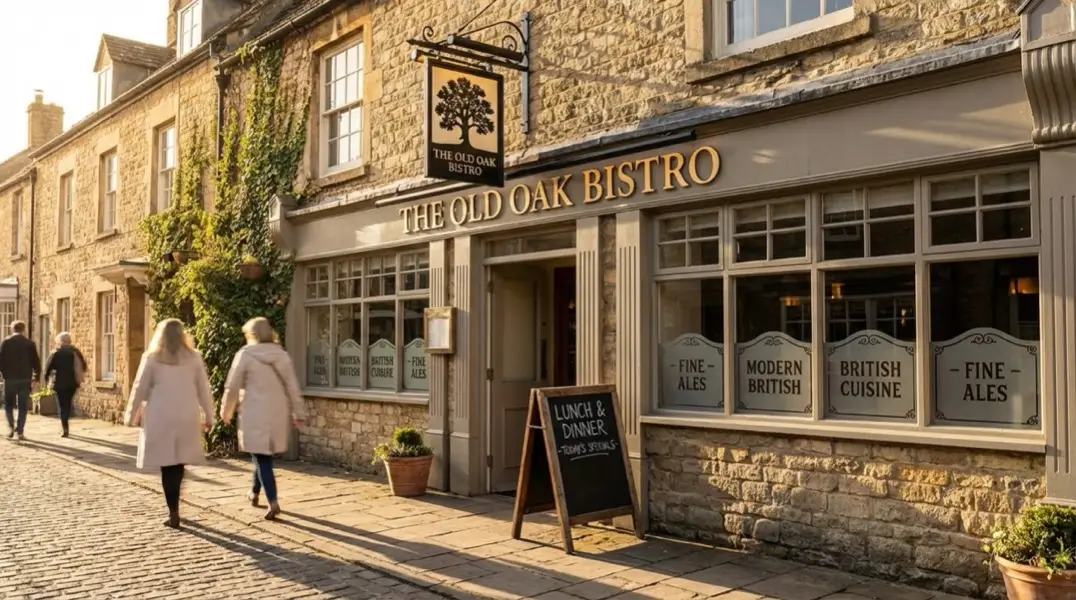
Restaurant Signage: Types, Costs and UK Regulations
Complete guide to restaurant signage for UK owners. Covers fascia signs, A-boards, LED lighting, menu boards, costs, materials and planning regulations.
 Marketing Tips
Restaurant Decor Christmas Guide: Look Good, Stay Safe
Restaurant decor Christmas planning for UK venues. Pick two or three anchor points, shoot the photos early, and keep every escape route clear.