
Watch the visual overview· 81 seconds
Master restaurant customer service with proven frameworks. Learn the 7 steps of service and strategies that turn diners into regulars.
Restaurant customer service is the combination of every guest interaction in your venue (from the first greeting to the final farewell, including seating, ordering, serving, and problem-solving) that determines whether someone becomes a loyal regular. Many customers leave businesses because of perceived indifference, not price, not food quality. What separates restaurants that thrive from those that struggle? Often, it's how your staff make guests feel.
Short on time? Here's the quick version
- 7 steps of service: Greeting, beverages, ordering, food delivery, table maintenance, dessert/payment, farewell
- 5 pillars of quality: Order accuracy, staff courtesy, timeliness, problem resolution, cleanliness
- Many leave due to indifference: Not price or food quality, perceived lack of care
- 79% return after resolved complaints: Recovery excellence matters more than perfection
- Key investment: Monthly team meetings + service standards = meaningful improvement for under £500/year
Full guide with frameworks and implementation strategies below
A three-year regular walks in. Your new server treats them like any walk-in. No greeting by name, no acknowledgment of their usual table. They smile politely, finish their meal, and never return. Sound familiar?
Here's the uncomfortable truth: many customers leave businesses not because of price or product, but because of perceived indifference. For restaurants, where competition is fierce and margins are thin, mastering customer service isn't optional. It's survival.
Related: Restaurant Customer Service Training - complete guide for staff development
What You'll Learn
- The 7 steps of service that define professional restaurant operations
- Five qualities that separate good service from memorable experiences
- How to handle complaints so 79% of unhappy guests still return
- Practical frameworks you can implement this week
- Why customer service training pays for itself
Let's start with the fundamentals before moving to actionable frameworks.
What Is Customer Service at a Restaurant?
First, let's define it clearly. The term restaurant customer service is a framework that encompasses every touchpoint where staff interact with guests: from greeting and seating through ordering, serving, problem-solving, and farewells. It combines attentiveness, product knowledge, efficiency, and genuine warmth to shape each diner's complete experience.
For example, a family restaurant might focus restaurant customer service efforts on child-friendly interactions: colouring sheets ready at seating, smaller portions offered without asking, and patient explanations of menu items. A business lunch venue might prioritise speed and discretion instead.
Unlike retail, restaurant service happens in real-time with no opportunity for returns or exchanges. A cold steak can be replaced; a rude interaction cannot be unfelt. This immediacy makes restaurant customer service uniquely challenging, and uniquely important.
Warning
Most unhappy customers never complain directly. They simply leave, tell friends about their experience, and choose your competitor next time.
The restaurants that thrive understand that improving customer service isn't a one-time training session. It's an ongoing commitment woven into daily operations.
Now that we've defined the concept, let's look at the structured framework most hospitality professionals use.
What Are the 7 Steps of Service in a Restaurant?
Now that we understand what it means, here's the core framework. The 7 steps of service is a structured framework used in hospitality to ensure consistent, professional guest experiences from arrival to departure. Each step builds on the previous one, creating a seamless dining journey.
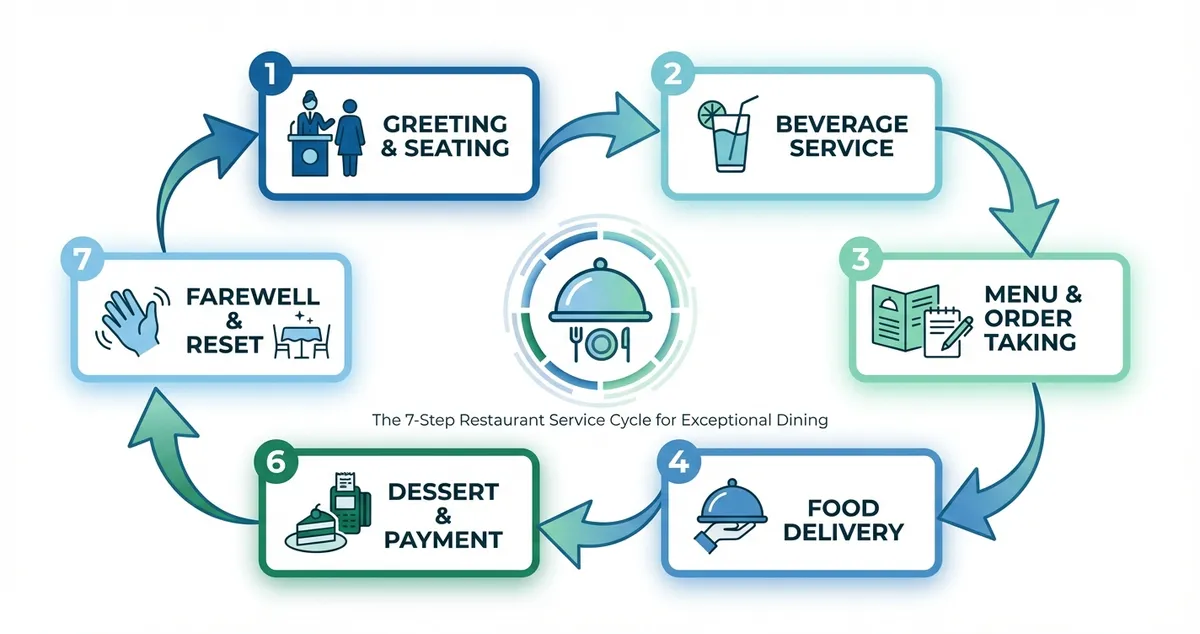
The 7 Steps of Service Framework:
Greeting and Seating: Acknowledge guests within 30 seconds of arrival. Make eye contact, smile, and guide them to their table.
Beverage Service: Take drink orders within 2 minutes of seating. Suggest specific options rather than asking "what would you like?"
Menu Presentation and Order Taking: Explain specials confidently, answer questions about ingredients, and use proper seat position numbering.
Food Delivery: Serve from the left, clear from the right. Announce dishes as you place them. Check back within two bites.
Table Maintenance: Refill drinks proactively, clear empty plates, and maintain visual contact throughout the meal.
Dessert and Payment: Offer dessert and coffee genuinely (not as an afterthought). Process payment promptly without making guests wait.
Farewell and Reset: Thank guests by name if possible, invite them to return, and reset the table for the next service.
For example, a gastropub implementing this framework might station a host specifically for Step 1, ensuring no guest waits more than 30 seconds for acknowledgment, even during busy Saturday evenings. A fine dining restaurant might assign one server to Steps 5-6 exclusively during peak hours, ensuring no table goes unchecked for more than three minutes.
Info
If you're only training new staff on food delivery, you'll lose to competitors who drill all seven steps consistently.
For detailed implementation guidance, see our restaurant customer service standards guide.
With the process framework covered, let's examine what quality actually looks like from the guest's perspective.
What Are the 5 Good Customer Services?
With that process framework in place, let's examine quality from the guest's viewpoint. The five pillars of good restaurant customer service represent the qualities guests consistently rate highest when evaluating their dining experiences.
According to the American Customer Satisfaction Index (ACSI) 2023 Restaurant Study (US data, UK trends similar), these factors scored highest among diners:
Order Accuracy (92/100): Getting orders right the first time. This includes dietary requirements, cooking preferences, and modifications.
Staff Courtesy and Helpfulness (90/100): Genuine friendliness without being intrusive. Reading when guests want conversation versus privacy.
Timeliness (88/100): Appropriate pacing. Fast-casual diners expect speed; fine dining guests expect deliberate pacing between courses.
Problem Resolution (85/100): How issues are handled matters more than avoiding them entirely. 79% of diners who had problems resolved satisfactorily planned to return.
Cleanliness (73% rank top 3): Tables, cutlery, restrooms, and visible kitchen areas all contribute to perception of care.
Real example
A café that resolved a complaint about a cold sandwich by replacing it immediately, apologising sincerely, and offering a complimentary coffee demonstrated problem resolution excellence, earning a five-star review from a previously frustrated customer.
If you're thinking "we focus on food quality first", you're not wrong, but you're missing the bigger picture. Food quality matters, yet guest experience encompasses everything from the temperature of the room to how long the toilet queue is.
These quality pillars tell us what matters. Next, let's examine how to deliver them consistently.
What Are the 7 Basics of Excellent Customer Service?
Building on those pillars, here's how to deliver them consistently. These seven fundamentals apply across hospitality but take specific forms in restaurant settings:
Anticipatory Service: Fill water glasses before they're empty. Bring extra napkins when serving ribs. Offer a box before guests ask.
Product Knowledge: Staff should know every dish's ingredients, preparation method, and allergen information without checking.
Active Listening: Repeat orders back. Note preferences. Remember regulars' usual choices.
Empathy Under Pressure: During a busy service, stressed staff create stressed guests. Training must include composure techniques.
Consistency: The lunch experience should match the dinner experience. Thursday should match Saturday.
Recovery Excellence: When things go wrong (and they will), the response defines your reputation. See our guide on handling restaurant customer complaints.
Genuine Warmth: Scripts help, but genuine care cannot be faked. Hire for attitude, train for skill.
For instance, a casual Italian restaurant might implement anticipatory service by automatically bringing bread and olive oil within two minutes of seating. Guests notice when they don't have to ask.
Pro tip
The reality for most independent restaurants is that you're competing against chains with bigger budgets but worse service. That's your advantage, if you use it.
If your service feels inconsistent between lunch and dinner, that's usually a sign the fundamentals need reinforcing. Start with our restaurant customer service tips for quick wins.
Frameworks matter, but people execute them. Here's what to look for in your team.
What Are 5 Important Customer Service Qualities?
Moving on from processes to people, let's look at individual staff qualities. Beyond frameworks and standards, individual staff qualities determine whether service feels mechanical or memorable:
| Quality | Why It Matters | How to Develop It |
|---|---|---|
| Patience | Handling difficult requests without frustration | Role-play challenging scenarios |
| Attentiveness | Noticing empty glasses, finished plates, confused expressions | Train peripheral awareness |
| Communication | Clear explanations, appropriate tone, multilingual skills | Regular briefings and feedback |
| Adaptability | Adjusting approach for families, couples, business lunches | Discuss guest reading techniques |
| Accountability | Owning mistakes rather than deflecting | Create blame-free reporting culture |
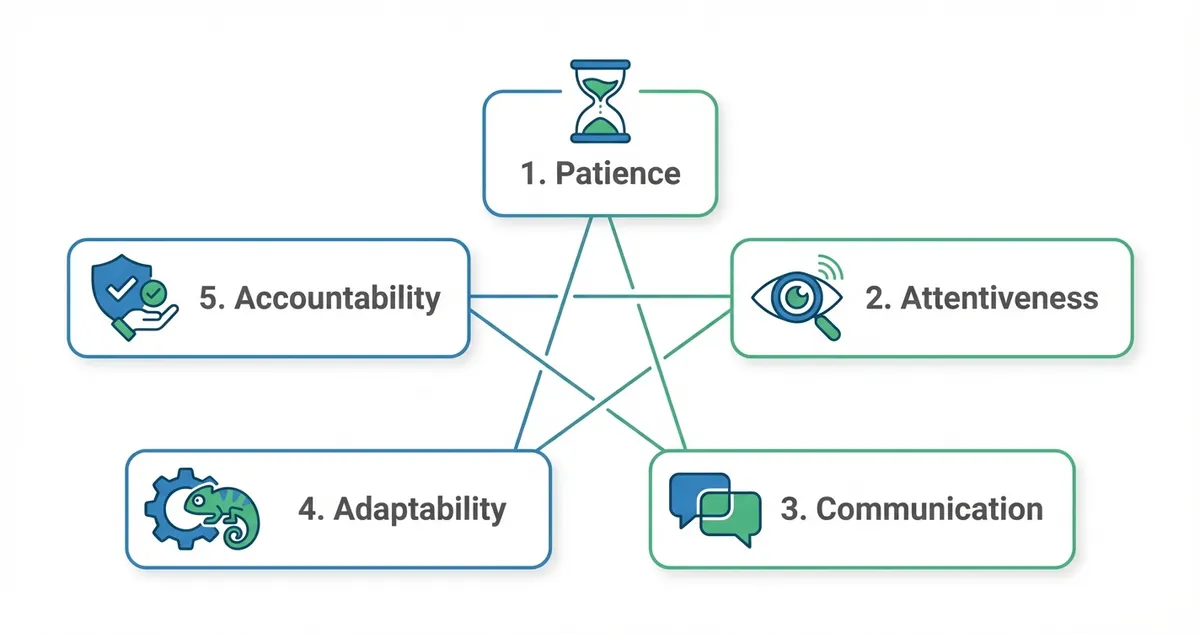
For example, a server demonstrating adaptability might recognise that a business lunch table wants minimal interruptions, while a family celebration table appreciates more engagement and photos of their special dessert.
For fine dining, add precision and formality. For casual venues, warmth and speed matter more. The key is matching service quality to your concept.
Info
If you only have 30 minutes a week to work on customer service, spend it on pre-shift briefings. Five minutes before each service discussing the specials, VIP bookings, and any known issues creates more impact than monthly training sessions.
Understanding the qualities is one thing; justifying investment is another. Here's why excellent service pays for itself.
The Business Case for Excellence
Here's why all this effort pays off. Customer service directly impacts your bottom line:
- Retention economics: Acquiring a new customer costs 5-25x more than keeping an existing one
- Review impact: A 1-star improvement on review platforms correlates with 5-9% revenue increase
- Word of mouth: Most guests who had unresolved problems told family and friends about it
- Repeat visits: Many customers with positive experiences dine more frequently
For detailed metrics and customer satisfaction tracking approaches, see our dedicated guide. Those stronger reviews are also a local search ranking signal, so tools that show your Google rating and local visibility help turn great service into more people discovering you.
Why this matters
A neighbourhood bistro that implemented consistent greeting standards saw their Google rating climb noticeably within six months. The only change? Training all staff to acknowledge every guest within 30 seconds and use names when taking bookings.
With the business case clear, let's move to practical implementation you can start immediately.
This Week, Strengthen Your Service Foundation
Now let's make this actionable. Here's a simple plan:
Day 1-2: Observe your team during service. Note where the 7 steps break down.
Day 3-4: Hold a team meeting discussing one specific improvement area. Pick the weakest step.
Day 5-7: Implement a simple tracking method, even a tally sheet, to measure improvement.
For example, a small bistro tracked how often servers used guests' names during farewells. Within two weeks, name usage increased sharply, and positive mentions of "personal service" appeared in new reviews.
Info
If you're posting only about problems in staff WhatsApp groups, you'll lose to competitors who celebrate service wins publicly. Recognition drives repetition.
Common Mistakes to Avoid
However, watch out for these pitfalls that undermine even well-intentioned efforts.
Over-scripting: "Hi, my name is Sarah and I'll be your server today" feels rehearsed when delivered identically by every team member.
Ignoring regulars: Long-time customers expect recognition. Train staff to note preferences in your booking system.
Inconsistent standards: If the manager provides great service but junior staff don't, you have a training problem.
Reactive only: Waiting for complaints means missing the many who leave silently.
What Does Customer Service Training Cost?
Finally, let's talk investment. Budget reality varies significantly by approach:
- DIY training materials: £0-200 (your time is the main cost)
- Online courses per staff member: £50-150
- External trainer (half-day session): £500-1,500
- Mystery shopper programmes: £100-300 per visit
- Hospitality NVQ programmes: £1,000-3,000 per candidate
Most independent restaurants achieve meaningful improvement with monthly team meetings (free), printed service standards (£50), and quarterly mystery shopper visits (£400/year). The ROI becomes clear quickly: if better service retains just two tables per week who might have gone elsewhere, that's £5,000+ in annual revenue from a £500 investment.
Key Takeaways
If you run a restaurant and want to see how Local Brand Hub can support your marketing, explore our restaurant marketing tools.
Key Takeaways
In summary, here's what matters most. Restaurant customer service determines whether guests return, recommend you, or warn others away. The frameworks exist (7 steps of service, 5 pillars of quality, core qualities) but implementation requires daily commitment.
The restaurants that succeed treat service as a competitive advantage, not a cost centre. They train consistently, measure outcomes, and create cultures where staff genuinely care about guest experiences.
- Master the 7 steps of service for consistent guest journeys
- Focus on the 5 pillars that guests rate highest
- Hire for attitude, train for skill
- Celebrate wins publicly to reinforce good behaviour
- Start with one improvement this week and build from there
Weekly Action
This week, audit your service
- Observe one full service and note where the 7 steps break down
- Pick the weakest step and discuss it in a team meeting
- Implement simple tracking (even a tally sheet works)
- Celebrate improvements publicly to reinforce good behaviour
Next steps:
- Review our customer service training guide for staff development
- Implement service standards appropriate to your concept
- Track customer satisfaction to measure progress
For UK restaurant owners
Transform Your Service
LocalBrandHub works with UK restaurants to develop customer service strategies that turn first-time visitors into loyal regulars.
Start freeGet More Marketing Tips
Practical marketing tips for UK business owners, straight to your inbox. No spam, unsubscribe anytime.
About the Author
Local Brand Hub
Empowering UK Businesses
Local Brand Hub provides comprehensive business management tools designed specifically for UK local businesses to streamline operations, automate marketing, and grow revenue.
More articlesRelated Articles
 Marketing Tips
How to Improve Restaurant Customer Service: 7 Proven Steps
Train your team with the 10/5/3 greeting rule and 7 C's framework to lift restaurant customer service without spending more on staff.
 Marketing Tips
Restaurant Customer Service Standards: A Practical UK Guide
Set clear restaurant customer service standards your team can follow. Covers greeting protocols, timing benchmarks, and quality checklists for UK venues.
 Marketing Tips
10 Restaurant Customer Service Tips That Actually Work
10 restaurant customer service tips that work for UK independents. Covers the 10/5/3 rule, the 7 C's framework, and budget-friendly quick wins.