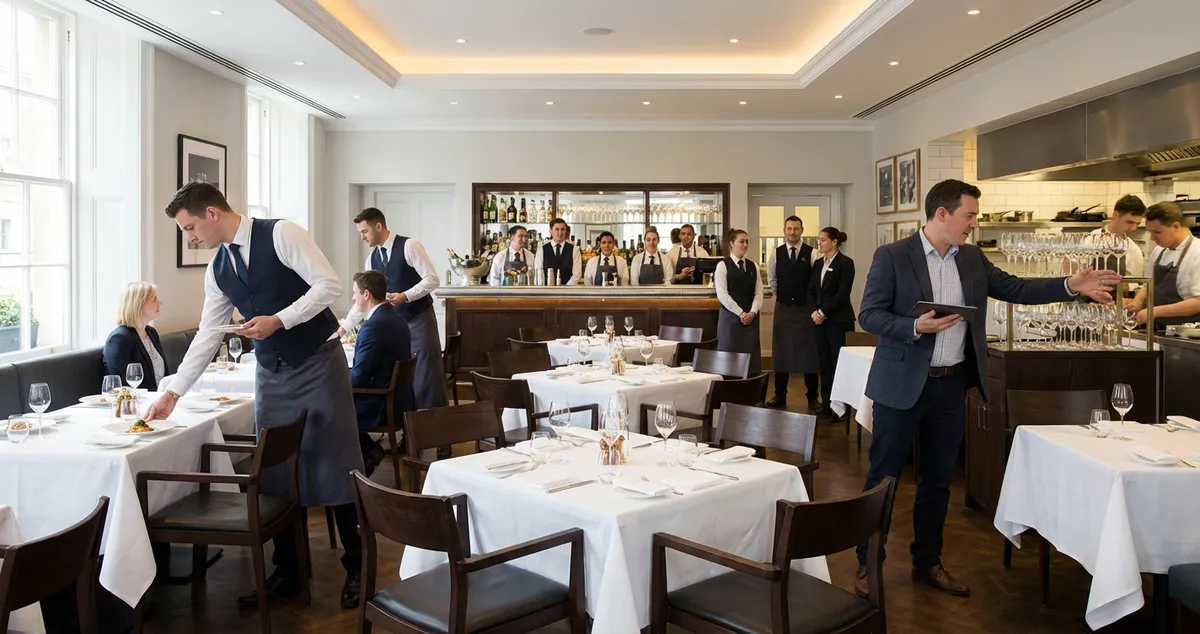
Set clear restaurant customer service standards your team can follow. Covers greeting protocols, timing benchmarks, and quality checklists for UK venues.
Restaurant customer service standards are written rules that define exactly how every guest should be treated, from the moment they arrive until they leave, ensuring consistency across your entire team. Service varies wildly between shifts. One server is brilliant, another barely adequate. Guests never know what they'll get.
Short on time? Here's the quick version
- Greet within 30 seconds: Clear, measurable, trainable
- Drink orders within 2 minutes: Timing benchmarks remove guesswork
- Check back within 3 bites: Catch problems before they escalate
- Document everything: Written standards beat verbal instructions
- Key mistake: "Be friendly" means different things to different people, be specific
Full standards framework with timing benchmarks below
Without standards, you're relying on individual judgment. Some staff have great instincts. Others don't. Many guests leave over service issues, not food quality. Standards help you catch those problems before they cost you bookings.
Related: Restaurant Customer Service - our complete hub guide
What You'll Learn
- Core standards every restaurant needs
- Timing benchmarks for key service moments
- How to document and train standards
- Measuring compliance without micromanaging
What Are Restaurant Service Standards?
Let's start with the basics. Restaurant service standards are simple rules that tell staff how to treat guests at every step of their visit.
Standards typically cover:
- Greeting and seating procedures
- Order-taking protocols
- Food and drink service
- Problem resolution
- Farewell and follow-up
For example, a standard might say "Greet all guests within 30 seconds of seating." That's clear, measurable, and trainable. Compare that to "Be friendly", which means different things to different people.
Info
If you're only giving verbal instructions about service, you'll lose to competitors who write standards down and train them consistently.
Core Service Standards to Set
Now that we've defined standards, here are the essentials every UK restaurant should document. These build on the customer service tips we covered elsewhere.
Greeting Standards
| Touchpoint | Standard | Timing |
|---|---|---|
| Door greeting | Eye contact + verbal welcome | Within 5 seconds |
| Table greeting | Introduce yourself, offer menus | Within 30 seconds of seating |
| Drink order | Offer water + take drink order | Within 2 minutes |
Example: A neighbourhood bistro sets this standard: "Greet arriving guests with 'Good evening, welcome to Marco's' before they reach the host stand." Staff know exactly what to say and when.
Order-Taking Standards
- Repeat orders back to confirm accuracy
- Note dietary requirements and allergies clearly
- Upsell once per table (drinks or starters) without pressure
- Confirm estimated wait time for food
For instance, a casual dining spot trains servers to say: "Just to confirm, that's the beef burger medium-rare, the fish and chips, and you've noted the nut allergy. Your food should be about 15 minutes."
Food Service Standards
These standards ensure consistency when plates hit the table.
- Serve from the left, clear from the right (traditional British service)
- Announce each dish: "The lamb for you, sir"
- Check back within 3 bites of first course arriving
- Never clear plates until everyone at the table has finished
Would you eat at your own restaurant as a first-time guest? Walk through the experience and check if your team follows these standards.
Bill and Farewell Standards
The ending matters as much as the start. Set clear standards for the final impression.
- Present bill only when requested (never assume)
- Process payment promptly, within 3 minutes
- Thank guests by name if known
- Invite them to return: "We'd love to see you again"
Timing Benchmarks That Matter
With core standards set, let's make them measurable. Here's where many restaurants fail. Knowing what to do isn't enough. You need to define when. Timing benchmarks make standards measurable.
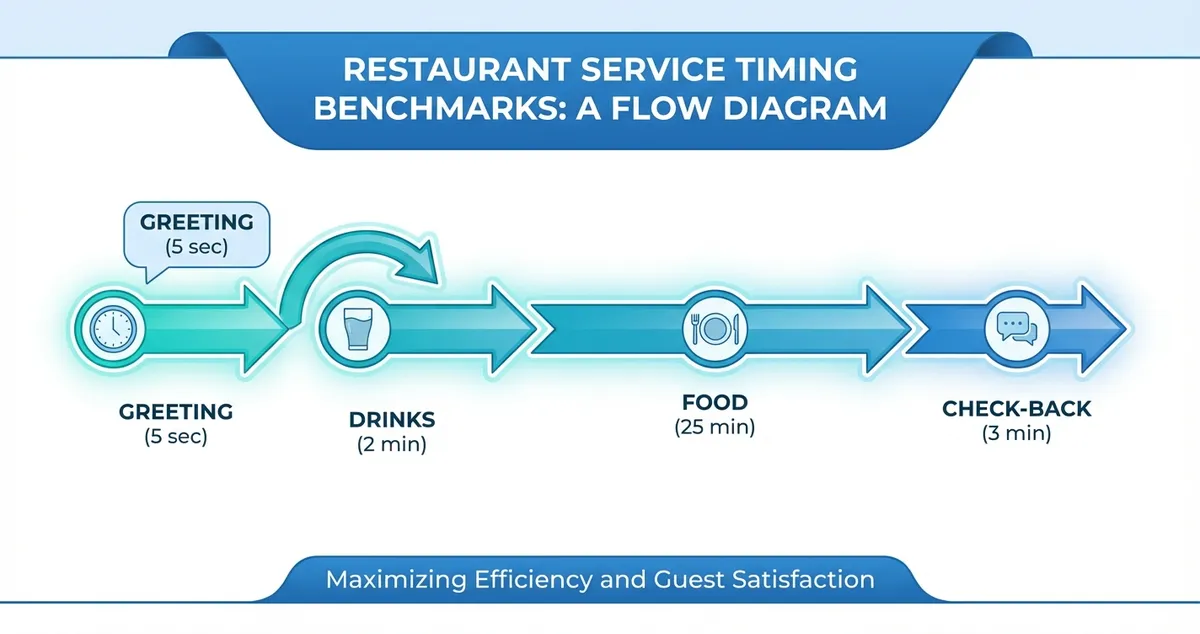
Key Timing Standards:
| Service Moment | Target Time | Maximum Time |
|---|---|---|
| Door greeting | 5 seconds | 15 seconds |
| Drink order taken | 2 minutes | 5 minutes |
| Drinks served | 5 minutes | 8 minutes |
| Food order taken | 10 minutes | 15 minutes |
| Starters served | 15 minutes | 20 minutes |
| Mains served | 25 minutes | 35 minutes |
| Check-back after food | 2 minutes | 5 minutes |
| Bill presented | 2 minutes after request | 5 minutes |
| Payment processed | 3 minutes | 5 minutes |
Warning
If you can't tell whether your team meets these targets, that's usually a sign you need to start tracking timing during service.
Measuring Tip: Have a manager use a stopwatch during one service per week. Track three tables from arrival to departure. You'll quickly spot where delays happen.
Real example
A gastropub discovered their drink service averaged 8 minutes, way over their 5-minute target. The fix was simple: pre-poured house wines ready during busy periods.
How to Document Your Standards
With benchmarks clear, here's how to make them stick. Writing standards your team can actually use requires clarity and accessibility.
Documentation Tips:
- Keep it simple: One page per area (greeting, service, recovery)
- Use specific language: "Within 30 seconds" not "promptly"
- Include examples: Show what good looks like
- Add visuals: Photos of correct table settings, tray carrying
Standard Template:
STANDARD: Check-back after food arrives
TIMING: Within 2-3 minutes (approx. 3 bites)
ACTION: Ask a specific question about the food
EXAMPLE: "How's the steak cooked for you?"
NOT: "Everything okay?"
Store standards in a shared location: a printed handbook, a digital folder, or a wall poster in the staff area. Accessibility matters more than format.
Training Standards Effectively
Documentation alone isn't enough. Standards only work when trained and reinforced. See our training guide for complete methods.
Training Approach:
- Day 1: Walk new staff through the standards document
- Week 1: Shadow experienced staff who model standards
- Week 2-4: Supervised service with real-time feedback
- Ongoing: Monthly refreshers on one standard area
Pre-Shift Reinforcement:
Use 5-minute pre-shift briefings to highlight one standard each service:
- "This service, focus on the 3-bite check-back"
- "Make sure we're greeting within 30 seconds"
- "Watch your drink order timing, we were slow last night"
Info
If you're only training standards during onboarding, you'll lose to competitors who reinforce them every shift.
For instance, a fine dining restaurant runs a 5-minute "standard spotlight" before every service. Last week: greeting timing. This week: the 3-bite check-back. Consistent reinforcement builds habits.
Measuring Compliance Without Micromanaging
Training is done, now how do you know it's working? Here's where balance matters. You want consistency, not robots. Measure standards without killing morale.
Measurement Methods:
- Mystery shoppers: External checks against your standards (quarterly)
- Manager observations: Structured notes during service (weekly)
- Self-assessment: Staff rate their own compliance (builds ownership)
- Guest feedback: Look for patterns in reviews and learn from customer complaints
Sample Scorecard:
| Standard | Met | Partially Met | Not Met |
|---|---|---|---|
| Greeted within 30 seconds | ✓ | ||
| Drink order in 2 minutes | ✓ | ||
| Check-back within 3 bites | ✓ | ||
| Bill processed in 3 minutes | ✓ |
Use scorecards for coaching, not punishment. The goal is improvement, not blame. The same consistency pays off online: working through a local SEO checklist keeps the reviews and listings guests check before booking as reliable as your service.
Why this matters
A neighbourhood bistro uses a simple weekly scorecard. Staff see it as feedback, not surveillance. One server improved their greeting timing by 40% in a month once they could see the data.
Common Standards Mistakes
Watch out for these pitfalls when setting standards.
- Too many standards: Start with 10-15 core standards, not 50
- Vague language: "Be attentive" vs. "Check tables every 5 minutes"
- No buy-in: Involve team in setting standards for better adoption
- Set and forget: Standards need regular review and updates
Warning
If you're thinking "my team knows what to do without written standards", you're probably overestimating consistency. Write them down. Train them. Measure them.
Minimum Viable Standards
If you only have 30 minutes to set up service standards, start with these five:
- Greet within 30 seconds of seating
- Take drink orders within 2 minutes
- Check back within 3 bites of food arriving
- Never clear plates until all have finished
- Thank guests and invite them back
That's enough for a foundation. Add more as your team masters these basics.
Key Takeaways
If you run a restaurant and want to see how Local Brand Hub can support your marketing, explore our restaurant marketing tools.
Key Takeaways
In summary, here's what matters. Restaurant customer service standards turn good intentions into consistent actions. They remove guesswork and give every team member a clear target.
- Document your five core standards this week
- Add timing benchmarks so you can measure
- Brief standards at every pre-shift meeting
- Use scorecards for coaching, not punishment
- Review and update standards regularly
Weekly Action
This week, set your standards
- Audit current standards: what's documented vs. assumed?
- Write or update one standard area with specific timing
- Brief staff at pre-shift and observe compliance
- Celebrate improvements to build positive momentum
For deeper learning:
- Read our customer service training guide
- Apply improvement strategies systematically
- Handle issues with our complaints guide
For UK restaurant owners
Set Your Standards
LocalBrandHub works with UK restaurants to develop service standards that create consistency and drive repeat visits.
Start freeGet More Marketing Tips
Practical marketing tips for UK business owners, straight to your inbox. No spam, unsubscribe anytime.
About the Author
Local Brand Hub
Empowering UK Businesses
Local Brand Hub provides comprehensive business management tools designed specifically for UK local businesses to streamline operations, automate marketing, and grow revenue.
More articlesRelated Articles
 Marketing Tips
How to Improve Restaurant Customer Service: 7 Proven Steps
Train your team with the 10/5/3 greeting rule and 7 C's framework to lift restaurant customer service without spending more on staff.
 Marketing Tips
Restaurant Customer Service: UK Guide
Master restaurant customer service with proven frameworks. Learn the 7 steps of service and strategies that turn diners into regulars.
 Marketing Tips
10 Restaurant Customer Service Tips That Actually Work
10 restaurant customer service tips that work for UK independents. Covers the 10/5/3 rule, the 7 C's framework, and budget-friendly quick wins.