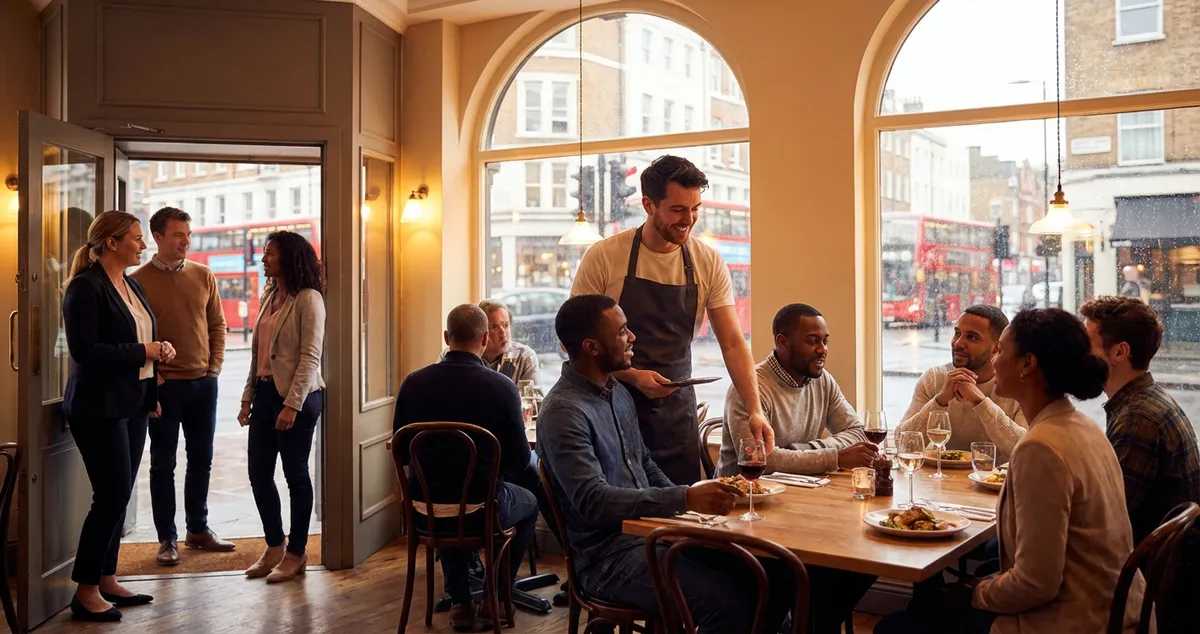
Train your team with the 10/5/3 greeting rule and 7 C's framework to lift restaurant customer service without spending more on staff.
How to improve restaurant customer service means training staff well, setting clear standards, and building a culture of care. You're running a solid kitchen. Good food, fair prices, nice atmosphere. But tables stay empty while the place next door has a queue out the door.
Short on time? Here's the quick version
- 10/5/3 rule: Acknowledge at 10 feet, greet at 5 feet, engage at 3 feet
- Written standards: Greet within 30 seconds, drinks within 2 minutes, check back within 3 bites
- Empower staff: Give servers authority to comp up to £10 without asking
- Measure simply: Track review scores, complaint rates, return visits
- Key mistake: No written standards, just assumptions that vary by shift
7-step improvement framework below
Many UK diners say great customer service matters to them, and a large share will pay more for it, according to industry research. That's not a marketing stat. That's money walking past your door because service falls short.
Related: Restaurant Customer Service - our complete hub guide
What You'll Learn
- The 10/5/3 rule that changes how staff greet guests
- Budget-friendly training methods that actually work
- How to measure service without expensive tools
- Quick wins you can start today
- The 7 C's framework for consistent service
Step 1: Train Your Team on Guest Engagement Rules
First, let's fix how your team greets guests. The 10/5/3 rule is a framework that tells staff exactly when to engage based on how close a guest is.
The 10/5/3 Rule Explained:
- 10 feet: Make eye contact and smile
- 5 feet: Say hello: "Good evening" or "Welcome"
- 3 feet: Engage directly: "Can I help you find a table?"
For example, a host using this rule might spot a couple at the door (10 feet), smile and nod. At 5 feet, greet them warmly. At 3 feet, ask about their booking or offer to seat them.
Info
If you're only training staff on taking orders, you'll lose to competitors who drill guest engagement from the moment someone walks in.
Budget Training Tip: Run a 10-minute role-play before each shift. One person plays the guest, another practises the 10/5/3 approach. Free and takes no extra time.
Step 2: Create Service Standards Everyone Follows
Now that engagement is covered, here's how to keep things consistent. Service standards are written rules that define how every guest should be treated, from greeting to farewell.
Core Standards to Set:
- Greet within 30 seconds of seating
- Take drink orders within 2 minutes
- Check back after food arrives (within 3 bites)
- Clear plates promptly but not rushed
- Present bill only when requested
Write these down. Print them. Put them where staff see them daily.
Warning
If you're reading this because service varies wildly between shifts, that's usually a sign you have no written standards, just assumptions.
The 30/30/30/10 Rule for Restaurants
This budget rule helps balance your costs: 30% on food, 30% on labour, 30% on overhead, and 10% profit. While it's about finances, it matters for service because underspending on labour means understaffing, which kills service quality.
Step 3: Gather and Act on Feedback
With standards set, here's how to know if they're working. Feedback isn't just nice reviews: it's your early warning system.
Free Feedback Methods:
- Table cards: Simple "How was everything?" cards with a QR code
- Google reviews: Monitor and respond to every single one
- Staff observations: End-of-shift debrief: what went well, what didn't?
- Direct asks: Train servers to ask one specific question: "Was there anything we could have done better?"
Did you know
Most UK diners prefer physical menus over QR codes. This tells you something important: guests want human interaction, not just tech solutions.
Would you eat at your own restaurant as a first-time guest? Walk through the door like a stranger. What do you notice?
Step 4: Empower Staff to Solve Problems
Here's where many restaurants fail. A complaint comes in, and staff freeze because they need manager approval for everything. That delay makes small problems feel big. For more on this, see our guide on handling restaurant customer complaints.
Empower Your Team:
- Set a "make it right" budget: Give servers authority to comp a dessert or drink (up to £10) without asking
- Train on common complaints: What to say when food is late, cold, or wrong
- Create a recovery script: "I'm so sorry that happened. Let me fix it right now."
For instance, a busy gastropub might train servers to immediately offer a free round when food takes too long. No need to find a manager. Problem solved in 30 seconds.
Pro tip
Staff who can fix problems keep guests happy. Staff who have to wait make guests wait, and waiting makes everything worse.
Step 5: Personalise the Guest Experience
Moving from fixes to delight, here's how to make guests feel special. Personalisation doesn't need expensive tech.
Simple Personalisation Tactics:
- Remember regulars: Keep a notebook of preferences (Mrs. Chen: still water, no ice)
- Celebrate occasions: Train staff to spot celebrations and acknowledge them
- Use names: If a booking has a name, use it at the table
- Note allergies: Record them so guests don't repeat themselves every visit
The 7 C's of customer service provide a useful frame here. The 7 C's framework is a set of principles that guide service delivery: Courtesy, Consistency, Communication, Competence, Customisation, Commitment, and Care.
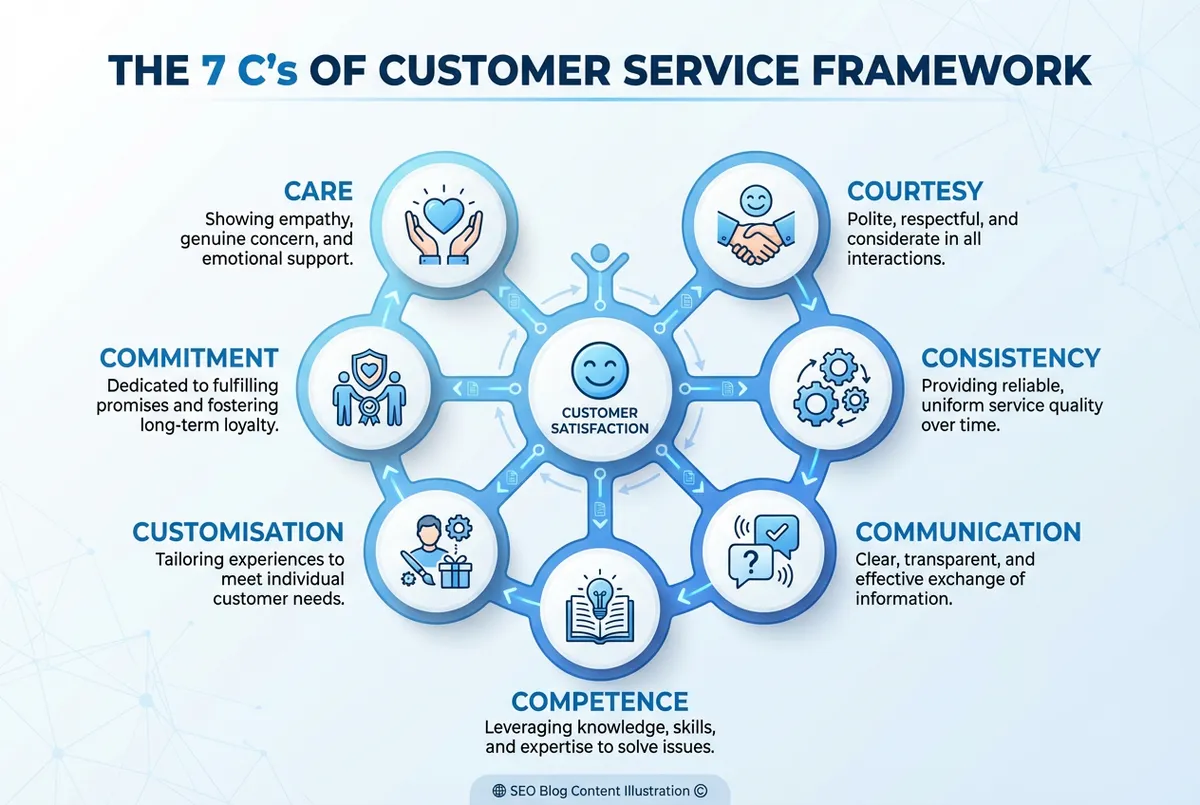
Customisation is where personalisation lives. A café might train staff to ask "Your usual?" to familiar faces, a small touch that signals recognition.
Step 6: Measure What Matters
Finally, let's track progress. You can't improve what you don't measure, but you don't need fancy tools. Beyond the in-house metrics below, a visibility score gives you a single number that reflects how your reviews and online presence are performing.
Free Measurement Methods:
| Metric | How to Track | Target |
|---|---|---|
| Review score | Google/TripAdvisor average | 4.5+ stars |
| Complaint rate | Tally complaints per 100 covers | Under 2% |
| Return visits | Ask "Have you been before?" | Track weekly |
| Table turnover | Time from seat to bill | Know your average |
Info
If you can't tell whether your service brings repeat bookings or just one-time visits, that's usually a sign you need better tracking. Start with one metric. Review scores are easiest because guests do the work.
Weekly Action
- Day 1-2: Review last week's feedback
- Day 3-4: Pick one issue to fix
- Day 5-7: Brief staff on the fix
Step 7: Build a Culture of Care
None of this works without the right culture. Systems matter, but people make them work.
Culture-Building Habits:
- Pre-shift huddles: 5 minutes to share wins and focus points
- Recognition: Highlight one great service moment each day
- Team input: Ask staff what frustrates them, and fix it
- Lead by example: Managers should work the floor, not hide in offices
Why this matters
Restaurants that invest in service culture see lower staff turnover and higher repeat bookings, according to UKHospitality research.
Minimum Viable Effort
If you're short on time, start here:
- Day 1-2: Write down your 5 core service standards
- Day 3-4: Teach the 10/5/3 rule in a pre-shift briefing
- Day 5-7: Ask three guests for feedback and note patterns
This is enough to start. Perfect is the enemy of good.
How to Improve Customer Experience in a Restaurant
Customer experience goes beyond service: it's the whole journey. From finding you online to leaving the door.
Quick Experience Wins:
- Online: Is your website mobile-friendly? Can people book easily?
- Arrival: Is the entrance welcoming? Can they see where to go?
- During: Is the lighting right? Music at the right level?
- Departure: Do you thank them warmly? Offer a reason to return?
For example, a neighbourhood bistro might realise their entrance feels unwelcoming because the door sticks. A £20 fix that changes first impressions.
How to Improve Customer Satisfaction in Restaurants
Satisfaction is whether guests got what they expected. It's simpler than experience but just as vital.
Satisfaction Checklist:
- Food matches menu descriptions
- Portions meet expectations
- Wait times are reasonable (or communicated)
- Bill is accurate with no surprises
- Complaints are handled quickly
Warning
If you're only fixing problems after complaints, you'll lose to competitors who spot issues before guests notice.
Common Mistakes to Avoid
Watch out for these pitfalls that undermine good intentions:
- Over-promising: Don't say "5 minutes" when you mean 15
- Ignoring regulars: New guests matter, but regulars pay the bills
- Blaming staff publicly: Never correct team members in front of guests
- Copying chains: Independent restaurants succeed by being different, not cheaper versions of chains
Key Takeaways
If you run a restaurant and want to see how Local Brand Hub can support your marketing, explore our restaurant marketing tools.
Key Takeaways
In summary, here's what matters most. Improving restaurant customer service doesn't need big budgets or complex systems. It needs clear standards, trained staff, and a culture that cares.
- Teach the 10/5/3 rule this week
- Write your five core service standards and post them
- Empower one staff member to fix small problems
- Ask three guests what you could do better
- Start with one metric and track it weekly
Weekly Action
This week, start improving
- Write down your 5 core service standards and share with the team
- Teach the 10/5/3 rule in a pre-shift briefing
- Empower one server to comp up to £10 without asking
- Ask three guests for specific feedback
For deeper guidance:
- Read our restaurant customer service training guide
- Check our customer service standards framework
- Review customer satisfaction strategies
For UK restaurant owners
Improve Your Service
LocalBrandHub works with UK restaurants to develop service improvement strategies that turn first-time visitors into regulars.
Start freeGet More Marketing Tips
Practical marketing tips for UK business owners, straight to your inbox. No spam, unsubscribe anytime.
About the Author
Local Brand Hub
Empowering UK Businesses
Local Brand Hub provides comprehensive business management tools designed specifically for UK local businesses to streamline operations, automate marketing, and grow revenue.
More articlesRelated Articles
 Marketing Tips
Restaurant Customer Service: UK Guide
Master restaurant customer service with proven frameworks. Learn the 7 steps of service and strategies that turn diners into regulars.
 Marketing Tips
Restaurant Customer Service Standards: A Practical UK Guide
Set clear restaurant customer service standards your team can follow. Covers greeting protocols, timing benchmarks, and quality checklists for UK venues.
 Marketing Tips
10 Restaurant Customer Service Tips That Actually Work
10 restaurant customer service tips that work for UK independents. Covers the 10/5/3 rule, the 7 C's framework, and budget-friendly quick wins.