
Learn how to measure and improve restaurant customer satisfaction with proven survey methods, key metrics, and practical strategies for UK venues.
Restaurant customer satisfaction is the degree to which guest expectations are met or exceeded across food, service, atmosphere, and value: measured through feedback, reviews, return visits, and recommendation rates. You think guests are happy. Reviews seem fine. But bookings aren't growing and repeat visits are flat. What's going wrong?
Short on time? Here's the quick version
- 4 pillars: Food, Service, Atmosphere, Value
- Service drives loyalty: guests leave over feeling uncared for, not the food itself
- NPS target: 50+ is good, track weekly not annually
- Return rate benchmark: 30%+ of guests should come back
- Key mistake: Measuring satisfaction but not acting on the data
Measurement methods and pillar improvements below
Many guests stop coming back because they feel uncared for, not because of the food itself. If you're thinking "our food is great, that's enough," the experience your guests have may say otherwise. Satisfaction spans everything from greeting to farewell.
Related: Restaurant Customer Service - our complete hub guide
What You'll Learn
- How to measure satisfaction without expensive tools
- The key drivers of satisfaction in UK restaurants
- Simple surveys that guests actually complete
- Turning satisfaction data into action
Why Customer Satisfaction Matters
Let's start with why this matters beyond "happy guests are good." Satisfaction drives three business outcomes.
The Business Case:
| Metric | Satisfied Guests | Unsatisfied Guests |
|---|---|---|
| Return visits | 70% likely | 10% likely |
| Recommend to others | 65% will | 5% will |
| Spend per visit | 15-20% higher | Average or below |
| Price sensitivity | Lower | Much higher |
Info
If you're only tracking revenue without tracking satisfaction you'll always lose to competitors who understand why guests return.
For example, a gastropub noticed revenue plateauing despite good covers. They measured satisfaction and discovered check-back timing was poor. Staff weren't returning to tables quickly enough. One training session later, satisfaction scores rose 15%, and repeat visits followed.
The 4 Pillars of Restaurant Satisfaction
Now let's look at what drives satisfaction. Guests evaluate four core areas.
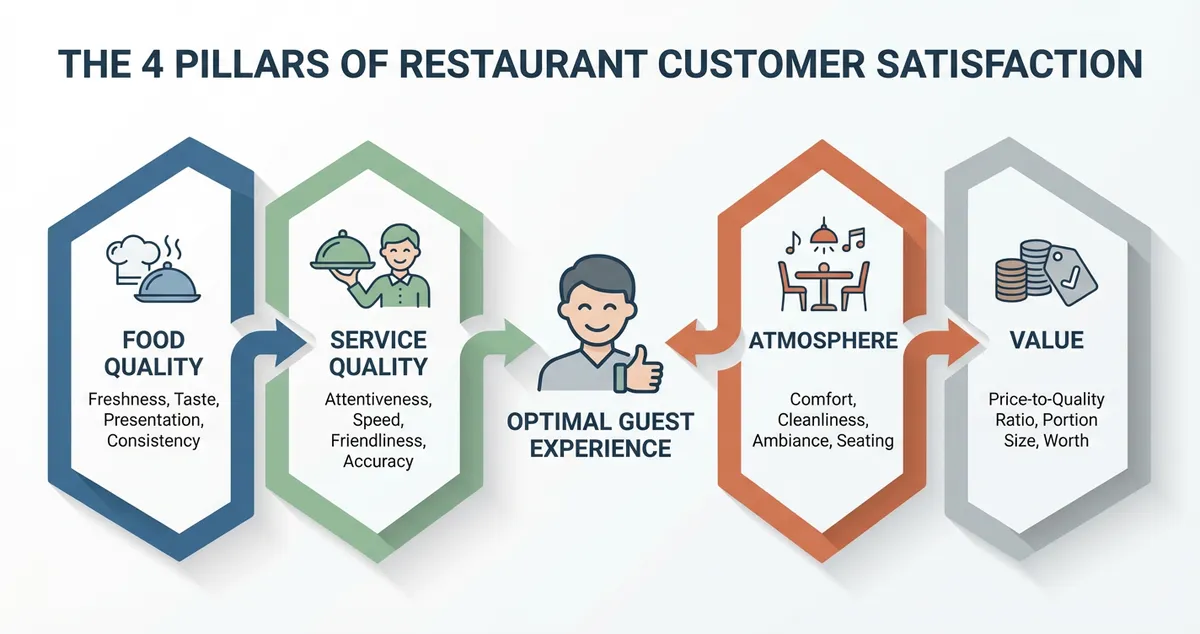
1. Food Quality
Does the food meet or exceed expectations set by menu descriptions, photos, and price point?
Key Elements:
- Taste and flavour profiles
- Presentation and portion size
- Temperature (hot food hot, cold food cold)
- Consistency between visits
2. Service Quality
Does the service feel attentive without being intrusive? Is staff knowledge good?
Key Elements:
- Greeting and welcome
- Order accuracy
- Staff knowledge (menu, allergens)
- Timing and pacing
- Problem resolution
See our customer service tips for practical training approaches.
3. Atmosphere
Does the environment support the dining experience? Is it comfortable?
Key Elements:
- Cleanliness
- Noise levels
- Lighting and ambience
- Temperature
- Music and background
4. Value
Does the overall experience justify the price? Would guests return at this price point?
Key Elements:
- Price vs. portion size
- Quality vs. competitors
- Hidden costs (service charges)
- Special offers and loyalty value
Real example
A casual dining spot raised prices by 10% without improving quality. Satisfaction dropped immediately, and reviews mentioned "not worth the money." They added a loyalty scheme offering every 6th meal free, and perception shifted.
Info
If you can't tell whether your restaurant delivers satisfaction or just fills seats, that's usually a sign you need to start measuring properly.
Pillar Priority Order:
When you're short on time, focus on pillars in this order:
- Service (easiest to fix, highest impact on perception)
- Food (requires kitchen changes but directly affects satisfaction)
- Atmosphere (can be quick wins like lighting)
- Value (hardest to change without affecting margins)
How to Measure Satisfaction
With pillars clear, here's how to measure them. You don't need expensive tools.
Free Methods
Review Analysis:
- Monitor Google, TripAdvisor, Facebook weekly
- Track rating trends over time
- Note specific mentions (service, food, atmosphere)
- Categorise complaints by pillar
Direct Feedback:
- Ask one question at the bill: "What could we do better?"
- Train staff to note responses
- Review weekly in team meetings
Observation:
- Watch body language during service
- Note what gets left on plates
- Track complaint frequency
Simple Survey Methods
Table Cards:
Create a simple 4-question card guests can complete:
- How was the food? (1-5)
- How was the service? (1-5)
- How was the atmosphere? (1-5)
- Would you recommend us? (Yes/No)
Add a QR code linking to a Google review for those who score 4-5.
Email Follow-Up:
For guests who book online, send a next-day email:
"Thank you for dining with us. We'd love your feedback. How was your experience? Reply to this email or leave a review."
Keep it simple. Long surveys don't get completed.
Real example
A neighbourhood bistro switched from a 10-question survey to a 3-question one. Response rates tripled, and they got more useful data.
Key Metrics to Track
| Metric | How to Calculate | Good Benchmark |
|---|---|---|
| NPS (Net Promoter Score) | % Promoters - % Detractors | 50+ |
| Average Review Rating | Sum of ratings ÷ number | 4.5+ |
| Return Rate | Repeat guests ÷ total guests | 30%+ |
| Complaint Rate | Complaints ÷ covers | Under 2% |
Would you eat at your own restaurant as a mystery shopper? Would you recommend it to a friend? Try it once a month and score yourself honestly. The answers reveal more than any survey.
Turning Data Into Action
Measurement alone isn't enough. Here's how to act on what you learn.
Weekly Review Process:
- Read reviews: Note patterns, not just individual comments
- Categorise by pillar: Is it food, service, atmosphere, or value?
- Identify trends: One complaint is noise; five is a pattern
- Pick one focus: Choose the weakest pillar for this week
- Brief staff: Share the feedback and the action plan
Real example
A café saw repeated mentions of "noisy." They investigated and found a broken speaker creating distortion. A £50 fix improved satisfaction scores.
Closing the Loop:
When you fix something guests mentioned:
- Respond to the review explaining the change
- Mention improvements to regulars
- Track whether that issue recurs
Weekly Action
- Day 1-2: Read last week's reviews and feedback
- Day 3-4: Identify the weakest pillar
- Day 5-7: Brief staff and implement one improvement
Building a Satisfaction Culture
With measurement sorted, let's talk about the bigger picture. Satisfaction isn't a one-off project. It's a culture.
The Four Habits of Satisfaction-Focused Teams:
- Weekly review: Review feedback every week, not monthly
- Open feedback loop: Staff can report guest concerns without blame
- Quick fixes: Small issues get fixed within 24 hours
- Celebration: Share positive feedback as well as criticism
Real example
A casual dining chain introduced a daily 5-minute huddle where staff share one piece of guest feedback from the previous shift. Within three months, their NPS rose from 42 to 58.
Warning
If you're only measuring satisfaction annually you'll always lose to competitors who track it weekly and act on it daily.
Improving Each Pillar
With measurement in place, here's how to improve each area.
Improving Food Satisfaction
- Consistency: Use recipes and portion guides
- Temperature: Pre-warm plates, use heat lamps
- Presentation: Photo each dish for training
- Expectations: Ensure menu describes dishes accurately
Improving Service Satisfaction
- Training: Teach the 10/5/3 rule for greetings
- Standards: Set timing benchmarks for each service step
- Empowerment: Let staff fix problems without managers
- Recognition: Praise good service publicly
See our service standards guide for complete benchmarks.
Improving Atmosphere Satisfaction
- Noise: Check acoustics, adjust music volume
- Lighting: Use dimmers, add candles for evenings
- Cleanliness: Spot checks every 30 minutes
- Temperature: Monitor and adjust throughout service
Improving Value Satisfaction
- Transparency: No hidden charges, clear pricing
- Portions: Ensure portion size matches price
- Loyalty: Offer rewards for return visits
- Quality: Ensure ingredients match the price point
Info
If you're thinking "we can't afford to do all this," start with one pillar. The weakest one. Small improvements compound.
Using Technology to Track Satisfaction
You don't need expensive software, but the right tools can help.
Free and Low-Cost Options:
| Tool | Cost | Best For |
|---|---|---|
| Google Forms | Free | Simple surveys via email |
| QR code feedback | Free | Table cards linking to survey |
| Booking system notes | Usually included | Tracking repeat visit data |
| Review aggregators | £20-50/month | Monitoring all platforms in one place |
Real example
A neighbourhood restaurant uses a free Google Form linked via QR code on receipts. They get 50+ responses per month, enough data to spot trends.
What to Automate:
- Review alerts (get notified of new reviews instantly)
- Email follow-ups after bookings
- Monthly satisfaction reports
What to Keep Manual:
- Reading every review personally
- Responding to complaints
- Team briefings on feedback
The best satisfaction systems combine automated data collection with human analysis and response. If tracking reviews across Google, TripAdvisor and Facebook by hand feels relentless, tools that show your Google rating and local visibility in one place take some of the manual work off your plate.
Common Satisfaction Mistakes
Watch out for these pitfalls.
- Measuring but not acting: Data without action is useless
- Only reading positive reviews: Negative feedback is more valuable
- Blaming individuals: Look for system problems, not person problems
- Infrequent measurement: Satisfaction changes; measure weekly
- Ignoring silent unhappiness: Most unsatisfied guests don't complain; they just don't return
- Averaging everything: A 4-star average can hide that half your guests gave 5 stars and half gave 3
Info
If you can't tell which of these mistakes you're making, that's usually a sign you need an outside perspective.
Why this matters
Restaurants that actively measure and act on satisfaction tend to see stronger return rates than those that leave it to guesswork.
The Satisfaction-Revenue Connection
Let's connect satisfaction directly to your bottom line. Happy guests don't just return; they bring others.
The Maths:
Consider a restaurant with 500 covers per week at £30 average spend.
- Satisfied guests: 70% return within 6 months, 65% recommend to 2+ friends
- Unsatisfied guests: 10% return, 5% recommend (often negatively)
If you improve satisfaction by just 10%:
- That's 50 more satisfied guests per week
- 35 of those return (at £30 each = £1,050/week)
- Each recommends 2 friends who visit once (100 new covers = £3,000)
The numbers compound. In this example, a sustained satisfaction improvement of that size works out to roughly £200,000 in additional annual revenue.
Pro tip
If you're reading this after a slow month, know that satisfaction improvements take 3-6 months to show in revenue. The guests you delight this week become your regulars next quarter.
Training Staff on Satisfaction
Your team needs to understand why satisfaction matters, not just what to do.
Pre-Shift Briefings:
Use 3-minute briefings to focus staff attention on satisfaction:
- Share one piece of feedback from the previous shift
- Highlight one pillar to focus on this service
- Celebrate one win from a recent review
Service Floor Habits:
Train these micro-behaviours that guests notice:
- Eye contact when speaking
- Using guest names when known
- Checking back at the right moment (not too early, not too late)
- Thanking guests warmly at departure
Real example
A high-street restaurant trained servers on the "3-bite check-back": return to the table after guests have had three bites to ask specifically about the dish. Issues get caught and fixed before they become complaints.
See our customer service training guide for complete training approaches.
Minimum Viable Satisfaction System
If you only have 30 minutes to start measuring satisfaction:
- Read your last 10 Google reviews and categorise by pillar
- Pick the most common complaint and fix it this week
- Ask 5 guests at the bill what could be better
That's enough to start. Build from there.
Key Takeaways
If you run a restaurant and want to see how Local Brand Hub can support your marketing, explore our restaurant marketing tools.
Key Takeaways
In summary, here's what matters most. Restaurant customer satisfaction spans food, service, atmosphere, and value. Measuring it is free. Improving it requires consistent effort.
- Track the 4 pillars: Food, Service, Atmosphere, Value
- Measure weekly: Reviews, feedback cards, observations
- Focus on one pillar at a time, start with the weakest
- Act on data: Measurement without action is useless
- Build the culture: Daily huddles, weekly reviews, quick fixes
Weekly Action
This week, start measuring satisfaction
- Read your last 10 reviews and categorise by pillar
- Identify your weakest pillar based on feedback
- Implement one improvement this week
- Track the change in next week's feedback
For deeper learning:
- Create a great guest experience across all touchpoints
- Handle issues with our complaints guide
- Apply our improvement strategies
For UK restaurant owners
Measure What Matters
LocalBrandHub works with UK restaurants to build satisfaction measurement systems that drive repeat visits and revenue growth.
Start freeGet More Marketing Tips
Practical marketing tips for UK business owners, straight to your inbox. No spam, unsubscribe anytime.
About the Author
Local Brand Hub
Empowering UK Businesses
Local Brand Hub provides comprehensive business management tools designed specifically for UK local businesses to streamline operations, automate marketing, and grow revenue.
More articlesRelated Articles
 Marketing Tips
How to Improve Restaurant Customer Service: 7 Proven Steps
Train your team with the 10/5/3 greeting rule and 7 C's framework to lift restaurant customer service without spending more on staff.
 Marketing Tips
Restaurant Customer Complaints: How to Handle Them
Handle restaurant customer complaints with proven scripts and the LAST framework. Turn upset guests into regulars with these UK approaches.
 Marketing Tips
Restaurant Customer Service: UK Guide
Master restaurant customer service with proven frameworks. Learn the 7 steps of service and strategies that turn diners into regulars.