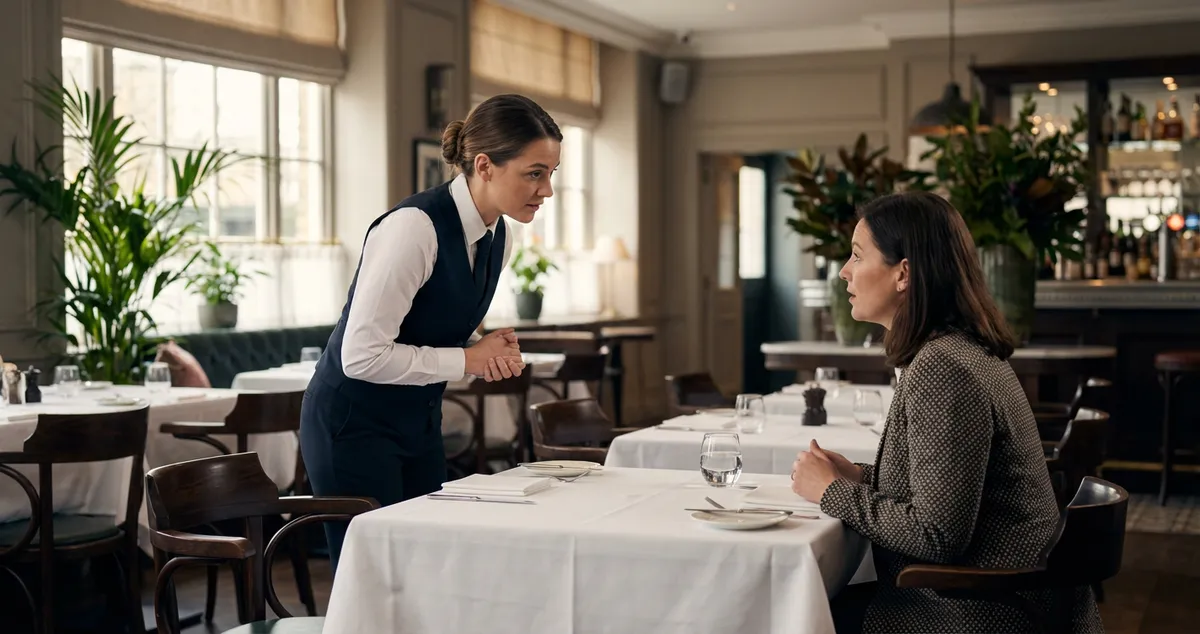
Handle restaurant customer complaints with proven scripts and the LAST framework. Turn upset guests into regulars with these UK approaches.
Restaurant customer complaints are guest concerns or dissatisfactions that require staff response: from minor issues like slow service to serious problems like food safety, allergies, or incorrect billing. A guest flags you down. Their food is wrong, or cold, or late. Your heart sinks. What happens next defines whether they ever return.
Short on time? Here's the quick version
- LAST framework: Listen, Apologise, Solve, Thank: works for any complaint
- £10 "make it right" budget: Empower servers to fix issues without managers
- Don't argue: Remove the dish, remake it, apologise sincerely
- Service drives loyalty: most complaints are fixable if you respond correctly
- Key mistake: Freezing because staff need manager approval for everything
10 common complaints with scripts below
Many guests leave restaurants over service issues, not food quality. That means most complaints are fixable, if you respond correctly. The difference between a lost customer and a loyal regular often comes down to how you handle the next 60 seconds.
Related: Restaurant Customer Service - our complete hub guide
What You'll Learn
- The LAST recovery framework for any complaint
- Scripts for the 10 most common complaints
- How to empower staff to fix problems fast
- When to escalate vs. resolve on the spot
The LAST Recovery Framework
Let's start with a system that works for any complaint. The LAST framework is a method that gives staff a clear four-step process for handling any complaint: Listen, Apologise, Solve, Thank.
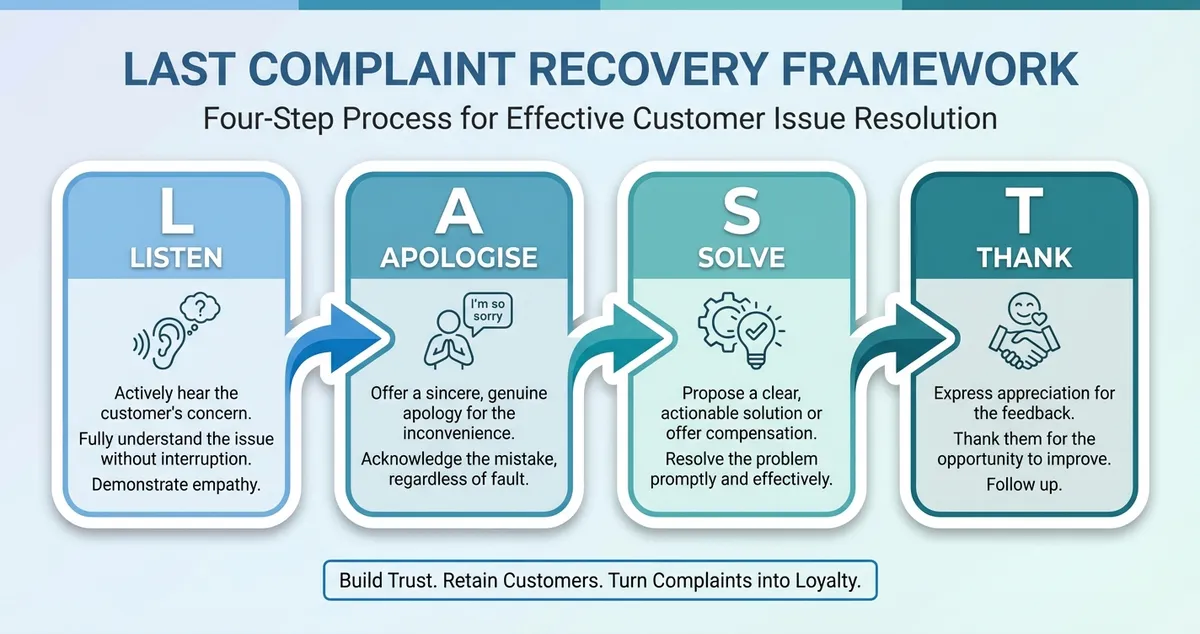
L: Listen Stop what you're doing. Give full attention. Let them finish speaking without interrupting.
A: Apologise Acknowledge the problem sincerely. "I'm sorry that happened" works better than excuses.
S: Solve Fix the issue immediately. Remake the dish, adjust the bill, offer compensation.
T: Thank Thank them for bringing it to your attention. "Thank you for telling us; we want to make this right."
For example, a diner complains their steak is overcooked. Using LAST: Listen to the concern, apologise without blame, offer to remake it immediately, thank them for letting you know.
Info
If you're only apologising without solving, you'll lose to competitors who fix problems on the spot.
The 10 Most Common Restaurant Complaints
Now let's look at specific issues and how to handle each one. These cover the majority of complaints you'll face.
1. Slow Service
See our service standards guide for timing benchmarks.
The Complaint: "We've been waiting ages for our food."
Why It Happens: Kitchen backup, understaffing, poor communication between front and back.
How to Handle:
- Acknowledge the wait: "You're right, this is taking too long"
- Give a specific update: "Your mains will be 5 more minutes"
- Offer something: "Let me bring you some bread while you wait"
Script: "I'm sorry for the wait. The kitchen is running behind, but your food will be out in 5 minutes. Can I get you anything in the meantime: some bread or a top-up on drinks?"
Did you know
59% of UK diners say service speed matters as much as food quality. This complaint is common, and how you handle it makes the difference.
2. Cold Food
The Complaint: "This arrived cold."
Why It Happens: Food sitting on pass too long, plates not pre-warmed, long carry time.
How to Handle:
- Don't argue or make excuses
- Remove the dish immediately
- Offer to remake or replace
Script: "I'm so sorry about that. Let me take this back and get you a fresh, hot one right away. Is there anything else I can get you while you wait?"
3. Wrong Order
Here's one of the most common, and easiest to fix.
The Complaint: "This isn't what I ordered."
Why It Happens: Miscommunication, order entry errors, kitchen mix-ups.
How to Handle:
- Take responsibility (even if unclear whose fault)
- Fix immediately
- Consider discount on this item
Script: "I apologise. That's our mistake. Let me get this corrected right now. Your correct order will be out in 10 minutes, and we'll take that item off your bill."
4. Food Quality Issues
The Complaint: "This doesn't taste right" or "The food wasn't what I expected."
Why It Happens: Recipe inconsistency, ingredient issues, unmet expectations.
How to Handle:
- Ask what specifically is wrong
- Offer alternative or replacement
- Consider partial refund if declining replacement
Script: "I'm sorry it's not meeting your expectations. Can you tell me what's wrong so we can fix it? Would you like something else, or can I have the chef remake this?"
5. Long Wait for a Table
First impressions matter: see our guest experience guide for more.
The Complaint: "We had a booking but still waited 20 minutes."
Why It Happens: Previous table overstayed, overbooking, timing issues.
How to Handle:
- Acknowledge the frustration
- Offer drinks at the bar while waiting
- Provide a concrete timeframe
Script: "I sincerely apologise for the wait. Your table will be ready in 10 minutes. Would you like to have a drink at the bar while you wait, on us?"
6. Dirty Tables or Utensils
The Complaint: "This glass has marks on it" or "The table wasn't cleaned."
Why It Happens: Rush between seatings, oversight, staff shortcuts.
How to Handle:
- Replace immediately without argument
- Thank them for noticing
- Check the rest of the setting
Script: "I'm sorry about that. Let me replace this right away. Thank you for pointing it out. Let me also check your other glasses and cutlery."
7. Rude Staff
Warning
If you're only addressing rudeness after guest complaints, you'll lose to competitors who catch attitude problems in staff training.
The Complaint: "Your server was dismissive" or "They were rude to me."
Why It Happens: Staff stress, miscommunication, personality clashes, genuine rudeness.
How to Handle:
- Take it seriously, never dismiss
- Apologise on behalf of the team
- Offer to change server if appropriate
- Follow up internally
Script: "I'm really sorry you experienced that. That's not the service we want to provide. Would you prefer a different server, or can I take care of you personally for the rest of your meal?"
8. Billing Errors
The Complaint: "There's a mistake on my bill" or "I was charged for something I didn't order."
Why It Happens: Order entry errors, split bill confusion, system issues.
How to Handle:
- Check immediately, never argue
- Correct the error on the spot
- Add a small gesture if significant error
Script: "Let me check this right now. You're right. I'll correct that immediately. I'm sorry for the confusion, and I've also taken a drink off the bill for the inconvenience."
9. Noise Levels
The Complaint: "It's too loud in here. We can't have a conversation."
Why It Happens: Acoustics, music volume, neighbouring tables.
How to Handle:
- Offer to move them if possible
- Lower music if within your control
- Acknowledge the limitation honestly
Script: "I understand. It does get lively in here. Would you prefer the quieter table near the window, or I can turn down the background music slightly?"
10. Dietary Requirements Not Met
Warning
If you're thinking "our kitchen is careful about this", good. But one slip can be serious. This is a training priority.
The Complaint: "I said no gluten and there's bread crumbs on this" or "This has dairy and I'm vegan."
Why It Happens: Miscommunication, kitchen errors, cross-contamination.
How to Handle:
- Take allergy concerns extremely seriously
- Remake with clear kitchen communication
- Manager involvement for allergy-related complaints
- Document and follow up
Script: "I'm very sorry. That should not have happened. Let me get this remade in a clean area of the kitchen with fresh utensils. Is there anything else I can do to make this right?"
Empowering Staff to Resolve Complaints
Here's where many restaurants fail. Staff freeze because they need manager approval for everything. That delay makes small problems feel big.
Give Staff Authority:
- Set a "make it right" budget (£10-15 per incident)
- Train common complaint scripts from our customer service tips
- Trust them to use judgment
- Review decisions weekly, not during service
For instance, a casual dining spot empowers servers to comp any dessert or drink without asking. Problems get solved in seconds, not minutes.
Info
If you can't tell whether complaints are being resolved well or just buried, that's usually a sign you need better tracking.
When to Escalate to Management
With staff empowered to handle most issues, here's when to involve management. Not every complaint should be handled by floor staff.
Escalate When:
- Allergy-related safety concerns
- Serious illness claims
- Threats or aggressive behaviour
- Requests for significant compensation
- Legal implications mentioned
- Repeat complaints about same staff member
Stay on Floor When:
- Standard food complaints (cold, wrong, slow)
- Minor billing errors
- Noise or seating issues
- General service dissatisfaction
Why this matters
Restaurants that empower frontline staff to resolve complaints see faster resolution times and higher guest satisfaction, according to UKHospitality research.
Turning Complaints Into Loyalty
Now for the bigger picture. The goal isn't just to stop complaints: it's to create loyalty. Guests whose problems are handled well often become your most loyal customers.
After Resolution:
- Follow up if possible (manager visit to table)
- Consider a handwritten note with the bill
- Offer a reason to return: "Please come back; dinner's on us next time"
- Ask if there's anything else you can do
Real example
A neighbourhood restaurant had a guest with a terrible experience: cold food, long wait, wrong order. They handled it well: comped the meal, manager apologised personally, sent a £50 gift card the next day. That guest now comes weekly and recommends the restaurant to everyone.
Studies show guests whose complaints are handled well become 14% more loyal than guests who never had a problem in the first place. Handle them badly, though, and that frustration often resurfaces as a one-star review, which is why complaint recovery and a steady local SEO and reviews routine protect your reputation together.
Minimum Viable Complaint System
If you only have 30 minutes to set up a complaint process, start here:
- Teach LAST: Listen, Apologise, Solve, Thank
- Set a £10 "make it right" budget for each server
- Track complaints with a simple notepad behind the bar
- Review weekly in a 5-minute team huddle
That's enough to transform how your team handles problems.
Pro tip
A small café implemented just these four steps. Within a month, their negative reviews dropped by half, and several guests mentioned how well issues were handled.
Key Takeaways
If you run a restaurant and want to see how Local Brand Hub can support your marketing, explore our restaurant marketing tools.
Key Takeaways
In summary, here's what matters most. Restaurant customer complaints are opportunities, not threats. How you respond determines whether an upset guest becomes a lost customer or a loyal advocate.
- Train the LAST framework at your next pre-shift
- Give staff authority to comp up to £10
- Use specific scripts for common complaints
- Track complaints and review weekly
- Follow up to turn problems into loyalty
Weekly Action
This week, improve complaint handling
- Review last week's complaints: what patterns emerge?
- Train one recovery script with the team
- Set a £10 "make it right" budget for servers
- Track resolutions and follow up with guests
For deeper learning:
- Set service standards to prevent common complaints
- Apply improvement strategies systematically
- Focus on customer satisfaction holistically
For UK restaurant owners
Handle Complaints Better
LocalBrandHub works with UK restaurants to develop complaint handling systems that turn problems into loyalty.
Start freeGet More Marketing Tips
Practical marketing tips for UK business owners, straight to your inbox. No spam, unsubscribe anytime.
About the Author
Local Brand Hub
Empowering UK Businesses
Local Brand Hub provides comprehensive business management tools designed specifically for UK local businesses to streamline operations, automate marketing, and grow revenue.
More articlesRelated Articles
 Marketing Tips
How to Improve Restaurant Customer Service: 7 Proven Steps
Train your team with the 10/5/3 greeting rule and 7 C's framework to lift restaurant customer service without spending more on staff.
 Marketing Tips
Restaurant Customer Satisfaction: Measure and Improve It
Learn how to measure and improve restaurant customer satisfaction with proven survey methods, key metrics, and practical strategies for UK venues.
 Marketing Tips
Restaurant Customer Service: UK Guide
Master restaurant customer service with proven frameworks. Learn the 7 steps of service and strategies that turn diners into regulars.