
Master restaurant customer service training with proven frameworks. Learn the 10/5/3 rule, essential skills, and training methods that transform your team.
Restaurant customer service training is a set of lessons that teach staff the skills and habits needed to give guests a great time. You're hiring new staff every month. Turnover is relentless. Yet when they arrive, training means shadowing for a shift and hoping they pick things up.
Short on time? Here's the quick version
- 10/5/3 rule: Acknowledge at 10 feet, greet at 5 feet, engage at 3 feet
- 7 C's framework: Courtesy, Consistency, Communication, Competence, Customisation, Commitment, Care
- 5 P's mindset: Professionalism, Patience, Politeness, Personalisation, Proactiveness
- Budget training: Pre-shift briefings (free) + peer mentoring beat expensive workshops
- Key mistake: Treating training as "done" after week one: skills need regular practice
Full guide with frameworks and training structures below
Many customers leave because they feel ignored, not because of bad food or high prices. Good training separates staff who go through the motions from teams who create memorable experiences.
Related: Restaurant Customer Service - our comprehensive hub guide
What You'll Learn
- The 10/5/3 rule that transforms guest interactions
- Core skills every front-of-house team member needs
- How to structure training that actually sticks
- Budget-friendly approaches for independent restaurants
- Measuring whether your training is working
What Is the 10/5/3 Rule in Customer Service?
Now that we've covered why training matters, here's one of the best frameworks. The 10/5/3 rule is a framework that guides staff on when to greet guests based on distance. Acknowledge at 10 feet. Greet at 5 feet. Engage at 3 feet.
The 10/5/3 Rule Explained:
- 10 feet: Make eye contact and smile to acknowledge the guest's presence
- 5 feet: Offer a verbal greeting: "Good evening" or "Welcome back"
- 3 feet: Engage directly: "May I help you find your table?" or "Can I get you started with drinks?"
For example, a host using this rule might spot a couple entering the restaurant (10 feet), look up and smile. As they approach (5 feet), say "Good evening, welcome to The Oak." At 3 feet, ask "Do you have a reservation, or shall I find you a table?"
Info
If you're only training staff on order-taking, you'll lose to competitors who drill these engagement fundamentals.
What Are the 7 C's of Customer Service?
Building on engagement rules, let's look at the core skills. The 7 C's provide a simple framework for great service:
- Courtesy: Polite, respectful interactions regardless of circumstances
- Consistency: Same quality every shift, every staff member
- Communication: Clear, professional verbal and non-verbal skills
- Competence: Product knowledge and technical ability
- Customisation: Adapting service to individual guest needs
- Commitment: Going beyond minimum requirements
- Care: Genuine concern for guest satisfaction
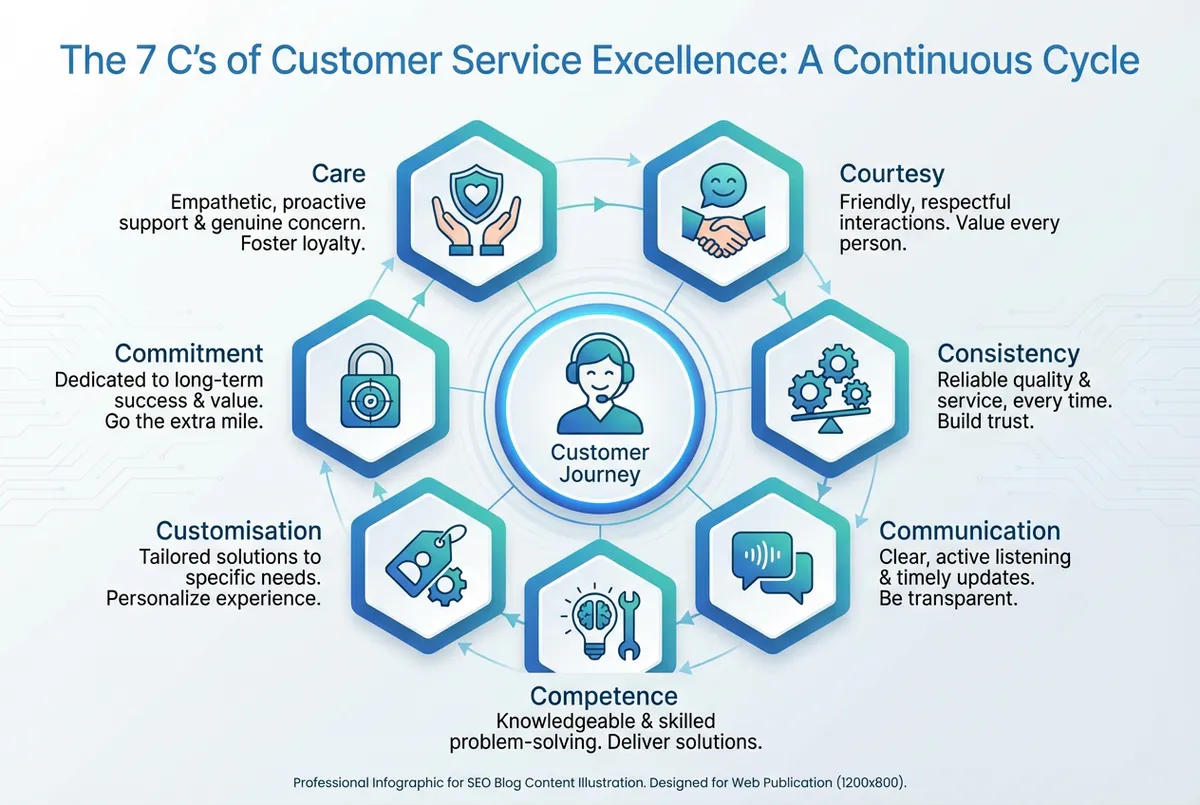
For example, a café might train Consistency by using a checklist for each table visit. A bistro might teach Customisation by helping staff spot regulars' habits: "Mrs. Thompson always wants still water with lemon, no ice."
What Type of Training Is Needed for Customer Service?
With frameworks covered, here's how to actually deliver training. Most programmes include three key areas:
Skills-Based Training
- Active listening: Hearing orders correctly, noting preferences
- Conflict resolution: Handling complaints without escalation
- Upselling techniques: Suggesting without being pushy
- Body language: Projecting warmth and attentiveness
Knowledge Training
- Menu expertise: Ingredients, allergens, preparation methods
- Wine and beverage: Pairing recommendations, proper service
- Company policies: Reservation systems, complaint procedures
- Health and safety: Food hygiene, licensing requirements
Practical Training
- Role-playing scenarios: Practise tricky situations before real service
- Shadowing experienced staff: Learn by watching with clear feedback
- Service simulations: Trial runs before live shifts
- Video review sessions: Record and review service moments
For instance, a gastropub might run weekly 15-minute role-plays. New staff practise handling wait time gripes. Mistakes in training mean fewer slip-ups when it counts.
Common Training Mistakes to Avoid
Many restaurants make training harder than it needs to be. Watch out for these pitfalls:
- Information overload: Cramming day one means nothing sticks
- No follow-up: One session without practice wastes the effort
- Theory without practice: Staff need hands-on time, not just talks
- Ignoring experienced staff: Long-time team members need growth too
Warning
If you're only doing one-off training sessions, you'll lose to competitors who build ongoing learning into their culture.
What Are the 5 P's of Customer Service?
Here's another framework that complements the 7 C's. The 5 P's focus on the mindset and approach:
| P | Meaning | Restaurant Application |
|---|---|---|
| Professionalism | Maintaining standards under pressure | Stay calm during busy Saturday service |
| Patience | Giving guests time and space | Allow customers to browse menus without rushing |
| Politeness | Courteous language and tone | "Certainly" not "Yeah, sure" |
| Personalisation | Individual attention | Remember names and preferences |
| Proactiveness | Anticipating needs | Refill water before glasses empty |
For example, a fine dining spot might drill Patience by timing how long servers wait before asking if guests have chosen. Staff who rush diners lose repeat bookings.
Pro tip
If your team struggles with keeping things the same between shifts, that's usually a sign the 5 P's need more focus in training.
How to Structure Effective Training
Moving from theory to practice, here's how to structure training. Good programmes follow a clear timeline:
Onboarding (Week 1)
- Company values and service philosophy
- Core systems and procedures
- Shadowing across all positions
- Initial menu and product training
Foundation (Weeks 2-4)
- Customer engagement frameworks (10/5/3, 7 C's)
- Practical skills development
- Supervised live service
- Feedback and coaching
Ongoing Development
- Monthly sessions on one skill area
- Quarterly checks to spot gaps
- Yearly reviews tied to staff appraisals
- Pair veterans with new hires
The biggest mistake? Treating training as "done" after the first week. Service skills need regular practice. Staff who trained six months ago need reminders too.
Info
If you only have 30 minutes a week for training, use it for a pre-shift chat. Cover that night's specials, VIP bookings, and one thing to work on. This builds skills bit by bit.
Why this matters
Restaurants that invest in structured training see 25-40% lower staff turnover than those relying on informal approaches, according to UKHospitality research.
Training on a Budget
But not every restaurant has money for training. Here are cheap approaches that work for small places:
Free and Low-Cost Options:
- Free resources: City & Guilds samples, supplier modules, YouTube tutorials
- Internal expertise: Senior staff leading sessions. They learn while teaching
- Micro-training: 10-minute sessions beat half-day workshops
- Peer feedback: Staff review each other with simple forms
- Online courses: £50-150 per person for certified courses
Budget Training Investment Guide:
| Approach | Cost | Time Required | Best For |
|---|---|---|---|
| Pre-shift briefings | Free | 5-10 mins daily | Ongoing reinforcement |
| Peer mentoring | Free | 1 hour weekly | New staff development |
| Online courses | £50-150 | Self-paced | Formal certification |
| External trainer | £500-1,500 | Half-day | Team building |
A local restaurant might try a "service star" system. Highlight one great moment each shift. It's free and creates good competition among staff.
Measuring Training Effectiveness
Finally, let's make sure your investment pays off. Without measurement, you won't know if training is working. Track these metrics:
Quantitative Measures:
- Mystery shopper scores: Outside checks on service quality
- Online review mentions: Track good and bad service comments
- Complaint frequency: Are issues going down over time?
- Average table spend: Good service often means bigger bills
- Staff retention rates: Trained staff stay longer
Qualitative Measures:
- Staff confidence surveys: How staff rate their own skills
- Manager observations: Feedback during shifts
- Guest feedback cards: Direct input from diners
- Table turn satisfaction: Did guests leave happy?
Much of this feedback surfaces in your online reviews, so it helps to pair training with tools that let you monitor your local reputation and catch service comments as they appear.
Warning
If you're reading this after a run of bad reviews, that's usually a sign training needs urgent help. Consider outside support for a reset.
Key Takeaways
If you run a restaurant and want to see how Local Brand Hub can support your marketing, explore our restaurant marketing tools.
Key Takeaways
In summary, here's what matters most. Restaurant customer service training isn't a one-time event. It's an ongoing process that separates thriving restaurants from struggling ones.
The tools exist (10/5/3 rule, 7 C's, 5 P's). But using them well takes practice. Start with one, master it, then build from there.
- Master the 10/5/3 rule for consistent guest engagement
- Use the 7 C's as your quality framework
- Apply the 5 P's for the right mindset
- Structure training across onboarding and ongoing development
- Measure results to know what's working
Weekly Action
This week, strengthen your training
- Review last week's feedback (reviews, complaints, observations)
- Run one focused 15-minute training session on a specific skill
- Observe and document improvement areas during service
- Celebrate one service win publicly with the team
Next steps:
- Implement the 10/5/3 rule in your next pre-shift meeting
- Review our customer service tips for quick wins
- Establish service standards to measure against
For UK restaurant owners
Train Your Team
LocalBrandHub works with UK restaurants to develop training programmes that transform service quality.
Start freeGet More Marketing Tips
Practical marketing tips for UK business owners, straight to your inbox. No spam, unsubscribe anytime.
About the Author
Local Brand Hub
Empowering UK Businesses
Local Brand Hub provides comprehensive business management tools designed specifically for UK local businesses to streamline operations, automate marketing, and grow revenue.
More articlesRelated Articles
 Marketing Tips
How to Improve Restaurant Customer Service: 7 Proven Steps
Train your team with the 10/5/3 greeting rule and 7 C's framework to lift restaurant customer service without spending more on staff.
 Marketing Tips
Restaurant Customer Service: UK Guide
Master restaurant customer service with proven frameworks. Learn the 7 steps of service and strategies that turn diners into regulars.
 Marketing Tips
Restaurant Customer Service Standards: A Practical UK Guide
Set clear restaurant customer service standards your team can follow. Covers greeting protocols, timing benchmarks, and quality checklists for UK venues.