
Learn how to measure and improve restaurant service quality using the SERVQUAL framework. Covers the 5 dimensions and practical UK tips.
Restaurant service quality is the measurable gap between what guests expect and what they actually experience across tangibles, reliability, responsiveness, assurance, and empathy: the five dimensions that determine whether guests return. You train your team. You set standards. Yet guests still leave unhappy, and you're not sure why. What's missing?
Short on time? Here's the quick version
- 5 SERVQUAL dimensions: Tangibles, Reliability, Responsiveness, Assurance, Empathy
- Service quality drives satisfaction: not the food alone, it is the service guests remember
- Gap 3 is critical: The delivery gap between standards and actual service
- Measure weekly: Score each dimension 1-5 and track trends
- Key mistake: Focusing on one dimension while neglecting others
5-dimension framework with improvement tips below
Many guests leave restaurants over service issues, not food quality. That means service quality often matters more than what's on the plate. If you're thinking "our food speaks for itself", the guest experience often says otherwise.
Related: Restaurant Customer Service - our complete hub guide
What You'll Learn
- The 5 SERVQUAL dimensions every restaurant should measure
- How to identify gaps between expectations and delivery
- Practical ways to improve each dimension
- Budget-friendly quality measurement tools
What Are the 5 Dimensions of Restaurant Service Quality?
Let's start with the basics. The SERVQUAL model is a framework that measures service quality across five core dimensions. Guests use these five areas to judge your service, often without knowing it.
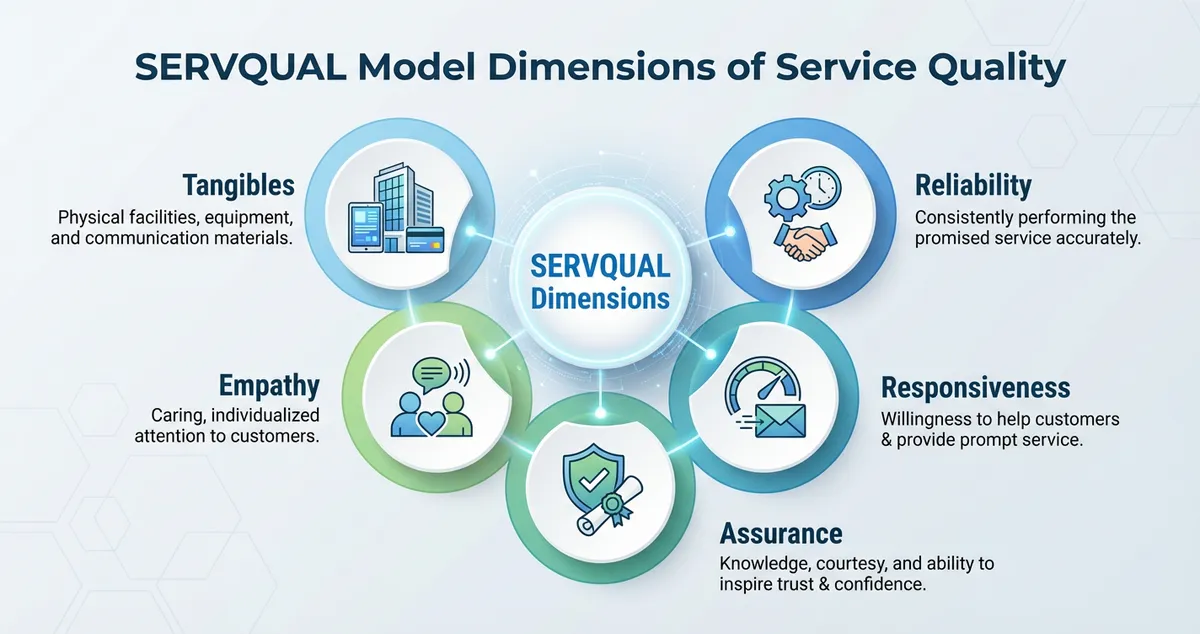
1. Tangibles
What guests can see and touch. The physical evidence of your service.
Key Elements:
- Restaurant cleanliness and décor
- Staff appearance and uniforms
- Table settings and presentation
- Menu design and quality
- Restroom condition
Real example
A gastropub might have brilliant food but lose marks when guests notice stained menus or unkempt restrooms. Tangibles set expectations before any service interaction happens.
2. Reliability
Your ability to deliver what you promise, consistently.
Key Elements:
- Order accuracy
- Consistent food quality
- Accurate wait time estimates
- Bill accuracy
- Keeping reservations
Info
If you're only getting orders right 90% of the time you'll always lose to competitors who achieve 99%. Reliability is the foundation of trust.
3. Responsiveness
How quickly and willingly you help guests.
Key Elements:
- Speed of initial greeting
- Attentiveness to guest needs
- Problem resolution speed
- Check-back timing
- Bill presentation when requested
For example, a casual dining spot might take 10 minutes to acknowledge a new table. That delay shapes the entire experience, regardless of what follows.
4. Assurance
The confidence your team inspires through knowledge and courtesy.
Key Elements:
- Menu knowledge
- Allergen information accuracy
- Wine and drinks expertise
- Professional demeanour
- Ability to answer questions
A server who confidently recommends dishes and explains allergens builds trust. One who says "I'll have to check" repeatedly undermines it.
5. Empathy
The individual attention and understanding guests receive.
Key Elements:
- Remembering regular guests
- Accommodating special requests
- Genuine care for guest experience
- Personalised service
- Understanding dietary needs
Real example
A neighbourhood bistro that remembers a guest's usual table and favourite wine delivers empathy that chains struggle to match.
Info
If you can't tell which dimension is weakest in your restaurant, that's usually a sign you need to start measuring properly.
Understanding the Gap Model of Service Quality
Now that you know the five dimensions, here's how to spot problems. The gap model is a framework that measures the difference between what guests expect and what they get. This gap shapes satisfaction.
The Perception-Expectation Gap:
| Scenario | Guest Experience | Outcome |
|---|---|---|
| Perception > Expectation | Exceeded expectations | Loyalty, recommendations |
| Perception = Expectation | Met expectations | Satisfaction, likely return |
| Perception < Expectation | Fell short | Disappointment, complaints |
Common Service Gaps:
- Knowledge Gap: Management doesn't know what guests expect
- Standards Gap: Service standards don't match guest expectations
- Delivery Gap: Actual service doesn't match standards
- Communication Gap: Marketing promises more than you deliver
- Perception Gap: Guests perceive service differently than intended
Real example
A restaurant advertises "fast casual service" but takes 25 minutes to serve mains. The communication gap between promise and reality creates dissatisfaction.
What Is Gap 3 in the Gap Model?
Gap 3 is the delivery gap. The delivery gap is a framework term for the difference between your written standards and what staff actually do during service. It's often the biggest gap in restaurants.
Why Gap 3 Happens:
- Staff don't know the standards
- Training is inadequate
- High turnover before habits form
- Standards aren't enforced
- No measurement or feedback
Closing Gap 3:
- Document standards clearly (see our service standards guide)
- Train standards at every pre-shift
- Measure compliance weekly
- Provide real-time feedback
- Celebrate staff who model standards
How Does Service Quality Affect Customer Satisfaction?
With gaps clear, let's connect this to business results. Service quality directly drives three outcomes: return visits, word-of-mouth, and spending. When guests feel service quality exceeds their expectations, satisfaction rises.
The Satisfaction Chain:
- Quality drives satisfaction: High perceived quality = high satisfaction
- Satisfaction drives loyalty: Satisfied guests return
- Loyalty drives revenue: Return guests spend more and recommend
Research on UK restaurants confirms this pattern. Happy guests come back. They tell friends. They spend more. Once your service consistently earns those return visits, it pays to keep your marketing just as consistent: you can compare the plans that help you fill tables week after week.
Why this matters
Improving service quality by even one dimension can shift guest perception from "acceptable" to "would recommend," according to UKHospitality research.
Would you recommend your own restaurant to a friend? That question reveals more about your service quality than any survey.
Measuring Service Quality in Practice
So how do you actually track this? You don't need fancy tools. Here's how to assess each dimension with what you already have.
Info
If you're reading this thinking "I don't have time for surveys", you're not alone. Start simple.
Simple Measurement Methods:
| Dimension | Measurement Method | Frequency |
|---|---|---|
| Tangibles | Walkthroughs, photo audits | Daily |
| Reliability | Order accuracy tracking | Every service |
| Responsiveness | Timing checks (greeting, food) | Weekly |
| Assurance | Mystery shopper, menu tests | Monthly |
| Empathy | Guest feedback, repeat rate | Monthly |
DIY Quality Scorecard:
Rate each dimension 1-5 weekly:
- Tangibles: Is everything clean and presentable?
- Reliability: Did we deliver what we promised?
- Responsiveness: Did guests wait too long for anything?
- Assurance: Could staff answer all questions confidently?
- Empathy: Did we make guests feel valued?
Track trends over time. A dip in one dimension signals where to focus.
Weekly Action
- Day 1-2: Review last week's feedback by dimension
- Day 3-4: Pick the weakest dimension and brief staff
- Day 5-7: Measure improvement and adjust
Improving Each Dimension
With measurement in place, here's how to improve each area. Focus on one dimension at a time, trying to fix everything at once never works.
Improving Tangibles
- Daily walkthroughs: Manager checks all guest-facing areas before service
- Photo standards: Take reference photos of correct table settings
- Uniform policy: Clear, enforced dress code
- Maintenance schedule: Fix issues within 24 hours
Improving Reliability
- Order systems: Use clear ticket systems to prevent errors
- Recipes: Standardise portions and presentation
- Time tracking: Monitor actual vs. promised wait times, and measure your table dwell time so faster service never tips into rushing guests
- Quality checks: Plate inspection before service
See our customer service tips for reliability scripts.
Improving Responsiveness
- The 30-second rule: Acknowledge all guests within 30 seconds
- The 3-bite check-back: Return within 3 bites of food arriving
- The 2-minute bill: Present bill within 2 minutes of request
- Empowerment: Staff can solve problems without manager approval
Improving Assurance
- Menu training: Test staff knowledge weekly
- Allergen confidence: Train on allergen procedures monthly
- Scenario practice: Role-play difficult questions
- Recognition: Praise staff who demonstrate expertise
Improving Empathy
- Guest notes: Record preferences in your booking system
- Name use: Use guest names when known
- Personalisation: Remember special occasions, dietary needs
- Genuine interest: Train staff to listen, not just serve
Warning
If you're only focusing on food service without considering these dimensions you'll always lose to competitors who deliver consistently across all five.
Common Service Quality Mistakes
Watch out for these pitfalls that undermine quality efforts.
- Measuring but not acting: Data without action is useless
- Focusing on one dimension: All five matter, don't neglect any
- Inconsistent standards: Quality varies by shift or staff member
- Blaming individuals: Look for system problems, not person problems
- Ignoring intangibles: Empathy and assurance are as important as speed
Real example
A fine dining restaurant focused heavily on tangibles and reliability but neglected empathy. Reviews praised the "beautiful room" but complained about "cold, robotic service."
Would you return to a restaurant where the décor was perfect but the staff seemed not to care? That question reveals why all five dimensions matter.
Minimum Viable Quality System
If you only have 30 minutes to start measuring service quality, do these three things:
- Score your five dimensions 1-5 based on last week's service
- Pick the lowest score and brief staff on improving it
- Ask 5 guests this week how you could improve
That's enough to start. Build from there.
Key Takeaways
If you run a restaurant and want to see how Local Brand Hub can support your marketing, explore our restaurant marketing tools.
Key Takeaways
In summary, here's what matters most. Restaurant service quality is measurable across five dimensions: tangibles, reliability, responsiveness, assurance, and empathy. The gap between guest expectations and perceptions determines satisfaction.
- Use the SERVQUAL framework: 5 dimensions to measure and improve
- Mind the gaps: Especially Gap 3 (delivery gap) between standards and reality
- Measure weekly: Score each dimension 1-5 and track trends
- Focus on one dimension at a time for improvement
- Connect quality to outcomes: Better quality = more returns and revenue
Weekly Action
This week, assess your service quality
- Complete a 5-dimension self-assessment based on last week
- Identify your weakest dimension and brief staff
- Gather guest feedback and compare to your assessment
- Track improvement in next week's review
For deeper learning:
- Set clear service standards for each dimension
- Train your team with our training guide
- Handle issues with our complaints guide
- Focus on customer satisfaction holistically
For UK restaurant owners
Measure Service Quality
LocalBrandHub works with UK restaurants to implement SERVQUAL-based measurement systems that drive consistent quality and repeat visits.
Start freeGet More Marketing Tips
Practical marketing tips for UK business owners, straight to your inbox. No spam, unsubscribe anytime.
About the Author
Local Brand Hub
Empowering UK Businesses
Local Brand Hub provides comprehensive business management tools designed specifically for UK local businesses to streamline operations, automate marketing, and grow revenue.
More articlesRelated Articles
 Marketing Tips
How to Improve Restaurant Customer Service: 7 Proven Steps
Train your team with the 10/5/3 greeting rule and 7 C's framework to lift restaurant customer service without spending more on staff.
 Marketing Tips
Restaurant Customer Complaints: How to Handle Them
Handle restaurant customer complaints with proven scripts and the LAST framework. Turn upset guests into regulars with these UK approaches.
 Marketing Tips
Restaurant Customer Satisfaction: Measure and Improve It
Learn how to measure and improve restaurant customer satisfaction with proven survey methods, key metrics, and practical strategies for UK venues.