Master restaurant signage marketing with this UK guide covering sign types, design principles, regulations, costs and ROI strategies.
You've spent thousands on the fit-out, but people walk past because your sign blends into the high street. Restaurant signage marketing is the strategic use of exterior, interior and digital signs to attract diners, reinforce your brand and increase revenue. Good signage turns foot traffic into paying customers.
What You'll Learn
- The main types of restaurant signage and when to use each one
- Design principles that make your signs readable and memorable
- UK planning permission and Advertisement Consent rules you need to follow
- How to calculate the ROI of your signage investment
- A step-by-step strategy to audit and upgrade your restaurant signs
- Budget benchmarks so you know what to expect from UK sign companies
Why Restaurant Signage Marketing Matters
First, let's establish why this matters more than most owners realise. You spent months perfecting your menu. The food is brilliant, the service is sharp, and the reviews are glowing. But people walk straight past your door because your sign blends into the high street like wallpaper. That's not a food problem. That's a restaurant signage marketing problem.
79% of diners say they would be less likely to enter a restaurant that had no signage at all (Custom Neon, 2025). That statistic makes intuitive sense. Your sign is often the first impression a potential customer gets. It tells them what kind of food you serve, what price point to expect, and whether the place is even open.
Info
Related: Restaurant Marketing Strategies: our complete guide to building your restaurant's marketing foundation
If you're thinking "my food speaks for itself," the reality is that nobody tastes your food from the pavement. Your signage does the talking before your kitchen gets a chance.
Good restaurant signage marketing works across three levels. First, it attracts new customers from passing foot traffic. Second, it informs: communicating your menu, opening hours, and offers. Third, it reinforces your brand so regular customers recognise you instantly, even from a moving car.
Types of Restaurant Signage
Building on that foundation, let's look at what options are actually available. Not every restaurant needs every type of sign. But understanding the full range helps you build a restaurant signage marketing plan that works for your location, budget, and brand.
Exterior Fascia Signs
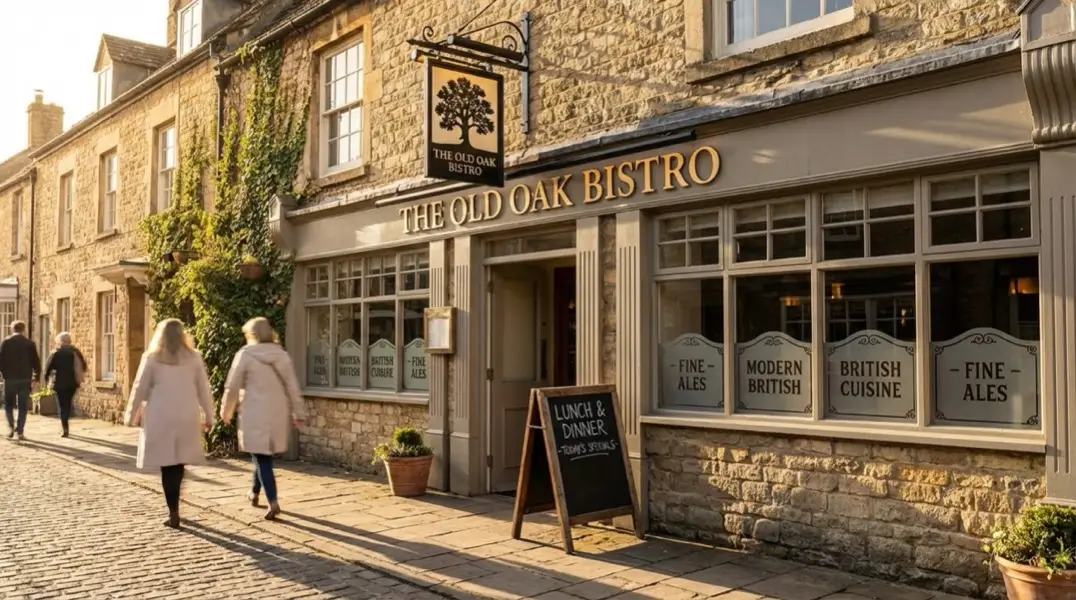
Your main sign: the one above the door. In any restaurant signage marketing strategy, this is your 24/7 salesperson. Fascia signs come in several forms:
- Flat panel signs: Printed or painted boards mounted flush to the building. Cost-effective and versatile.
- Built-up letters: Individual 3D letters fixed to the wall. Premium look, excellent for brand recognition.
- Illuminated signs: Internally lit panels or halo-lit letters. Essential if you serve dinner or operate on streets with poor lighting.
- Projecting signs: Signs that jut out from the building face, visible to pedestrians walking along the pavement rather than looking across the street.
A-Boards and Pavement Signs
The humble A-board is often one of the most cost-effective restaurant signage marketing tools available. Position it on the pavement to catch foot traffic with your daily specials, lunch deals, or a clever message that stops people scrolling their phones.
Be aware that many UK local councils have specific rules about A-boards: more on this in the regulations section below.
Window Graphics and Vinyl
Your windows are prime advertising space. Options include:
- Vinyl lettering: Opening hours, phone numbers, website URLs
- Frosted vinyl: Privacy with brand identity (great for ground-floor restaurants)
- Full window wraps: High-impact graphics showcasing your food or brand story
- Seasonal promotions: Removable graphics for Christmas menus, summer specials, or events
Menu Boards
Both indoor and outdoor menu boards play a crucial role in restaurant signage marketing. Outdoor menu boards let customers browse before committing to enter. This reduces the anxiety of walking into an unknown restaurant. Indoor menu boards behind the counter speed up ordering, particularly in quick-service settings.
Info
Related: Restaurant Branding Guide: how to build a brand identity that extends across all your signage
Digital Signage
Digital screens allow you to update menus instantly, run promotional content, and use dayparting to show different menus at breakfast, lunch, and dinner. For instance, a quick-service restaurant might display a breakfast deal until 11am, then automatically switch to the lunch menu without any staff intervention.
Wayfinding and Directional Signs
Often overlooked, but essential for multi-storey restaurants, venues with hidden entrances, or restaurants inside shopping centres. Clear directional signs reduce frustration and improves the customer experience from the moment they arrive.
For example, an Italian restaurant in a basement unit might use a pavement-level sign with an arrow pointing downstairs, a branded stairwell, and a lit entrance, turning an otherwise hidden location into a deliberate destination.
Restaurant Sign Design Principles
Now that you know what types of signs exist, how do you make them effective? A sign that looks good but cannot be read from 10 metres away is not a good sign. Effective restaurant signage marketing starts with function, then aesthetics.
Readability Comes First
For outdoor signs, text should have a minimum height of 3 inches for menu content, with your restaurant name significantly larger (Nento, 2025). Indoor menu boards should use 12-14 point fonts minimum for body text.
The 10-second rule: A passing pedestrian gives your sign roughly 10 seconds of attention. If they cannot read your name and understand what you serve in that time, the sign is failing. For example, a Thai restaurant with a decorative script font might look stunning close up, but from across the road nobody can tell whether it is a restaurant, a spa, or a solicitor's office.
Colour and Contrast
High-contrast combinations work best: dark text on light backgrounds, or light text on dark backgrounds. Avoid trendy low-contrast designs that look great on Instagram but disappear in daylight.
Readability ratings below are a rule of thumb based on general visibility at distance.
| Combination | Readability | Often Suited For |
|---|---|---|
| Black on white | Excellent | Menu boards, information signs |
| White on dark green/navy | Very good | Traditional pubs, fine dining |
| Gold on black | Good | Premium positioning |
| Neon colours | High impact | Casual dining, street food |
Brand Consistency
Consistent restaurant signage marketing means every sign, from the main fascia to the A-board to the toilet door signs, should feel like it belongs to the same family. Use consistent fonts, colours, and logo placement. If you're thinking "does the toilet sign really matter?", yes. It signals attention to detail.
Info
Related: Restaurant Website Design: extend your signage branding into your online presence
Lighting Matters
If you cannot tell whether your sign attracts customers or just fills space, that's usually a sign that your lighting and positioning need professional attention. If you serve evening meals, unlit signage is invisible signage. Options include:
- Internal illumination: Light boxes or channel letters with internal LEDs
- External spotlights: Gooseneck or trough lights mounted above the sign
- Halo lighting: LEDs behind letters creating a glow effect against the wall
- Neon or faux-neon: Statement lighting that doubles as decor
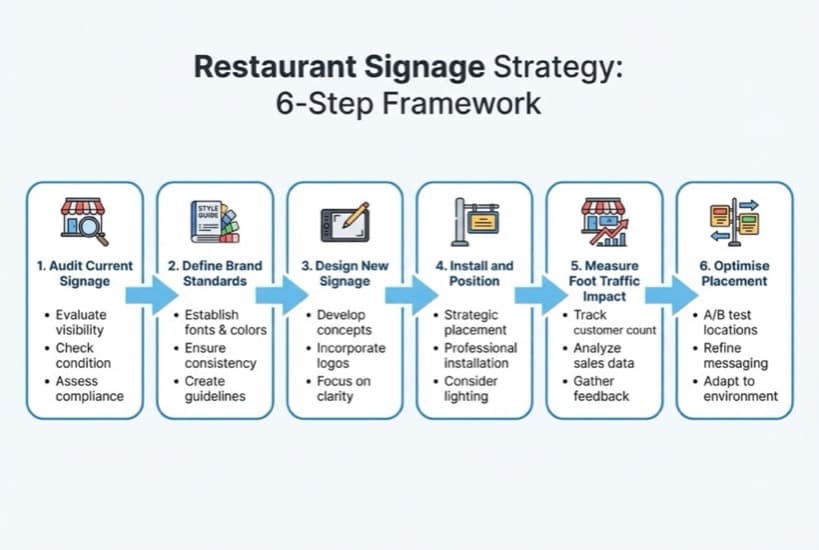
Restaurant signage design principles: readability, contrast, and lighting guidelines
UK Signage Regulations for Restaurants
However, before you commission any restaurant signage marketing materials, understand what you are legally allowed to display. Getting this wrong can mean removal notices, fines, or expensive sign modifications.
Planning Permission and Advertisement Consent
Under the Town and Country Planning (Control of Advertisements) (England) Regulations, most commercial signs require Advertisement Consent from your local planning authority. See the full gov.uk guidance on advertisements. Some signs benefit from "deemed consent", meaning they are automatically permitted if they meet specific size and placement criteria.
Signs that typically need explicit consent:
- Illuminated signs in most areas
- Signs above a certain size (varies by council)
- Signs in Conservation Areas, National Parks, or Areas of Outstanding Natural Beauty
- Projecting signs extending beyond certain distances
Signs that often have deemed consent:
- A single business nameplate under 0.3 square metres
- Temporary event notices (with restrictions)
- Signs within your building that are not visible from outside
Listed Building Restrictions
If your restaurant occupies a listed building, you will almost certainly need Listed Building Consent in addition to Advertisement Consent. This applies even for relatively minor changes like drilling fixings into the facade.
A-Board Regulations
A-boards are regulated at the local council level, and rules vary significantly across the UK. Some councils ban them outright on public pavements. Others permit them with restrictions on size, placement distance from the kerb, and the number allowed per business. Always check your local council's specific policy before investing.
Health and Safety Signage
Certain signs are legally required regardless of your restaurant signage marketing preferences: fire exits, allergen information displays, food hygiene rating stickers (see FSA food hygiene ratings), and no-smoking signs.
Signage ROI: What Returns Can You Expect
Consequently, is the investment actually worth it? Restaurant signage marketing is one of the few investments that works for you 24 hours a day without ongoing costs.
Digital signage can boost average order value by 3-5% (Market.us, 2025). Upselling opportunities increase by roughly 32% through dynamic digital content (Poster Booking, 2025).
The reality for most independent restaurants is that traditional signage ROI is harder to measure precisely. But consider this simple calculation:
Example ROI for a new illuminated fascia sign costing £2,500 installed: If it attracts just two extra covers per day at £25 average spend, that is roughly £18,000 in additional annual revenue. The sign pays for itself in weeks, not months. You can run the same sums for your own venue with our marketing ROI calculator to see how quickly an investment like this could pay off.
If you're only relying on online marketing you'll always lose to competitors who combine digital efforts with strong physical signage. People still walk down streets. They still look up.
Info
Related: Restaurant Gift Card Marketing: another in-venue marketing tactic that pairs well with signage
How to Plan Your Restaurant Signage Strategy
Now that the numbers make the case, here is how to put it all into practice.
Step 1: Audit Your Current Signage
Walk past your restaurant as if you have never seen it before. Better yet, ask someone who has genuinely never visited. Can they tell what you serve from across the street? Is your sign lit at night? Are opening hours visible? Is the A-board readable or has it faded?
Step 2: Identify Gaps
For instance, a curry house audit might reveal that the sign is invisible after 5pm, the A-board mentions a lunch deal that ended three months ago, and there is no outdoor menu board at all. Each gap is a lost customer.
Common signage gaps for UK restaurants include:
- No illumination for evening visibility
- Missing outdoor menu board
- Inconsistent branding across different signs
- No directional signs from nearby car parks or transport links
- Faded or damaged existing signs that hurt rather than help your image
Step 3: Set a Budget
Signage is a capital investment, not an ongoing expense. A reasonable restaurant signage marketing budget depends on your venue size and ambitions, but most small-to-medium restaurants spend several thousand pounds.
For example, a neighbourhood bistro might allocate the bulk of its budget to an illuminated fascia, then spend modest amounts on a chalkboard A-board and window vinyl, covering the essentials without overspending.
Step 4: Get Multiple Quotes
For your restaurant signage marketing project, approach at least three UK sign companies. Provide them with your brand guidelines (or let them know you need help creating them), your building photos, and your budget range. Compare not just price but also materials, warranty, installation quality, and aftercare.
- Photograph your building frontage (daytime and after dark)
- Prepare brand guidelines or logo files
- Contact three sign companies for quotes
- Compare materials, warranty, and installation terms
Step 5: Factor in Lead Times
Most UK sign companies need several weeks from design approval to installation. If you need planning permission or Advertisement Consent, add a further couple of months for the application process. Plan accordingly, especially if you are launching or rebranding.
Step 6: Measure and Iterate
After installation, track the impact of your restaurant signage marketing. Simple methods include:
- Asking new customers how they found you
- Comparing footfall or cover counts before and after
- Monitoring online search impressions for your restaurant name
- Tracking redemption of any offers displayed on signage
If your delivery drivers and first-time customers stop asking for directions, that's usually a sign your signage marketing is working.
Restaurant Signage Costs in the UK
Additionally, here is what you should expect to pay.
Costs below are typical industry estimates and vary by supplier and location.
| Sign Type | Typical UK Cost Range |
|---|---|
| Flat panel fascia | From a few hundred pounds |
| Illuminated fascia | Mid-four figures |
| A-board or window vinyl | Under £500 |
A complete restaurant signage marketing refresh for a small-to-medium venue typically costs several thousand pounds. Installation is usually included by reputable sign companies, but always confirm.
If You Only Have 30 Minutes a Week
Finally, not every restaurant owner has time for a complete signage overhaul this week. Here is your minimum viable approach:
This Week's Signage Audit
- Day 1-2: Walk past your restaurant at night. Can you read the sign? Take photos from across the street and from the pavement.
- Day 3-4: Check your A-board or outdoor menu board. Is the content current? Is it clean and legible? Update or clean it.
- Day 5-7: Search your local council's website for A-board and signage regulations. Note any restrictions that apply to your location.
For example, a fish and chip shop might discover their A-board is technically non-compliant with council rules, saving themselves a potential fine simply by checking. A gastropub might realise their beautiful hand-painted sign is invisible after 5pm because there is no lighting.
If you're reading this thinking "I don't have time for a signage project", start with the A-board. It takes 10 minutes to update and costs under £100 to replace.
Weekly Action
Maintain your restaurant signage marketing by picking one sign each week to clean, check, or update. Walk past it from both directions and note whether the message is clear and current. A 10-minute weekly habit keeps your signage working for you instead of against you.
Monthly Photo Check
Take a photo of each sign at night once a month. You will spot fading, burnt-out LEDs, and readability issues that you miss during daytime.
When did you last stand across the street and honestly assess your restaurant signage marketing? If the answer is "never," you have found your next priority.
If you run a restaurant and want to see how Local Brand Hub can support your marketing, explore our restaurant marketing tools.
Key Takeaway
Key Takeaway
- Signage is your silent salesperson: it works 24/7 without a wage bill
- Many diners are less likely to enter a restaurant without visible signage
- UK regulations matter: check Advertisement Consent rules and local council A-board policies before commissioning signs
- Design for readability first: if people cannot read your sign from the pavement, it is not working
- Brand consistency across all sign types builds recognition and trust
- Digital signage can increase average order values and drive impulse purchases
- Budget £3,000-£10,000 for a complete signage refresh for a small-to-medium UK restaurant
- Illumination is essential if you serve evening meals
Restaurant signage marketing is not decoration. It is marketing infrastructure. Treat it like any other investment, measure the returns, and update it before it starts working against you.
FAQ
Furthermore, here are the questions UK restaurant owners ask most often about signage marketing.
How much does restaurant signage cost in the UK?
Basic fascia signs start from a few hundred pounds for flat panels, with illuminated built-up lettering costing significantly more. A-boards are one of the most affordable options. A full restaurant signage marketing package for a small-to-medium venue typically costs several thousand pounds including installation.
Do I need planning permission for a restaurant sign?
Many commercial signs in England require Advertisement Consent under the Town and Country Planning (Control of Advertisements) Regulations. Some small signs have "deemed consent" automatically, but illuminated signs, signs in conservation areas, and larger signs typically need explicit permission from your local planning authority.
What is the best type of sign for a restaurant?
The best type of sign for a restaurant is a framework that combines visibility, information and brand consistency. For many UK restaurants, an illuminated fascia sign combined with an A-board and outdoor menu board often offers the strongest combination of brand visibility, practical information, and foot traffic conversion. Digital menu boards are increasingly popular for quick-service restaurants.
How often should I update my restaurant signage?
Refresh your restaurant signage marketing whenever the signs look tired or when rebranding. A-boards and promotional displays should be updated weekly or whenever your menu or offers change. Clean and maintain all signs at least quarterly. Faded or damaged signs actively hurt your restaurant signage marketing efforts.
Can I put an A-board outside my restaurant?
Rules vary by local council. Some UK councils ban A-boards on public pavements entirely, while others permit them with restrictions on size, placement, and number. Check your local authority's policy before purchasing. Penalties for non-compliance range from warnings to removal and fines.
For restaurants, salons, and local businesses
Need help with your marketing?
We help UK businesses turn social media into real results, not busywork.
Start freeGet More Marketing Tips
Practical marketing tips for UK business owners, straight to your inbox. No spam, unsubscribe anytime.
About the Author
Local Brand Hub
Empowering UK Businesses
Local Brand Hub provides comprehensive business management tools designed specifically for UK local businesses to streamline operations, automate marketing, and grow revenue.
More articlesRelated Articles
 Marketing Tips
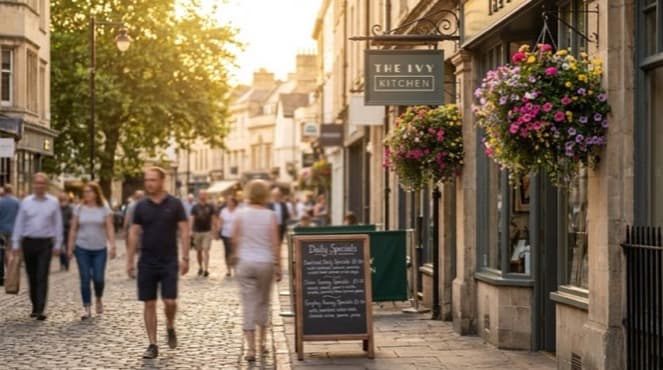
Restaurant Outdoor Signage: A-Boards & More
Choose the right restaurant outdoor signage for your UK venue. Compare A-boards, projecting signs, fascia options, costs and planning permission rules.
 Marketing Tips
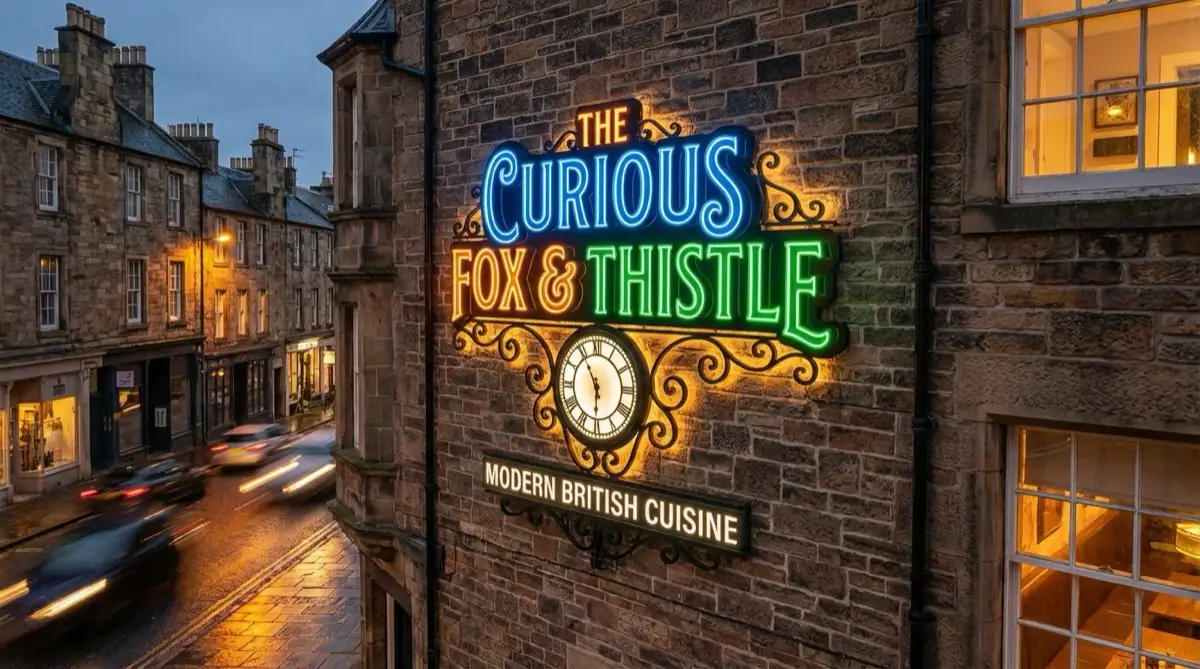
Restaurant Signage Ideas That Attract Customers
Discover 15+ creative restaurant signage ideas for UK venues. Chalkboards, neon, digital displays, window vinyl and menu boards with costs and tips.
 Marketing Tips
Restaurant Signage: Types, Costs and UK Regulations
Complete guide to restaurant signage for UK owners. Covers fascia signs, A-boards, LED lighting, menu boards, costs, materials and planning regulations.