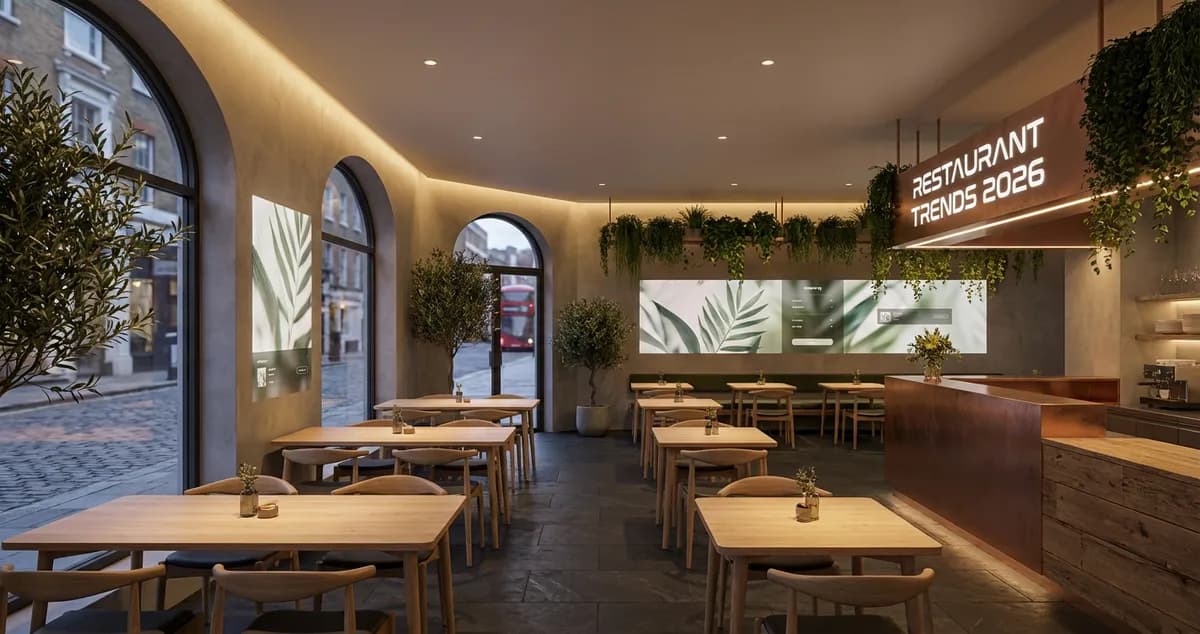
Watch the visual overview· 96 seconds
Restaurant trends reshaping UK dining: AI automation, plant-forward menus, 30/30/30 rule, actionable strategies for operators.
With UK restaurant profit margins averaging just 3-5%, your costs keep climbing while margins shrink. Energy bills doubled. Staff are harder to find. Yet the restaurant down the road seems busier than ever. Understanding the restaurant trends driving success in 2026 makes the difference.
Info
Related: Future of Restaurants - See where UK dining is heading next
If you are reading this after a 12-hour shift, you are not alone. Most owners know they should adapt. They just lack the time. The gap between knowing and doing is real.
The difference between struggling and thriving often comes down to understanding which restaurant trends matter and which ones you can ignore. This guide breaks down what is reshaping UK dining in 2026 so you can focus your limited energy where it counts.
What You'll Learn About Restaurant Trends
Restaurant trends in 2026 centre on three core themes: technology adoption, sustainable practices, and flexible dining experiences.
The UK foodservice market stands at roughly £104.8 billion according to industry forecasts. Understanding where this growth concentrates helps you position your restaurant to capture it.
In this guide, you will discover:
- The specific technology investments driving efficiency gains
- How the 30/30/30 rule applies to your cost structure
- Which food trends are worth adapting for your menu
- Design changes that improve both guest experience and operational flow
- What the future of restaurants looks like for UK operators
What Are the Latest Trends in Restaurants?
So where is the industry heading? The latest restaurant trends combine technology, sustainability, and personalisation. These changes help meet customer expectations while solving operational challenges.
According to SevenRooms 2025 research, most UK operators use AI for daily tasks. This has become essential rather than optional.
The trends break down into distinct categories. Each has practical applications for UK operators.
Info
Related: Restaurant Industry Trends UK - Deep dive into UK-specific patterns
Technology trends:
- AI-powered scheduling and inventory management
- Voice ordering and self-service kiosks
- Unified POS and kitchen display systems
- Predictive ordering based on weather and events
Menu and food trends:
- Plant-forward dishes as standard offerings
- Reduced menu complexity for efficiency
- Local sourcing to manage costs
- Global flavour integration, particularly Middle Eastern and Korean influences
For a deeper look at specific menu items, see our guide to food trends for restaurants.
Design and experience trends:
- Modular furniture for flexible layouts
- Acoustic improvements for comfort
- Technology integration points
- Outdoor dining as permanent features
What Is the 30/30/30 Rule for Restaurants?
Those trends sound promising, but how do you know if your business can afford to adapt? That brings us to the numbers.
The 30/30/30 rule is a financial framework that recommends putting 30% of revenue toward food costs, 30% toward labour, and 30% toward overhead. That leaves 10% as profit. This guideline helps operators maintain healthy margins while balancing competing expenses.
According to restaurant accounting specialists (US data, principles apply to UK), this breakdown provides a benchmark to measure your operations:
| Category | Target Allocation | What It Includes |
|---|---|---|
| Food Costs | 30% | Ingredients, beverages, packaging |
| Labour Costs | 30% | Wages, benefits, payroll taxes |
| Overhead | 30% | Rent, utilities, insurance, marketing |
| Profit | 10% | Net operating profit |
For example, a gastropub with £500,000 annual revenue would target £150,000 each for food, labour, and overhead.
In practice, many operators find their labour costs have crept higher while profit margins shrink. Current market conditions make hitting these targets difficult according to UKHospitality.
If you're thinking your percentages are nowhere close to these targets, you're not alone. Most independent restaurants face the same squeeze. The solution lies in leveraging restaurant technology trends to improve efficiency without simply cutting staff or reducing quality. If you want to see the numbers for your own venue, work out how much time and money you could save before committing to any new system.
What Is a Current Trend in the Food Industry?
Now that you understand the financial framework, what do diners actually want?
The plant-forward approach is a strategy that puts vegetables at the centre of the plate. It treats them as main dishes, not just sides. This is a dominant food trend according to industry research.
The key distinction: plant-forward is not the same as vegan-only. According to the National Restaurant Association (US data, principles apply to UK): restaurants position plant-based options as appealing choices rather than restrictions.
For instance, a neighbourhood Italian might add a mushroom and walnut ragu next to their classic bolognese. Same price. Now you reach flexitarian diners who were not booking before.
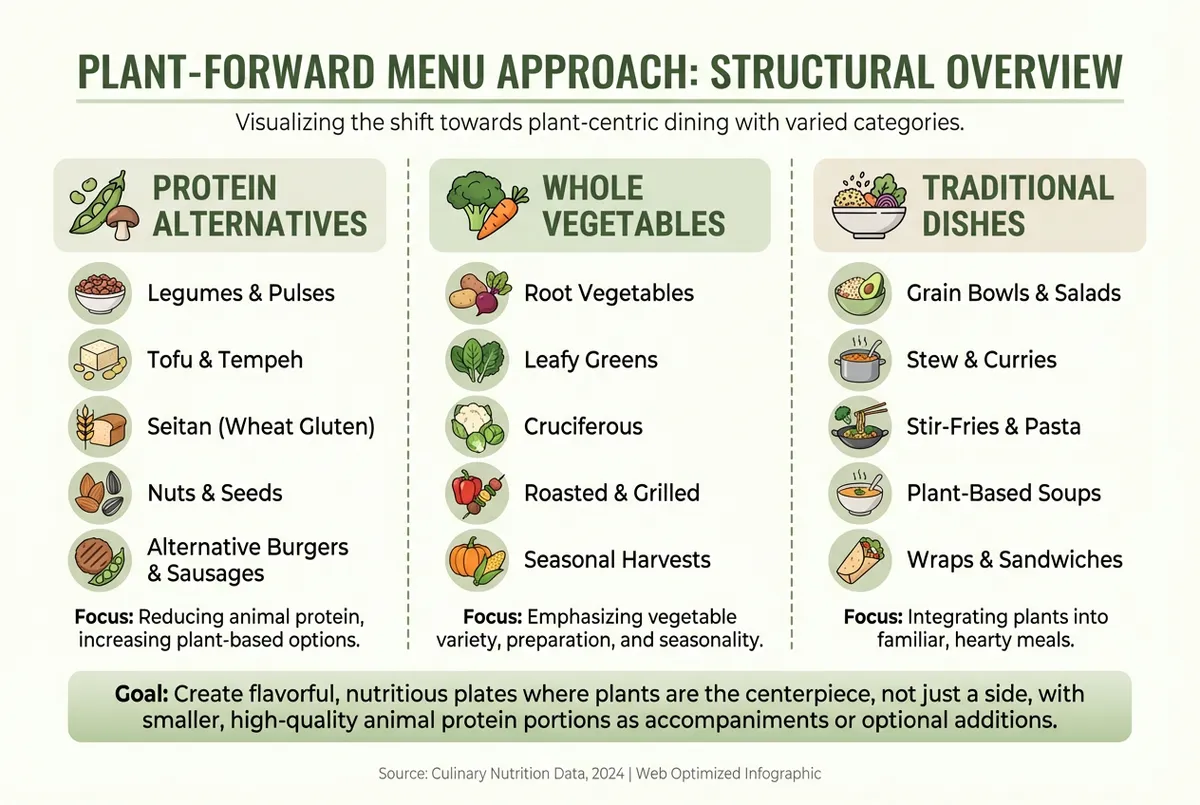
Plant-forward menu trends diagram
What is working in plant-forward menus:
- Whole ingredients over processed alternatives (lentils, chickpeas, mushrooms)
- Fungi and fermentation-based proteins gaining traction
- Fibre-forward dishes responding to health awareness
- Clean labels with recognisable ingredients
If you're only adding vegan options as an afterthought you'll always lose to competitors who integrate plant-forward dishes as genuine menu highlights.
For detailed guidance on adapting your menu, explore our restaurant menu trends guide.
What Are the Latest Restaurant Trends That Excite You?
With the financial and menu foundations covered, what gets UK operators genuinely excited? The trends generating enthusiasm focus on solving real problems rather than chasing novelty.
Unified technology ecosystems
For years, restaurants used disconnected systems. The industry has shifted toward integrated platforms. POS, kitchen displays, inventory, and scheduling work together. This means less manual data entry. Fewer errors. Better insights into what affects your bottom line.
For example, a busy bistro might use a unified system where a cancelled reservation automatically adjusts prep lists. The kitchen knows to scale down without a manager making calls.
Adaptive design
If you're juggling lunch service followed immediately by dinner prep, modular furniture and flexible layouts let you transform spaces fast. Switch between lunch and dinner service. Accommodate private events. Respond to changing customer preferences without major renovation.
According to restaurant design experts (US data, principles apply to UK), this adaptability directly affects check averages and return rates. For more on this topic, see our guide to restaurant design trends.
AI for back-of-house efficiency
The most exciting AI applications are not customer-facing. They are the systems that adjust staffing schedules based on predicted demand. They flag inventory issues before they become problems. They optimise prep schedules across the week.
If you can't tell whether your scheduling system is saving you time or just creating different admin work, that's usually a sign your current systems are creating work rather than reducing it. The restaurants that never quite get around to adopting better tools always lose to competitors who treat technology as essential.
Restaurant Trends 2026
So you understand the current landscape. What comes next? Several developments shape how UK restaurants operate and compete throughout 2026.
Labour efficiency remains critical
Hospitality vacancies remain elevated according to ONS data. Technology that helps existing staff work more effectively is not optional. Voice AI, self-service ordering, and automated scheduling are practical responses to an ongoing challenge.
Automation that began as simple scheduling includes predictive elements that anticipate problems before they occur. If you're only reacting to staffing gaps on the day, predictive scheduling puts other restaurants ahead.
Info
Related: Restaurant Trends 2025 - How these patterns emerged
Sustainability as baseline expectation
Zero-waste kitchens and local-first sourcing have moved from differentiators to basic requirements. If you're thinking "I can barely manage food costs, how am I supposed to worry about sustainability?", you are not alone. But customers expect environmental responsibility. This expectation influences booking decisions.
Experience over expansion
Rather than opening new locations, successful operators are deepening the experience at existing sites. Better acoustics. More comfortable seating. Improved lighting. Technology that enhances rather than interrupts dining.
If you are only investing when revenue is strong, restaurants that treat improvements as ongoing operations will consistently outperform you.
If You Only Have 30 Minutes a Week
Having explored these trends, let's talk about action. What can you actually do? When you are down two staff and barely keeping up, the last thing you need is another list. Here is a simpler path.
Here is a structured approach that respects your time:
If you only have 30 minutes a week, do this:
- Day 1-2: Pick one cost category (food, labour, or overhead). Calculate your actual percentage against the 30% benchmark.
- Day 3-4: During one quiet Wednesday service, note where guests seem confused or delighted. These observations reveal low-cost improvements.
- Day 5-7: Spend 30 minutes researching what solutions other restaurants use for your biggest friction point.
For example, a cafe owner might calculate labour costs on Monday, observe guest flow during a slow Tuesday afternoon, and spend Thursday morning reading about scheduling software options.
Weekly Action
Use this checklist to track your progress:
- Calculate one cost category percentage
- Note one guest friction point during service
- Research one solution for your biggest challenge
- Schedule 30 minutes next week to continue
Would you implement advice from someone who has never worked a Saturday rush? Based on our experience working with UK restaurant operators, everything in this guide comes from patterns that work for operators who are already stretched thin.
If you are reading this thinking "I barely have time to read this, let alone implement anything," that is exactly why the weekly checklist exists. Small consistent actions compound over time.
Key Takeaways: Restaurant Trends
If you run a restaurant and want to see how Local Brand Hub can support your marketing, explore our restaurant marketing tools.
Key Takeaways: Restaurant Trends
What matters most? The restaurant trends shaping 2026 help operators do more with less while meeting higher customer expectations.
- Technology should reduce staff burden, not add complexity
- Plant-forward menus appeal to mainstream diners, not just vegans
- Design flexibility pays dividends in operational adaptability
- The 30/30/30 rule provides benchmarks for healthy margins
Industry professionals confirm that successful restaurants treat these trends as tools for solving problems, not boxes to tick. Start with your biggest challenge and work backwards.
Your next step: Pick one section from this guide that addresses your most pressing challenge. Read the corresponding detailed guide and implement one change this week.
Ready to take action?
LocalBrandHub can help you build a content strategy around the trends that matter most to your restaurant. Our restaurant industry trends UK guide provides deeper insights for UK operators specifically.
For more on each trend area, explore our guides to restaurant technology trends, restaurant design trends, and restaurant menu trends.
For restaurants, salons, and local businesses
Need help with your marketing?
We help UK businesses turn social media into real results, not busywork.
Start freeGet More Marketing Tips
Practical marketing tips for UK business owners, straight to your inbox. No spam, unsubscribe anytime.
About the Author
Local Brand Hub
Empowering UK Businesses
Local Brand Hub provides comprehensive business management tools designed specifically for UK local businesses to streamline operations, automate marketing, and grow revenue.
More articlesRelated Articles
 Marketing Tips
Food Trends for Restaurants: What UK Diners Want in 2026
Top food trends for restaurants in 2026. Plant-forward menus, global comfort foods, functional ingredients: what UK diners expect.
 Marketing Tips
Future of Restaurants: UK Dining Trends for 2025-2026
Prepare your restaurant for 2025-2026 with trends shaping UK dining: AI ordering, nostalgia menus, and the 30/30/30 cost framework.
 Marketing Tips
Restaurant Technology Trends 2026: 7 UK Innovations
7 restaurant technology trends for 2026: AI ordering, smart kitchens, unified POS. Learn which tech investments deliver real ROI for UK venues.