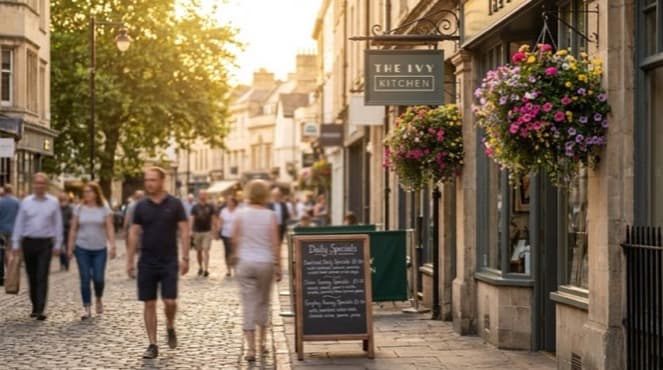
Choose the right restaurant outdoor signage for your UK venue. Compare A-boards, projecting signs, fascia options, costs and planning permission rules.
If you're a UK restaurant owner choosing exterior signs, restaurant outdoor signage includes five core types: A-boards, fascia signs, projecting signs, awnings and digital displays. The right combination attracts foot traffic, builds brand recognition and meets UK planning rules without overspending.
What You'll Learn:
- The five main types of restaurant outdoor signage and when to use each
- UK planning permission rules, including deemed consent and conservation areas
- Material and weatherproofing options suited to the British climate
- How to budget for outdoor signs without surprises
- Design tips that attract footfall without breaking regulations
You spent months perfecting your menu. The interior looks brilliant. But people keep walking past without a second glance. That hurts.
When did you last stand across the street and honestly judge whether your frontage draws people in? Your restaurant outdoor signage is the first thing potential customers see. If it is faded, cluttered or invisible, you are losing footfall before anyone reads a single dish.
Info
Related: Restaurant Signage Marketing, our complete guide to signage strategy for UK restaurants
This guide covers every type of restaurant outdoor signage in the UK, from budget-friendly A-boards to illuminated fascia signs. You will learn what needs planning permission, which materials survive British weather, and how to budget for each option.
Types of Restaurant Outdoor Signs
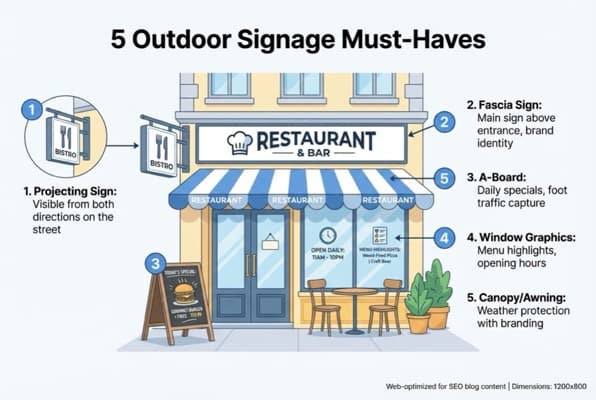
First, restaurant outdoor signage falls into five core categories. Each serves a different purpose, and many successful venues use a combination of two or three.
A-Boards and Pavement Signs
A-boards (also called sandwich boards or pavement signs) are the workhorses of restaurant outdoor signage. They sit on the pavement outside your door and show specials, opening hours or a simple invitation to come inside. Quick to update. Low cost. High impact.
One thing to watch: many local councils regulate pavement signs under the Highways Act. Some require permits, some ban them, and others set rules about placement width so pushchairs and wheelchairs can pass. Check your council's street trading or licensing team before you invest.
Info
Related: Restaurant Marketing Strategies, broader marketing tactics for independent restaurants
Fascia Signs and 3D Lettering
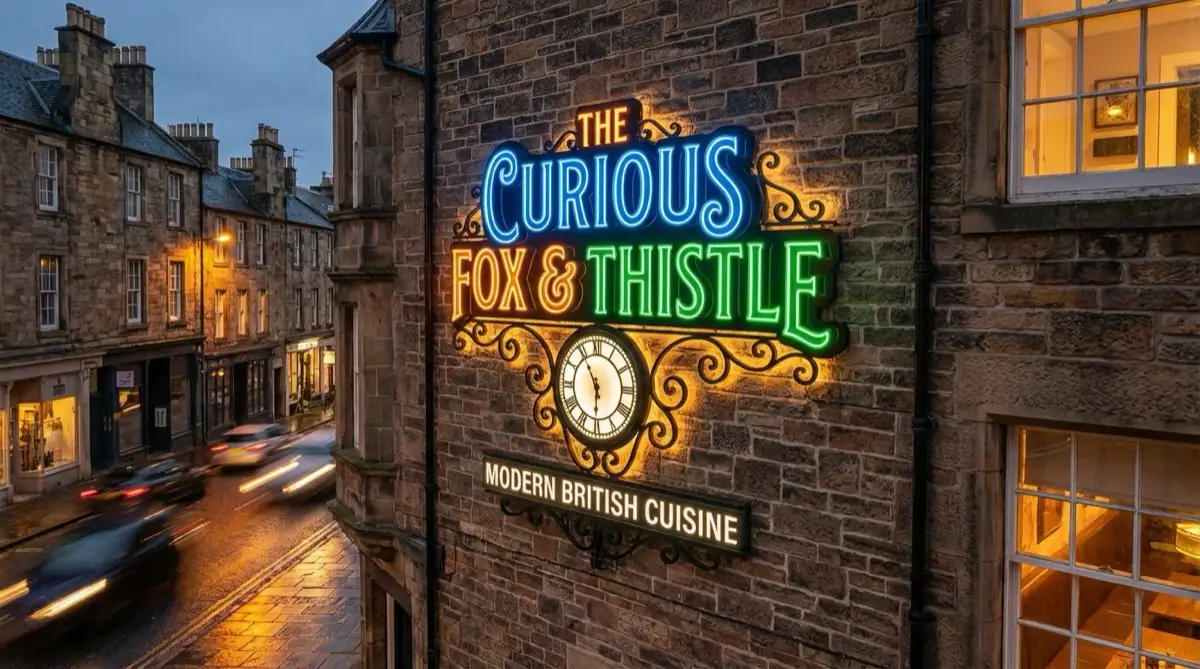
Your fascia sign is the permanent nameplate above your door. It works around the clock. It tells every passerby what your business is. Options range from flat vinyl lettering on an existing fascia board to bespoke 3D acrylic or metal letters with LED halo lighting. For example, a Thai restaurant on a busy high street might choose warm gold 3D acrylic letters on a dark timber fascia, visible from a distance and unmistakably inviting after dark.
Projecting Signs and Hanging Signs
Projecting signs (also called hanging signs or bracket signs) stick out from your building at a right angle. That means people walking along the street can spot them, not just those standing outside. For instance, a gastropub with a wrought-iron hanging sign gains visibility from well down the pavement. These signs typically need express advertisement consent from your local planning authority.
Awning Signage and Canopy Branding
Awnings serve a double purpose: shelter for outdoor diners and a branded canvas facing the street. Custom-printed retractable awnings with your restaurant name and logo create a welcoming entrance.
If you're thinking "we don't have outdoor seating," an awning still works. It frames your entrance, adds colour, and signals that your restaurant is open and welcoming. That visual warmth matters on a grey Tuesday afternoon when the tables are half empty and you need every walk-in you can get.
Digital Outdoor Displays
Digital restaurant outdoor signage is growing fast. Outdoor-rated screens let you rotate menus, show food photos, and update content remotely. The catch? Cost.
Outdoor-rated screens need a higher upfront investment plus ongoing content management. For most independent restaurants, a digital screen works as a supplement to traditional signage, not a replacement.
Best First Investment
If you can only afford one sign upgrade, make it your fascia. It is the one piece of restaurant outdoor signage that works around the clock and defines your street presence.
UK Planning Permission for Restaurant Signs
Building on those sign types, here is where restaurant owners often get caught out. Not every outdoor sign needs planning permission, but getting it wrong can mean a removal notice and a fine.
Deemed Consent vs Express Consent
Under UK advertising regulations, certain signs benefit from deemed consent, meaning you do not need to apply for permission. This generally applies to:
- Fascia signs on commercial premises (with size limits)
- Non-illuminated signs below a certain area
- Temporary signs for specific events
However, express consent (advertisement consent) is typically required for:
- Illuminated signs above certain brightness thresholds
- Projecting signs that extend beyond the building
- Signs in conservation areas or on listed buildings
- Digital or electronic displays
Conservation Areas and Listed Buildings
If your restaurant sits in a conservation area or occupies a listed building, the rules tighten. Expect extra steps. You will likely need both advertisement consent and listed building consent. Materials, colours, lighting and dimensions may all be restricted.
Your local conservation officer can advise on what is acceptable.
If you're only guessing at the rules without checking you'll always lose to competitors who got their permissions right and avoided enforcement delays.
The reality for most restaurant owners is that this feels slow. But ignoring it risks enforcement action. A 15-minute phone call to your council's planning department saves weeks of hassle later.
Info
Related: Restaurant Grand Opening Marketing, planning your launch, including signage
What Your Council Wants to See
When you apply for advertisement consent, your council will typically assess:
| Factor | What They Check |
|---|---|
| Amenity | Does the sign fit the visual character of the area? |
| Public safety | Could the sign distract drivers or block pedestrians? |
| Size and position | Does it meet the size limits for its type? |
| Lighting | Is the lighting level appropriate and not too bright? |
| Materials | Are they right for the building and area? |
Materials and Weatherproofing
Moreover, British weather is unkind to outdoor signs. Rain, wind, UV light and occasional frost all take their toll. Choosing the right materials is not about looks alone. It is about how your restaurant outdoor signage holds up after two winters, not just on install day.
Restaurant outdoor signage materials comparison
Material Comparison
Durability and weather resistance vary depending on installation quality and location, but as a rule of thumb:
| Material | Durability | Weather Resistance | Suits |
|---|---|---|---|
| Aluminium composite (Dibond) | Long-lasting | Excellent | Fascia signs, flat panels |
| Acrylic | Long-lasting | Very good | 3D letters, illuminated signs |
| Hardwood (oak, iroko) | Very long-lasting | Good (with treatment) | Hanging signs, traditional pubs |
| PVC foam board (Foamex) | Short-term outdoor | Moderate | Temporary signs, budget options |
| Chalkboard | Short-term | Poor (needs shelter) | A-boards, specials |
If you can only invest in one sign, make it aluminium composite or acrylic for the fascia. These materials handle UV, rain and temperature changes without warping or cracking.
For example, a seaside chippy in Cornwall might choose marine-grade aluminium composite for its fascia. It survives salt air and coastal winds. A cheaper foam board would degrade within a year.
LED Lighting
LED lighting has transformed restaurant outdoor signage. Energy-efficient LED tech can cut lighting costs compared to older fluorescent or neon options. Key options include:
- Halo-lit letters: LEDs behind 3D letters create a glow effect against the wall
- Front-lit letters: LEDs inside translucent acrylic letters
- Trough lighting: LED strips above or below the sign face
- Internally lit lightboxes: the entire sign panel glows
For most restaurants, halo-lit or front-lit 3D letters often offer a strong balance of visibility and style. Trough lighting is a more affordable retrofit if you already have a flat fascia board.
Design Tips for Outdoor Restaurant Signs
With your materials chosen, here's how to make sure your restaurant outdoor signage actually performs.
Readability Rules
Your sign needs to work at three distances:
- Far away: People should spot your business type (restaurant, cafe, pub)
- Mid-range: The full name should be clearly readable
- Close up: Extra details (opening hours, specials) should be legible
A common mistake is cramming too much text onto a fascia sign. Keep it simple. If you cannot read your sign from across the road in under three seconds, that's usually a sign your fascia has too much on it. Your name and cuisine type are enough. Save the details for your A-board or window graphics.
Colour Contrast and Font Choices
Contrast matters most. Dark text on a light background (or the reverse) outperforms low-contrast schemes. Avoid script fonts for main signage. They look elegant up close but vanish at distance.
Brand Consistency
Your outdoor signs should match your interior branding, your website, and your social media. Consistency builds trust. It also builds recognition. A customer who sees your sign, checks your Instagram, and then visits your website should get the same visual identity at every step. For instance, a modern burger bar with a neon-green logo on its fascia but a muted brown palette on Instagram sends mixed signals that weaken brand recall. And once your branding is consistent, make sure customers can actually find you online: working through a local SEO checklist keeps your opening hours, reviews and directions as easy to spot as your sign itself.
Info
Related: Restaurant Gift Card Marketing, another touchpoint where brand consistency matters
Accessibility
Good restaurant outdoor signage is inclusive. This matters. Consider:
- Strong colour contrast for visitors with visual needs
- Large enough text for older customers
- Clear wayfinding for wheelchair users approaching your entrance
- Avoiding signs that create trip hazards on the pavement
How to Budget for Restaurant Outdoor Signage
Additionally, if you're thinking "how much is this actually going to cost me?", here is a straightforward breakdown by sign type and budget tier.
Budget tiers are approximate and vary by supplier, location and spec:
| Sign Type | Budget Tier | Notes |
|---|---|---|
| A-board (chalkboard) | Low | Cheapest entry point for restaurant outdoor signage |
| Window vinyl | Low | Cut letters or frosted effect |
| Fascia sign (flat vinyl) | Low-Mid | Permanent, defines street presence |
| 3D lettering | Mid | Acrylic or metal, with or without LED |
| Projecting sign | Mid | Requires planning consent in most areas |
| Branded awning | Mid-High | Doubles as shelter and branding |
| Digital screen (outdoor) | High | Higher upfront and ongoing costs |
Installation adds to the total depending on height and building type. Planning permission applications also carry a fee. If your signage has not been updated in over five years, that's usually a sign your restaurant outdoor signage is costing you customers without you knowing.
Where to Spend and Where to Save
For most independent restaurants, the smart approach is:
- Spend well on your fascia sign. It is permanent, visible round the clock, and defines your street presence
- Go mid-range on a projecting sign if your location has passing foot traffic from both directions
- Start budget on an A-board. A cheap chalkboard updated with fresh content often outperforms a pricier printed board with outdated information
For example, a new Italian trattoria might spend the bulk of its signage budget on an illuminated 3D fascia and pair it with a hand-lettered chalkboard A-board for specials. That combination covers both permanent identity and flexible daily messaging.
Weekly Action Plan
Finally, here's a structured plan to get your restaurant outdoor signage sorted this week.
If you only have 30 minutes a week, do this:
- Day 1-2: Photograph your current outdoor signage from across the street, halfway down the pavement and right outside the door. Can you read it at each distance?
- Day 3-4: Call your local council planning department and ask about advertisement consent for your property
- Day 5-7: Get three quotes from local sign companies for the most urgent upgrade (usually fascia or A-board)
Restaurant Outdoor Signage Checklist
- Fascia sign is clean, well-lit and readable from across the street
- A-board or pavement sign shows fresh content (not last week's specials)
- Projecting sign is secure and visible from both directions (if applicable)
- All outdoor signs match your brand colours and fonts
- Planning permission is confirmed for any illuminated or projecting signs
- Materials can withstand British weather for years, not months
- Signs do not obstruct the pavement for wheelchair or pushchair users
- Lighting is working and appropriate for evening visibility
Frequently Asked Questions
Do I need planning permission for a restaurant A-board?
A-board rules vary by council. Many UK local authorities require a licence or permit under the Highways Act, and some ban pavement signs. Contact your council's street licensing team before buying. For example, Westminster Council in London has strict rules on A-boards, while many rural councils are more relaxed. Always check before you invest.
What material works for outdoor restaurant signs in the UK?
The aluminium composite panel (Dibond) system is a framework that combines thin aluminium sheets with a solid core. It offers strong durability, weather resistance and value for most UK restaurants. It lasts many years. It resists UV fading and rain damage. It works well for both flat fascia signs and mounted panels. For traditional pubs, treated hardwood remains a solid choice.
How much does a restaurant fascia sign cost?
Costs vary widely. It depends on materials, size and lighting. A basic flat vinyl fascia sits at the low end of the budget range. Mid-range options with acrylic lettering cost more but look substantially better. Illuminated 3D lettering or halo-lit signs represent the premium tier. For instance, a small cafe might get a clean vinyl fascia for a modest sum, while a large pub frontage with 3D halo-lit letters would need a much bigger investment. Installation adds to each tier.
Can I have an illuminated sign on my restaurant?
Illuminated signs are typically permitted in commercial areas but often require express advertisement consent from your local planning authority. Conservation areas and listed buildings face stricter controls on lighting type, brightness and operating hours. LED lighting is generally preferred for its energy savings and lower light spillage.
How do I make my restaurant outdoor signage stand out?
Focus on three things: high contrast between text and background, large enough text to read from a distance, and consistent branding across all signs. A well-lit, clean fascia sign with your restaurant name in a clear font typically outperforms elaborate designs that sacrifice readability. If your sign looks great at arm's length but disappears from across the road, that's usually a sign you have prioritised style over function.
If you run a restaurant and want to see how Local Brand Hub can support your marketing, explore our restaurant marketing tools.
Key Takeaway
Key Takeaway
Restaurant outdoor signage isn't about spending thousands. It's about making the right impression before anyone opens your door.
- Restaurant outdoor signage works in layers: fascia for identity, projecting signs for visibility, A-boards for daily content
- UK planning permission rules vary by sign type, lighting and location. Check before you order
- Aluminium composite and acrylic tend to be among the more durable materials for the British climate
- Invest in your fascia sign first: it is typically the highest-impact outdoor sign
- High-contrast text, clear fonts and consistent branding often beat elaborate design
- If you're thinking "I'll sort the signage later," remember that every day without clear outdoor signs is a day of lost footfall
For restaurants, salons, and local businesses
Need help with your marketing?
We help UK businesses turn social media into real results, not busywork.
Start freeGet More Marketing Tips
Practical marketing tips for UK business owners, straight to your inbox. No spam, unsubscribe anytime.
About the Author
Local Brand Hub
Empowering UK Businesses
Local Brand Hub provides comprehensive business management tools designed specifically for UK local businesses to streamline operations, automate marketing, and grow revenue.
More articlesRelated Articles
 Marketing Tips
Restaurant Signage: Types, Costs and UK Regulations
Complete guide to restaurant signage for UK owners. Covers fascia signs, A-boards, LED lighting, menu boards, costs, materials and planning regulations.
 Marketing Tips
Restaurant Interior Signage: Menu Boards & Upselling
Plan your restaurant interior signage strategy. Compare menu boards, wayfinding signs, hygiene displays and upselling signage with UK costs and rules.
 Marketing Tips
Restaurant Signage Ideas That Attract Customers
Discover 15+ creative restaurant signage ideas for UK venues. Chalkboards, neon, digital displays, window vinyl and menu boards with costs and tips.