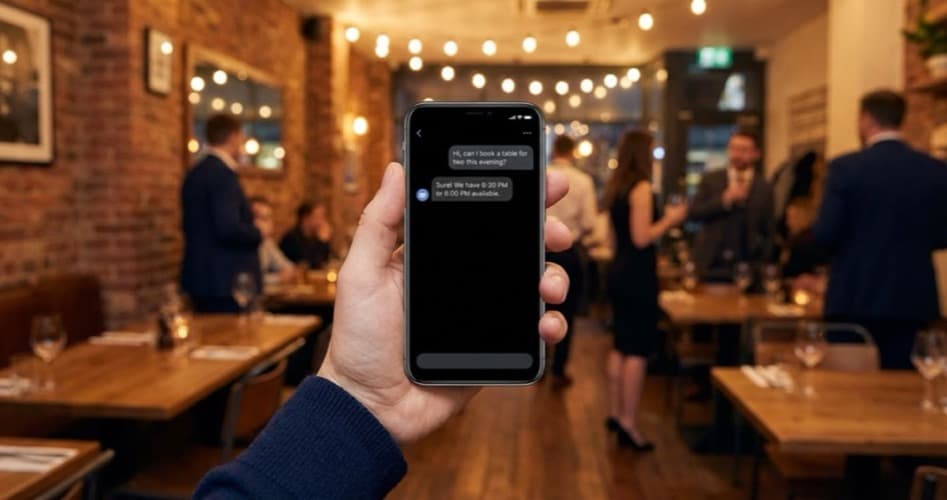
Set up a restaurant chatbot for bookings, FAQs and WhatsApp at your UK venue. Compare providers with real pricing and a step-by-step guide.
It is 10pm on a Friday. You've just finished cashing up after a 12-hour shift. Your phone pings: three Facebook messages asking about tomorrow night. A restaurant chatbot is an AI-powered tool that handles booking requests, answers common questions and takes orders through your website or messaging apps, without you lifting a finger.
How many booking enquiries did you miss last weekend? Those unanswered messages are costing you covers. Around a third of customers prefer using a chatbot to make a restaurant reservation (Tidio, 2025). Miss those messages overnight and they book somewhere else.
This guide walks you through choosing, setting up and actually using a restaurant chatbot for your UK venue, with real pricing and honest trade-offs.
What You'll Learn
- What a restaurant chatbot does and what it cannot do
- How booking bots, FAQ bots and ordering bots differ
- UK providers with real pricing from free to £30/month
- How to set up a chatbot on WhatsApp, Messenger and your website
- GDPR considerations UK operators need to know
- A 30-minute-a-week plan to keep your bot running smoothly
What Is a Restaurant Chatbot?
The restaurant chatbot is a framework that automates conversations with your customers across your website, social media and messaging apps. It uses pre-set rules or AI to answer questions, take bookings and sometimes process orders, all without needing a human on the other end.
Think of it as a digital front-of-house assistant that never clocks off.
Early chatbots followed rigid scripts. Modern AI chatbots from providers like Feebi, Tableo and ManyChat understand natural language, handle follow-up questions and connect directly to your restaurant technology stack.
Info
Why this matters: A restaurant that replies within five minutes is far more likely to secure the booking than one that takes seven hours. Chatbots close that gap overnight.
If you're thinking "my customers want to talk to a real person," you are partly right. Complex complaints still need a human touch. But most questions ("Are you open on Mondays?", "Can I book for six on Saturday?") follow predictable patterns. That is where a chatbot earns its keep.
Three Types of Restaurant Chatbot and Which You Need
Now that you know what a chatbot does, which type do you actually need? Not all restaurant chatbots handle the same tasks.
Booking Bots
These handle the reservation workflow: checking availability, confirming dates and party sizes, and syncing with your booking system. If you already use ResDiary, OpenTable or Tableo, a booking bot slots in as the front end.
Best for: Restaurants losing bookings because nobody answers the phone during service.
FAQ Bots
These answer the same twenty questions you get every week. Opening hours, parking, dietary options, dress codes, group bookings.
Best for: Venues drowning in repetitive enquiries across multiple channels.
Ordering Bots
These let customers browse your menu and place orders through WhatsApp or Messenger. Integrations with AI for restaurants tools make these increasingly accurate.
For example, a fish and chip shop in Leeds uses a WhatsApp ordering bot. Customers message their order, the bot confirms it and gives a collection time. No phone queue, no misheard orders.
Best for: Takeaway-heavy restaurants wanting to reduce reliance on third-party delivery platforms.
Pro Tip
For most independent UK restaurants, a combined booking and FAQ bot typically offers the strongest return on investment. Ordering bots add complexity and usually suit high-volume takeaway operations.
If you're only answering phone calls for bookings and ignoring online messages you'll always lose to competitors who capture those enquiries automatically.
UK Restaurant Chatbot Providers Compared
With that in mind, here's how the main UK-relevant providers compare. Pricing reflects February 2026 rates.
| Provider | Starting Price | Channels | Best For | Booking Integration |
|---|---|---|---|---|
| Feebi | From £30+VAT/mo | Website, Messenger | UK restaurants, pubs, bars | ResDiary, OpenTable |
| Tableo | Free (with plan) | WhatsApp, Messenger, Instagram | Venues using Tableo | Built-in |
| ManyChat | Free tier available | Messenger, Instagram, WhatsApp | Multi-channel marketing | Via integrations |
| Landbot | Paid plans available | Website, WhatsApp | No-code custom bots | Via webhooks |
| Chatfuel | Paid plans available | Messenger, Instagram, WhatsApp | Facebook-heavy venues | Via integrations |
Prices sourced from provider websites, February 2026. Rates may vary.
Which Should You Choose?
Already using ResDiary or OpenTable? Feebi plugs in directly. At £30+VAT per month per venue, it is among the most affordable purpose-built options for UK hospitality.
Using Tableo for bookings? Their built-in AI assistant handles WhatsApp, Messenger and Instagram at no extra cost beyond your Tableo subscription.
Want flexibility on a budget? ManyChat's free tier covers up to 1,000 contacts across Messenger, Instagram and WhatsApp. It takes more setup time, but you can customise flows for your exact needs.
For instance, a family-run Italian in Manchester chose Feebi because it connected to their existing ResDiary account. Setup took less than a day. Within a fortnight, the chatbot was handling booking enquiries that previously went unanswered overnight.
How Do Reservation Bots Work?
You have picked a provider. Now here is what actually happens when a customer messages your chatbot about a booking.
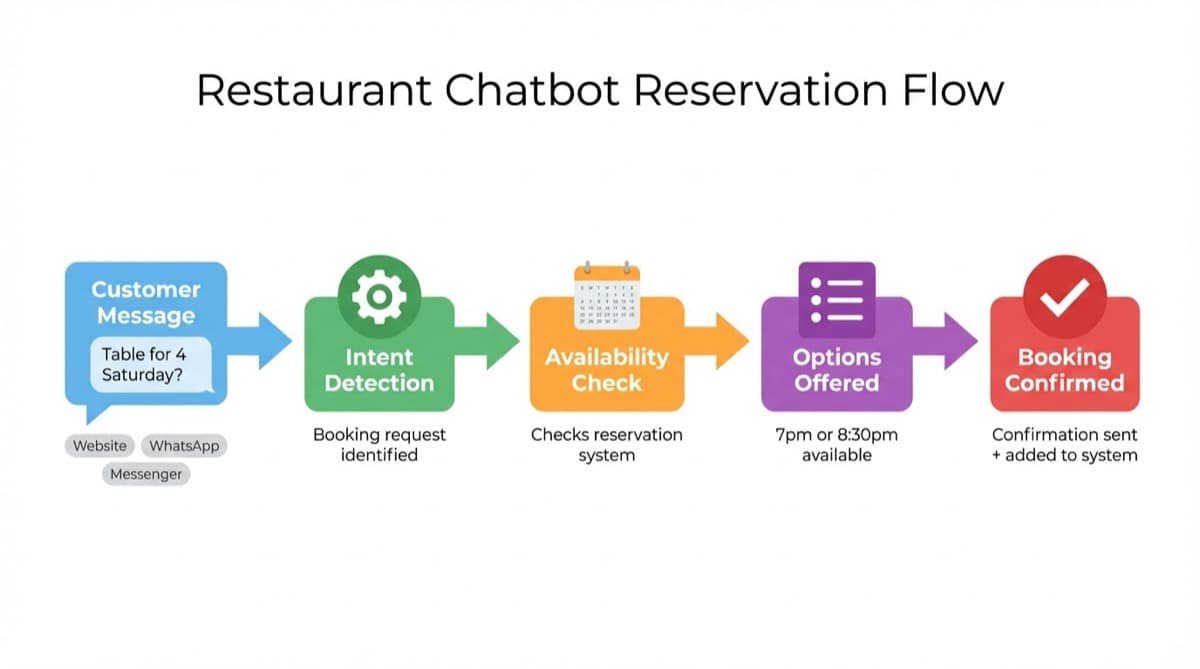
Restaurant chatbot reservation flow from customer message to confirmed booking
- Customer sends a message: "Table for 4 this Saturday?" via your website widget, WhatsApp or Messenger
- Bot identifies intent: The chatbot recognises this is a booking request, not a menu question
- Bot checks availability: It queries your booking system in real time
- Bot asks for details: Date, time, party size, name, phone number and dietary requirements
- Bot confirms the booking: Customer receives instant confirmation with a reference number
- Booking syncs: The reservation appears in your booking system automatically
The entire exchange often takes under two minutes. No phone tag. No lost bookings.
For example, if Saturday at 7pm is full, a well-configured bot suggests alternatives: "Saturday at 7pm is fully booked, but we have tables at 6:15pm or 8:30pm. Would either work?" That ability to offer alternatives rather than simply saying "no" separates a useful chatbot from a glorified contact form.
If you can't tell whether your current enquiry process is losing you bookings or just annoying people, that's usually a sign it is time to test a chatbot on one channel and compare.
Setting Up a Restaurant Chatbot on WhatsApp and Messenger
Next, let's walk through the practical setup for two of the most widely used messaging channels in the UK.
WhatsApp Business Setup
WhatsApp has an estimated 30 million UK users (Statista, 2025), making it one of the most popular messaging apps in the country. Setting up a restaurant chatbot on WhatsApp requires:
- WhatsApp Business account: Download the free WhatsApp Business app or apply for the Business API (needed for chatbot providers)
- Chatbot provider: Connect through Tableo, ManyChat or Chatfuel
- Verified business number: WhatsApp requires a dedicated phone number
Cost note: WhatsApp Business API uses conversation-based pricing: typically a few pence per exchange. For most restaurants, this amounts to under £20 per month.
Facebook Messenger Setup
Messenger connects directly to your Facebook page, which many UK restaurants already have.
- Link your Facebook page to your chatbot provider
- Build conversation flows: Start with booking and FAQ templates, then customise
- Test thoroughly: Cover common scenarios before going live
If you're thinking "that sounds like a lot of work," most providers offer restaurant-specific templates. Feebi comes pre-loaded with hospitality conversation flows. You add your specific details: menu, hours, parking instructions, and go live.
Match your brand voice
Set your chatbot's greeting to match your brand voice. A casual pizza place and a fine dining venue should not sound the same in automated messages.
For restaurant customer service teams, the key benefit is consistency. Every customer gets the same accurate information, whether they message at 2pm or 2am.
Website Chat Widget
Many providers also offer an embeddable widget for your website. This typically means copying a small code snippet into your site header. WordPress, Squarespace and Wix generally support paste-and-go integrations.
Would I actually use my own restaurant's chatbot to book a table? If the answer is no, your customers probably will not either. Test it yourself first.
How Much Does a Restaurant Chatbot Cost?
Setup is sorted. Now the honest cost breakdown, because the sticker price rarely tells the full story.
Budget tier (most independents): Free to around £30+VAT per month for the chatbot subscription, plus modest WhatsApp fees. Total year-one spend typically falls under £600.
Mid-range tier: Monthly subscriptions between £30 and £100, often with professional onboarding. Expect a first-year investment of roughly £600 to £2,400.
Premium tier: Multi-site chains with complex integrations. Costs run higher and usually include dedicated support.
For instance, a neighbourhood bistro paying £30+VAT for Feebi plus modest messaging fees spends well under £600 in year one. Chatbot interactions typically cost a fraction of what a human agent charges for the same query (Tidio, 2025). That difference adds up when you are fielding enquiries every evening.
If you cannot tell whether the investment makes sense for your venue, count your missed calls and unanswered messages over the past month. Multiply by your average cover value. That is your potential upside. The same simple maths applies to your wider marketing spend: our ROI calculator turns the hours you could save into a pound figure.
GDPR and Data Compliance
Under UK GDPR, any personal data your chatbot collects (names, phone numbers, dietary information) must be:
- Collected with clear consent: Explain what data you collect and why
- Stored securely: Choose providers with UK or EU data centres (Feebi hosts in the UK)
- Deletable on request: Customers can ask for their data to be removed
Practical step: Add a privacy notice to your chatbot's welcome message and review your provider's data processing agreement before signing up. The ICO's guide to UK GDPR covers the essentials.
If You Only Have 30 Minutes a Week
Finally, here's how to get a restaurant chatbot running if you only have 30 minutes a week:
This week, set up your first restaurant chatbot
- Day 1-2: Sign up for Feebi (free trial) or ManyChat (free tier). Connect your Facebook page and enter your restaurant details: hours, menu highlights, parking info
- Day 3-4: Build your top 10 FAQ answers. Write short, accurate replies for your most common questions. Connect your reservation system
- Day 5-7: Go live on one channel (website or Messenger). Monitor responses over the weekend. Adjust answers that miss the mark
Week 2 onwards (10 minutes per week): Review conversation logs. Add responses for questions the bot could not answer. Check booking confirmations are syncing correctly.
The reality for most independent restaurants is that time is the scarcest resource. The most common mistake is trying to automate everything at once. Start with bookings and your top FAQs. Add ordering later if it makes sense for your operation.
For example, a curry house in Birmingham launched with just ten FAQ answers and a booking link. After two weeks they added five more answers based on questions the bot could not handle. By week four, the bot was answering over 90% of incoming messages without help.
Info
A restaurant chatbot is not about replacing your team. It is about freeing them to do what humans do best: make guests feel welcome when they walk through the door.
Key Takeaway
If you run a restaurant and want to see how Local Brand Hub can support your marketing, explore our restaurant marketing tools.
Key Takeaway
A restaurant chatbot handles bookings, FAQs and orders through your website, WhatsApp and Messenger, giving customers instant replies around the clock. UK providers like Feebi (from £30+VAT/month) and Tableo (built-in) offer purpose-built solutions with local booking system integrations. Start with a booking and FAQ bot before adding ordering: it covers the highest volume of enquiries with the least complexity. GDPR compliance matters: choose providers with UK data hosting and clear data processing agreements. Pick one provider from the comparison table above, sign up for a free trial today, connect it to one channel, and let it run for seven days to see the difference.
Frequently Asked Questions
Can a chatbot order food?
Yes, a chatbot can handle food orders. Ordering bots allow customers to browse your menu and place orders directly through WhatsApp, Messenger or your website. That said, ordering bots tend to suit takeaway and delivery operations best. If you run a dine-in restaurant, a booking and FAQ bot usually delivers stronger returns for less setup effort.
How much does a restaurant chatbot cost in the UK?
Costs start from free with providers like ManyChat and go up to around £30+VAT per month for hospitality-specific tools such as Feebi. Factor in WhatsApp messaging fees and most independent UK restaurants spend a modest amount monthly in total. Premium solutions for chains run higher but are generally unnecessary for single venues.
Can Google Assistant make restaurant reservations?
Google Assistant offers a Duplex feature that can call restaurants and make bookings on behalf of users. In practice, this service has limited availability in the UK compared with the US market. UK restaurants looking for automated booking are typically better served by dedicated providers such as Feebi or Tableo, which integrate directly with reservation systems.
How do I set up a chatbot on WhatsApp for my restaurant?
Start by creating a WhatsApp Business account with a dedicated phone number. From there, connect to a chatbot provider that supports WhatsApp: Tableo, ManyChat and Chatfuel are popular choices. Use their restaurant templates to build your conversation flows, add your venue details (hours, menu, parking), and run test messages before going live. The whole process typically takes under a day.
What is the best AI chatbot for UK restaurants?
Choosing the best AI chatbot for UK restaurants depends on your existing setup. Feebi often offers a strong combination of affordability, UK-based data hosting and direct booking system integration with ResDiary and OpenTable. If you already use Tableo for reservations, their built-in AI chatbot comes at no extra cost. For venues wanting a free starting point with multi-channel reach, ManyChat is worth trying.
Explore more restaurant technology in our complete restaurant technology hub, or learn how AI for restaurants is changing daily operations across the UK.
For restaurants, salons, and local businesses
Need help with your marketing?
We help UK businesses turn social media into real results, not busywork.
Start freeGet More Marketing Tips
Practical marketing tips for UK business owners, straight to your inbox. No spam, unsubscribe anytime.
About the Author
Local Brand Hub
Empowering UK Businesses
Local Brand Hub provides comprehensive business management tools designed specifically for UK local businesses to streamline operations, automate marketing, and grow revenue.
More articlesRelated Articles
 Tutorials
Digital Restaurant Signage: Screens, Costs and Setup
How to set up digital restaurant signage in the UK. Covers screens, digital menu boards, software platforms, realistic costs and installation.
 Tutorials
E-Gift Card Restaurant Guide: UK Costs and Setup
Compare e-gift card restaurant platforms for UK venues. Square, Toggle and Giftpro setup costs, commission fees, redemption steps and gifting tips.
 Tutorials
Restaurant Tech Stack: UK Integration Guide
Build a restaurant tech stack that works together. Covers the five essential systems, integration priorities and realistic costs for UK independents.