
See real restaurant business plan examples for UK restaurants. Learn what makes plans work, common elements, and how to adapt them to your concept.
You've found the perfect location. The lease looks reasonable. Now your bank wants a business plan and you're staring at a blank document wondering where to start. Around 60% of small business loan applications are rejected on first submission. You need to see what a winning plan actually looks like.
Short on time? Here's the quick version
- What makes examples useful: Realistic UK figures, conservative projections, local market analysis
- 7 common elements: Executive summary, concept statement, market analysis, financials, cash flow, team section, risk analysis
- Key adaptation rule: Replace every number with your own research, never copy figures
- Warning signs: American examples, outdated costs, fill-in-the-blank templates
- Best sources: British Business Bank, UKHospitality, local enterprise partnerships
Full guide with benchmarks and adaptation framework below
The problem with most restaurant business plan examples online? They're either American templates with irrelevant tax rules and dollar figures, or they're so generic they could describe any business. UK restaurant owners need real examples that reflect British market conditions and actual funding needs.
Related: For the complete guide to writing your own plan, see our restaurant business plan hub article.
This guide breaks down what makes examples useful, the common elements you'll find in successful UK plans, and how to adapt examples to your concept.
What You'll Learn
- What separates useful restaurant business plan examples from generic templates
- The common elements every successful UK restaurant plan includes
- How to adapt a sample business plan to your specific concept
- Real figures and benchmarks from UK restaurant launches
- Warning signs that an example won't help your planning
What Makes a Restaurant Business Plan Example Useful?
First, let's cover what you're looking for. A useful restaurant business plan example shows realistic financial numbers, reflects your market conditions, and shows clear thinking rather than wishful assumptions.
Info
If you're thinking "I'll just find a template and change the numbers," stop there. Banks see through this every time. The planning process matters as much as the final document.
Here's what separates helpful examples from time-wasters:
Useful examples include:
- Startup cost breakdowns with UK figures
- Cash flow projections with seasonal dips
- Market analysis for a real location
- Clear concept statements
- Conservative revenue assumptions
Generic templates miss:
- UK costs like business rates and employer NI
- Realistic first-year occupancy (40-50%, not 70-80%)
- Seasonal revenue drops in January and August
- Working capital for quiet months
For example, a London cafe example showing £120,000 startup costs might work for Zone 2. But in Central London, lease premiums alone could top that figure.
Warning
If you can't tell whether an example reflects reality or optimism, that's usually a sign to keep looking.
Pro tip
When reviewing any example, check the date. UK restaurant costs have risen sharply since 2023. An older example may underestimate expenses by 25-40%.
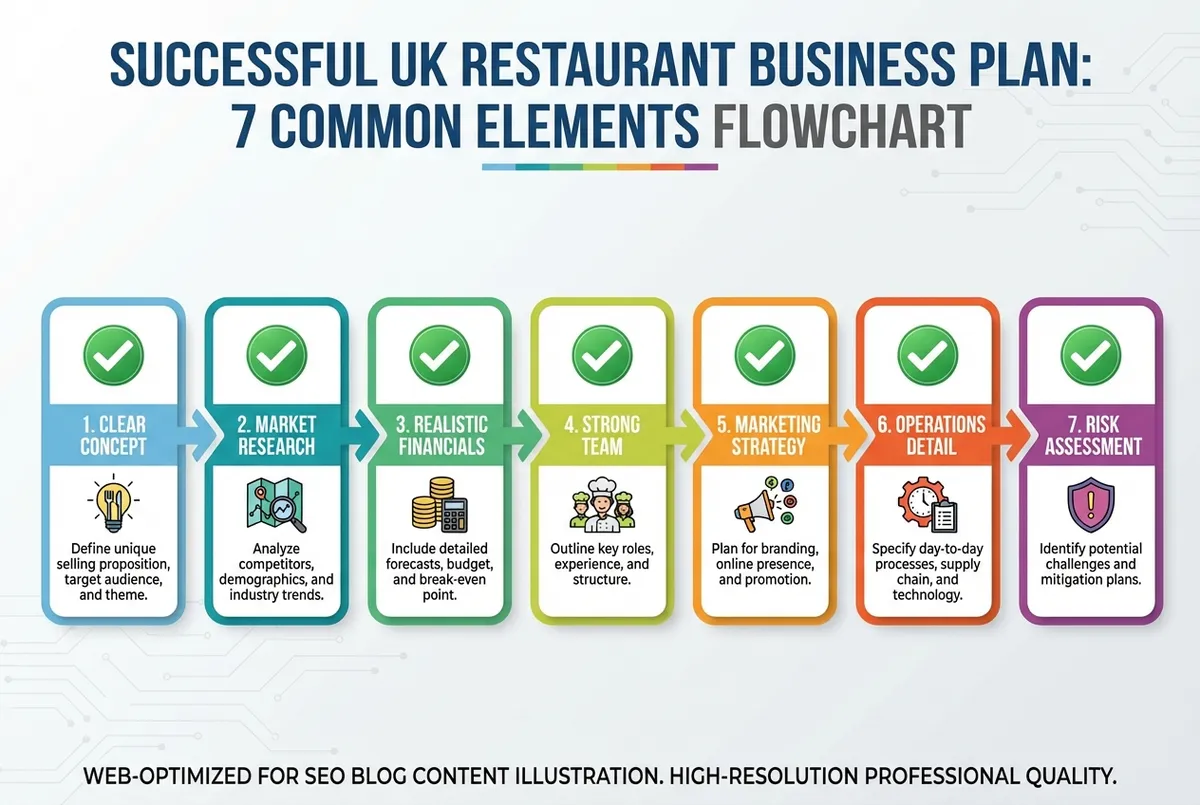
The 7 Common Elements in Successful UK Plans
Now that you know what to look for, let's examine what good plans consistently include. These elements appear in virtually every plan that gets funded.
1. Executive Summary That Sells the Vision
The executive summary is your one-page pitch. It sums up everything else and should make readers want to learn more.
A strong executive summary example might read:
"The Corner Kitchen is a 40-cover bistro targeting young professionals in Leeds' Northern Quarter, seeking £165,000 to launch in Q3 2026. We project break-even within 14 months, based on £28 average covers and 55% occupancy. Our founder brings 8 years of experience at award-winning Leeds restaurants."
Notice what's included: location, target market, funding amount, timeline, key metrics, and relevant experience. What's missing: vague promises or generic phrases about "passion for food."
2. Clear Concept Statement
Your concept statement explains what makes your restaurant different. "Italian restaurant" isn't a concept. "Handmade pasta using recipes from my grandmother's village in Puglia, served in an intimate 25-cover setting" is.
Info
The reality is that most concepts aren't as unique as founders believe. If you can't explain what makes yours different in two sentences, that's usually a sign you need to sharpen your positioning.
3. Market Analysis With Local Data
Good plans include specific local research. This means demographic data from the Office for National Statistics, competitor analysis from site visits, and foot traffic counts.
A Manchester restaurant example might note: "Within 400 metres of the site, we found 7 restaurants: 3 Italian, 2 Indian, 1 Thai, 1 British. None offer Neapolitan pizza with sourdough bases. Average meal prices range from £12-25."
4. Realistic Financial Projections
This is where examples help most. Seeing actual numbers helps set your expectations.
A typical UK casual dining startup might show:
| Category | Amount |
|---|---|
| Lease deposit and legal fees | £25,000 |
| Fit-out and renovations | £75,000 |
| Kitchen equipment | £35,000 |
| Furniture and fixtures | £15,000 |
| Licences and permits | £3,000 |
| Initial inventory | £8,000 |
| Working capital (3 months) | £30,000 |
| Contingency (15%) | £28,000 |
| Total | £219,000 |
(These figures reflect 2025/2026 UK market conditions. Your actual costs will vary.)
5. Monthly Cash Flow Projections
Beyond startup costs, good examples show month-by-month cash flow for 18 months. This reveals how long until break-even and how much reserve you need.
Warning
If you can't tell whether your projected cash flow is realistic or wishful thinking, that's a sign you need to dig deeper into the numbers.
A realistic example might show losses of £5,000-8,000 monthly for months 1-6, break-even around month 10-14, and modest profits after.
6. Team and Experience Section
Banks want confidence that capable people will run the operation. Good examples show relevant experience without puffery.
If you lack direct experience, an honest example might state: "While I don't have restaurant management experience, I've secured agreement from Sarah Chen, former head chef at The Olive Branch, to consult during our first year."
7. Risk Analysis and Mitigation
The best examples admit what could go wrong and explain backup plans. This shows mature thinking rather than naive optimism.
Info
Ask yourself: Would I trust someone who claims their restaurant will definitely succeed, or someone who's thought through what happens if it doesn't?
How to Adapt a Sample Plan to Your Concept
However, finding a good example is only half the job. The real skill is adapting it to your situation without losing what made it effective.
Here's a practical framework:
Step 1: Separate the universal from the specific.
Some elements transfer directly: the structure, the types of info included, how financials are presented. Other elements must be fully rewritten for your situation.
Step 2: Replace every number with your own research.
Never copy financial figures. Even a similar restaurant in a different city has different rent, labour costs, and revenue potential. Use examples to learn what categories to include, then research your own numbers.
For instance, if an example shows 30% food costs, don't assume yours will match. Calculate based on your menu pricing and supplier quotes. Do the same for recurring overheads the example glosses over: checking what marketing tools actually cost, for instance, keeps your monthly projections grounded in real figures.
Step 3: Match the level of detail in market analysis.
If an example includes competitor visits, do the same. If it cites demographic data, find your area's figures.
Step 4: Match the tone, not the claims.
A successful example sounds confident but realistic. Adopt that tone. Avoid both underselling and making promises you can't back up.
Warning
If you're only copying structure and filling in blanks, you'll always lose to applicants who've done genuine research. Banks notice the difference immediately.
Restaurant Business Plan Example Formats
Moving on, restaurant business plan examples come in several formats. Each serves different purposes.
Quick-Reference Sample Plans
These show essential sections in short form. Useful for checking structure, but not enough for funding applications.
A quick-reference example might run 5-8 pages. Use these to check you haven't missed key sections.
Comprehensive Sample Plans
Full-length examples (15-25 pages) with detailed financials, market analysis, and appendices. These show the depth banks expect.
Look for examples that match your funding size. A plan for £50,000 looks different from one seeking £500,000.
Restaurant-Type-Specific Examples
Examples for particular formats: cafe plans, pub plans, fine dining plans. These cover format-specific considerations.
A cafe example might focus on morning trade and coffee margins. A pub example would include wet/dry sales ratios and gaming machine income.
Why this matters
If you're thinking "this all sounds like a lot of work," you're right. If you're only skimming examples for numbers to copy, you'll always lose to applicants who've done genuine research. Banks can tell. The restaurants that get funded are the ones whose owners put in the hours.
For most UK restaurants, start with a solid general example and adapt it. Type-specific examples are useful add-ons but often lack rigorous financial modelling.
Common Mistakes When Using Business Plan Examples
Furthermore, even with good examples, certain errors appear repeatedly. Here's your checklist of traps to avoid:
Copying American examples without adjustment: US economics differ. Labour costs, tipping, leases, and regulations all vary. A US example showing 20% labour won't reflect UK minimum wage and employer NI.
Using outdated examples: Costs rose sharply between 2023 and 2025. An older example may understate expenses by 25-40%.
Treating examples as fill-in-the-blank templates: The value is understanding how operators think through problems, not copying their answers.
Ignoring location factors: A London example won't reflect costs in Newcastle. Even within London, Zone 1 and Zone 4 differ dramatically.
Matching optimistic projections: If an example shows 70% occupancy in month one, question it. Most new restaurants achieve 40-50% initially.
Warning
If you can't explain why each number in your plan differs from the example, you haven't done enough research. Banks will ask.
Where to Find Quality UK Examples
As a result, you're now better equipped to evaluate available resources. Here are sources for UK-relevant examples:
Government and business support:
- British Business Bank sample plans
- Start Up Loans templates
- Local enterprise partnerships
Industry associations:
- UKHospitality guidance documents
- British Institute of Innkeeping resources for pubs
Business planning software:
- LivePlan and similar tools include restaurant templates
- Often US-focused but adaptable
What to avoid:
- Free templates from random websites (often generic, outdated)
- Fiverr or similar platforms (quality varies wildly)
- Examples without dates or attribution
The best examples often come from successful local restaurants willing to share their experience. Networking through local business groups can give you access to real plans that worked.
Info
If you're struggling to find good examples, that's frustrating but normal. Most quality examples aren't freely available online. The effort required to find good ones is part of why they're valuable.
Minimum Viable Business Plan
Finally, if you're short on time, here's the minimum you need for a credible first draft. This isn't cutting corners. It's being strategic about where to start.
This week, start your research
- Day 1-2: Write your concept statement (one paragraph) and list your target customers
- Day 3-4: Visit three competitors: note prices, count covers, observe demographics
- Day 5-6: Build a startup cost spreadsheet with real quotes for your five biggest expenses
- Day 7: Draft a one-page executive summary combining the above
This gives you enough to start bank and landlord conversations. You can add detail as those conversations reveal what they need.
Info
If you genuinely only have 30 minutes total this week, spend it on the executive summary. It's what gets read first, and sometimes all that gets read.
Key Takeaways
If you run a restaurant and want to see how Local Brand Hub can support your marketing, explore our restaurant marketing tools.
Key Takeaways
To sum up: useful restaurant business plan examples share specific traits that generic templates lack. They include realistic UK figures, conservative projections, local market analysis, and honest risk assessment.
When adapting examples, focus on understanding the thinking behind decisions rather than copying numbers. Replace every figure with your own research. Match the depth of analysis, not the specific conclusions.
The most common mistakes involve using American examples, relying on outdated figures, and treating examples as fill-in templates.
For detailed guidance on writing each section of your plan, return to our restaurant business plan guide. And remember: the planning process has value beyond the document. Problems found during planning cost nothing to fix. Problems found after signing a lease cost everything.
Weekly Action
This week, complete these specific tasks:
- Find one quality restaurant business plan example that matches your concept type
- Note which sections feel strongest and which numbers seem realistic for your area
- List three areas where you'll need to conduct your own research
- Download or bookmark the example for reference during your planning
That analysis forms the foundation for your own plan.
For UK restaurant owners
Build Your Restaurant's Future
LocalBrandHub works with UK restaurant owners to build sustainable customer acquisition systems.
Start freeGet More Marketing Tips
Practical marketing tips for UK business owners, straight to your inbox. No spam, unsubscribe anytime.
About the Author
Local Brand Hub
Empowering UK Businesses
Local Brand Hub provides comprehensive business management tools designed specifically for UK local businesses to streamline operations, automate marketing, and grow revenue.
More articlesRelated Articles
 Business Growth
Restaurant Opening Costs: What You Can Actually Price
Restaurant opening costs are two budgets, not one. Price the published UK rates today, quote the rest twice, then size your reserve in months.
 Business Growth
How to Write a Restaurant Business Plan: UK Lender Guide
How to write a restaurant business plan UK lenders will read: the seven sections, covers-based financial projections and real Start Up Loans cases.
 Business Growth
Restaurant Business Plan: The Complete UK Guide for 2025
Build a restaurant business plan using the 30/30/30/10 cost rule, realistic financial projections, and executive summary templates for UK lenders.