
Watch the visual overview· 88 seconds
Build a restaurant business plan using the 30/30/30/10 cost rule, realistic financial projections, and executive summary templates for UK lenders.
You've found the perfect location. The lease is reasonable, the foot traffic looks promising, and you can already picture the tables full on a Friday night. Then your bank asks for a business plan, and suddenly that vision feels a lot further away.
Sound familiar? Most first-time restaurant owners have the passion and the concept, but the 40-page document your lender wants? That's where the excitement turns to dread.
Short on time? Here's the quick version
- 7 essential sections: Executive summary, company description, market analysis, organisation, menu concept, marketing strategy, financial projections
- 30/30/30/10 rule: Aim for 30% food costs, 30% labour, 30% other expenses, 10% profit
- Quick service is most profitable: 10-15% margins, but execution matters more than category
- Be conservative: Project 40-50% occupancy for month one, add 20-30% contingency to costs
- Write executive summary last: It summarises everything else
Full guide with templates and examples below
A restaurant business plan is the document that transforms your concept into something investors, banks, and landlords take seriously. It demonstrates you've done the research, understood the numbers, and planned for what happens when things don't go perfectly.
In the UK, where restaurant margins typically hover between 3-9% according to industry benchmarks, that planning isn't optional: it's survival.
This guide draws on analysis of successful UK restaurant launches and input from hospitality business advisors. It walks you through every section of your restaurant business plan, from executive summary to financial projections.
Related: Restaurant Marketing, once your plan is complete, you'll need strategies to attract customers.
What You'll Learn
- The 7 essential sections every restaurant business plan needs
- How to apply the 30/30/30/10 rule to your financial planning
- Which restaurant types typically generate the strongest margins
- Realistic financial projections that banks actually believe
- Common mistakes that sink otherwise promising plans
How Do I Write a Business Plan for a Restaurant?
First, let's cover the fundamentals. Your restaurant business plan needs seven core sections: executive summary, company description, market analysis, menu and concept, marketing strategy, operations plan, and financial projections. Start with the sections you know best. Research and refine the areas where you need more data.
Here's the practical approach that works for most UK restaurant owners:
Step 1: Define your concept clearly. Before writing anything else, articulate what makes your restaurant different. "Italian restaurant" isn't a concept; "handmade pasta using recipes from my grandmother's village in Puglia" is.
Step 2: Research your local market. Walk the streets around your proposed location. Count how many restaurants already serve similar food. Note their price points, busy periods, and customer demographics.
Step 3: Build realistic financials. This is where most plans fall apart. Use actual quotes from suppliers, real rental prices, and conservative revenue estimates. Banks have seen enough inflated projections to spot them immediately.
Step 4: Write the executive summary last. Though it appears first, this one-page overview should summarise everything else. You can't summarise what you haven't written.
Case example
A Birmingham café owner spent three weeks building her business plan. She visited 12 competing cafés, collected actual supplier quotes, and projected 40% occupancy for month one. Her bank approved the loan on first submission, unusual for hospitality, because the numbers reflected reality rather than optimism.
If you're short on time, focus on the financial projections and executive summary first. These are what banks and investors read most carefully.
Related: Restaurant Business Plan Template, copy the UK-specific blocks from our template into a fresh document to structure your plan.
What Is the 30/30/30/10 Rule for Restaurants?
Now that you understand the structure, let's talk numbers. The 30/30/30/10 rule is a financial guideline suggesting restaurants should allocate roughly 30% of revenue to food costs, 30% to labour, 30% to all other operating expenses, and aim for 10% profit margin.

In practice, these percentages shift based on your restaurant type. Fine dining typically runs higher labour costs and lower profit margins. Quick service restaurants achieve better margins through volume and simplified operations. Delivery-focused concepts trade lower labour for higher platform fees.
These aren't rigid rules; they're benchmarks. A restaurant with exceptionally low rent might spend more on premium ingredients. A high-wage area might compress profit margins. The value is in understanding the trade-offs.
Warning
When your food costs creep above 35%, something needs attention. Either your menu prices are too low, your portions are too generous, or waste is eating into your margins.
If you're only tracking costs monthly, you'll always lose to competitors who check weekly. The 30/30/30/10 framework helps you spot these issues before they become critical.
Which Type of Restaurant Is Most Profitable?
With financials in mind, you might be wondering which format tends to offer stronger odds.
Info
The reality: Quick service and fast-casual restaurants typically generate the highest profit margins in the UK, often reaching 10-15%. However, profitability depends more on execution than category: a well-run fine dining establishment outperforms a poorly managed takeaway.
Here's how profitability typically breaks down by format:
| Format | Typical Margin | Key Advantage |
|---|---|---|
| Quick service | 10-15% | High turnover |
| Fast casual | 8-12% | Premium pricing |
| Casual dining | 5-10% | Alcohol sales |
| Fine dining | 3-8% | Higher tickets |
The most profitable restaurants share common characteristics regardless of category:
- Tight menu focus. Fewer dishes mean less waste, simpler training, and faster service.
- Strong beverage margins. Drinks typically carry 70-80% gross margins compared to 65-70% for food.
- Efficient scheduling. Labour costs destroy margins when staffing doesn't match demand.
- Location match. A fine dining concept in a student area struggles; a quick service format in a business district thrives.
If you're choosing a concept purely for profitability, consider delivery-only or ghost kitchen models. Without front-of-house costs, these formats can achieve strong margins, but they require expertise in delivery logistics and digital marketing.
Warning
If you can't tell whether your concept has a genuine market gap or just feels exciting to you, that's usually a sign you need more customer research before committing capital.
Related: Restaurant Marketing Ideas, profitable restaurants need consistent customer flow.
What Are the 7 Parts of a Business Plan?
Here's where the structure comes together. The seven essential sections of a restaurant business plan are: executive summary, company description, market analysis, organisation and management, menu and service concept, marketing and sales strategy, and financial projections.
Warning
If you can't explain your concept in two sentences, that's usually a sign you need to refine your positioning before writing the rest of the plan.
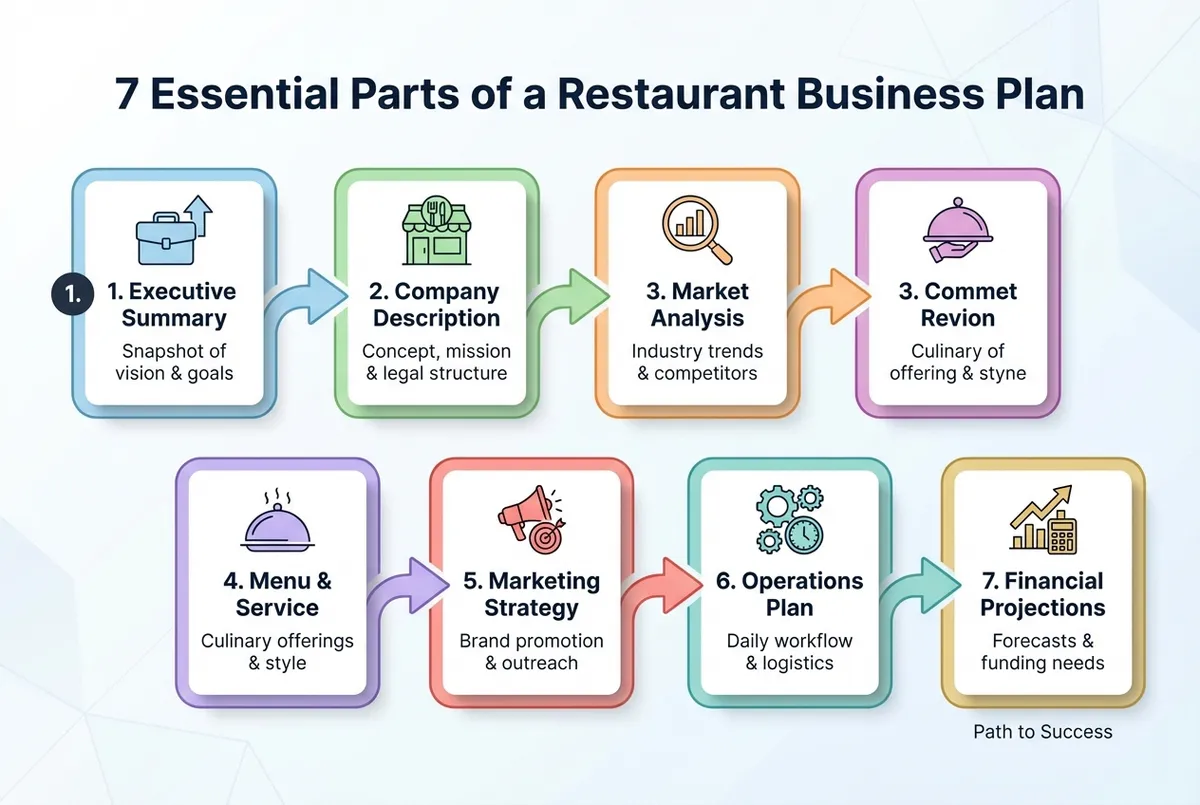
1. Executive Summary
One to two pages summarising your entire restaurant business plan. Include your concept, target market, financial highlights, and funding requirements. Write this last, but place it first. A strong executive summary might open: "The Oak Table is a 45-cover neighbourhood bistro targeting young professionals in Bristol's Harbourside area, seeking £150,000 to launch in Q2 2026."
2. Company Description
Your restaurant's legal structure, location, ownership, and history. For new ventures, focus on your background, why you're qualified to run this restaurant, and what gap in the market you're filling.
A street food vendor transitioning to a permanent site might emphasise their three years of market trading, their established following, and the gap for authentic Thai food in the area.
3. Market Analysis
Research on your target customers, local competition, and industry trends. Include demographic data for your area (available free from the Office for National Statistics), competitor analysis, and how your concept fits the local market.
4. Organisation and Management
Your team structure, key personnel, and their relevant experience. Banks want to see that competent people will run the operation. Include an organisational chart for larger operations.
Pro tip
If you lack direct restaurant experience, partner with someone who has it, or explain how you'll address this gap through hiring or consultants.
5. Menu and Service Concept
Your food concept, sample menu with pricing, service style, and sourcing strategy. This section should make readers hungry, and confident you've thought through the operational details.
6. Marketing and Sales Strategy
How you'll attract and retain customers. Cover pre-launch marketing, ongoing promotion, and customer retention tactics. Include realistic customer acquisition costs, and factor in what your marketing tools will cost each month so lenders see you have budgeted for ongoing promotion, not just the launch. See our restaurant marketing plan guide for detailed strategies.
7. Financial Projections
The section banks scrutinise most carefully. Include startup costs, monthly cash flow projections for years one through three, break-even analysis, and funding requirements with repayment terms.
A neighbourhood bistro might project: £180,000 startup costs, 18-month break-even, £4,500 monthly loan repayments, and £35,000 in reserve for unexpected expenses.
Related: Restaurant Executive Summary, detailed guidance on writing the most important page.
Business Plan Checklist
Before submitting your plan, verify you've covered:
- Executive summary fits on one page
- Concept statement is clear and differentiated
- Market analysis includes local competitor research
- Financial projections use real quotes and conservative estimates
- Break-even analysis is included
- Funding requirements are specific and justified
- Team section demonstrates relevant experience
Financial Projections That Banks Actually Believe
With the structure clear, let's focus on the numbers, because this is where your plan succeeds or fails.
Your financial projections must show real understanding of restaurant economics. Banks have seen thousands of restaurant business plans and spot inflated numbers immediately.
Startup Costs (Realistic Ranges for UK)
Expect to invest £75,000-200,000 for a small restaurant (under 30 covers), £200,000-500,000 for medium-sized venues, and significantly more for larger operations. Key cost categories include lease deposits, fit-out, kitchen equipment, furniture, licenses, initial inventory, and working capital.
Deeper insight
Fit-out typically represents the largest variable, heavily influenced by your concept and the starting condition of the premises. A second-generation restaurant space (previously a restaurant) can save 30-50% on fit-out versus converting retail space.
Monthly Operating Costs
Build your projections around fixed and variable costs:
Fixed costs (remain constant regardless of sales):
- Rent and rates
- Insurance
- Loan repayments
- Management salaries
Variable costs (scale with revenue):
- Food and beverage purchases
- Hourly staff wages
- Credit card processing fees
- Marketing spend
A casual dining restaurant might have fixed monthly costs around £8,000 and variable costs equal to roughly half of revenue. The key is understanding your break-even point: the revenue level where costs equal income.
Revenue Projections
Conservative revenue projections use this formula: Covers per day × Average spend × Days open × Occupancy rate = Monthly revenue.
Most restaurants don't reach full potential until month 6-12. Build your projections accordingly, with occupancy starting at 40-50% and growing gradually. A 50-seat restaurant at 60% occupancy with £25 average spend generates roughly £20,000 monthly, but expect less in year one.
Info
Ask yourself: Would I invest in this restaurant based on these numbers? If you can't confidently answer yes, your projections need more work.
Common Business Plan Mistakes to Avoid
After analysing patterns in successful and unsuccessful UK restaurant launches, these issues appear most frequently:
- Underestimating startup costs: Add 20-30% contingency to every estimate. Fit-outs always cost more than quoted.
- Overestimating revenue: Your restaurant won't be full every night in month one. Use 40-50% occupancy for initial projections.
- Ignoring seasonality: UK restaurants typically see drops in January and August. Your cash flow projections should reflect this.
- Forgetting working capital: You need enough cash to operate for 3-6 months while building customer base. A wine bar might need £40,000 in reserve to cover wages and rent during a slow first quarter.
- Copying competitor pricing: The established restaurant down the road has different supplier relationships, lease terms, and debt obligations.
Real-world example
A Manchester restaurant owner learned this the hard way: he matched a competitor's lunch special price without realising they'd negotiated significantly better supplier rates through volume. His version lost money on every plate sold until he adjusted pricing months later.
Info
Why This Matters: According to UKHospitality, hospitality business failures often stem from cash flow issues rather than lack of demand. A realistic business plan is your first line of defence.
If you're only writing a business plan because the bank asked for one, you're missing the point. The planning process itself reveals problems: better to discover them now than after you've signed a five-year lease.
Warning
If you can't explain why customers will choose your restaurant over the three nearest competitors, that's usually a sign your concept needs more work before you spend money on fit-out.
Would you invest your savings in a restaurant with the projections you've written? If the honest answer is no, revise until it's yes.
Minimum Viable Business Plan
All of this might feel overwhelming. If you only have 30 minutes a week to work on your business plan, here's what to focus on first:
This week, complete your foundation
- Day 1-2: Write your concept statement (one paragraph) and list your target customers
- Day 3-4: Research three direct competitors: visit them, note prices, count customers
- Day 5-6: Build a basic startup cost spreadsheet with real quotes where possible
- Day 7: Draft your executive summary based on what you've learned
This gives you enough to start conversations with banks and landlords. You can refine the details as those conversations reveal what additional information they need.
Related: Small Restaurant Business Plan, streamlined guidance for independent operators.
Frequently Asked Questions
Based on common questions from restaurant owners, interviews with hospitality consultants, and feedback from UK business lenders.
How long should a restaurant business plan be?
Most effective restaurant business plans run 15-25 pages, excluding appendices. Banks prefer concise documents that demonstrate clear thinking over lengthy plans padded with generic content.
Do I need a business plan for a small café?
Yes. Even a small café needs financial projections and market analysis, though the plan can be shorter. Banks and landlords expect documentation regardless of size.
How often should I update my business plan?
Review financial projections quarterly against actual results. Update the full plan annually or when seeking new funding. Major changes warrant immediate revision.
Can I write a business plan myself?
Absolutely. The best restaurant business plans come from owners who understand their concept deeply. Consider professional review for financial projections if needed.
Key Takeaways
If you run a restaurant and want to see how Local Brand Hub can support your marketing, explore our restaurant marketing tools.
Key Takeaways
To summarise what we've covered: your restaurant business plan transforms your vision into a document that attracts funding and guides operations. Focus on realistic financial projections, clear market understanding, and honest assessment of your concept's strengths and weaknesses.
The 30/30/30/10 rule provides a framework for financial planning: aim for 30% food costs, 30% labour, 30% other expenses, and 10% profit. These percentages vary by restaurant type, but significant deviations warrant investigation.
Your plan should answer three questions convincingly: Why will customers choose your restaurant? How will you operate profitably? What happens when things don't go as planned? For strategies on attracting customers, see our restaurant promotions guide.
Weekly Action
This week, complete these specific tasks:
- Day 1-2: Create a startup cost spreadsheet with real quotes for lease, fit-out, and equipment
- Day 3-4: Visit three competing restaurants and document their pricing, service style, and busy periods
- Day 5-7: Write your one-paragraph concept statement and test it with five people outside the industry
These tasks take roughly 4-6 hours total and form the foundation for a credible business plan.
For UK restaurant owners
Get Your Restaurant Plan Right
LocalBrandHub works with UK restaurant owners to develop marketing strategies that support sustainable growth, starting with understanding your business fundamentals.
Start freeGet More Marketing Tips
Practical marketing tips for UK business owners, straight to your inbox. No spam, unsubscribe anytime.
About the Author
Local Brand Hub
Empowering UK Businesses
Local Brand Hub provides comprehensive business management tools designed specifically for UK local businesses to streamline operations, automate marketing, and grow revenue.
More articlesRelated Articles
 Business Growth
Restaurant Opening Costs: What You Can Actually Price
Restaurant opening costs are two budgets, not one. Price the published UK rates today, quote the rest twice, then size your reserve in months.
 Business Growth
How to Write a Restaurant Business Plan: UK Lender Guide
How to write a restaurant business plan UK lenders will read: the seven sections, covers-based financial projections and real Start Up Loans cases.
 Business Growth
Restaurant Business Plan Example: UK Plans to Learn From
See real restaurant business plan examples for UK restaurants. Learn what makes plans work, common elements, and how to adapt them to your concept.