A restaurant business plan template you can paste and fill in, with the UK lines an American version leaves out and a source beside every number.
A restaurant business plan template is a set of prompts covering summary, business, market, people, menu, marketing, numbers and timeline. A UK one differs in two ways that matter: it carries the registration and tax lines an American version omits, and it leaves a column for the source behind every figure.
The blank document is not the hard part. Trouble arrives four lines into the market section, when the template asks for a number you do not have, cannot invent and have not worked out how to find. That is where plans turn into fiction, and an unsourced market section is the part a reader can check without leaving their desk. So this page hands over the thing itself: paste the blocks, replace every bracketed prompt, and keep the register at the end open while you work.
Related: restaurant business plan is the parent guide, and how to write a restaurant business plan takes the sections one at a time.
What should a restaurant business plan template include?
Eight blocks. Naming drifts between templates and the running order is negotiable. The questions underneath are neither.
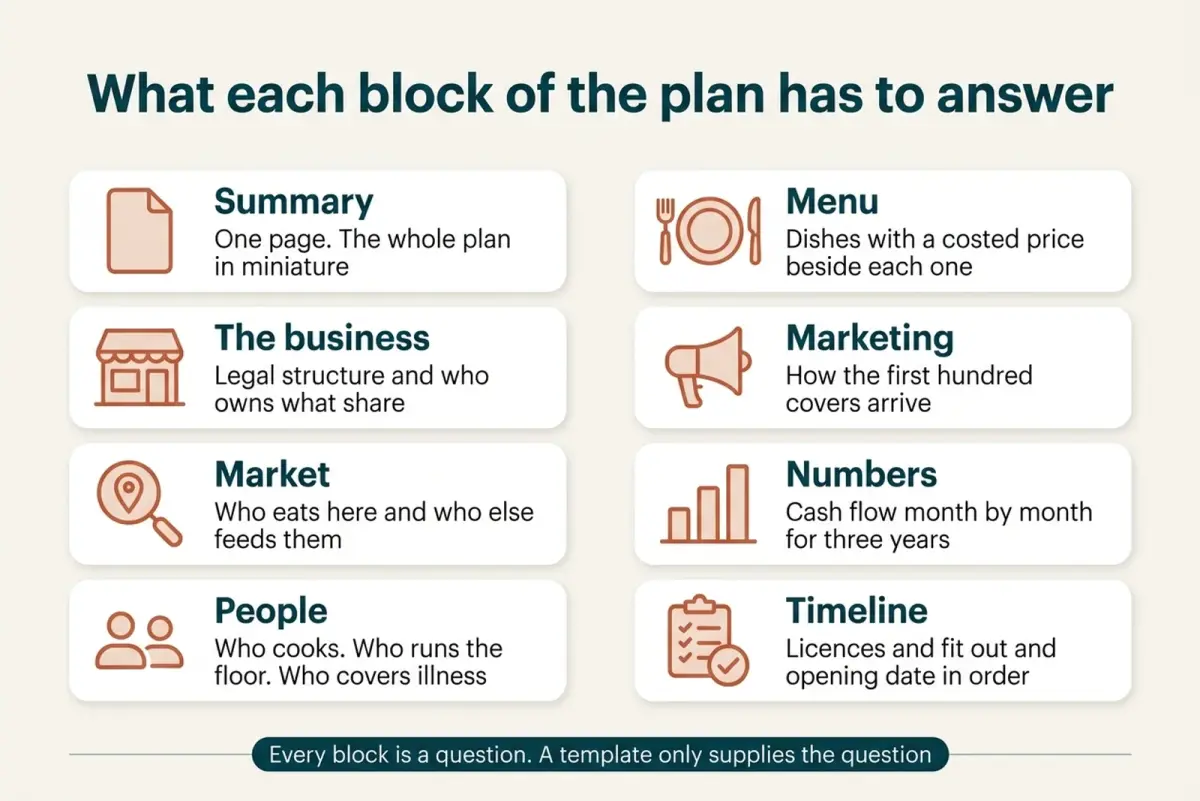
Eight blocks, eight questions. Three and seven are the ones that need evidence rather than intent.
A template on its own disappoints, because it is a list of questions in a good font and nothing in it knows your rent, your postcode or what the unit next door does after midnight. A plan full of unanswered prompts reads worse than a blank one, because now it looks finished.
The template, block by block
Paste this into a fresh document. Everything in square brackets is a prompt to delete. Nothing below is real. Replace every bracketed item with something you can evidence before the file leaves your laptop: no supplier, award, chef history, sourcing story or family recipe should survive into your version unless you can show where it came from.
One. Summary. One page, written last.
- We are opening [CONCEPT IN ONE LINE] at [ADDRESS], seating [NUMBER] covers.
- Our customer is [WHO, IN A SENTENCE, NOT EVERYONE].
- We need [AMOUNT], split across [FIT OUT, EQUIPMENT, STOCK, WORKING CAPITAL].
Two. The business. The dull facts, checked first.
- Trading name, legal structure, registered address: [DETAIL].
- Owners and their shares: [NAME AND SHARE, EACH].
- Relevant experience: [ROLES AND YEARS EACH].
Three. Market. Researched or hopeful, and it shows.
- Catchment: [WHO LIVES OR WORKS WITHIN A TEN MINUTE WALK, AND YOUR SOURCE].
- Comparable venues: [NAME, DISTANCE, PRICE POINT, WHAT THEY DO BETTER].
- The gap, and why it stays open: [REASONING].
Four. People. Who cooks, who runs the floor, who covers the flu.
- Roles at opening with hours and pay: [TABLE].
- Kitchen lead: [NAME, OR RECRUITING WITH A TIMELINE].
- What you personally do on a Saturday night: [BE HONEST].
Five. Menu. Costed, not just written.
- Service style: [COUNTER, TABLE OR TASTING].
- Sample menu with selling price and food cost per dish: [TABLE].
- Suppliers and lead times: [NAME, PRODUCT, DELIVERY DAYS].
Six. Marketing. How the first covers arrive.
- Pre opening: [WHAT YOU DO IN THE WEEKS BEFORE THE DOORS OPEN].
- Ongoing: [THE TWO OR THREE THINGS YOU DO EVERY WEEK].
- Who owns it, on which day, and what they measure: [DETAIL].
Seven. Numbers. Read twice, by everyone.
- Start up costs itemised, with a quote reference on each line: [TABLE].
- Monthly cash flow: [APPENDIX].
- Break even, and the assumptions behind it: [COVERS PER WEEK].
Eight. Timeline. Dates in order, with the ones outside your control marked.
- Lease, fit out, hiring, soft launch, opening: [DATES AS DD/MM/YYYY].
- Registrations and permissions, with the lead time each needs: [LIST].
- What slips if any single date slips: [ONE SENTENCE].
A thin block is information, not a formatting problem. Three and seven carry the most weight, because a wobble in either moves the summary, the funding ask and the timeline with it, and restaurant financial projections goes further into block seven than any template can.
What makes a UK template different from an American one?
Search for a template and much of what comes back was written for a US reader. Differently shaped rather than wrong, and three lines need adding.
A registration date in the timeline. GOV.UK guidance for England, Wales and Northern Ireland states that you are required to register a food business with the local authority at least 28 days before trading. Scotland runs on separate Food Standards Scotland guidance, worth reading directly if you open there. Either way it is a calendar item, not a paperwork item, and it belongs in block eight beside the fit out dates.
A VAT row in the forecast. HMRC guidance on GOV.UK states that you must register for VAT if your total taxable turnover for the last 12 months goes over £90,000. It is a rolling test, so a busy first summer can take you over it mid year, and a forecast treating takings and turnover as one number overstates what the business keeps once registration bites.
Cost lines with no American equivalent. Business rates, trade waste collection, insurance and the music you play in the dining room all cost real money here and have no row waiting in a US template. One American convention left in the document is a sign the file was pasted rather than costed.
How far ahead should the cash flow forecast run?
UK government guidance on preparing for funding applications states that your cash flow forecast should cover the next 12 months. That is the span the guidance names rather than a ceiling, and lenders set their own document lists, so ask yours what it wants on top.
Build those twelve months first regardless. A three year projection resting on a first year nobody costed is three years of decoration.
Is there a free UK restaurant business plan template?
Look at what the state publishes before you pay anyone. GOV.UK guidance on writing a business plan points readers to a free business plan template on The King's Trust website, and to a free cash flow forecast template on the Start Up Loans website. A government backed Start Up Loan runs from £500 to £25,000 to start or grow a business. Neither template is restaurant specific, which is the gap the eight blocks above fill. The forecast template comes from a public lender's own site, which makes it the closest thing to a free marking scheme.
The assumptions register, and why it is the useful part
Prose is the easy part. What a plan stands on is whether a stranger can redo your arithmetic and land near where you landed. So add a table nobody asked for: one row per number, four columns, being the number, its source, the date you checked it and what breaks if it is wrong.
| The number | Source | Checked | What breaks |
|---|---|---|---|
| Monthly rent | [HEADS OF TERMS] | [DD/MM/YYYY] | [EVERY LINE BELOW] |
| Covers per service | [YOUR ASSUMPTION] | [DD/MM/YYYY] | [BREAK EVEN] |
| Spend per head | [PRICED SAMPLE MENU] | [DD/MM/YYYY] | [REVENUE] |
| Fit out | [BUILDER QUOTE REF] | [DD/MM/YYYY] | [THE ASK] |
Copy the header row if you copy nothing else. Which rows you need varies by site, so treat these four as a starting set and add your own.
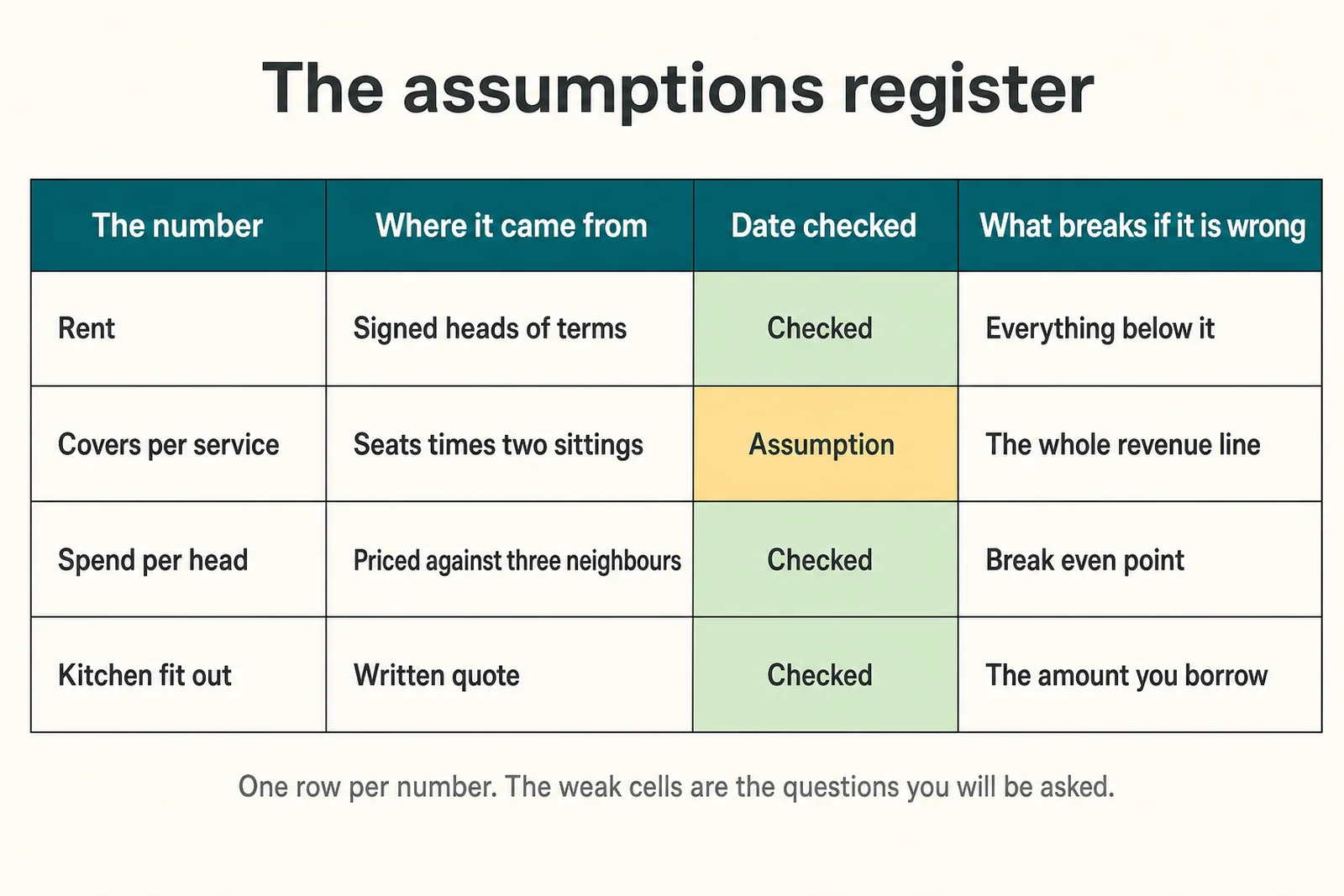
One row per number. The weak cells are the questions you will be asked.
Filled in honestly, the register separates the figures that are quotes from the figures that are hopes, and it turns an uncomfortable meeting into a reading exercise: asked where spend per head came from, you point at a row rather than improvise.
Picture a forty cover neighbourhood bistro filling that table in. Rent is a signed figure. Covers per service is seats times two sittings, an assumption rather than a fact, and marked as one. Spend per head came from pricing a sample menu against three named neighbours. One row of guesswork out of four is defensible. Four blank source cells is not.
It also forces the question founders avoid: what would have to be true for this to fail? A row whose what breaks column reads everything below it is telling you where the rest of your research week goes.
Where templates go wrong
Square brackets surviving to submission. A bracket in a finished document reads as a document nobody reread. Search for one before you send it.
Answering the prompt instead of the question. Target market gets young professionals back, which is a demographic label, not a market. The question underneath is who walks past at seven on a Tuesday and what would make them stop.
A narrative the forecast contradicts. The prose promises a second site by year three while the cash flow never shows the surplus. A restaurant business plan example is worth reading for structure, then closing.
Frequently asked questions
Should I pay for a plan template?
Rarely, though a ready made spreadsheet earns its price if you dislike writing formulas. What no paid version supplies is your rent, your covers or your supplier quotes, and those decide the application.
Can I use one plan for a bank, an investor and a landlord?
Use one document and change the emphasis. A bank asks what happens in a bad quarter. An investor asks how this becomes a second site. A landlord wants evidence you can pay rent through a slow January.
What is the difference between a business plan and a cash flow forecast?
The plan is the argument and the forecast is the arithmetic that has to survive it. If the narrative promises growth the forecast never shows, the document argues against itself.
Start with the register
Key Takeaway
Paste the eight blocks, then open the register before you write a word of prose. Working from the numbers outwards feels backwards and produces a better document, because the narrative ends up describing something that adds up. If the blocks look oversized, small restaurant business plan trims the same structure down.
A template will not get you funded. A source beside every number turns a document that has to be trusted into one that can be checked, and that is the part you can finish this week.
Once the plan exists, block six becomes a weekly job. LocalBrandHub gives independent UK venues a social media calendar, free to use, plus ready made seasonal campaigns and a Monday morning report on what is working on the Growth plan.
For restaurants, salons, and local businesses
Need help with your marketing?
We help UK businesses turn social media into real results, not busywork.
Start freeSources
Get More Marketing Tips
Practical marketing tips for UK business owners, straight to your inbox. No spam, unsubscribe anytime.
About the Author
Local Brand Hub
Empowering UK Businesses
Local Brand Hub provides comprehensive business management tools designed specifically for UK local businesses to streamline operations, automate marketing, and grow revenue.
More articlesRelated Articles
 Business Growth
Restaurant Opening Costs: What You Can Actually Price
Restaurant opening costs are two budgets, not one. Price the published UK rates today, quote the rest twice, then size your reserve in months.
 Business Growth
How to Write a Restaurant Business Plan: UK Lender Guide
How to write a restaurant business plan UK lenders will read: the seven sections, covers-based financial projections and real Start Up Loans cases.
 Business Growth
Restaurant Business Plan PDF: Free Templates & Examples
Download free restaurant business plan PDF templates formatted for UK bank applications. Covers every required section and what lenders look for.