
How to write a restaurant business plan UK lenders will read: the seven sections, covers-based financial projections and real Start Up Loans cases.
A restaurant business plan is seven decisions written down: what you serve, who buys it, who runs it, how it operates day to day, how customers hear about you, what it costs, and why the numbers hold up. Write the sections in that order, build the revenue forecast on covers per service, and draft the executive summary last.
Related: Restaurant Business Plan, the pillar guide this piece sits under, covering every section of the plan in full detail.
Here is the scene this document exists for. The lease is agreed in principle, your head chef is ready to hand in her notice, and the bank manager has just used the phrase "once we've read your plan". What she wants is evidence that you have already run the restaurant in your head, with numbers she can check.
The stakes are real: across the whole UK economy, only 38.4% of businesses started in 2019 were still trading five years later (ONS, Business demography 2024). A plan changes those odds only by finding the problems while they are still cheap, on paper, before anything is signed.
Treat the plan as the first service you run: a full rehearsal with a stranger's money on the line. Learning how to write a restaurant business plan is really learning to run that rehearsal on paper, section by section.
What Are the Seven Parts of a Restaurant Business Plan?
The seven parts are: the concept, the market analysis, the team, the menu and operations section, the marketing plan, the financial projections, and the executive summary. Each one answers a question a lender was going to ask anyway, and together they make one argument: this restaurant works, and here is the evidence.
- Concept: what are you selling, and who crosses the road for it?
- Market analysis: who already feeds your street?
- Team: who in the room has done this before?
- Menu and operations: what does a Saturday service actually take?
- Marketing plan: how does anyone hear about you?
- Financial projections: do the numbers survive checking?
- Executive summary: the one-page version, written last.
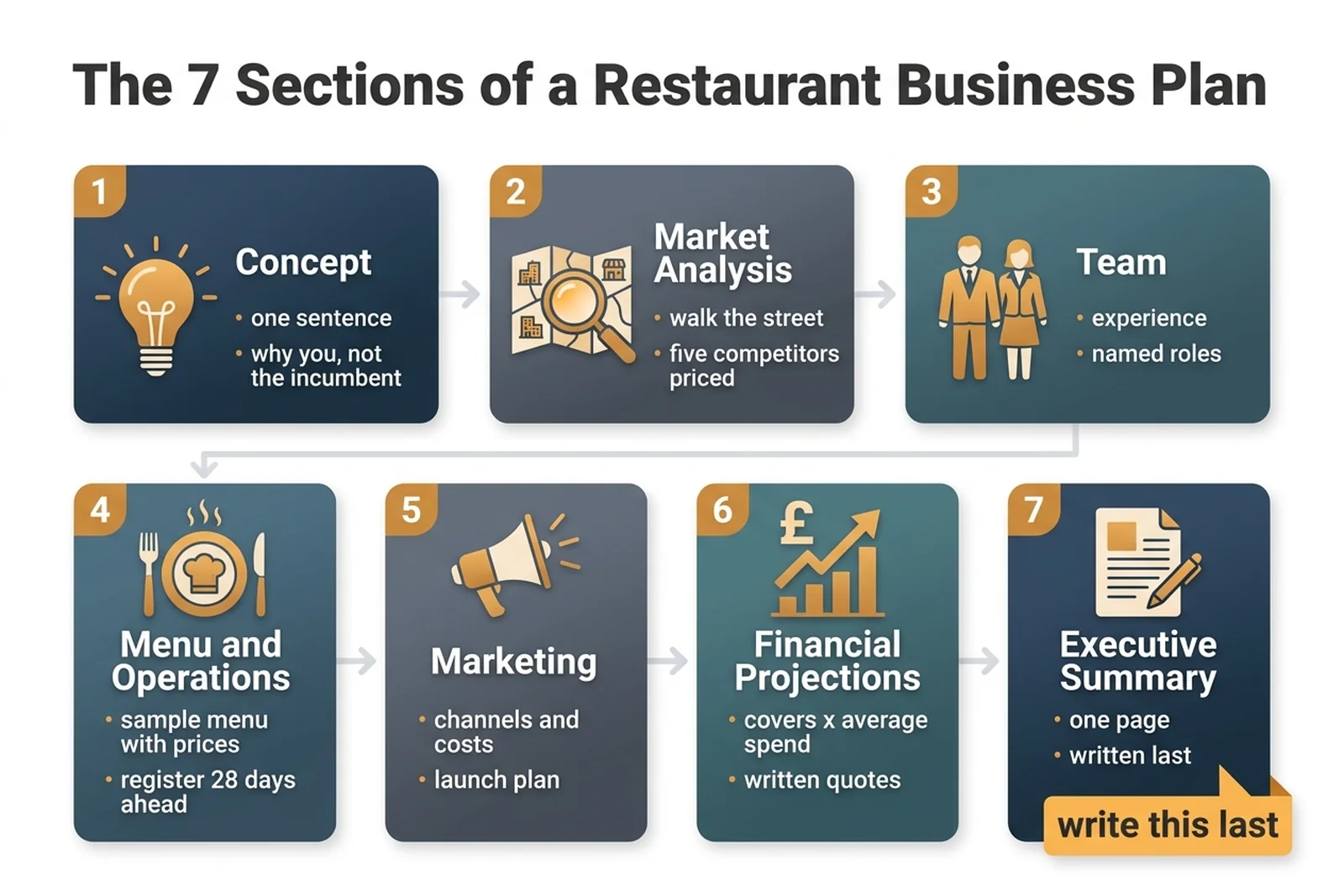
Seven sections, one argument: each answers a question a lender will ask anyway.
None of this is bureaucratic decoration. The government-backed Start Up Loans application, for example, requires you to submit a business plan and cash flow forecast before anyone lends you a pound (Start Up Loans, application FAQ). High street banks ask for the same in different clothes. The order above is also the order to write in, with one deliberate quirk: the executive summary goes first in the document and last in the writing, because you cannot summarise thinking you have not done yet.
How Do You Write Each Section?
Step 1: Pin the concept to one sentence
"Italian restaurant" is a category. "Handmade pasta from a twelve-dish menu, forty covers, aimed at the office crowd within ten minutes' walk" is a concept. Your opening section needs the second kind: cuisine, service style, price bracket, target customer, and the one reason someone crosses the road to you.
If you cannot get it into a sentence yet, that is useful information: the sections below will sharpen it before a lender ever sees it.
Step 2: Research the market on foot
Desk research and ONS demographic data will tell you who lives near your site. What they cannot tell you is that the pizzeria two doors down dies on Tuesdays, or that the sandwich queue at noon is out the door. So walk it:
- Count the competitors, and sit in them at their busiest and their quietest.
- Note their prices, dish by dish.
- Watch what tables actually order, and what goes back barely touched.
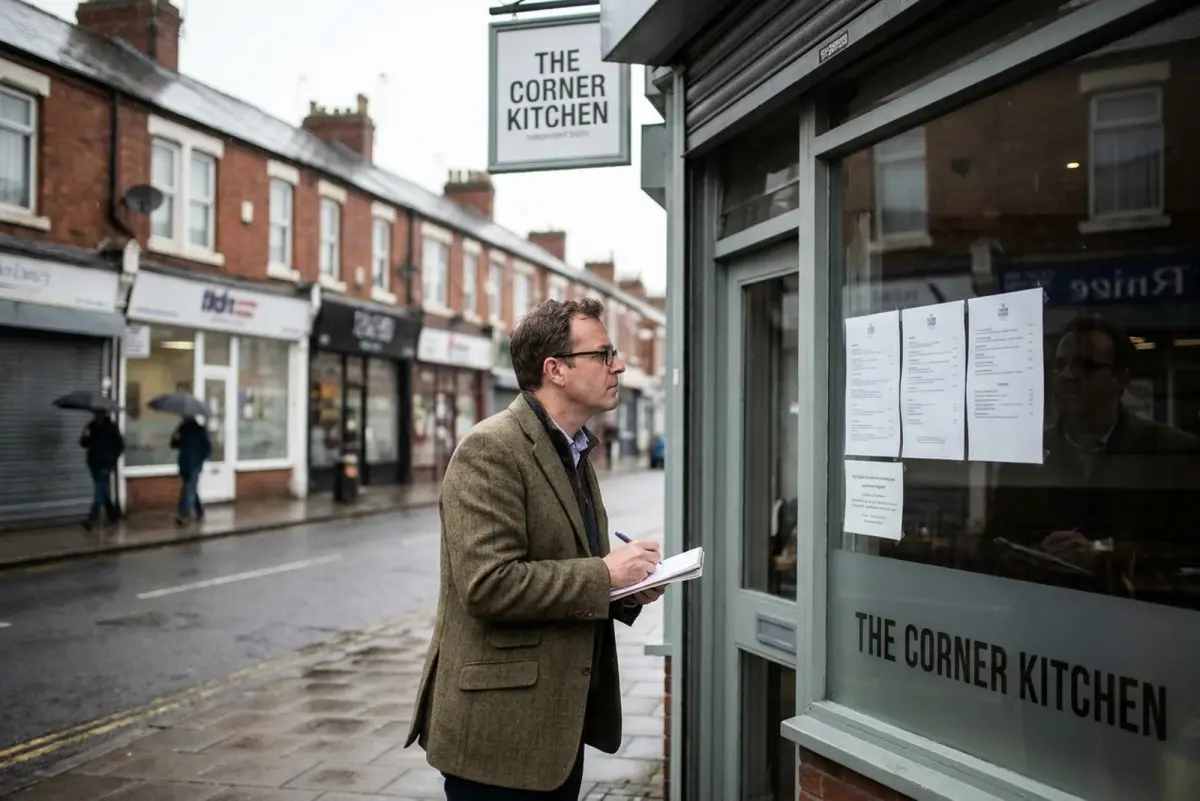
An hour on the pavement tells you things no industry report can.
Your market analysis should name at least five direct competitors, with their price points and their gaps. "We will be better" is a hope. "Nobody within half a mile does a vegetarian set lunch under fifteen pounds, and the three office blocks opposite hold hundreds of desks" is analysis.
Step 3: Prove the team can cook and count
Lenders back people before they back menus. For each key person, set out the hospitality experience they bring, the role they will hold, and any stake they own. Gaps are fine if you name them and show the fix: a general manager hired before opening, a part-time bookkeeper, a chef consultant for the launch menu.
What reads badly is silence. A plan with no answer to "who has done this before?" invites the lender to supply their own, and it will be less generous than yours.
Step 4: Set out the menu and the operation behind it
This section should make the reader hungry and reassure them you know what a Saturday service costs: a sample menu with prices, your service style, key suppliers, and the kitchen kit the menu depends on. Then show the regulatory homework is done: a new food business must register with its local authority at least 28 days before opening (GOV.UK), and if you plan to sell alcohol you will need a premises licence, which takes its own lead time.
Pro tip: put both dates in your opening timeline. A licence application submitted the week you sign the lease reads like it was written by someone who has opened a restaurant before, even if you have not.
Step 5: Show how anyone will hear about you
A forecast full of covers implies customers, and this section explains where they come from: the pre-opening buzz, the launch, and the steady drumbeat afterwards. Name the channels you will actually work (a claimed Google listing, local press, a founding diners email list), what each costs, and who runs them once service starts eating your week. Your business plan needs the one-page version with a budget attached; our restaurant marketing plan guide covers the full framework.
Step 6: Build financial projections on covers, not vibes
This is the section lenders read first and trust least, so it is where checkable working pays off hardest. Three rules keep it honest.
Model revenue the way restaurants actually earn it. Hotels have occupancy; you have covers. Forecast covers per service, multiply by average spend, and build up to weekly and monthly revenue, with a ramp that starts modestly and earns its growth.
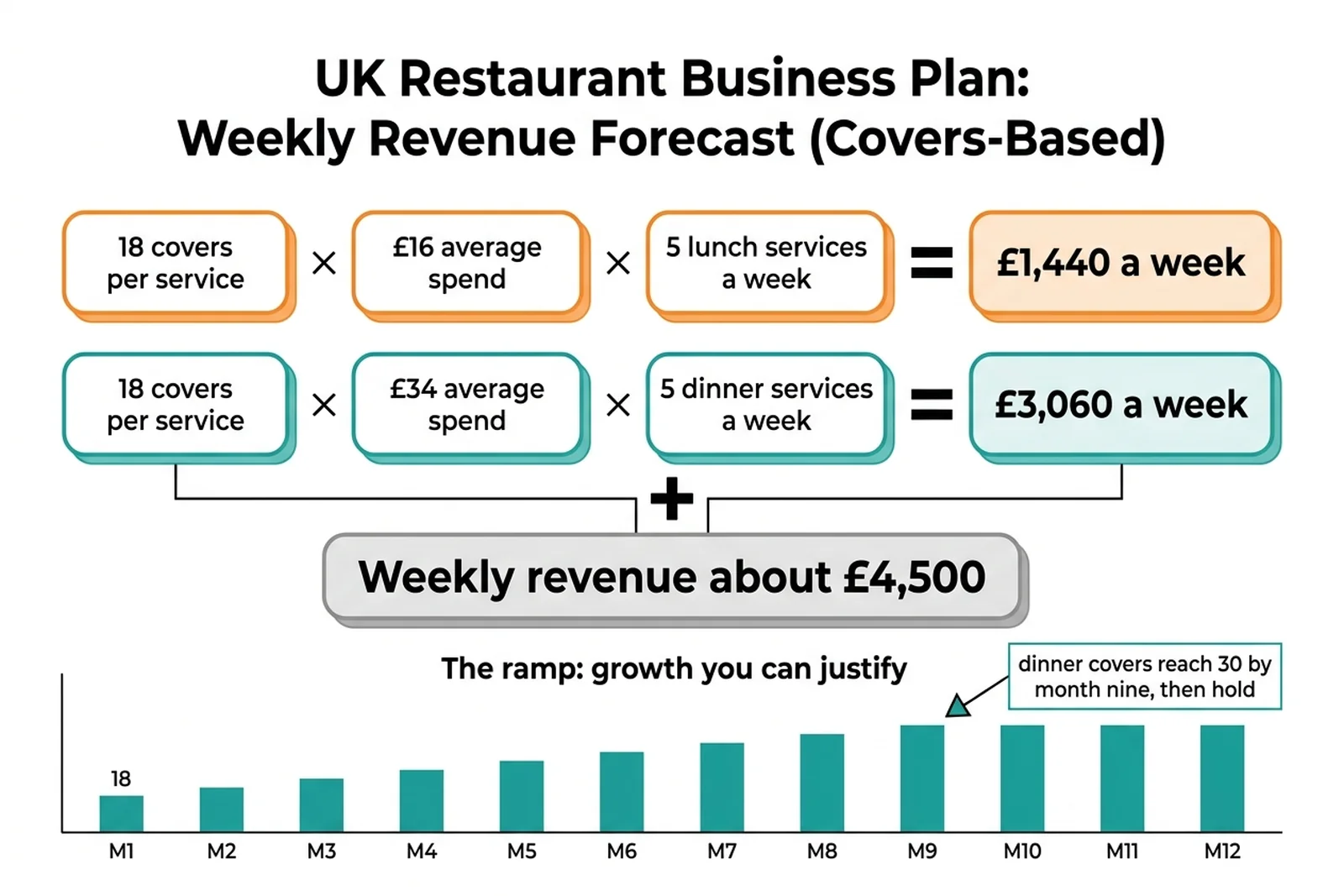
A forecast a stranger can follow: covers, spend, services per week, then the monthly ramp.
Imagine a 45-cover bistro trading five dinners and five lunches a week. A cautious opening month might model 18 lunch covers at £16 average spend and 18 dinner covers at £34: roughly £4,500 a week. The plan then shows dinner covers climbing towards 30 by month nine as reviews and repeat trade build, and states the assumption behind each step of the climb.
Price costs from written quotes, not memory. Fit-out, kit, deposits, insurance, licences: get real numbers in writing and put the quotes in an appendix. Add honest headroom for the surprises fit-outs tend to spring, and say what the headroom is for. Our restaurant opening costs breakdown lists what tends to get missed.
Respect the thresholds and the rhythm. Registering for VAT becomes compulsory once taxable turnover for the last 12 months passes £90,000 (GOV.UK), which most viable restaurants cross quickly, so build it in from the start. Seasonality belongs in the forecast too, and it is local: a city lunch spot and a seaside bistro have opposite Augusts, so model your street's rhythm rather than another town's. For the full method, see restaurant financial projections.
Step 7: Write the executive summary last
One page. Concept, location, target market, the funding ask, what the money buys, and when the numbers turn. It is the only page some readers finish, and the easiest to write once the other six exist: every line summarises work you have already shown. Our restaurant executive summary guide has worked structures.
A strong closing line names the ask plainly: "Seeking £120,000 alongside £45,000 owner investment to open in spring 2027, with the cash flow forecast showing the business covering its monthly costs within the second year."
What Do UK Lenders Actually Look For?
Under the section headings, most lenders are checking the same five things, the classic five Cs: character, capacity, capital, collateral and conditions. In restaurant terms: have you handled money well before, can the covers forecast repay the loan, what are you risking yourself, what secures the rest, and do you understand the street you are opening on. A plan that answers all five without being asked reads like competence.
Funding routes are more varied than most first-time owners expect. Alongside bank lending, the British Business Bank's Start Up Loans programme lends between £500 and £25,000 per applicant (British Business Bank), and its public case studies show real plans meeting real money:
- The Cellar at 24, a wine and tapas bar in Anstruther, received a £20,000 loan from DSL Business Finance through the Start Up Loans programme to help with set-up costs (Start Up Loans case study).
- Clare Lewis of Hello Good Pie, a pie production and delivery business in Treharris, said that without her £17,500 Start Up Loan she would not have got the business off the ground, needing the money for branding and a catering trailer (Start Up Loans case study).
- Tony Singh used his Start Up Loan to renovate the store space of Caffe Venecia in Huddersfield, and in nine months of trading the business grew from four to seven employees with turnover up more than 300% (Start Up Loans success story).
The common thread: the money bought concrete things (a fit-out, a trailer, branding) that a plan had already priced. That is "use of funds" in practice.
The strongest endorsement of the writing process comes from a founder. Emma Swiggs of Dandelion Coffee House in Corsham accessed a £6,000 Start Up Loan through X-Forces Enterprise. In her words:
"The process of applying for the Start Up Loan was more beneficial than I'd expected. It forced me to think carefully about wages and supplier costs, and develop a detailed business plan and cashflow forecast, which I probably wouldn't have written otherwise." (Start Up Loans case study)
The document got her the loan; the thinking is what she kept.
How Long Should a Restaurant Business Plan Be?
Honest answer: we have yet to find a UK lender that publishes a required page count, and anyone quoting you an ideal number is passing on folklore. What lenders reward is density of evidence: a page earns its place by making a decision or showing a number someone can check, and a page that does neither is garnish.
In practice that pushes most plans towards the executive summary being genuinely one page, the financials carrying tables rather than prose, and the supporting research (the full quotes, menus, CVs and competitor audit, for instance) living in appendices where a reader can dig if they choose. Length takes care of itself when padding has nowhere to hide; our restaurant business plan template guide gives you the eight UK blocks to paste in and fill.
Which Mistakes Make Lenders Stop Reading?
A lender who reads restaurant plans all week develops fast reflexes; these tics trigger them:
- Hotel maths. Revenue forecast as "occupancy" percentages rather than covers per service. It signals the model came from a template rather than a kitchen.
- Round-number costs. A fit-out priced at a suspiciously tidy figure with no quote behind it. One written quote per big line item changes the texture of the whole document.
- Borrowed seasonality. Quiet months copied from a generic guide rather than your location and trade. The seasonality argument should name your street, not "UK restaurants".
- A cash flow that opens full. Forecasts where the restaurant trades at capacity from week one. The ramp is where credibility lives; show it, and show what you live on while it climbs.
- No working capital arithmetic. A funding ask that spends everything on the fit-out and leaves nothing for the quiet months after opening. Say what cash you hold back for the gap between opening and steady trade, derived from your own fixed costs rather than a rule of thumb.
Every one of these is fixable with the same move: replace the inherited number with one you found yourself, and show where you found it. Take borrowed seasonality, for example: swap the copied quiet months for what your own street told you at eight on a Tuesday evening.
The Version You Can Write in a Bad Week
Restaurant weeks eat planning time, so here is the plan-writing equivalent of a tight prep list, three sittings of about an hour each:
- Sitting one: write the concept sentence, then list the three reasons a stranger picks you over the incumbent. If the reasons are thin, better to learn it now.
- Sitting two: walk your street at lunch and at eight in the evening. Note every competitor, their prices, their empty tables. Photograph menus.
- Sitting three: open a spreadsheet and price the ten biggest startup costs, marking which are real quotes and which are guesses still needing calls.
Three sittings will not finish the plan, but they will tell you whether the concept survives contact with the pavement, the question everything else depends on.
Frequently Asked Questions
What is the 30 30 30 rule for restaurants?
It is a rough rule of thumb that holds each of the three big cost lines to just under a third of turnover: food and drink, labour, and everything else (rent, rates, energy, marketing), leaving the thin slice the three do not eat as margin. Real accounts rarely land that neatly. Use it as a sanity check on your projections, never as a target to force.
What are the 5 Cs lenders check in a business plan?
Character, capacity, capital, collateral and conditions: your track record with money, whether the cash flow can repay the loan, what you are putting in yourself, what secures the rest, and the market you are walking into. A good restaurant business plan answers all five before anyone asks.
Can ChatGPT write my restaurant business plan?
It can tidy prose and suggest structure, which makes it a decent editor. It cannot know your covers, your rent, your suppliers' prices or your street, and those are precisely what a lender reads the plan to check. Use AI to sharpen a plan built on your own research; a generated one reads generic because it is.
Do I need a full business plan for a small cafe?
Yes, though it can be lean. A bank, the Start Up Loans programme, or a landlord sizing up a tenant will want the same core evidence: clear concept, local research, and a cash flow forecast built from your actual costs. A ten-table cafe, for instance, can cover all three in a handful of tight pages; our small restaurant business plan guide shows how.
How long does it take to write a restaurant business plan?
As long as the research takes; the writing is the quick part. Walking the street, gathering written quotes, and building the covers forecast consume the time, and they are what make the document worth reading. A plan finished fast is usually built on guesses.
How often should I update the plan once I open?
Check projections against real takings every quarter, and rework the plan properly when something material changes: new funding, a second site, a jump in costs. A plan that still says what you believed before opening is a souvenir, not a tool.
Key Takeaway
Conclusion: The Plan Is the First Service You Run
Back to that bank manager and her "once we've read your plan". This guide hands you the answer she is hoping to read: a concept in one sentence, a market you walked yourself, a team with named strengths, a forecast built on covers and quotes, and a one-page summary written last because now there is something true to summarise.
Emma Swiggs's case study carries the deeper payoff: the plan she almost did not write is the one that made her think hard about wages and suppliers before they could hurt her. Run the rehearsal on paper. It is the cheapest bad Saturday you will ever have.
When the plan is written and the doors are in sight, LocalBrandHub picks up the next job: getting your first customers through them.
For restaurants, salons, and local businesses
Need help with your marketing?
We help UK businesses turn social media into real results, not busywork.
Start freeSources
- Office for National Statistics, Business demography, UK
- British Business Bank, Start Up Loans
- Start Up Loans, The Application Process FAQ
- GOV.UK, Register for VAT
- GOV.UK, Register a food business
- Start Up Loans (British Business Bank), case study: The Cellar at 24
- Start Up Loans (British Business Bank), case study: Dandelion Coffee House
- Start Up Loans (British Business Bank), case study: Hello Good Pie
- Start Up Loans (British Business Bank), success story: Caffe Venecia
Get More Marketing Tips
Practical marketing tips for UK business owners, straight to your inbox. No spam, unsubscribe anytime.
About the Author
Local Brand Hub
Empowering UK Businesses
Local Brand Hub provides comprehensive business management tools designed specifically for UK local businesses to streamline operations, automate marketing, and grow revenue.
More articlesRelated Articles
 Business Growth
Restaurant Opening Costs: What You Can Actually Price
Restaurant opening costs are two budgets, not one. Price the published UK rates today, quote the rest twice, then size your reserve in months.
 Business Growth
Restaurant Business Plan Template: Copy the UK Blocks
A restaurant business plan template you can paste and fill in, with the UK lines an American version leaves out and a source beside every number.
 Business Growth
Small Restaurant Business Plan: A Practical UK Guide
Write a small restaurant business plan using the 30/30/30/10 cost rule. Covers 7 essential sections with realistic UK startup figures.