
Write a restaurant executive summary for UK bank managers. What to include, common mistakes, real funding-winning examples.
Why does your 25-page business plan die in thirty seconds? You have spent weeks on it. Every section is solid. Then the bank manager flips to page one, scans briefly, and puts it in the rejection pile. Your restaurant executive summary determines if the rest gets read. Get it wrong, and your plan dies on page one.
Short on time? Here's the quick version
- Purpose: One page (400-600 words) that summarises your entire business plan
- Write it last: You can't summarise what you haven't written
- 6 essential elements: Concept, target market, competitive advantage, team, financial highlights, funding request
- Strongest point first: Lead with your most compelling element
- Be specific: Replace "quality food" with verifiable, unique claims
Full guide with structure and examples below
Related: For the complete business plan framework, see our restaurant business plan guide.
If you're staring at a blank page wondering how to summarise months of planning into one page, you're not alone. Most restaurant owners find the executive summary the hardest section to write. This guide shows you exactly what to include, what to avoid, and how to make every sentence count.
Based on analysis of successful UK restaurant funding applications and feedback from bank lending officers.
What You'll Learn
- What a restaurant executive summary actually includes
- How to structure your summary for maximum impact
- The six essential elements every summary needs
- Common mistakes that kill funding applications
- When to write your executive summary (hint: last)
What is a Restaurant Executive Summary?
First, let's define the term clearly. The restaurant executive summary is a framework that condenses your entire business plan into one page of 400-600 words. It covers your concept, market opportunity, team credentials, financial highlights, and funding request. A lender can read it in two minutes.
Think of it as your business plan's trailer. Just as a film trailer must convince someone to watch the full movie in under three minutes, your executive summary must convince a lender to read your complete plan in under two minutes. The difference is that a poor trailer loses cinema tickets. A poor executive summary loses your funding.
Your executive summary should answer:
- What is your restaurant concept?
- Who are your target customers?
- Why will your restaurant succeed in this location?
- How much funding do you need and how will you use it?
- When will you break even?
For example, a bistro owner in Bristol might write: "The Oak Table is a 45-cover neighbourhood bistro targeting young professionals in the Harbourside area, seeking £150,000 to launch in Q2 2026 with projected break-even at month 14."
The gov.uk business plan guidance confirms the executive summary should appear first but be written last: you cannot summarise what you have not yet written.
Info
If you can't explain your restaurant concept in two sentences without mentioning "passion" or "quality," that's usually a sign your positioning needs more work before writing the summary.
What Should a Restaurant Executive Summary Include?
Now that you understand the purpose, let's examine structure. An effective restaurant executive summary includes six essential elements in roughly one page.
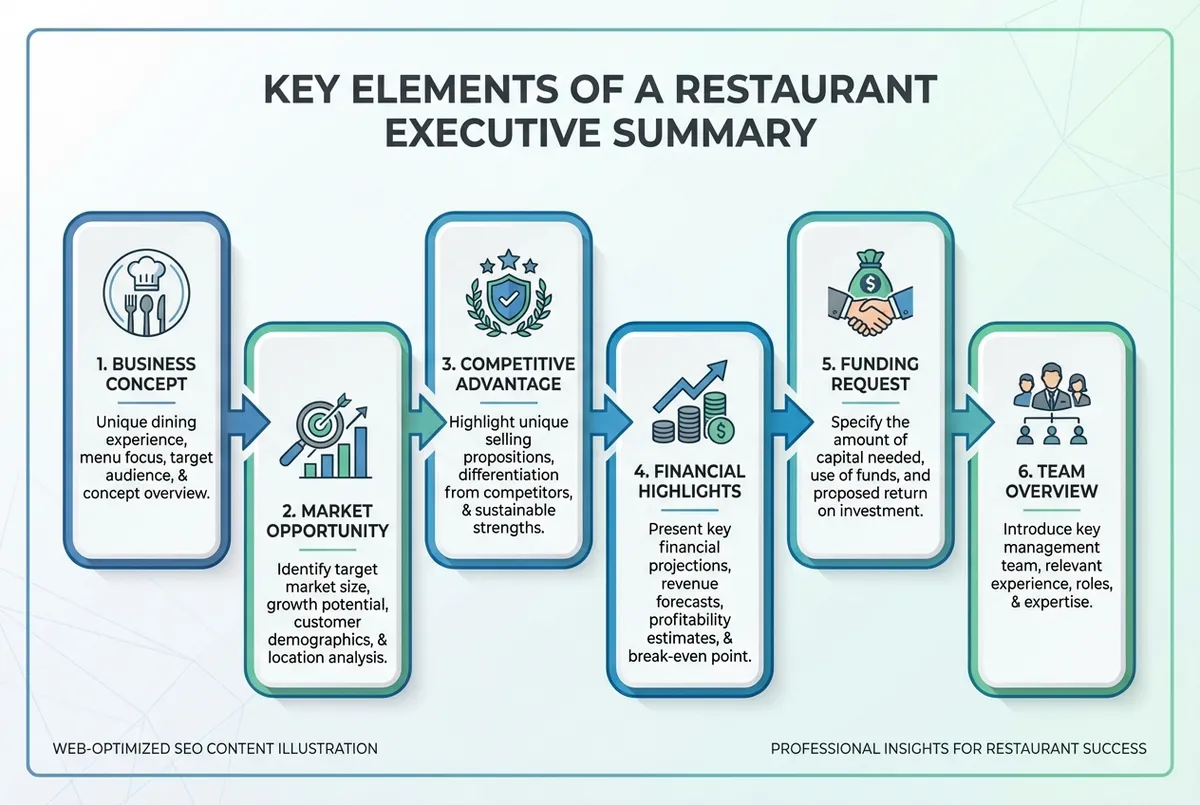
The six essential elements:
| Element | What to Include | Word Count |
|---|---|---|
| Concept | Restaurant type, cuisine, service style | 50-75 words |
| Target market | Customer profile, location catchment | 50-75 words |
| Competitive advantage | Why customers choose you | 50-75 words |
| Team | Key credentials and experience | 50-75 words |
| Financial highlights | Startup cost, break-even, projections | 75-100 words |
| Funding request | Amount needed, use of funds | 50-75 words |
For instance, a pizza restaurant owner might write: "Authentic Neapolitan pizza from a wood-fired oven imported from Naples. We use 48-hour fermented dough. We are the only city centre restaurant with this style."
Warning
If you're only listing generic differentiators like "quality food" and "great service," you'll lose to applicants who articulate specific, verifiable advantages.
How Do You Present Your Team Credentials?
One section many restaurant owners underestimate is the team element. Lenders invest in people, not just concepts. Your executive summary needs to establish why you and your team can actually deliver what you are promising.
Effective team credentials include:
- Relevant industry experience: Years in hospitality, roles held
- Specific achievements: Revenue grown, awards won, venues opened
- Complementary skills: Business acumen alongside culinary expertise
- Local knowledge: Understanding of the specific market you are entering
For example, a chef opening her first restaurant might write: "Head chef with 12 years experience. Five of those years were at Michelin-starred venues in London. Business partner brings 15 years of restaurant management. He launched two successful independents in Manchester."
First-time restaurateurs
Most first-time restaurateurs lack track records. That is okay. Emphasise transferable experience, relevant qualifications, and advisory support. Mention your mentor or consultant if you have one.
Lenders are not expecting you to have already succeeded. They want evidence that you understand what success requires.
Warning
If you're only listing job titles without specific results, you'll lose to applicants who quantify their track record.
How Do You Write a Compelling Opening?
Moving on to the actual writing. Your opening sentences determine whether the reader continues. Bank managers see hundreds of executive summaries. Yours needs to stand out immediately.
Strong openings share these traits:
- State the concept in one clear sentence
- Include location and target market
- Mention a specific competitive angle
- Avoid generic hospitality language
Example of a weak opening:
"We are passionate about food and want to open a restaurant that provides excellent service and quality ingredients."
Example of a strong opening:
"The Copper Kettle is a 35-cover brunch cafe for remote workers in Shoreditch. We offer all-day breakfast, speciality coffee, and workspace tables. This addresses the growing demand for work-friendly dining."
The strong version tells you exactly what, where, who, and why in two sentences. The weak version could describe any restaurant in any city.
Info
Ask yourself: Would a stranger understand my concept after reading the first two sentences? If you're hesitating, that's usually a sign you need to be more specific.
Techniques for stronger openings:
- Lead with your location and covers, not your passion
- Name your target customer specifically (remote workers, young families, business lunchers)
- Include one number in the first paragraph (covers, investment, or projected revenue)
- End with your unique positioning statement
A neighbourhood Italian restaurant is not a positioning. A 40-cover neighbourhood Italian specialising in Sardinian cuisine with a dedicated aperitivo menu from 5-7pm. That is a positioning that a lender can evaluate.
What Financial Information Goes in the Summary?
At this point, let's address the numbers. Your restaurant executive summary needs financial highlights that demonstrate viability without overwhelming detail.
Include these financial elements:
- Startup costs: Total investment required
- Funding request: Amount sought and from whom
- Use of funds: How the money will be spent
- Break-even timeline: When revenue covers costs
- Revenue projection: Year one expected sales
For example: "Total startup cost: £180,000. This breaks down as £100,000 fit-out, £30,000 equipment, £20,000 deposits, and £30,000 working capital. We seek a £130,000 bank loan. Owner investment is £50,000. Break-even is at month 16 with year one revenue of £320,000."
Why this matters
According to UK Finance data, lenders often decide whether to request the full business plan based solely on the executive summary. If your numbers lack credibility here, they will not read further.
Avoid including detailed monthly projections in the summary. Those belong in your financial projections section. The summary needs headline figures only.
Common financial mistakes in executive summaries:
- Omitting working capital (lenders notice this immediately)
- Using round numbers without breakdown (£200,000 feels like a guess; £187,500 feels researched)
- Projecting break-even before month 12 (unrealistic for most concepts)
- Forgetting to mention your own investment (lenders want skin in the game)
Info
If you can't explain where every pound of your funding request goes without checking your notes, that's usually a sign your financial planning needs more depth before you attempt the summary.
What Are Common Executive Summary Mistakes?
Furthermore, knowing what to avoid is as important as knowing what to include. These mistakes damage otherwise solid applications.
Mistake 1: Writing it first
The executive summary summarises your plan. If you write it before completing other sections, you are guessing rather than summarising. Write it last.
Mistake 2: Exceeding one page
If your summary runs to two or three pages, you have not summarised. Cut hard. Every sentence must earn its place. Lenders see this as a sign you cannot prioritise.
Mistake 3: Generic language
"Quality food," "excellent service," "passionate team": these phrases mean nothing. Replace them with specifics that only your restaurant could claim.
Mistake 4: Missing the funding ask
Some owners bury the funding request or leave it vague. State clearly: "Seeking £150,000 bank loan for fit-out and working capital." Lenders need the number, the source, and the purpose in one sentence.
Mistake 5: Ignoring the local context
UK lenders want to see you understand British regulations, local competition, and realistic UK market data. Generic plans that could apply anywhere signal inexperience.
Warning
If you're only copying executive summary templates without adapting them to your specific situation, you'll lose to applicants who demonstrate genuine local knowledge.
How Should You Format Your Executive Summary?
Presentation matters more than many restaurant owners realise. A well-formatted executive summary signals professionalism before the reader absorbs a single word.
Formatting best practices:
- Keep to one page: This is non-negotiable for traditional bank applications
- Use consistent headings: Match the style of your main business plan
- Include white space: Dense text discourages reading
- Lead with the strongest point: Put your most compelling element first
- Use bullet points sparingly: For key facts, not entire paragraphs
For instance, a cafe owner might lead with location if she has a prime high-street unit. Or she might lead with team if her head chef has a strong reputation. The strongest element comes first.
Pro tip
Print your executive summary and read it standing up. If you cannot absorb the key points in 90 seconds while standing, neither can a busy bank manager between meetings.
What not to include:
- Detailed monthly projections (save for the financial section)
- Long paragraphs about your passion for hospitality
- Technical menu descriptions or recipes
- Extensive market research citations (reference the section, do not reproduce it)
The executive summary invites deeper reading. It does not replace the detailed sections that follow.
Minimum Viable Action Plan
That is a lot to take in. If you only have 30 minutes a week to work on your restaurant executive summary, start here:
This week, draft your executive summary foundation
- Day 1-2: Write your concept statement in two sentences (what, where, who)
- Day 3-4: List your three strongest competitive advantages with specifics
- Day 5-7: Summarise your financial highlights in five bullet points
You can refine later. Getting the key messages down matters more than perfect prose. A rough summary with strong content beats a polished summary with weak substance. When you cost out those financial projections, remember to budget for marketing. Seeing how affordable the right tools can be helps keep that line item realistic from day one.
Key Takeaways
If you run a restaurant and want to see how Local Brand Hub can support your marketing, explore our restaurant marketing tools.
Key Takeaways
Here is what matters most when writing a restaurant executive summary that secures funding:
- Write it last: Summarise your completed plan, do not guess
- Keep it to one page: Maximum 600 words, ideally 400-500
- Include all six elements: Concept, market, advantage, team, financials, request
- Be specific: Replace generic claims with verifiable details
- State your ask clearly: Amount, source, purpose, timeline
Info
Your restaurant executive summary is not an introduction; it is your pitch. Make every word count, because this is often the only page that gets read before a decision is made.
Your next step? Complete your other business plan sections first. Then return to write an executive summary that accurately reflects your strongest points. For guidance on financial projections, see our restaurant financial projections guide.
For the complete business plan framework, return to our restaurant business plan guide.
For UK restaurant owners
Make Your Summary Count
LocalBrandHub supports UK restaurant owners with marketing strategies that complement solid business fundamentals.
Start freeGet More Marketing Tips
Practical marketing tips for UK business owners, straight to your inbox. No spam, unsubscribe anytime.
About the Author
Local Brand Hub
Empowering UK Businesses
Local Brand Hub provides comprehensive business management tools designed specifically for UK local businesses to streamline operations, automate marketing, and grow revenue.
More articlesRelated Articles
 Business Growth
Restaurant Business Plan UK: What British Lenders Want
Create a restaurant business plan UK lenders will approve. VAT registration, premises licensing, and business rates requirements British banks expect.
 Business Growth
Restaurant Opening Costs: What You Can Actually Price
Restaurant opening costs are two budgets, not one. Price the published UK rates today, quote the rest twice, then size your reserve in months.
 Business Growth
How to Write a Restaurant Business Plan: UK Lender Guide
How to write a restaurant business plan UK lenders will read: the seven sections, covers-based financial projections and real Start Up Loans cases.