
Write a small restaurant business plan using the 30/30/30/10 cost rule. Covers 7 essential sections with realistic UK startup figures.
Why do small restaurants fail? Not the food: the finances. A small restaurant business plan does not need to be complicated, but it does need the right sections to secure funding, track costs, and guide your first year without running out of cash.
Short on time? Here's the quick version
- 30/30/30/10 rule: 30% food costs, 30% labour, 30% overheads, 10% profit as your benchmark
- 7 essential sections: Executive summary, business description, market analysis, menu/operations, marketing, management team, financial projections
- Most profitable formats: Pizza, takeaways, cafes: simpler operations, higher turnover
- Minimum budgets: £50k-£90k (small cafe), £100k-£200k (full-service small restaurant)
- Professional help: Only worth it for funding requests over £100k
Full practical guide below
Related: For the complete framework, see our restaurant business plan guide which covers all sections in detail.
If you're reading this after a long shift, thinking "I just want to cook," you're not alone. Most small restaurant owners find planning overwhelming. This guide strips away the unnecessary complexity and focuses on what actually matters for a small operation.
This guide draws on analysis of successful UK small restaurant funding applications and input from hospitality business advisors.
What You'll Learn
- The 30/30/30/10 cost rule that keeps small restaurants profitable
- The seven essential sections every business plan needs
- Which restaurant types offer the best profit margins
- When professional help makes sense for your plan
- Realistic startup budgets for small UK restaurants
What is the 30/30/30/10 Rule for Restaurants?
First, let's cover the most important financial framework. The 30/30/30/10 rule is a benchmark for restaurant cost allocation that helps small operators stay profitable. It suggests your costs should roughly break down as 30% food costs, 30% labour costs, 30% overheads, and 10% profit.
- Food costs: 30%
- Labour costs: 30%
- Overheads (rent, rates, utilities): 30%
- Profit: 10%
This is a rule of thumb, not a guarantee. Your actual percentages will vary based on concept and location.
For example, a small cafe might achieve 25% food costs but face 35% rent in a prime high-street location. A small restaurant in a secondary location might run lower overheads while commanding moderate prices.
Pro tip
Use this framework as a sanity check. If your projections show 40% labour costs without explanation, a lender will question your assumptions.
Warning
If you're only guessing at these numbers, you'll lose to competitors who have actually costed their dishes. Every ingredient, every staff hour, every utility bill: know your numbers before you open.
What are the 7 Things in a Business Plan?
Now that you understand the financial framework, let's examine the structure. A complete small restaurant business plan needs seven core sections. These are not optional extras. Lenders expect to see each one addressed.
The seven essential sections:
- Executive Summary: Your pitch in one page (write this last)
- Business Description: Concept, location, legal structure
- Market Analysis: Local competition and target customers
- Menu and Operations: Food costs, suppliers, service style
- Marketing Strategy: How you will attract customers
- Management Team: Your experience and key staff
- Financial Projections: Startup costs, cash flow, break-even
For a small restaurant, each section can be concise. For example, a 30-cover neighbourhood bistro might write a two-page market analysis covering three direct competitors and local demographics, while a franchise application would need ten pages of detailed research. That competitor research doesn't stop at opening either. Ongoing competitor tracking shows how nearby rivals shift their prices and offers, so your plan stays grounded in reality.
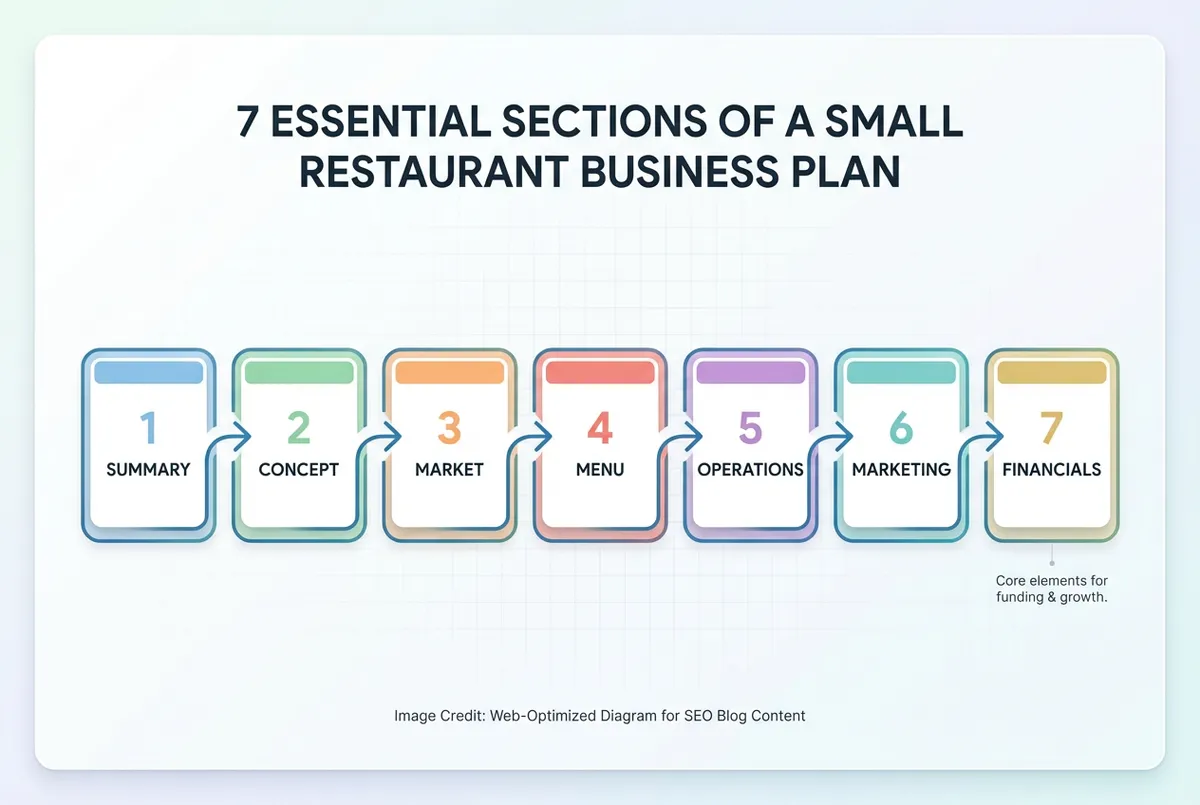
The gov.uk business plan guidance confirms these seven sections as standard requirements. However, brevity is not the same as skipping sections.
Warning
If your plan lacks market analysis because you "know the area," a lender will assume you have not done proper research. That approach never works with experienced lenders.
Info
Ask yourself: Would I invest my savings in this restaurant based on what I have written? If you're hesitating, that's usually a sign your plan needs more substance, not more pages.
Which Type of Restaurant is Most Profitable?
Moving on to the question every aspiring owner asks. The most profitable restaurant types for small operators typically include pizza and fast-casual concepts, according to industry benchmarks. These formats benefit from lower food costs, simpler operations, and higher table turnover.
Profitability tiers for small restaurants:
| Tier | Margin Range | Examples |
|---|---|---|
| Higher margin concepts | 15%+ | Pizza, takeaways, cafes: lower labour, higher turnover |
| Mid-range concepts | 10-15% | Casual dining, bistros: balance of service and efficiency |
| Lower margin concepts | 5-10% | Fine dining: high costs, premium positioning |
Margins vary significantly based on execution, location, and management.
The reality for most small restaurant owners is that profitability depends more on execution than concept. A well-run casual dining restaurant will outperform a poorly managed pizza shop every time.
Info
A small restaurant business plan is not about proving you can cook; it is about proving you can count.
For instance, a 25-seat cafe in Bristol achieved 18% profit margins by focusing on breakfast and lunch service only, avoiding the high staffing costs of evening trade.
Warning
If you're only choosing a concept because it sounds exciting without checking the margins, you'll lose to competitors who picked their format strategically.
Is It Worth Paying Someone to Write a Business Plan?
At this point you might be considering whether to hire help. This is the question everyone asks but few answer honestly. For a small restaurant business plan, the answer depends on your circumstances.
Consider professional help if:
- You are seeking substantial funding (£100k+) from banks
- English is not your first language and precision matters
- Your deadline is tight and you have never written a plan
- You want an outside perspective on your assumptions
Write it yourself if:
- You are self-funding or seeking smaller amounts
- You have time to research and iterate
- You want to deeply understand your own numbers
- Your concept is straightforward
Professional business plan writers typically charge £2,000-£5,000 for a comprehensive restaurant plan. However, no writer can create your vision, experience, or local market knowledge. Even with professional help, you will spend significant time in interviews and reviews.
Warning
One word of caution: If you cannot explain your financial projections without reading from the document, you are not ready for a bank meeting. The plan must reflect your understanding, not just professional formatting.
Info
If you can't articulate why your break-even is at month 14 rather than month 8, that's usually a sign you need to dig deeper into your own numbers.
What is the Minimum Budget to Open a Restaurant?
Finally, let's address startup costs. UK small restaurant startup costs vary dramatically, but realistic minimums for a basic operation start around £50,000-£80,000 for a small cafe or takeaway, and £100,000-£200,000 for a full-service small restaurant.
Startup cost ranges (UK):
| Restaurant Type | Minimum Budget |
|---|---|
| Small cafe/takeaway | £50k-£90k |
| Small full-service | £100k-£200k |
Key cost categories include fit-out, deposits, licences, and working capital (budget three months minimum).
Warning
If you can't tell whether your working capital covers slow months or just opening week, that's a sign your projections need more detail.
These are minimums. Prime locations and extensive fit-outs will cost significantly more.
Your small restaurant business plan must justify every figure. Banks consistently reject plans lacking supporting documentation. Include contractor quotes for fit-out, supplier quotes for equipment, and realistic working capital calculations.
Why this matters
According to UK Finance data, incomplete applications are the primary reason for business loan rejections, not weak financials, but missing information. Thorough documentation improves approval rates significantly.
Minimum Viable Action Plan
That is a lot to take in. If you only have 30 minutes a week to work on your small restaurant business plan, start here:
This week, begin your small restaurant business plan
- Day 1-2: Draft your concept statement and unique selling proposition in two sentences
- Day 3-4: Research three direct competitors: visit them, note prices, count covers
- Day 5-7: Create a basic startup cost spreadsheet with real quotes for your top three equipment items
You can refine your small restaurant business plan later. Getting the foundation right matters more than perfecting every paragraph. A rough plan you can iterate on beats a perfect plan that never gets written.
Key Takeaways
If you run a restaurant and want to see how Local Brand Hub can support your marketing, explore our restaurant marketing tools.
Key Takeaways
Creating a small restaurant business plan does not require corporate complexity, but it does need these fundamentals:
- Apply the 30/30/30/10 rule as your financial sanity check
- Include all seven sections even if each is brief
- Choose your concept wisely: simpler formats often mean better margins
- Consider professional help only for large funding applications
- Budget realistically: £100k minimum for a small full-service restaurant
The best small restaurant business plans tell a clear story: who you are, what you are building, why it will work in your specific location, and how you will survive the inevitable challenges.
Info
A small restaurant business plan is not paperwork for the bank; it is your roadmap from idea to opening night.
Your next step? Start with the 30/30/30/10 framework. Cost your menu, estimate your labour, research your rent. If the numbers work at 50% occupancy, you have a viable concept. If they only work at 90% occupancy, you need to rethink your approach.
For the complete framework covering all sections in depth, return to our restaurant business plan guide which complements these small restaurant specifics.
For UK restaurant owners
Turn Your Plan Into Reality
LocalBrandHub supports UK restaurant owners with marketing strategies that complement solid business fundamentals.
Start freeGet More Marketing Tips
Practical marketing tips for UK business owners, straight to your inbox. No spam, unsubscribe anytime.
About the Author
Local Brand Hub
Empowering UK Businesses
Local Brand Hub provides comprehensive business management tools designed specifically for UK local businesses to streamline operations, automate marketing, and grow revenue.
More articlesRelated Articles
 Business Growth
Restaurant Opening Costs: What You Can Actually Price
Restaurant opening costs are two budgets, not one. Price the published UK rates today, quote the rest twice, then size your reserve in months.
 Business Growth
How to Write a Restaurant Business Plan: UK Lender Guide
How to write a restaurant business plan UK lenders will read: the seven sections, covers-based financial projections and real Start Up Loans cases.
 Business Growth
Restaurant Business Plan Template: Copy the UK Blocks
A restaurant business plan template you can paste and fill in, with the UK lines an American version leaves out and a source beside every number.