
Learn what a restaurant consultant does, how much they charge in the UK, and how to hire the right one. Pricing table, hiring checklist, and FAQ.
Your food costs have crept past 35%. Staff quit faster than you can train replacements. Last Tuesday you sat in an empty dining room wondering if the problem is your location, your menu, or something you cannot see any more. You need a fresh pair of eyes, but where do you start?
A restaurant consultant is a method that connects experienced hospitality professionals with restaurant owners to solve specific business problems. Their role covers everything from menu development and financial restructuring to staff training and operational efficiency. Unlike a restaurant marketing agency, a consultant focuses on the internal workings of your business rather than external visibility. For a broader view of the consulting landscape, see our complete guide to restaurant consulting.
What You'll Learn
- What a restaurant consultant actually does day to day
- How much consultants charge in the UK
- The different types of consultant and which one you need
- A step-by-step process for finding and hiring the right one
- When to hire a consultant versus handling problems yourself
What Is a Restaurant Consultant?
First, let's define the role clearly. Hiring a restaurant consultant is a strategy that pairs specialist advisers with restaurant owners to improve business performance. They diagnose problems, recommend solutions, and often help implement changes across operations, finances, menus, and staffing.
Think of it this way: a chef knows how to cook. A consultant knows why the business is not making money despite the chef cooking well.
For example, a curry house in Birmingham might bring in a consultant after three straight months of declining profits. The consultant reviews the P&L, discovers the issue is portion creep rather than falling covers, and fixes it within a week.
Info
Many consultants in the UK work independently or through small boutique consultancy firms. The larger management consulting companies like McKinsey or Deloitte do work with major chains, but independent restaurants typically hire solo consultants or small hospitality practices.
If you're reading this thinking "I don't have time for this," you are not alone. The UK restaurant sector employs roughly 1.8 million people (UKHospitality, 2025), and many owners are too busy running the business to step back and see the bigger picture. That is exactly what a consultant is for.
What Does a Restaurant Consultant Do?
Here's what a typical engagement looks like. A consultant analyses your business across several key areas and delivers actionable recommendations. The exact scope depends on your brief, but many consultations cover these core functions:
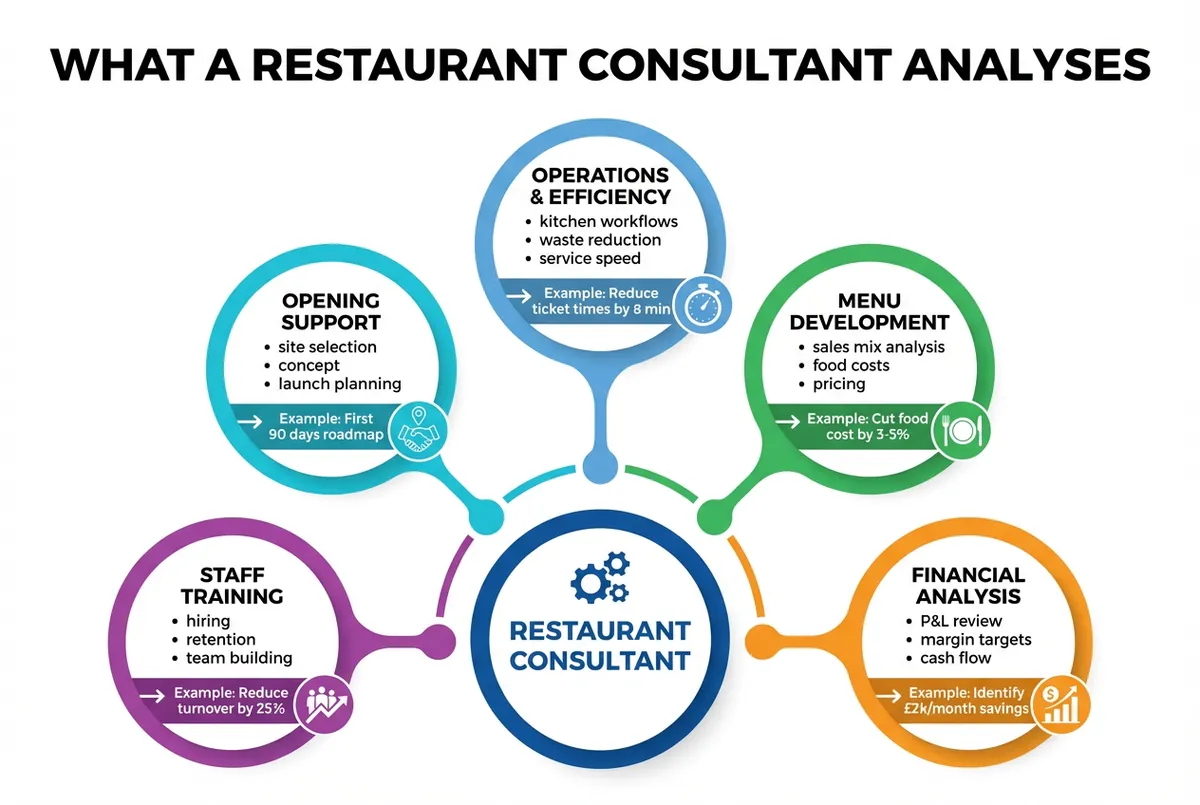
The five core areas a restaurant consultant typically covers
- Operations and efficiency: A consultant watches your service from prep through to close. They time kitchen workflows, monitor waste, and identify bottlenecks. For example, a pizza restaurant in Manchester might discover its kitchen layout forces chefs to walk extra steps per service; a simple rearrangement could shave minutes off average ticket times.
- Menu development and engineering: A consultant analyses your sales mix, food costs per dish, and contribution margins. They identify which dishes are popular but unprofitable and recommend changes to pricing, portions, or ingredients. For more on this topic, see our guide to menu engineering.
- Financial analysis: A consultant reviews your profit and loss statements, identifies where money is leaking, and sets targets. The average UK restaurant operates on net profit margins of around 3 to 9% (Hospitality Insights, 2025). If your margins are below that, a consultant can often find savings quickly.
- Staff training and retention: With UK hospitality staff turnover rates often reaching 30% annually (People 1st International, 2025), consultants help with hiring processes, training programmes, and retention strategies.
- Concept and opening support: Opening a new restaurant without professional guidance is like performing surgery on yourself. Consultants help with site selection, concept development, menu creation, and launch planning.
Info
If you're thinking "I could probably work this out myself," you probably could, given enough time. The question is whether you have six months to spare while your restaurant bleeds money.
How Much Should a Restaurant Consultant Charge?
Now that you know what they do, let's talk numbers. Consultant fees in the UK vary based on experience, specialism, and engagement type:
| Engagement Type | Typical UK Cost | Duration |
|---|---|---|
| Initial audit | £500-£1,500 | 1 day |
| Menu review | £1,000-£3,000 | 2-5 days |
| Operational overhaul | £3,000-£10,000 | 2-8 weeks |
| Opening consultancy | £5,000-£20,000 | 3-6 months |
| Monthly retainer | £1,000-£5,000/month | Ongoing |
Independent consultants in the UK typically charge £500 to £1,500 per day (Restaurant Consultant Group, 2025). More experienced consultants, particularly those who have successfully opened or turned around well-known venues, charge at the higher end. For a deeper breakdown, see our guide to restaurant consultant costs.
For example, a family-run Italian restaurant turning over £30,000 a month might invest £2,500 in a three-day operational audit and menu review. If the consultant identifies £1,500 a month in food cost savings, the engagement pays for itself in under two months.
Pro Tip
Be wary of consultants who charge based on a percentage of savings. This model can create perverse incentives. A flat fee or day rate keeps everyone honest.
How Much Should I Pay for a Business Consultant?
This sounds like an obvious choice, but in practice many restaurant owners default to the cheapest option when budgets are tight. Here's how the costs compare:
Note: "Relevance" reflects typical fit and may vary by individual consultant.
| Consultant Type | UK Day Rate | Sector Knowledge | Relevance |
|---|---|---|---|
| General business consultant | £400-£2,000 | Broad | Low |
| Restaurant consultant | £500-£1,500 | Deep hospitality | High |
| Management consulting firm | £1,500-£5,000+ | Varies | Medium (chain-focused) |
For many independent restaurants, a specialist delivers better value than a generalist. A generalist might give you a solid cashflow analysis, but they will not know that your 34% food cost is above the UK casual dining average of around 30 to 32% (Fourth Hospitality, 2025).
If you are only comparing consultants on price you'll always lose to competitors who compare them on relevant experience. A cheaper generalist who does not understand covers, GP percentages, or seasonal trade patterns will cost you more in the long run.
Ask yourself: if your margins have not improved in two years, is another year of doing the same thing really the answer?
For UK-specific options and pricing, see our guide to restaurant consultants in the UK.
Types of Restaurant Consultant
Building on the overview above, here are the main types of consultant and when each one makes sense:
- Restaurant management consultant: Focuses on overall business strategy, financial planning, and growth. Often the right choice if you are planning expansion or your profits are declining without a clear reason.
- Restaurant operations consultant: Specialises in kitchen efficiency, service flow, and staffing. For example, a busy city-centre brasserie with slow ticket times would benefit from an operations audit before spending on marketing.
- Restaurant marketing consultant: Handles branding, digital marketing strategy, and customer acquisition. Typically suited to restaurants that are well-run but unknown. Note: for ongoing marketing execution, a restaurant marketing agency may be more appropriate: it is worth weighing an agency against doing it in-house before you commit to either.
- Menu consultant: Works specifically on menu design, pricing, and food cost management. Suited to venues with thin margins despite good covers.
- Restaurant opening consultant: Guides new ventures from concept through launch. Important if this is your first restaurant or you are entering an unfamiliar market.
A pub restaurant in the Cotswolds struggling with midweek trade might need a marketing consultant to drive awareness. But if their weekend covers are strong yet profits are still thin, that's usually a sign the issue is operational, and an operations consultant would be the better investment.
How to Find and Hire a Restaurant Consultant
Next, let's walk through the practical steps for finding the right person.
- Define your problem clearly. Write down the three biggest challenges in your restaurant. Be specific. "Revenue is down" is not enough. "Weekday covers have dropped since March while food costs have risen" gives a consultant something to work with.
- Search for specialists. Look for consultant companies with UK hospitality experience. Industry bodies like the Institute of Hospitality and UKHospitality can point you toward accredited professionals.
- Request case studies. Any consultant worth hiring can show you examples of UK restaurants they have helped, with measurable outcomes. For example, a good consultant might share that they cut food costs from 36% to 29% at a similar venue. If they cannot show numbers, keep looking.
- Start with a paid audit. Do not commit to a large project without a trial. A one-day paid diagnostic lets both sides assess the fit before committing further.
- Agree on deliverables and timelines. Get everything in writing. What will they deliver? By when? A good consultant sets clear KPIs that tie back to your bottom line.
Restaurant Consultant Hiring Checklist:
- Problem statement is written and specific
- Shortlisted at least three consultants with UK restaurant experience
- Reviewed case studies with measurable financial outcomes
- Spoken to at least one reference from a similar restaurant type
- Agreed on a paid initial audit before any larger engagement
- Scope, deliverables, and timeline are documented in writing
- Payment terms and cancellation policy are clear
Info
The reality for many independent restaurants is that you cannot afford to hire the wrong person. Spend an extra week on due diligence rather than rushing into a contract you regret.
How to Become a Consultant for Restaurants
This section is for hospitality professionals considering a move into consulting. Here's a brief roadmap:
- Gain operational experience. Many successful consultants have at least five to ten years of hands-on experience in restaurant management or ownership. There is no substitute for having actually run a kitchen, managed staff, and handled the pressures of a quiet Wednesday night when the bills still need paying.
- Develop a specialism. The consultants in highest demand are known for solving a specific type of problem: menu engineering, financial turnarounds, or new openings. Generalists compete on price. Specialists compete on value.
- Build a portfolio. Document your successes with data. "Reduced food costs by 6% across three venues" is a portfolio piece. "Helped restaurants get better" is not.
- Get qualified. The Institute of Hospitality offers professional memberships and qualifications. A management qualification adds credibility, though results matter more than letters after your name.
- Start with freelance projects. Before going full-time, take on consulting projects alongside your current role. For instance, offering a paid menu audit to a former colleague's restaurant is a low-risk way to build your portfolio while testing whether consulting suits your working style.
If you're only reading guides and collecting qualifications you'll always lose to consultants who have real kitchen and floor experience. Get the hours in first.
If You Only Have 30 Minutes This Week
Now let's be practical. If you only have 30 minutes a week, do this:
- Day 1-2: Calculate your food cost percentage and labour cost percentage for last month. Write both numbers down. If either exceeds 33%, you have a clear starting point for any consultant conversation.
- Day 3-4: Write a one-paragraph description of your restaurant's biggest problem. Be honest. This becomes your brief when approaching consultants.
- Day 5-7: Send that paragraph to two consultants and ask for a 15-minute phone call. Many will do an initial conversation for free.
Frequently Asked Questions
What is a restaurant consultant?
The restaurant consultant approach is a method that brings specialist hospitality expertise to your business on a project basis. They analyse operations, finances, menus, and staffing to identify problems and recommend practical solutions. For example, a consultant might spot that your Thursday food waste is double your Friday waste because of poor forecasting. They work on specific engagements rather than as permanent staff.
How much does a restaurant consultant cost in the UK?
UK consultants typically charge £500 to £1,500 per day for independent practitioners. Project-based engagements range from £2,000 for a menu review to £20,000 for full opening consultancy. Monthly retainers for ongoing advisory work cost £1,000 to £5,000. Get a clear scope of work before agreeing to any fee.
Are management consultants well paid?
In the restaurant sector, experienced management consultants earn between £50,000 and £100,000 annually if working full-time, or equivalent day rates of £500 to £1,500 as independents (Glassdoor UK, 2025). Independent consultants often have higher effective rates because they keep their full fees rather than sharing with an employer.
What is the difference between a restaurant consultant and a restaurant manager?
The restaurant consultant approach is a method that focuses on external diagnosis and strategic recommendations, while a manager runs day-to-day operations as a permanent employee. The consultant diagnoses and recommends; the manager executes. Some consultants provide interim management, but this is a separate service.
How do I know if I need a restaurant consultant?
If you have a specific business problem that has persisted for three months or more despite your efforts to fix it, outside help is worth considering. Common triggers include declining profits, rising food costs, high staff turnover, or planning a new opening. If the cost of the problem exceeds the cost of the consultant, the maths works in your favour.
If you run a restaurant and want to see how Local Brand Hub can support your marketing, explore our restaurant marketing tools.
Key Takeaway
Key Takeaway
A restaurant consultant brings outside expertise to problems you are too close to see clearly.
- Define your problem first: A clear brief attracts better consultants and saves time
- Check hospitality experience: Generalists miss restaurant-specific issues
- Start with a paid audit: Do not commit to a large project without testing the fit
- Compare on value, not price: The cheapest consultant is rarely the strongest investment
- Know when to act: Three months of declining performance is a clear signal
For UK-specific options, see our guide to restaurant consultants in the UK. For the full picture of how consulting fits alongside other support options, explore our restaurant consulting hub.
For restaurants, salons, and local businesses
Need help with your marketing?
We help UK businesses turn social media into real results, not busywork.
Start freeGet More Marketing Tips
Practical marketing tips for UK business owners, straight to your inbox. No spam, unsubscribe anytime.
About the Author
Local Brand Hub
Empowering UK Businesses
Local Brand Hub provides comprehensive business management tools designed specifically for UK local businesses to streamline operations, automate marketing, and grow revenue.
More articlesRelated Articles
 Business Growth
How to Become a Restaurant Consultant: A Practical UK Guide
Learn how to become a restaurant consultant in the UK. Qualifications, experience paths, building your practice, and landing your first clients.
 Business Growth
Restaurant Consultant Services: What They Offer
Every restaurant consultant service in the UK explained. Menu engineering, operations, turnarounds, openings and more. Costs, scope and expected outcomes.
 Business Growth
Restaurant Consultant UK: Costs, Firms & How to Choose
Find the right restaurant consultant UK owners trust. Covers pricing, top UK consultancy firms, regulations, and a framework for hiring well.