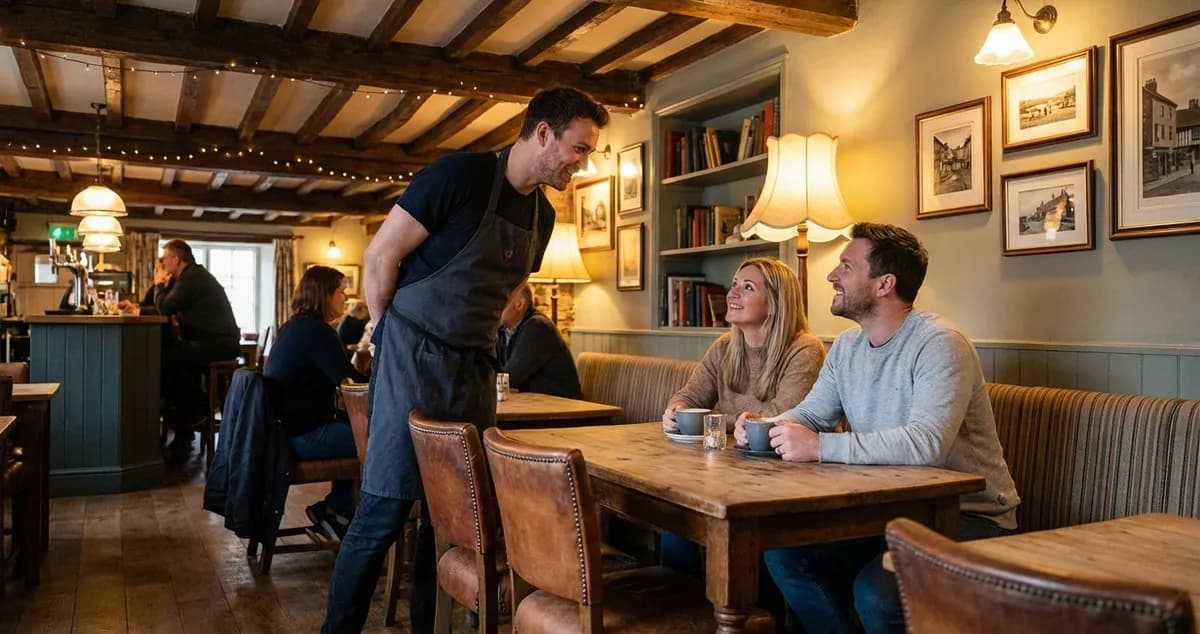
Proven restaurant customer retention strategies for UK independents. Turn first-time diners into loyal regulars who return.
Restaurant customer retention is the practice of turning one-time diners into regular guests who choose your restaurant repeatedly over competitors. A good retention rate for restaurants sits around 55%, though most UK independents operate well below this benchmark. Improving retention by even 5% can increase profits by 25-95%, making it one of the most cost-effective strategies for sustainable growth.
You've just finished a Saturday rush. Tables were full, food went out quickly, and you caught a few genuine smiles. But here's the uncomfortable truth: 69% of those guests will never come back (Bloom Intelligence, 2025). Not because the food was bad or the service was slow. They simply forgot about you.
That's the reality for most independent restaurants. And if you're reading this after another quiet Wednesday night wondering where everyone went, you're not alone. The good news? Retention is entirely within your control.
Info
Related: Build a loyalty programme that drives repeat visits with our Restaurant Loyalty Program guide.
What You'll Learn About Restaurant Customer Retention
- What constitutes a good retention rate for UK restaurants
- The 30/30/30/10 rule and why it matters for your margins
- The 4 Cs framework for building genuine customer loyalty
- Practical, low-effort strategies that fit around a 12-hour shift
- How to measure whether your retention efforts are actually working
What Is a Good Retention Rate for Restaurants?
So you've got the basics. But what does "good" actually look like?
A good customer retention rate for restaurants is around 55%, according to industry benchmarks (Exploding Topics, 2025). That might sound achievable, but it's weak compared to banking and media which achieve significantly higher rates.
Here's the harsh context: only a quarter of first-time visitors return within 90 days. The average lifetime value for a one-time visitor? Just £20.
If you're thinking "my retention rate must be fine because we're busy on weekends," that's usually a sign the strategy needs tightening. Weekend footfall often masks a retention problem. The real question is: how many faces do you recognise on a Tuesday?
What this means for you:
- If 55% seems unreachable, start smaller. Moving from 30% to 40% retention still represents significant profit improvement
- Track return visits, not just covers. Your POS system likely has this data buried in the reports
- Focus on the first 90 days. That's when you either win a regular or lose them forever
Info
Related: Learn more strategies in our Restaurant Repeat Customers guide.
What Is the 30/30/30/10 Rule for Restaurants?
That's the retention picture. Let's talk about why it matters for your bottom line.
The 30/30/30/10 rule is a budgeting framework where you allocate 30% of revenue to food costs, 30% to labour, 30% to overhead, and target 10% as profit (Elite Financial Accounting, 2025).
Why Retention Protects Your Margins
Retention directly protects that 10% profit slice. Key facts:
- Acquiring a new customer costs 5-7 times more than keeping existing ones
- According to UKHospitality, labour and ingredient costs continue rising
- Every guest who doesn't return means more marketing spend needed
A practical example: A gastropub spending heavily on social media ads might achieve the same revenue boost by focusing on more return visits from existing customers, costing almost nothing beyond better service.
If your profit margin has been hovering below 10% despite decent revenue, the leak is often in acquisition costs rather than food waste. That's where retention becomes your repair strategy.
What Is a Reasonable Customer Retention Rate?
Here's where it gets practical. Different restaurant types naturally achieve different retention rates.
A reasonable retention rate depends on your restaurant type. For quick-service, 40-50% is achievable. For fine dining, 30-40% may be reasonable given the occasional-visit nature of the experience.
Rather than fixating on one number, consider your restaurant type. Quick-service and pubs generally achieve higher retention than fine dining (which sees guests less frequently by nature). Aim for the middle of your category's range, then stretch from there.
The specific percentage matters less than consistent tracking and improvement.
The more useful metric is return visit frequency. Top-performing restaurants achieve around 1.5 visits per month from loyalty programme members, compared to the industry baseline.
| Retention Metric | Average Restaurant | Top Performer |
|---|---|---|
| Return visit rate | Below 50% | 55%+ |
| Visits per month (regulars) | 1.2 | 1.5+ |
| First-return window | Often lost | 90 days max |
Note: Figures represent general industry patterns. Track your own baseline first.
If you're only tracking revenue you'll always lose to competitors who actually measure retention. You're flying blind on the metric that matters most.
What Does 68 Mean in a Restaurant?
Before we dive into retention tactics, a quick detour into kitchen terminology that actually matters for customer experience.
In restaurant kitchen terminology, 68 means an item that was previously unavailable (86'd) is now back in stock (Rosso Vivo Ristorante, 2025). It's the reverse of 86, which signals an item has sold out.
While this seems unrelated to customer retention, it actually illustrates an important point: communication clarity affects customer experience.
When a guest orders something that's unavailable, how your team handles that moment matters enormously:
- Good response: "I'm sorry, we've just run out of the lamb. Our chef's special tonight is the beef cheek, which is excellent, or I'd recommend the pork belly."
- Poor response: Shrug. "We're out."
These small interactions compound. If you're handling unavailability with a shrug you'll always lose to competitors who train their staff to recommend alternatives confidently.
The retention lesson: Operational consistency isn't glamorous, but it's foundational.
Why This Matters
Constant stockouts erode customer trust faster than any marketing can rebuild it. Consistency beats creativity every time when it comes to retention.
Before investing in loyalty programmes, ask yourself: do staff know how to handle substitutions gracefully? Do popular items regularly run out?
How to Retain Customers in a Restaurant
Here's the practical part. Retaining customers doesn't require a complete operations overhaul. It requires consistent execution of fundamentals plus a few strategic touches that make guests feel valued, and a simple all-in-one marketing platform helps you stay consistent enough that regulars remember you between visits.
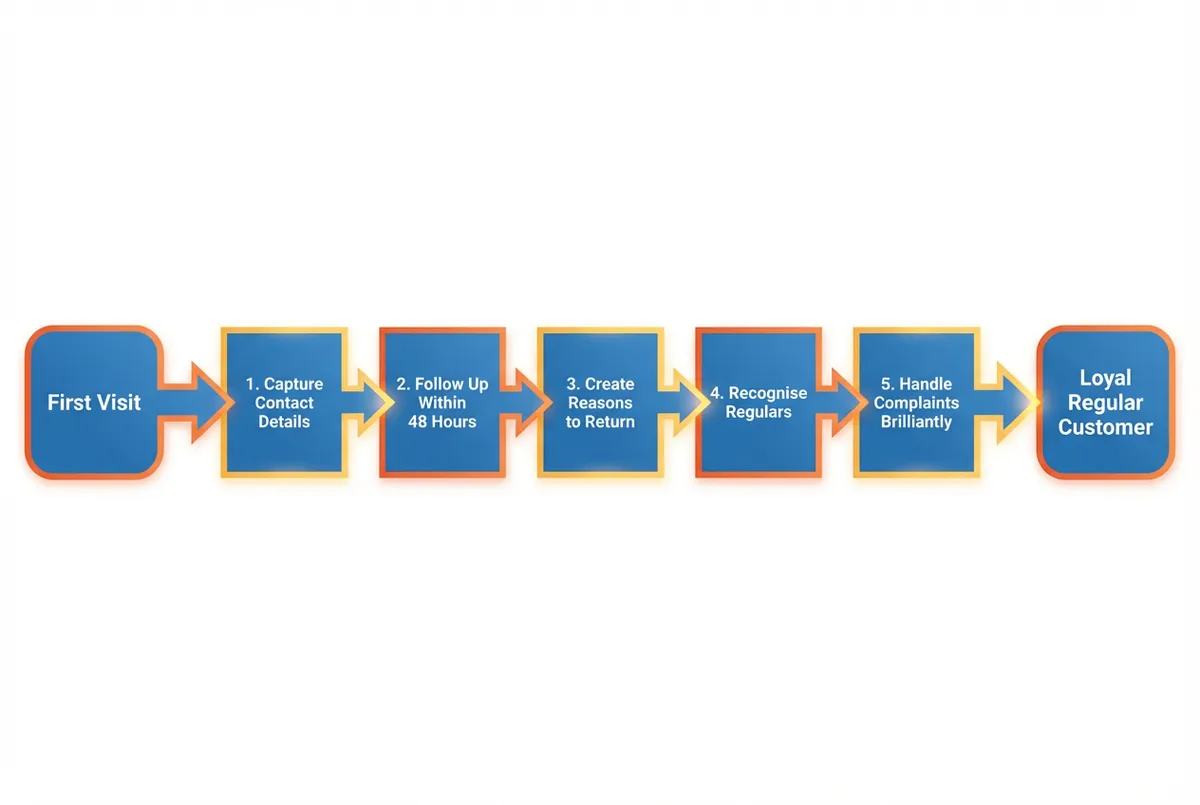
The path from first-time visitor to loyal regular
1. Capture Contact Information on First Visit
You can't follow up with guests you can't contact. The most effective retention happens between visits.
Low-friction methods:
- WiFi login requiring email address
- Digital receipt option via email
- Simple feedback card with optional contact details
- QR code linking to a brief post-meal survey
Don't make this feel invasive. A simple "Would you like to hear about our seasonal menus and occasional offers?" is enough.
2. Follow Up Within 48 Hours
The window for converting a first-time guest to a potential regular is narrow. A brief, personalised email within 48 hours keeps your restaurant in their mind.
This doesn't need to be elaborate. Even a simple "Thanks for visiting us on Saturday. We hope you enjoyed the lamb shoulder. If you have a moment, we'd love to hear how your experience was" works.
Info
Related: See our SMS Marketing for Restaurants guide for fast follow-up tactics.
3. Create Predictable Reasons to Return
Guests need a reason to choose you over every other option. Predictability creates that reason.
Examples that work:
- "Fish and chips Friday" with a small loyalty stamp card
- Monthly wine tasting evening (first Thursday of each month)
- Sunday roast pre-booking with a regular slot saved for repeaters
- Quiet weeknight "locals' discount" (show proof of local address)
The key is consistency. Desperation discounts train guests to wait for quiet periods. Regular, scheduled events create habitual visiting instead.
4. Recognise and Remember Regulars
Nothing builds loyalty faster than being remembered. Train front-of-house staff to note preferences for guests who visit more than twice.
A decent POS system can help with this. Many allow you to tag customer profiles with notes like "prefers corner table," "allergic to shellfish," or "always orders the house red."
When a guest walks in and the host says "Lovely to see you again, shall I get your usual table near the window?", you've just made them feel like a valued regular rather than a transaction.
Quick Win
Create a simple guest notes system. Even a shared document where staff add "John - allergic to nuts, prefers window seat, celebrates anniversary in March" is better than nothing.
5. Handle Complaints Brilliantly
A complaint handled well creates stronger loyalty than a perfect visit. Research consistently shows that customers whose problems are resolved satisfactorily become more loyal than those who never complained at all.
The 30/30/30/10 rule for complaint handling:
- 30 seconds: Acknowledge the problem without defensiveness
- 30 minutes: Resolve it, even if that means a manager visit or comped item
- 30 days: Follow up with a personal note or small gesture
- Then: A small proportion of those satisfied complainers will share their positive story
If you're defensive about negative feedback, that approach rarely wins. The guest isn't attacking your restaurant; they're giving you an opportunity to prove you care.
For example: A bistro in Manchester handled a complaint about a cold steak by immediately offering a replacement, comping desserts for the table, and following up a week later with a handwritten note and a voucher. That guest became a monthly regular who referred three friends. One well-handled complaint generated more value than months of advertising.
The 4 Cs of Customer Loyalty
You've got the tactics. Here's a framework to tie them together.
The 4 Cs framework offers a customer-centric approach to building loyalty: Customer Solution, Cost, Convenience, and Communication (Boston University Hospitality Review, 2025).
Customer Solution
Are you solving a problem for your guest? A quick lunch in 25 minutes? A romantic anniversary dinner? A reliable Sunday gathering spot for extended family? Understand which problem you solve, then solve it consistently.
Cost
Not just price, but perceived value. A more expensive main course that leaves guests satisfied is better value than a cheaper dish that feels skimpy. Retention suffers when guests feel short-changed.
Convenience
How easy is it to book, arrive, pay, and leave? Every friction point is a reason to choose somewhere simpler next time:
- Can guests book online at 11pm?
- Is your address easily findable?
- Do you accept contactless payment?
Communication
Stay in touch between visits without becoming annoying. Monthly emails with genuine updates keep you in mind. Daily promotional emails train people to unsubscribe.
For example: A gastropub using the 4 Cs might focus on:
- Solution: Being the reliable Sunday roast spot for families
- Cost: Offering a fixed-price Sunday menu that feels generous
- Convenience: Letting families book their regular table via WhatsApp
- Communication: A monthly email highlighting the roast menu and any seasonal changes
That's retention without complexity.
Minimum Viable Retention: If You Only Have 30 Minutes a Week
That's the theory. Here's where it gets messy.
In practice, when you're down two staff and the Saturday rush is about to hit, none of this feels achievable. So here's the minimum viable version.
This week, start your retention foundation:
- Day 1-2: Check if your POS tracks return visits. If not, create a simple spreadsheet and start noting recognisable faces manually
- Day 3-4: Set up a basic email capture method. A clipboard at the till asking "Join our mailing list for seasonal updates?" costs nothing
- Day 5-7: Send one email to whatever contacts you have. Just a genuine "Thank you for supporting us this month" with one piece of news
That's your floor. It's not perfect, but it's enough to start building the habit. Perfect systems mean nothing if they never get implemented.
Measuring Your Retention Success
You've started implementing. Next: knowing if it's working.
You can't improve what you don't measure. Here are the metrics that actually matter.
Essential tracking:
- Return visit rate: Returning guests / Total guests monthly
- Visit frequency: How often do your regulars actually visit?
- Customer lifetime value: Average spend x Visit frequency x Retention period
- Churn rate: Guests who haven't returned in 90 days
Practical advice: Don't overcomplicate this. Even a tally chart by the till marking "new vs returning" gives useful data.
For example: One café owner started tracking with a simple notebook. Within a month, she noticed most midweek regulars ordered the same thing. She created a "usual order" shortlist for staff. Those customers felt recognised, and return visits increased noticeably.
If you can't tell whether social media brings bookings or just likes, that's usually a sign the strategy needs tightening.
Frequently Asked Questions
How often should I email existing customers?
Monthly is the sweet spot for most restaurants. Frequent enough to stay top-of-mind, infrequent enough to avoid unsubscribes. Make every email valuable with genuine news, not just promotions.
What's the biggest mistake restaurants make with retention?
Focusing all energy on new customer acquisition while ignoring guests already in their database. The cost difference is significant: retaining a customer costs a fraction of acquiring a new one.
Do loyalty programmes actually work for small restaurants?
Yes, but keep them simple. Complex point systems confuse guests. A straightforward stamp card often outperforms elaborate digital programmes. See our guide to restaurant rewards programmes for more details.
How quickly should I see results from retention efforts?
Expect 3-6 months before metrics meaningfully shift. Retention is a compound effect. Early wins might include increased email sign-ups and higher follow-up email open rates.
Key Takeaways: Restaurant Customer Retention
If you run a restaurant and want to see how Local Brand Hub can support your marketing, explore our restaurant marketing tools.
Key Takeaways: Restaurant Customer Retention
Getting customers through the door is only half the battle. Keeping them coming back is where sustainable profitability lives.
Quick Summary
- The benchmark: Industry retention sits around 55%. Small improvements create significant profit impact
- The economics: Acquisition costs significantly more than retention
- The framework: Use the 4 Cs (Customer Solution, Cost, Convenience, Communication)
- The minimum: Capture contacts, follow up, create reasons to return, recognise regulars, handle complaints well
- The measurement: Track return visit rate and frequency, not just revenue
Would a tired restaurant owner nod while reading this? We hope so. The best retention strategies aren't complicated. They're consistent small actions that compound over time.
Ask Yourself
Would I come back to my own restaurant as a first-time customer? If the answer isn't an immediate yes, that's where your retention work starts.
Weekly Action
This week, complete your retention quick-start checklist:
- Check if your POS tracks return visits (ask your provider if unsure)
- Set up one email capture method (WiFi login, feedback card, or QR code)
- Note the names of three regulars and one thing about their preferences
- Send one thank-you email to your existing contact list
- Ask a team member to describe what happens when an item runs out
That's 30 minutes total. Do these five things and you've laid the foundation for everything else.
For UK restaurants
Ready to Build a Retention System?
Local Brand Hub combines loyalty tracking, automated follow-ups, and simple guest recognition tools designed specifically for independent restaurants.
Start freeGet More Marketing Tips
Practical marketing tips for UK business owners, straight to your inbox. No spam, unsubscribe anytime.
About the Author
Local Brand Hub
Empowering UK Businesses
Local Brand Hub provides comprehensive business management tools designed specifically for UK local businesses to streamline operations, automate marketing, and grow revenue.
More articlesRelated Articles
 Marketing Tips
Restaurant Loyalty Scheme: A UK Beginner's Guide (2026)
Learn how restaurant loyalty schemes drive repeat visits and boost revenue. The 4 types of loyalty programs and tips for UK independents.
 Marketing Tips
Restaurant Repeat Customers: Proven Retention Strategies
Turn first-time diners into loyal regulars. Proven strategies for building restaurant repeat customers with UK loyalty schemes and tactics.
 Marketing Tips
Restaurant Loyalty Program: UK Guide
Set up a restaurant loyalty programme that lifts repeat visits and average spend by 20%. Includes the 3 R's framework and UK app picks.