
Set up a restaurant rewards program to bring customers back repeatedly. UK guide with setup costs, examples, and 7-day plan.
Why do three out of four first-time customers never return? You know the Tuesday regular: same table, same order, same friendly nod. But for every loyal face, three others visited once, enjoyed the meal, and simply forgot about you. A restaurant rewards program gives people a reason to come back.
What You'll Learn About Restaurant Rewards Programs
- What a rewards programme actually is (and isn't)
- The real costs involved for UK restaurants
- How to choose between digital and traditional options
- A practical 7-day setup plan you can start this week
- Common mistakes that waste your budget
If you're new to restaurant loyalty programmes, this guide covers everything from scratch. No jargon, no assumptions that you've done this before.
Info
Related: For the foundational guide to retention strategy, see our complete restaurant loyalty program guide.
What Is a Restaurant Rewards Program?
Let's start with the basics. What does a restaurant rewards program actually mean for your business?
A restaurant rewards program is a structured system that gives customers incentives to return. Put simply: the restaurant rewards program is a framework that encourages repeat visits by rewarding customers with points, discounts, or free items after a certain number of purchases. The core idea is simple: reward repeat visits with points, discounts, or free items. The 10th coffee free model dates back decades, but modern programmes track behaviour digitally and personalise offers.
For independent UK restaurants, rewards programmes typically fall into three categories:
- Stamp cards - Physical cards stamped per visit (lowest cost, limited data)
- Digital apps - Smartphone-based tracking with customer data (higher setup cost, better insights)
- Integrated POS loyalty - Built into your till system (most seamless, requires compatible POS)
For example, a neighbourhood cafe might use simple stamp cards: "Buy 9 coffees, get the 10th free." A busy brunch spot might use Square Loyalty's free tier to track visits digitally through their existing POS. A multi-location restaurant group might invest in premium software like Como for detailed customer analytics.
According to Deloitte's 2025 UK hospitality report, restaurants with active loyalty programmes see 18-25% higher visit frequency from enrolled customers compared to non-members. UKHospitality's 2025 sector trends report confirms that customer retention remains the top priority for independent operators, with loyalty programmes cited as the most cost-effective retention tool.
Restaurant Loyalty Programs UK: What You Need to Know
Now that you understand the basics, let's look at what makes the UK market different.
The UK market has specific considerations that US-focused guides often miss.
GDPR compliance matters. Any digital programme collecting customer data must comply with data protection regulations. This means clear opt-in consent, the right to deletion, and transparent data usage policies. If you're using a third-party app, verify they handle GDPR compliance.
UK consumers respond differently to rewards. A 2025 YouGov survey found that 67% of UK diners prefer cashback-style rewards (money off next bill) over points-based systems they find confusing. Simple beats clever every time.
VAT implications exist. When you give away free items as rewards, VAT treatment can vary. Speak to your accountant about how your programme structure affects your tax position.
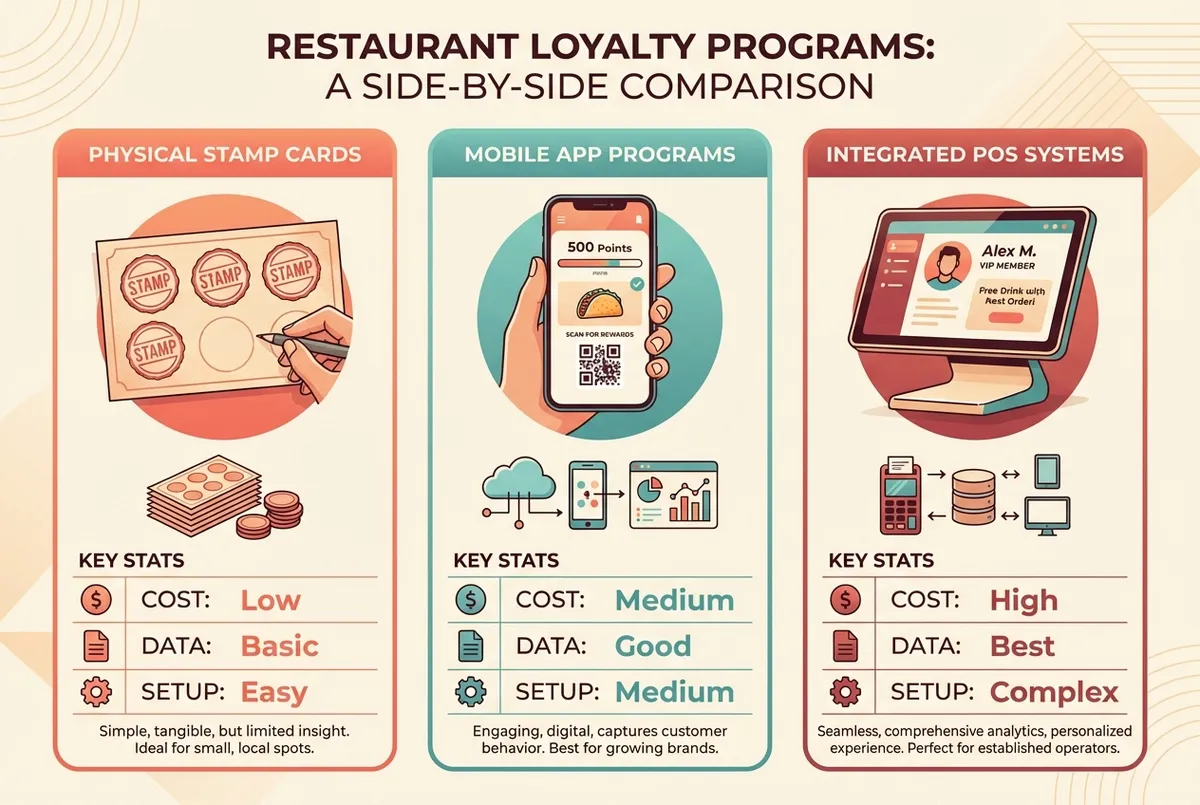
Choose the right programme type based on your budget and customer profile
Popular UK Restaurant Rewards Examples
Several UK chains run successful programmes worth studying:
- Pizza Express Club - Points per pound spent, birthday rewards, exclusive offers
- Nando's rewards - Chilli points system, free perks at tiers
- Wagamama Soul Club - Stamp-based digital card, free side dishes
These work because they match the brand personality. A formal gastropub wouldn't suit Nando's playful chilli system. Consider what fits your restaurant's character.
Case Study: A Manchester Bistro's Simple Approach
A 40-cover bistro in Manchester launched a straightforward stamp card programme in early 2025. The setup: physical cards, 10 visits for a free dessert. No app, no complexity. Within six months, they tracked 340 active loyalty members. Average visit frequency for members: 2.3 times per month compared to 0.8 for non-members. The programme cost: £180 in card printing plus staff training time. The owner's verdict: "We tried an app first. Nobody downloaded it. The stamp cards sit in wallets and purses. People actually use them."
Choosing the Right Programme Type
Here's where things get practical. If you're thinking "this sounds complicated," you're not alone. Most restaurant owners feel overwhelmed by options. Here's a decision framework.
Start Simple
Start with the simplest option that fits your budget. You can always upgrade once you've proven the concept works with your customers.
Start with your budget reality:
- Under £500 setup - Physical stamp cards or free-tier digital apps
- £500-2,000 setup - Mid-tier loyalty apps with basic analytics
- £2,000+ setup - Full POS integration or custom solutions
Then consider your customer profile:
Your typical customer's tech comfort matters. If you're in a village pub serving customers aged 55+, a smartphone app creates friction. Stamp cards work. If you're a city-centre lunch spot serving office workers, digital feels natural.
For instance, a traditional pub in the Cotswolds would likely see better adoption with physical stamp cards - their regulars prefer something tangible. Meanwhile, a trendy coffee shop in Shoreditch could push a digital app knowing their tech-savvy clientele already use mobile payments.
For most UK restaurants, Instagram often offers a strong combination of visual appeal and local discovery features when promoting loyalty programmes.
Info
Related: See our social media marketing for restaurants guide for choosing the right platforms.
The Cost Question
Let's talk numbers. UK restaurant loyalty software typically costs:
- Physical cards: £50-200 for initial print run
- Free-tier apps (Square Loyalty, Toast): £0 monthly, limited features
- Mid-tier apps (Yoyo, Stampede): £50-150/month
- Premium solutions (Como, Punchh): £200-500/month plus setup fees
The hidden cost is staff training and ongoing management. Budget 2-3 hours monthly for programme administration regardless of which system you choose.
Setting Up Your First Programme: A 7-Day Plan
That's the theory. Here's where it gets practical.
If you only have 30 minutes a week, do this: start with a simple stamp card and upgrade later once you've proven the concept works.
This week, set up your restaurant rewards programme:
Day 1-2: Decide your reward structure. One of the most popular UK models: 10% cashback on the 10th visit. Simple, clear, valuable.
Day 3-4: Order stamp cards from a local printer (£80-150 for 500 cards) or set up Square's free loyalty feature if you use Square POS.
Day 5-7: Train staff on the programme. Every team member should explain it in under 15 seconds: "Get a stamp each visit, your 10th meal gets 10% off."
For example, a casual dining restaurant might print 500 cards on Monday, brief staff on Wednesday, and launch on Friday. By the following week, they could have 50+ cards in circulation.
That's your floor. You can build from there.
Programme Structure That Works
A bistro using this framework might structure rewards as:
- Basic tier: Every visit earns a stamp
- Reward: 10 stamps = 10% off next bill
- Bonus: Double stamps on quiet Wednesday nights
- Birthday perk: Free dessert during birthday week
The double stamps on slow nights addresses a real operational need. If you're only promoting your rewards programme during quiet Wednesday nights you'll always lose to competitors who treat loyalty as part of daily operations.
Info
Related: Learn how loyalty programmes fit into your broader strategy in our customer retention for restaurants guide.
Common Mistakes to Avoid
Now for the uncomfortable truths. If you can't tell whether your rewards programme brings bookings or just costs you money, that's usually a sign the tracking needs tightening.
Mistake 1: Making rewards too hard to earn. If customers need 20 visits for a free coffee, they'll lose interest. The sweet spot is achievable within 6-8 weeks of normal visiting patterns.
Mistake 2: Overcomplicating the rules. "Earn 1 point per £1 on mains Monday-Thursday excluding specials, 0.5 points on weekends..." - nobody understands this. Keep it simple enough to explain in one sentence.
Mistake 3: Forgetting to promote it. A programme nobody knows about is a programme that doesn't work. Display at the till, mention during service, and post on social media with our AI social post generator.
Mistake 4: No staff buy-in. If your team doesn't believe in the programme, they won't mention it. Explain the business case: more repeat customers means steadier shifts and better tips.
Quick Check
Ask yourself: would I join my own rewards programme? If the answer is no, your customers probably feel the same way.
Measuring Success
With that foundation in place, let's talk metrics. How do you know if your programme is working? Don't track everything. Track what matters:
- Enrolment rate - What percentage of customers join?
- Redemption rate - How many actually claim rewards?
- Visit frequency change - Are members visiting more often?
- Average spend - Are members spending more per visit?
Most POS-integrated loyalty systems provide these metrics automatically. If you're using stamp cards, you'll need to track manually using a simple spreadsheet.
A reasonable target: 40% of regular customers enrolled within 6 months, with 60%+ redemption rate.
Quick Comparison: Loyalty Programme Types
| Feature | Stamp Cards | Digital Apps | POS Integrated |
|---|---|---|---|
| Setup Cost | £50-200 | £0-150/month | £200-500/month |
| Customer Data | Basic | Good | Excellent |
| Staff Training | Minimal | Moderate | Extensive |
| Ideal For | Testing concept | Growing restaurants | Established venues |
Info
Related: Use your loyalty data to send targeted campaigns with email marketing for restaurants.
Frequently Asked Questions
Finally, let's address the questions we hear most often from UK restaurant owners.
How much does a restaurant rewards program cost UK?
Basic stamp card programmes cost £50-200 to launch. Digital apps range from free (basic features) to £200-500/month for premium solutions. Most independent UK restaurants spend £50-150/month on loyalty software once established.
Do restaurant loyalty programs actually work?
Yes, when structured correctly. Industry data consistently shows 18-25% higher visit frequency from loyalty members. The key is making rewards achievable and valuable, typically within 6-8 visits.
Which loyalty apps work well for UK restaurants?
For most UK independents, Square Loyalty (free tier) or Stampede (UK-based, GDPR compliant) often offer the best value. If you already use a POS system, check if it includes built-in loyalty features first.
Should small restaurants have a loyalty program?
Yes, but start simple. A well-executed stamp card outperforms a poorly managed digital programme. Begin with physical cards, prove the concept works with your customers, then consider upgrading.
Setup Checklist
Before you launch, tick these boxes:
- Decide reward structure (recommend: 10 visits = 10% off)
- Order cards or activate digital system
- Train all staff on the 15-second explanation
- Create signage for till point
- Set up basic tracking (spreadsheet or app dashboard)
- Plan first-week promotional push
Key Takeaways
If you run a restaurant and want to see how Local Brand Hub can support your marketing, explore our restaurant marketing tools.
Key Takeaways
Here's what to remember:
- A restaurant rewards programme incentivises repeat visits through structured rewards
- UK-specific considerations include GDPR compliance and VAT treatment
- Start simple: stamp cards cost under £200 and prove the concept
- Focus on achievable rewards (6-8 visits) with clear, simple rules
- Track enrolment, redemption, visit frequency, and average spend
The reality for most independent restaurants: you don't need fancy technology to start. A £100 stamp card programme that staff actually promote beats a £300/month app that sits unused.
Weekly Action
This week's action: Decide your reward structure and order stamp cards, or activate your POS loyalty feature if available. One small step gets you 90% of the benefit.
For UK restaurants
Need Help With Restaurant Marketing?
Local Brand Hub helps independent restaurants run consistent marketing without the complexity. From loyalty programme promotion to social media, we make it simple.
Start freeGet More Marketing Tips
Practical marketing tips for UK business owners, straight to your inbox. No spam, unsubscribe anytime.
About the Author
Local Brand Hub
Empowering UK Businesses
Local Brand Hub provides comprehensive business management tools designed specifically for UK local businesses to streamline operations, automate marketing, and grow revenue.
More articlesRelated Articles
 Marketing Tips
Restaurant Loyalty Scheme: A UK Beginner's Guide (2026)
Learn how restaurant loyalty schemes drive repeat visits and boost revenue. The 4 types of loyalty programs and tips for UK independents.
 Marketing Tips
Restaurant Customer Retention: How to Keep Tables Full
Proven restaurant customer retention strategies for UK independents. Turn first-time diners into loyal regulars who return.
 Marketing Tips
Restaurant Loyalty Program: UK Guide
Set up a restaurant loyalty programme that lifts repeat visits and average spend by 20%. Includes the 3 R's framework and UK app picks.