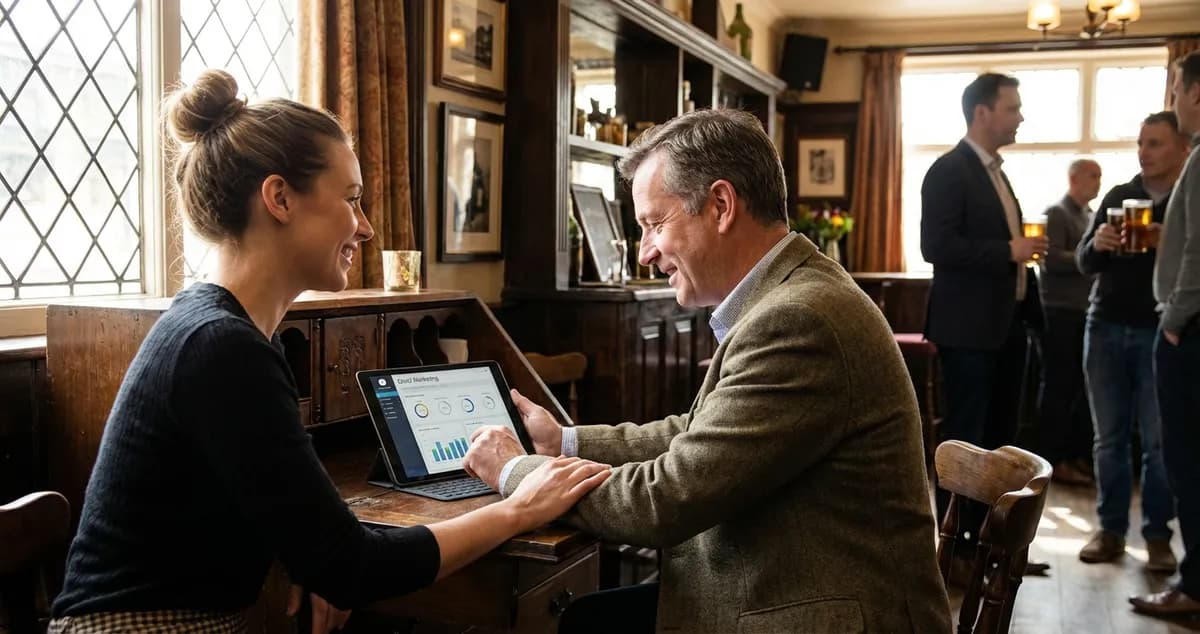
Set up restaurant email marketing that earns £36 for every £1 spent. Includes software picks, templates, and the 80/20 content rule.
You have spent years perfecting your menu, training your staff, and creating an atmosphere people love. Yet tables sit empty on quiet nights while loyal customers forget you exist between visits. Email marketing for restaurants offers a direct line to those customers, delivering an average return of £36 for every £1 spent.
According to Campaign Monitor, restaurants see some of the highest email open rates of any industry. Based on our experience working with independent UK restaurants, email consistently outperforms social media for driving repeat bookings. If you are building a broader restaurant loyalty programme, email becomes the backbone of keeping customers coming back.
Info
Related: See our Restaurant Loyalty Program guide for the complete retention strategy, or Restaurant Social Media Marketing for platform-specific tactics.
What You'll Learn About Email Marketing for Restaurants
- Why email outperforms social media for restaurant marketing
- The 80/20 rule that stops your emails feeling like spam
- Which software actually suits small UK restaurants
- How to build your email list without annoying customers
- Sample email templates you can steal today
Is Email Marketing Good for Restaurants?
Now that you understand the basics, let's look at why email works so well for restaurants. You have the kitchen running smoothly, but how do you keep customers thinking about you between visits? That is where email comes in.
Email marketing is often one of the most effective channels for restaurants seeking consistent customer engagement. The restaurant industry sees open rates averaging 40%, significantly higher than many other sectors (Stripo). More importantly, personalised email campaigns drive 5.7 times higher revenue than generic marketing (Campaign Monitor).
The numbers tell the story. Email marketing for restaurants can deliver up to 4,200% ROI, meaning every pound you invest might return over £40 (Tablein). Compare this to social media, where organic reach continues to decline and paid advertising costs keep rising.
Why email works for restaurants:
- Direct access: Your message lands in their inbox, not lost in an algorithm
- Ownership: Unlike social followers, you own your email list
- Timing control: Send offers when people are planning their week, not scrolling mindlessly
- Personalisation: Segment by visit frequency, preferences, or spending habits
If you are thinking "I do not have time for another marketing channel," you are not alone. The reality for most independent restaurants is that time is the scarcest resource. But email automation means you can set up campaigns once and let them run while you focus on service.
UK compliance note: Under UK GDPR, you need consent before sending marketing emails. The UK government's data protection guidance and ICO direct marketing guidance both emphasise keeping records of when and how customers opted in. Most email platforms handle this automatically with double opt-in features.
What Is the 80/20 Rule in Email Marketing?
Now that you understand why email works, let's talk about what to actually send. This is where most restaurants go wrong.
The 80/20 rule is a content framework that prevents your emails from feeling like constant sales pitches. It means 80% of your email content should provide genuine value: tips, stories, behind-the-scenes content, while only 20% should be promotional (Marketing Fuel).
This principle, also called the Pareto Principle, comes from economist Vilfredo Pareto's observation that 80% of outcomes result from 20% of causes. Applied to restaurant email marketing, it transforms how customers perceive your messages.
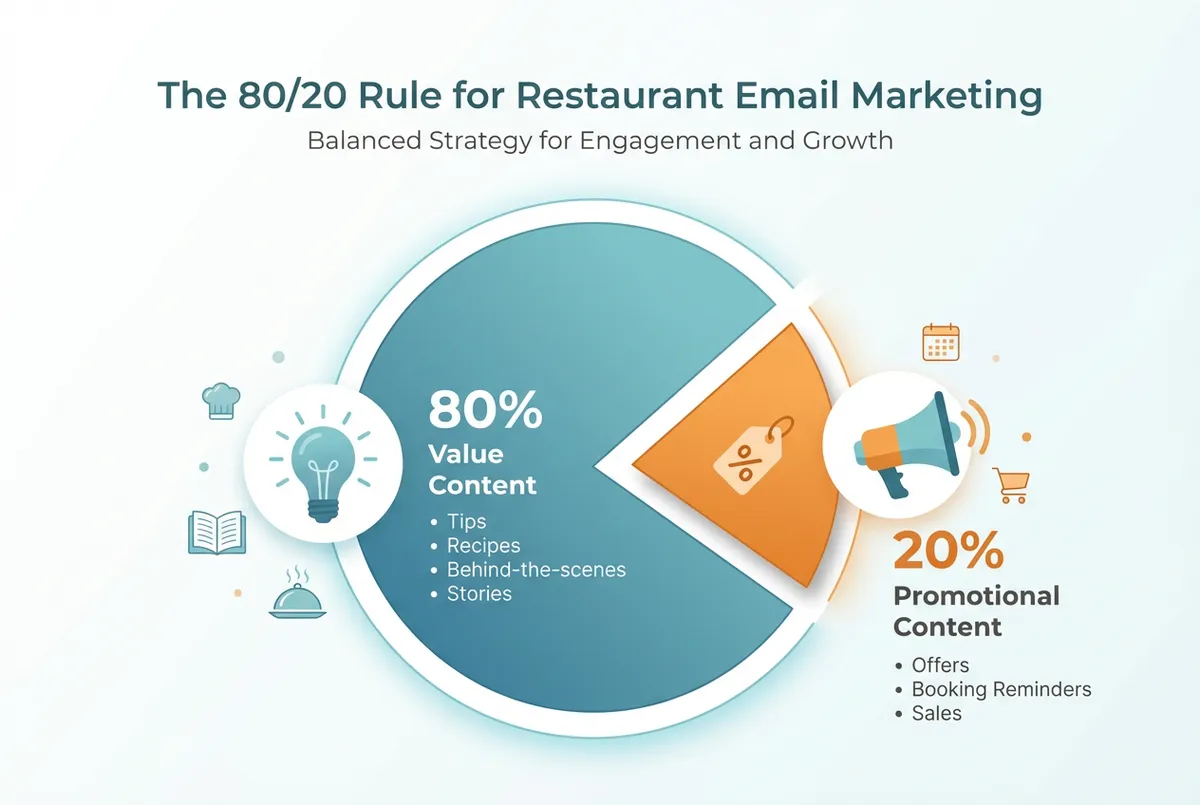
Balance value and promotion to keep subscribers engaged
Practical application for restaurants:
A gastropub using this framework might structure their monthly emails like this:
- Week 1 (Value): "How our head chef sources local ingredients"
- Week 2 (Value): Recipe for their signature starter
- Week 3 (Value): Interview with a regular customer about their favourite dish
- Week 4 (Promotional): Bank holiday booking reminder with 10% off
If you only send promotional emails, subscribers learn to ignore you. They might even unsubscribe. For example, a pizzeria that bombarded customers with daily discount codes saw their open rates drop from 45% to 12% within three months. The biggest mistake is treating email like a digital billboard instead of a conversation. But when you consistently deliver interesting content, that occasional promotional email feels like a favour rather than an intrusion.
"People do not open Instagram to see ads. They want something interesting. Email works the same way. When you do promote, people notice."
The rule also applies to understanding your audience. Research shows that 20% of your subscribers typically generate 80% of your email revenue (Benchmark Email). Focus your best offers on these engaged customers.
What Is the Best Software for Email Marketing?
With that content strategy sorted, let's look at tools. The best email marketing software is a platform that balances ease of use, automation features, and cost for your specific situation. Here is a practical breakdown for restaurants.
For most UK restaurants, Mailchimp or Brevo (formerly Sendinblue) offers the best balance of features, ease of use, and price. Both have free tiers suitable for smaller lists and restaurant-friendly templates.
Comparing the top options:
| Platform | Best For | Free Tier | UK Support |
|---|---|---|---|
| Mailchimp | Beginners, quick setup | 500 contacts | Yes |
| Brevo | Email + SMS combined | 300 emails/day | Yes |
| MailerLite | Budget-conscious | 1,000 subscribers | Yes |
| Email Blaster | UK-based, GDPR-focused | Trial only | Yes |
Your mileage may vary depending on list size and technical comfort.
Why This Matters
The right software removes friction. If your email tool feels clunky, you will stop using it. Start with something simple, you can always upgrade later.
For single-location restaurants: If you are just starting, Mailchimp's free plan handles up to 500 contacts with basic automation. The drag-and-drop editor means you do not need design skills.
For small chains (2-5 locations): Brevo combines email and SMS marketing, useful when you want to send same-day booking reminders. Their restaurant templates save hours of design work.
For larger groups (5+ outlets): ActiveCampaign or Zoho Campaigns provide advanced segmentation and CRM integration, though these require more setup time.
For example, a small Italian restaurant in Manchester might start with Mailchimp's free tier, import their 200-strong customer list, and send a monthly "Chef's Pick" email featuring their seasonal specials. Total setup time: about two hours.
UK ad spend on email marketing is projected to reach £682 million in 2026 (Encharge). The tools keep improving because businesses see results.
If you cannot tell whether your email software brings bookings or just busy work, that is usually a sign the strategy needs tightening.
What Is the Best Platform to Advertise a Restaurant?
Moving on to the bigger picture, let's compare email to other marketing channels. The best platform for restaurant advertising is one that delivers consistent returns while you retain control, and for most UK restaurants, email marketing often fits that description.
With so many options competing for your attention, where should you focus your limited time? Email often outperforms other advertising platforms for driving repeat business, though social media plays an important role in discovery. The best approach combines both channels strategically, which is easier when your marketing tools live in one place.
Platform comparison for restaurants:
- Email marketing for restaurants: Typically 40% average open rate, often £36 return per £1 spent, you own the audience
- Facebook/Instagram: Good for discovery, declining organic reach, algorithm-dependent
- Google Business Profile: Essential for local search, free, drives walk-ins
- TikTok: Viral potential, younger audience, time-intensive content creation
For most UK restaurants, email often offers the best combination of ROI, control, and reliability. You are not competing with an algorithm, and your message reaches people who have explicitly asked to hear from you.
For instance, a bistro using Facebook might reach 5% of followers organically. The same bistro's email list reaches 40% or more, and those readers made an active choice to hear from you.
That said, do not abandon social media entirely. Use it to grow your email list. A well-placed "Join our newsletter for exclusive offers" on Instagram can convert followers into subscribers you actually control.
Budget Considerations
Email marketing typically costs less than other channels:
- Free tier (0-500 contacts): Mailchimp, MailerLite, Brevo, suitable for most independent restaurants
- Growth tier (£10-30/month): 1,000-5,000 contacts with automation features
- Professional (£50-150/month): Advanced segmentation, multiple locations, CRM integration
Compare this to social media advertising, where £50 might buy a few days of local reach. The same amount covers months of email marketing for a typical restaurant list.
Sample Email Marketing for Restaurants
Finally, let's get practical. Here are ready-to-use templates you can adapt for your own restaurant. Each follows the 80/20 rule and includes clear calls to action.
Template 1: Welcome Email
Subject: Welcome to [Restaurant Name] - Here's 10% off your next visit
Hi [Name],
Thanks for joining our list. We will not spam you, just occasional updates, recipes, and the odd exclusive offer.
To say thanks, here is 10% off your next visit. Just show this email to your server.
Code: WELCOME10
See you soon, [Restaurant Name]
Template 2: Value Email (Recipe Share)
Subject: Our secret to perfect Sunday roast potatoes
We get asked about our roast potatoes every Sunday. Here is exactly how we make them crispy outside, fluffy inside.
[Recipe steps]
Try it at home, or let us do the work for you this weekend. Book your Sunday roast table at [link].
Template 3: Promotional Email
Subject: Bank holiday? Sorted.
Bank holiday weekend is coming. Tables are filling up fast.
Book by Friday and get a free glass of fizz per person.
[Book now button]
See you there, [Restaurant Name]
Building Your Email List
If you only have 30 minutes a week, do this: add an email signup to your reservation confirmation page. Most booking systems include this option. You will capture addresses from people who already want to visit.
This week, build your email marketing for restaurants foundation:
- Day 1-2: Set up a Mailchimp or Brevo account, import any existing customer emails
- Day 3-4: Create a simple welcome email using the template above
- Day 5-7: Add an email signup checkbox to your booking system or website
Other list-building methods that work well:
- WiFi signup: Offer free WiFi in exchange for an email address. For example, a café in Leeds collected 200 addresses in their first month using this approach
- Loyalty programmes: Link email signup to your rewards scheme
- Table tents with QR codes: Simple, low-cost, and surprisingly effective
- Staff prompts: Train servers to mention the newsletter when presenting the bill
What never works: Buying email lists. Purchased contacts have not opted in to hear from you, deliverability tanks, and you risk GDPR fines. If you're only focused on list size rather than list quality, you'll always lose to competitors who nurture engaged subscribers.
Another common mistake: sending emails only when business is slow. If you're only sending emails when business is slow, you'll always lose to competitors who treat email as part of their regular operations.
Info
Related: For more budget-friendly tactics, see our Restaurant Marketing Ideas guide, or boost local visibility with Local SEO for Restaurants.
Weekly Action
Pick one task this week:
- Enable email collection on your booking system
- Set up a Mailchimp or Brevo free account
- Write your first welcome email using the template above
- Add a WiFi signup page that captures email addresses
- Schedule your first value email for next week
That is it. One action, not five. Build the habit before scaling the system.
Key Takeaways: Email Marketing for Restaurants
If you run a restaurant and want to see how Local Brand Hub can support your marketing, explore our restaurant marketing tools.
Key Takeaways: Email Marketing for Restaurants
That covers the essentials. Here is what matters most when implementing email marketing for restaurants.
Email marketing for restaurants remains one of the highest-ROI channels available to independent operators. With average returns of £36 per £1 spent and open rates around 40%, it outperforms most digital alternatives.
Remember these essentials:
- Follow the 80/20 rule: 80% value, 20% promotion
- Start with Mailchimp or Brevo, both have free tiers for restaurant email marketing
- Build your list through reservations, WiFi, and loyalty programmes
- Send consistently, even if that is just twice per month
Would I follow my own restaurant's email list? If the answer is no, neither will your customers.
Your next step: Open your booking system today and check whether email collection is enabled. If not, turn it on. That single change captures addresses from every future reservation without any extra work from you.
For UK restaurants
Need Help With Restaurant Marketing?
Local Brand Hub specialises in practical digital marketing strategies for UK hospitality businesses. We focus on approaches that work for busy operators, not agency fluff that sits unused.
Start freeGet More Marketing Tips
Practical marketing tips for UK business owners, straight to your inbox. No spam, unsubscribe anytime.
About the Author
Local Brand Hub
Empowering UK Businesses
Local Brand Hub provides comprehensive business management tools designed specifically for UK local businesses to streamline operations, automate marketing, and grow revenue.
More articlesRelated Articles
 Marketing Tips
How to Build a Restaurant Email List That Fills Tables
Step-by-step guide to building a restaurant email list that drives repeat bookings. Covers collection tactics, segmentation, and UK GDPR compliance.
 Marketing Tips
SMS Marketing for Restaurants: Budget-Friendly Guide
Restaurant SMS marketing gets 98% open rates versus 20% for email. UK-compliant setup guide with budget platforms and a ready-made weekly plan.
 Marketing Tips
Restaurant Marketing Agency: Guide to Choosing
Compare restaurant marketing agencies by cost, specialism, and results. UK agency shortlist, pricing guide, and a framework to pick the right partner.