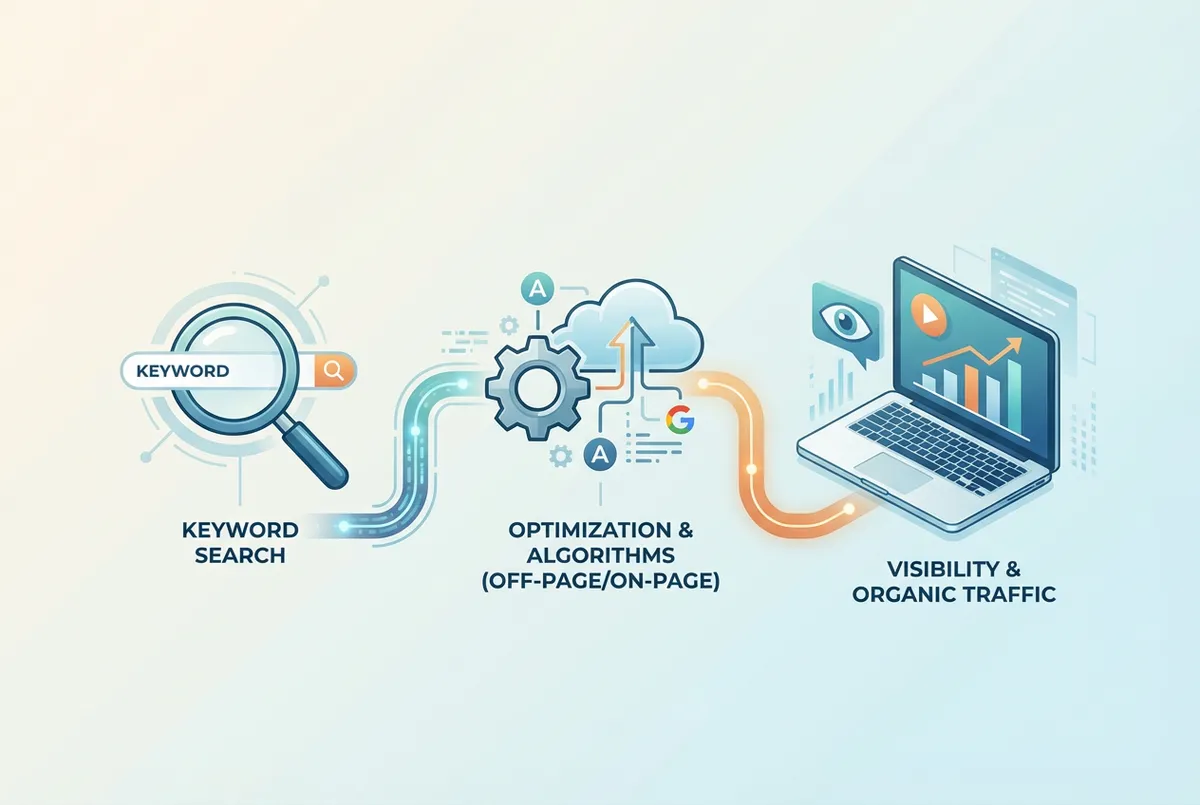
Watch the visual overview· 85 seconds
Restaurant local SEO helps UK restaurants rank when hungry customers search nearby. Covers Google Business Profile, reviews, citations, and local rankings.
Restaurant local SEO is how you get found when hungry customers search for places to eat nearby, covering everything from your Google Business Profile to reviews, citations, and local rankings. Without it, your competitors appear in the "restaurants near me" searches while your tables stay empty.
Short on time? Here's the quick version
- Claim and complete your Google Business Profile (this alone can double visibility)
- Use specific categories like "Italian Restaurant" not just "Restaurant"
- Get consistent NAP (Name, Address, Phone) across all directories
- Ask happy customers for reviews after every busy service
- The 80/20 rule: GBP + citations + reviews + basic website SEO = 80% of results
Full breakdown below 👇
You've spent years perfecting your menu, but that doesn't mean customers can find you online. The food is excellent, the service is warm, and your regulars love you. But when someone new searches "best restaurant near me," they find your competitors instead of you. Meanwhile, that chain down the road—the one with the frozen chips and microwaved sauces—shows up in the top three Google results and fills their tables with customers who should be at yours.
That's not a mystery of the algorithm. That's restaurant local SEO at work—or in your case, not working. According to BrightLocal's Local Consumer Review Survey, 98% of consumers use the internet to find information about local businesses, with restaurants being one of the most searched categories.
What You'll Learn
- How local search actually works for restaurants (and why it matters more than traditional SEO)
- The core elements that determine your local rankings
- Step-by-step actions to improve your visibility this week
- Common mistakes that keep restaurants invisible online
Contents:
- Why Local SEO Matters for Restaurants
- How Local SEO Actually Works
- The Five Core Areas of Restaurant SEO
- The 30/30/30/10 Rule
- The 3 C's of SEO
- Common Mistakes
- Minimum Viable Plan
- FAQs
Related: Restaurant Google Business Profile (spoke article)
Why Local SEO Matters More for Restaurants Than Any Other Business
Here's a number that should get your attention: 46% of all Google searches have local intent. That means nearly half the people typing into Google right now are looking for something nearby—a plumber, a dry cleaner, a place to eat.
Key Statistic
84% of people use search engines to find local businesses weekly, with restaurants being one of the most-searched categories (BrightLocal).
Think about your own behaviour. When you're hungry and away from home, what do you do? You search. "Thai food near me." "Best Sunday roast [town name]." "Restaurants open now."
If your restaurant doesn't appear in those results, you're invisible at the exact moment someone is ready to spend money. Not "considering" spending money—actively looking to spend it, phone in hand, stomach rumbling.
The local pack is prime real estate. When someone searches for a restaurant category plus location, Google shows a map with three businesses prominently displayed. These three results—called the "local pack" or "map pack"—get approximately 44% of all clicks. The organic results below? They share the scraps.
Related: Restaurant Local Pack Ranking (spoke article)
If you're not in that top three, you might as well not exist for that search.
How Local SEO Actually Works for Restaurants
Now that you understand why restaurant local SEO matters, let's look at what actually influences your rankings.
The Three Ranking Factors
Google determines local rankings based on three factors:
| Factor | What It Means | How You Influence It |
|---|---|---|
| Relevance | How well your listing matches what someone searched | Complete your Google Business Profile, use accurate categories |
| Distance | How close you are to the searcher | You can't move your building, but you can optimise for nearby areas |
| Prominence | How well-known and trusted your business is online | Reviews, citations, backlinks, and online presence |
A real example: A fish and chip shop in Brighton struggled to appear for "chippy near me" searches despite being in business for 15 years. Their issue? They'd listed themselves as a "Restaurant" on Google Business Profile rather than "Fish and Chip Shop" (relevance), had only 23 reviews compared to competitors' 200+ (prominence), and their NAP details differed across directories. After fixing these issues over three months, they moved from invisible to the top three local results.
You can't change your physical location, so your focus should be on relevance and prominence. These are the areas where consistent effort compounds over time.
The 80/20 Rule for Restaurant SEO
The Pareto principle applies to restaurant local SEO perfectly. About 80% of your local SEO results will come from 20% of your efforts. For restaurants, that 20% is:
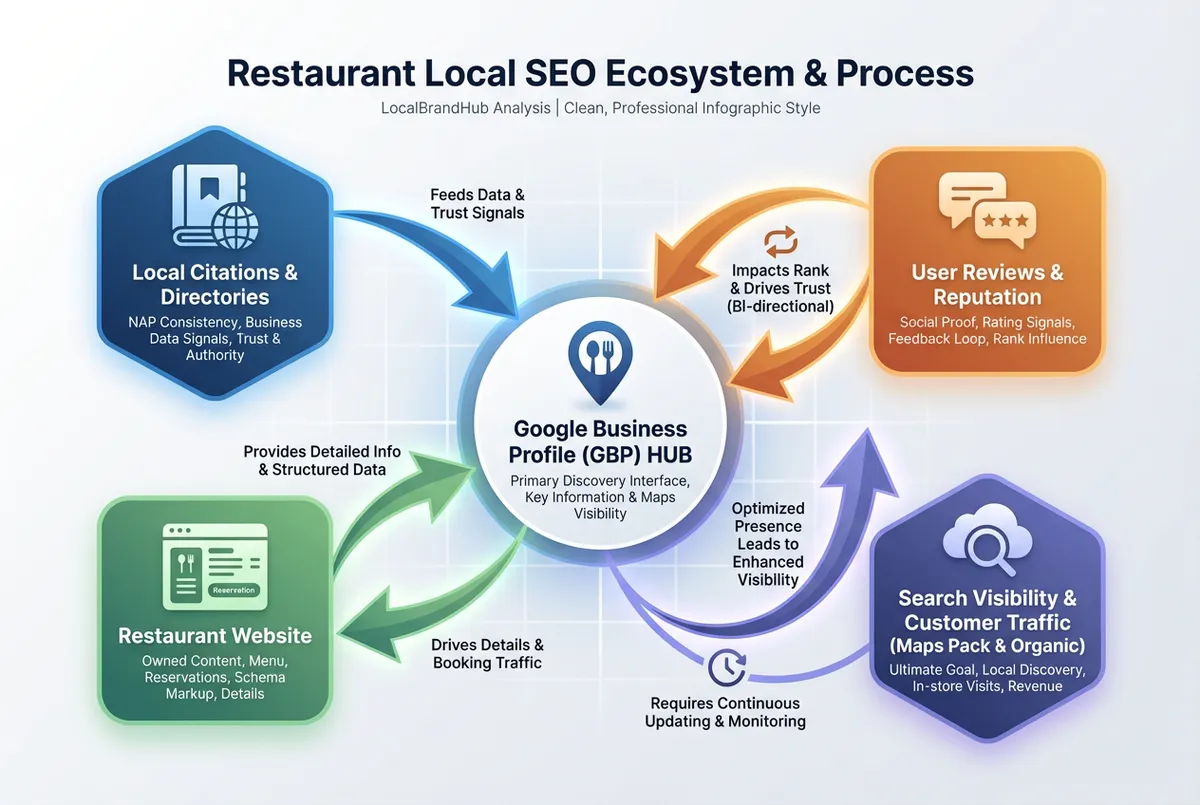
- A complete, accurate Google Business Profile (GBP)
- Consistent NAP citations (Name, Address, Phone number)
- A steady flow of genuine reviews
- Basic on-page SEO on your website
What this looks like in practice: A curry house in Manchester focused only on these four elements for six months. No blog content, no schema markup, no backlink campaigns. They updated their GBP weekly with photos, fixed their citations on the top 15 UK directories, and asked happy customers for reviews after every busy service. Result: they went from 12 reviews to 89 reviews and started appearing in the local pack for "Indian restaurant Manchester" searches.
Everything else—schema markup, backlink building, content marketing—helps, but if you only have 30 minutes a week for marketing, focus on these four.
How Do I Do SEO for My Restaurant?
Restaurant SEO breaks down into five core areas. Here's what each involves and how to approach it:
1. Google Business Profile Optimisation
Your Google Business Profile (formerly Google My Business) is arguably the most important factor in restaurant local SEO rankings. According to Moz's Local Search Ranking Factors study, GBP signals account for approximately 32% of local pack ranking factors. It's the listing that appears when someone searches for your restaurant directly, or when you show up in the local pack.
Essential actions:
- Claim and verify your listing at business.google.com
- Add your exact business name (no keyword stuffing)
- Select the most accurate primary category (e.g., "Italian Restaurant" not just "Restaurant")
- Add secondary categories if relevant (e.g., "Pizza Restaurant," "Wine Bar")
- Include your full address, phone number, and opening hours
- Add photos weekly—Google rewards active profiles
- Write a business description that includes your cuisine type and location
A gastropub in Manchester, for example, might describe themselves as: "Traditional British pub food with a modern twist in the heart of Manchester's Northern Quarter. Known for our Sunday roasts and craft beer selection."
Related: Restaurant Google Business Profile (spoke article)
2. Local Citations and Directories
Citations are mentions of your restaurant's name, address, and phone number on other websites. Consistency here is critical—Google cross-references your information across the web, and discrepancies hurt your rankings.
Key UK citation sources:
- TripAdvisor
- Yelp UK
- OpenTable
- Yell.com
- The Good Food Guide
- Hot Dinners (for London)
- Time Out
- Local council directories
A restaurant that appears on 50 directories with consistent information will outrank one with 100 listings full of old phone numbers and closed locations.
Related: Restaurant Citations (spoke article)
3. Review Management
Reviews influence both rankings and conversions. Google's algorithm considers review quantity, quality, velocity (how often you get new ones), and how you respond.
Why this matters: Reviews aren't just social proof—they're a ranking factor. A restaurant with 150 reviews and a 4.3 rating will typically outrank one with 30 reviews and a 4.8 rating. Quantity signals activity; quality signals satisfaction. You need both.
The strategy is simple but requires consistency:
- Ask every satisfied customer to leave a review
- Respond to every review—positive or negative—within 48 hours
- Never offer incentives for reviews (against Google's terms)
- Address negative feedback professionally and take conversations offline
Related: Restaurant Reviews SEO (spoke article)
4. On-Page Website SEO
Your website matters for local SEO, even if most customers find you through Google Maps. Key elements:
- Location in title tags: "Best Italian Restaurant in Leeds | [Your Name]"
- Location on every page: Footer should include full address
- Menu pages: Optimise for "[dish type] + [location]" searches
- Schema markup: Help Google understand your business type, location, and hours
If you're reading this thinking "I don't have time for this"—you're not alone. Most restaurant owners are running on fumes by the end of service. That's exactly why you need a system, not a project.
Related: Restaurant SEO Checklist (spoke article)
5. Local Content Strategy
Creating content that serves your local community builds relevance signals. This doesn't mean writing blog posts about SEO—it means content that your actual customers care about:
- Event pages for special occasions
- Local partnership announcements
- Neighbourhood guides
- Seasonal menu features with local supplier mentions
What Is the 30/30/30/10 Rule for Restaurants?
With the fundamentals covered, you might be wondering how local SEO fits into your budget. That's where understanding restaurant economics helps.
The 30/30/30/10 rule is a budget allocation framework suggesting restaurants allocate their costs as:
- 30% for food costs
- 30% for labour
- 30% for operating expenses (rent, utilities, equipment)
- 10% for profit
The reality for most independent UK restaurants is tighter. According to industry data, the average profit margin for independent UK restaurants hovers around 3-5%, which means marketing budgets are slim.
The Good News
Effective restaurant local SEO doesn't require much money—it requires consistent attention. The most important activities cost nothing but time.
Budget reality check: If you're running on a 5% margin, a £500/month SEO agency isn't realistic. But 30 minutes a week of your own time? That's doable. And if you're between the Saturday rush and Sunday prep, wondering whether marketing is even worth it, remember: consistent small efforts on restaurant local SEO compound faster than sporadic big pushes.
Typical restaurant local SEO costs:
| Option | Monthly Cost | Time Required | Best For |
|---|---|---|---|
| DIY (this guide) | £0 | 30 mins/week | Owners with some time |
| Citation service | £50-150 | 15 mins/week | Time-poor owners |
| Full local SEO agency | £300-800 | 1 hr/month for calls | Multi-location or competitive markets |
If you can carve out 30 minutes a week for local SEO maintenance, you'll outperform most competitors who treat it as a one-time task.
What Are the 3 C's of SEO?
Moving from budget to strategy, the 3 C's framework helps prioritise where to focus your restaurant local SEO efforts:
Content
For restaurants, content means:
- Your Google Business Profile description and posts
- Your website menu pages
- Any blog content or event pages
- Social media that links back to your website
Code (Technical SEO)
The backend stuff that helps search engines understand your site:
- Fast loading speed (under 3 seconds)
- Mobile-friendly design (most searches are mobile)
- Schema markup for restaurants
- Secure HTTPS connection
Credibility (Authority)
Signals that show Google you're a trusted, established business:
- Reviews (quantity and quality)
- Citations on trusted directories
- Links from local publications
- Social proof and engagement
How this plays out for a typical restaurant: A bistro in Leeds had excellent content—beautiful menu pages, regular GBP posts, weekly Instagram updates. Their technical SEO was solid too. But they had only 35 Google reviews while their competitors had 150+. Despite the content and code, they ranked lower. When they started systematically asking for reviews (a credibility signal), their rankings improved within two months.
For local restaurant SEO, credibility often matters most. A restaurant with 200 genuine reviews and consistent citations will outrank a competitor with a technically perfect website but no online reputation.
Ask yourself: when did I last check my own restaurant's Google reviews? Would I eat somewhere with our current rating and review count?
Common Mistakes That Keep Restaurants Invisible
With the strategy clear, let's look at what goes wrong. These are the restaurant local SEO errors that commonly hurt UK independent restaurants:
Mistake 1: Inconsistent Business Information
Your address says "123 High St" on Google, "123 High Street" on TripAdvisor, and "123 High St." on Yelp. To you, these are the same. To Google's algorithm, they're three different businesses—and that inconsistency dilutes your authority.
Fix: Create a master document with your exact NAP details and use it verbatim everywhere.
Mistake 2: Ignoring Google Business Profile After Setup
Claiming your GBP is not a one-time task. Google rewards active profiles with:
- Regular photo uploads
- Posts (special offers, events, updates)
- Prompt review responses
- Updated hours (especially for holidays)
A profile that's been dormant for six months signals to Google that the business might be closed—or at least, not worth recommending.
Mistake 3: Keyword Stuffing in Your Business Name
Adding "Best Pizza Delivery Near Me" to your restaurant name violates Google's guidelines and can get your listing suspended. Your business name should match your signage—nothing more.
Mistake 4: Not Asking for Reviews
Restaurants that actively ask for reviews get more of them. It's that simple. The ones that don't ask rely on organic reviews, which skew negative (unhappy customers are more motivated to complain).
Create a simple system: a card with a QR code to your Google review page, mentioned by staff after a positive interaction.
Mistake 5: Neglecting Mobile Experience
Over 60% of restaurant searches happen on mobile devices. If your website takes 10 seconds to load, shows a menu as a blurry PDF, or requires pinch-and-zoom navigation, you're losing customers at the final step.
Warning
If you're only updating your restaurant local SEO when things are quiet—a slow Tuesday afternoon, a dead Wednesday night—you'll always be playing catch-up. The restaurants that rank well treat local SEO as part of operations, not an afterthought when there's nothing else to do.
Related: Restaurant SEO Mistakes (spoke article)
The Minimum Viable Local SEO Plan
Now for the practical bit. If you're short on time—and what restaurant owner isn't, especially after a 12-hour shift?—here's a realistic starting point for restaurant local SEO.
What this looks like in practice: A pizza restaurant in Sheffield used exactly this approach. The owner allocated 20 minutes every Sunday evening—after close but before heading home—to update their GBP and respond to reviews. Within three months, they went from 45 reviews to 112 and started appearing in the local pack for "pizza Sheffield" searches.
This week, audit your restaurant's local SEO presence:
Day 1-2: Claim or access your Google Business Profile. Update your hours, add 5 recent photos, and ensure your address matches your signage exactly.
Day 3-4: Google your restaurant name. Check the top 10 results for old addresses, wrong phone numbers, or duplicate listings. Note any that need correction.
Day 5-7: Set up a review request system. Print QR code cards or add a review link to your receipts. Ask three happy customers to leave a review.
That's your baseline. From there, maintain it with 15-30 minutes weekly:
- Add 1-2 photos to GBP
- Respond to any new reviews
- Check for any citation inconsistencies
Would a tired owner-operator nod while reading this? That's the test. This isn't a complex strategy requiring hours of daily work. It's a minimum floor that beats doing nothing—and doing nothing is what most of your competitors are doing.
Multi-Location Considerations
If you run more than one restaurant, local SEO gets more complex. Each location needs:
- Its own Google Business Profile
- Location-specific pages on your website
- Unique citations for each address
- Location-specific reviews
The upside: once you have a system for one location, you can replicate it across others. The downside: inconsistency across locations hurts all of them.
Related: Multi-Location Restaurant SEO (spoke article)
How to Know If Your Restaurant Local SEO Is Working
The signs of effective restaurant local SEO:
- Increased "discovery" searches in your GBP insights (people who found you searching for a category, not your name)
- More direction requests from Google Maps
- Higher review velocity (more reviews per month than before)
- More website visits from local search
- Customers mentioning they found you on Google
If you can't tell whether your local SEO brings bookings or just clicks, that's usually a sign the strategy needs tightening—or the tracking needs improvement.
Key Takeaways
If you run a restaurant and want to see how Local Brand Hub can support your marketing, explore our restaurant marketing tools.
Key Takeaways
Restaurant local SEO comes down to one thing: being visible when hungry customers search nearby. The core elements:
- Google Business Profile is your most important asset—keep it complete, accurate, and active
- Citations need to be consistent everywhere your restaurant appears online
- Reviews influence both rankings and customer decisions—ask for them and respond to all of them
- Your website needs basic location signals and mobile-friendly design
You don't need to become an SEO expert. You need a simple system you can maintain alongside running your restaurant.
Start with the minimum viable plan above. Build from there as time allows. And remember: your competitors are probably doing nothing—which means consistent small efforts compound into real competitive advantage.
Weekly Action
This week, complete the three-day local SEO audit outlined above. By Friday, you should have an updated Google Business Profile, a list of citations that need fixing, and a review request system ready to use. Set a 20-minute calendar reminder for next week to add photos and respond to reviews.
For UK restaurants
Need help keeping your restaurant visible online?
LocalBrandHub handles local SEO, social media, and digital marketing in one simple platform built specifically for restaurants.
See how it worksFrequently Asked Questions
How long does it take to see results from local SEO?
Most restaurants see initial improvements within 4-8 weeks of consistent optimisation. Review growth often shows quicker results than ranking improvements. Major ranking changes typically take 3-6 months of sustained effort.
Is local SEO different from regular SEO?
Yes. Traditional SEO focuses on ranking in organic search results nationwide. Local SEO specifically targets geographic searches and the Google Map pack. For restaurants, local SEO is almost always more valuable than traditional SEO.
Do I need a website for local SEO?
Technically, no—you can rank in the map pack with just a Google Business Profile. But a website strengthens your local SEO signals and gives you control over your online presence. Even a simple site with your menu, location, and contact details helps.
How many reviews do I need to rank well locally?
There's no magic number, but quantity matters less than consistency. A restaurant with 50 reviews gained over 12 months signals ongoing activity better than one with 100 reviews from a burst three years ago. Aim for a steady flow rather than hitting a specific target.
Should I pay for local SEO services?
For most independent restaurants, DIY restaurant local SEO is achievable with the strategies in this guide. Paid services make sense if you have multiple locations, complex technical issues, or genuinely no time for even basic maintenance. Be wary of agencies promising guaranteed rankings—Google's algorithm isn't that predictable.
About the Author
Local Brand Hub
Empowering UK Businesses
Local Brand Hub provides comprehensive business management tools designed specifically for UK local businesses to streamline operations, automate marketing, and grow revenue.
More articlesRelated Articles
 Marketing Tips
Aesthetics Marketing: DIY Playbook for UK Clinics
Practical aesthetics marketing strategies you can run yourself. Social media, before-and-after content, local SEO, email, and referrals for UK clinics.
 Marketing Tips
20 Aesthetics Marketing Ideas to Fill Your Diary
20 actionable aesthetics marketing ideas for UK clinics — social media, trust-building content, local marketing, retention, and seasonal strategies.
 Tutorials
Beauty Salon Google My Business: Setup Guide
Set up your beauty salon Google My Business profile in seven steps. Claim, optimise, add treatments, upload photos, and get reviews. UK beginner guide.