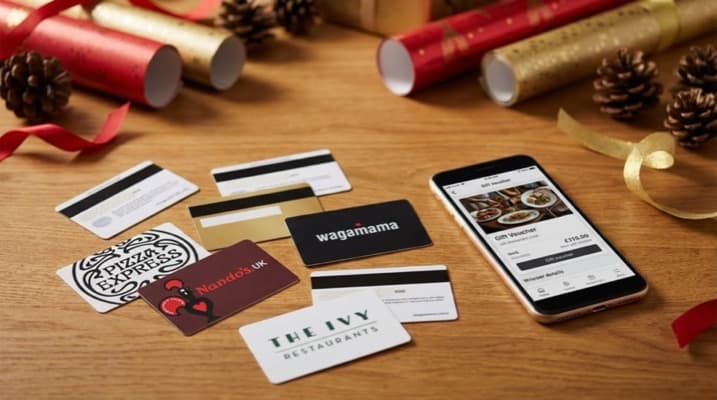
Compare UK restaurant gift card providers, understand Consumer Rights Act rules, VAT treatment, and expiry regulations. Setup guide for restaurants.
You're staring at a dozen gift card providers, each promising the world. Meanwhile, your accountant is asking about VAT treatment and you are not even sure if your expiry terms are legal. Every guide you find is written for US restaurants. Here is the UK-specific restaurant gift card guide you actually need.
Info
What You'll Learn
- Which UK voucher providers suit independent restaurants
- How consumer rights legislation affects your terms
- VAT treatment for single-purpose vs. multi-purpose vouchers
- Expiry rules and what happens to unredeemed balances
- Corporate regulations including the £50 trivial benefits exemption
- Step-by-step setup for your first restaurant voucher programme
Related: Restaurant Gift Card Marketing: The Complete Guide, parent hub
The UK Restaurant Gift Card Landscape
The restaurant gift card UK market is not just surviving; it is outperforming nearly every other retail category. The leisure sector, which includes restaurants and hospitality, grew strongly in the second half of 2025, well ahead of broader UK retail during the same period.
For example, a family-run bistro in Manchester launched restaurant gift cards in late 2025 and saw strong sales within two months, mostly from corporate Christmas orders they had never previously captured.
The overall UK gift card industry is large and well established. The restaurant gift card UK sector sits within one of the fastest-growing segments.
Digital vouchers make up the majority of the UK market. For restaurant owners, this means your strategy must include an online purchase option. Physical cards still matter for in-restaurant impulse buys, but digital is the majority format.
Related: Restaurant Marketing: The Complete Guide, broader strategies to drive customers through your door
If you're thinking "our customers are older, they prefer physical cards," that may be true in 2026. But the trend is accelerating, and offering both formats costs nothing extra with most providers.
UK Gift Card Providers Compared
With the restaurant gift card UK market growing this quickly, the next question is which provider to use. Choosing the right one depends on your restaurant size, existing technology, and whether you want to manage vouchers in-house or through a third-party scheme.
In-House Providers
These platforms let you sell your own branded vouchers, keeping full control over design, pricing, and customer data.
| Provider | Setup Cost | Fee | Features | Suited To |
|---|---|---|---|---|
| Square | Free | 2.5% per transaction | POS integration, digital + physical, analytics | Single-site restaurants already using Square |
| SumUp | Free | Transaction fees apply | Mobile-friendly, simple setup | Small independents wanting a quick start |
| Lightspeed | Included with POS subscription | Varies by plan | Full POS integration, multi-site support | Restaurants using Lightspeed POS |
| Giftpay | Commission-based | Per-transaction fee | No POS needed, online storefront, corporate portal | Restaurants without integrated POS gift card features |
| Toggle | Monthly subscription | Per-transaction fee | Multi-venue redemption, group management | Restaurant groups with 3+ sites |
Multi-Restaurant Schemes
If you want exposure without managing your own programme, you can join an existing multi-restaurant voucher scheme. These bring customers who might never have found you independently, though you will pay commission and lose some brand control.
Popular UK schemes include Restaurant Choice (Giftcard.co.uk), the Dining Out Card (Giftcards.co.uk), and One4all Restaurant Favourites. Commission rates typically range from 5% to 15% of the redeemed value.
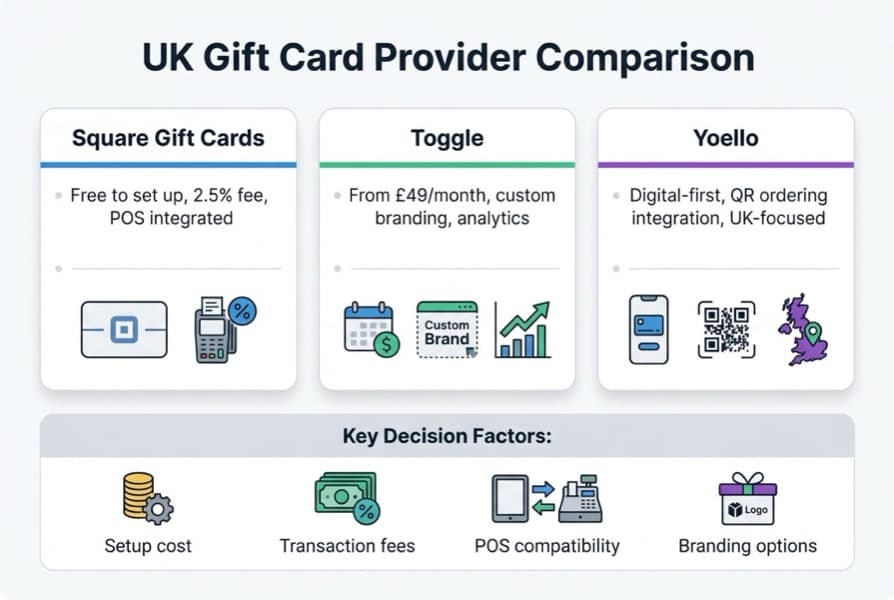
UK restaurant gift card providers compared: in-house vs. multi-restaurant schemes
For most independent UK restaurants, starting with your existing POS system is often the pragmatic choice. You can always add a multi-restaurant scheme later for additional exposure. However you sell them, keeping gift cards visible alongside your menu and offers helps turn browsers into buyers.
Check Your POS First
Ask your POS provider about their voucher features before paying for a separate platform. Many restaurants are already paying for this capability without realising it.
UK Legal Requirements for Restaurant Gift Cards
Now that you have a restaurant gift card UK provider shortlisted, you need to understand the legal framework. There is no dedicated "gift card law," but several pieces of legislation govern how you can sell and manage vouchers. Getting this wrong can lead to customer complaints, trading standards investigations, or unexpected VAT liabilities.
For instance, a seafood restaurant in Brighton faced a trading standards complaint after refusing to honour a voucher with unclear expiry terms, a situation that a simple one-paragraph terms statement would have prevented.
Consumer Rights Act 2015
Under this Act, restaurant vouchers are treated as a form of prepayment for goods or services. Key implications:
- Terms must be transparent. Any restrictions, expiry dates, or conditions must be clearly stated at the point of sale. Hidden terms that the buyer could not reasonably have known about may be unenforceable under the unfair terms provisions.
- Goods and services must match description. If your voucher promises "dining for two" or "any menu item," you must honour that. Excluding certain items or times after purchase could breach the Act.
- Refunds on unused cards. There is no automatic legal right to a cash refund for an unused voucher, but your terms should state this clearly.
Online Sales and the Cooling-Off Period
For vouchers sold online (which includes digital e-vouchers), the Consumer Contracts Regulations apply. Buyers have a 14-day cooling-off period for online purchases unless the digital voucher has already been used or you have obtained explicit consent to waive this right.
The reality for most independent restaurants: print your terms clearly on the card or in the confirmation email, set a reasonable expiry period, and be consistent. Most disputes arise from ambiguity, not from deliberate rule-breaking.
Would you buy a voucher from your own restaurant if the terms were unclear? If the answer is no, that is your benchmark for improvement.
VAT Treatment: Single-Purpose vs. Multi-Purpose Vouchers
Building on the legal basics above, this is where many restaurant owners get confused, and where mistakes can be costly. Under current UK VAT rules, HMRC distinguishes between two types of vouchers.
Single-Purpose Vouchers (SPVs)
A voucher is an SPV if the VAT treatment is known at the point of sale. For most single-site restaurants charging standard-rate VAT (20%) on all items, your vouchers are SPVs.
VAT is due when the card is sold, not when it is redeemed.
For instance, if you sell a £50 gift card, you owe VAT immediately on the full amount. When the card is redeemed, no additional VAT transaction occurs.
Multi-Purpose Vouchers (MPVs)
A voucher is an MPV if the VAT treatment is uncertain at the point of sale. This applies if your voucher could be used for items at different VAT rates (for example, hot food at 20% and cold takeaway food at 0%) or across multiple venues.
VAT is due when the card is redeemed, not when it is sold.
If you're reading this thinking "I just want to sell vouchers, not become a tax expert," that's usually a sign you need a 10-minute conversation with your accountant. Most single-site restaurants fall into the SPV category, which is simpler to manage. But if you offer takeaway alongside dine-in, check with your accountant whether your vouchers qualify as MPVs.
Related: Restaurant Website: What Every Owner Needs, ensure your online gift card page is set up correctly
Gift Card Expiry Rules in the UK
With your VAT approach sorted, the next restaurant gift card UK decision is expiry terms. There is no law that mandates a minimum or maximum expiry period for restaurant vouchers. However, the approach you take matters for customer relations and legal risk.
What the Law Says
- No statutory minimum expiry. Unlike some US states or EU member states, the UK does not require a minimum validity period.
- Unfair terms risk. An unreasonably short expiry (for example, 3 months) could be challenged as an unfair contract term under the 2015 consumer rights legislation.
- Industry standard. Most UK restaurant vouchers set a 12 to 24-month expiry period.
Practical Recommendations
| Expiry Period | Risk Level | Recommendation |
|---|---|---|
| 6 months | High, likely to generate complaints | Avoid |
| 12 months | Standard, widely accepted | Good default |
| 24 months | Low risk, generous | Recommended for premium cards |
| No expiry | Very low risk | Consider for digital cards (costs nothing to maintain) |
If you're only offering short expiry terms you'll always lose to competitors who give customers 12 months or more. Generous expiry terms cost you almost nothing but significantly reduce complaint rates and build goodwill. For example, a tapas bar in Leeds extended its expiry from 6 to 18 months and saw voucher complaints drop while redemption rates stayed the same.
Corporate and Employee Gift Cards UK
Additionally, the restaurant gift card UK landscape includes a lucrative B2B channel through corporate vouchers. Tax rules make them particularly attractive for employers.
The Trivial Benefits Exemption
Under HMRC rules, employers can give employees gifts worth up to £50 per occasion without triggering income tax or National Insurance contributions, provided:
- The gift is not cash or a cash voucher (restaurant-specific vouchers qualify)
- It is not a reward for work or performance
- It is not part of the employee's contract
- The total cost per occasion does not exceed £50
This means local businesses can buy your £50 vouchers as staff rewards, birthday gifts, or seasonal presents with no tax consequences. That is a powerful selling point when approaching corporate clients.
Approaching Local Businesses
A neighbourhood Italian restaurant might approach nearby offices with this pitch: "Reward your team with a meal on us. £50 vouchers, tax-free under the trivial benefits exemption. Order 20 or more and get 10% off."
For bulk orders, consider offering:
- 5% discount on orders of 10 to 19 vouchers
- 10% discount on orders of 20 or more
- Custom branding for the corporate client (their logo alongside yours)
- Digital delivery to individual employee emails
If you're only selling to walk-in customers you'll always lose to competitors who actively pitch corporate orders. One local office buying 20 vouchers at Christmas equals the same revenue as months of individual sales.
Where to Use Restaurant Vouchers in the UK
Let's switch perspective to the customer side of restaurant gift card UK usage. Where you can use a voucher depends on the type.
Single-Restaurant Vouchers
These are redeemable only at the specific restaurant (or restaurant group) that issued them. Check the card itself or the issuing restaurant's website for terms.
Multi-Restaurant Scheme Cards
The major UK multi-restaurant schemes offer wide acceptance:
- Restaurant Choice (Giftcard.co.uk): accepted at hundreds of UK restaurants
- Dining Out Card (Giftcards.co.uk): over 1,600 participating restaurants, pubs, and bars
- One4all Restaurant Favourites: redeemable at selected restaurant chains and groups
For instance, if you received a Restaurant Choice voucher as a birthday present, you could use it at participating independents and chains alike: just search by postcode on their website to find nearby options.
How to Check Your Restaurant Voucher Balance
Furthermore, checking your restaurant gift card UK balance is straightforward. Here's how depending on the provider:
- Single-restaurant vouchers: Call the restaurant directly or check their website if they have an online balance checker
- Restaurant Choice: Visit giftcard.co.uk and enter your card number and PIN
- Dining Out Card: Visit giftcards.co.uk, navigate to the balance check page, and enter your 16-digit card number
- One4all: Visit one4all.com or call their customer service line
For example, if you have a £50 Restaurant Choice voucher and used £30 at dinner, you can check the remaining £20 balance online within minutes. Keep your receipt and card number stored digitally (a photo on your phone works well) in case the physical card is lost or damaged.
If You Only Have 30 Minutes a Week
Now that you understand the restaurant gift card UK legal and practical framework, here's the good news: setting up a compliant programme does not have to consume your week. Here is the minimum:
Pro Tip
This week, get your restaurant vouchers sorted:
- Day 1-2: Check your POS system for built-in voucher features. If available, activate them and set a 12-month expiry.
- Day 3-4: Write your terms (template: "Valid for 12 months from purchase. Redeemable at [restaurant name] only. No cash refund. Lost cards replaced with proof of purchase."). Email these to your accountant for a quick VAT check.
- Day 5-7: Add a "Gift Cards" link to your website homepage and social media profiles. Place a small sign near your till: "Gift Cards Available from £25."
Quick Compliance Checklist
- POS system checked for built-in voucher features
- Expiry period set (12 months recommended)
- Written terms and conditions on card or confirmation email
- VAT treatment confirmed with accountant (SPV or MPV)
- Online purchase option available on website
- "Gift Cards" link added to homepage and social profiles
- Corporate pricing structure prepared for bulk orders
Weekly Action: Get Your Vouchers Legally Sorted
This week, do one thing based on where you are:
- Not started yet? Ask your POS provider whether voucher features are included in your plan. Most are.
- Cards available but no terms? Write a one-paragraph terms and conditions statement and print it on your cards or confirmation emails.
- Selling well but unsure on VAT? Book a 15-minute call with your accountant to confirm whether your vouchers are SPVs or MPVs.
If you run a restaurant and want to see how Local Brand Hub can support your marketing, explore our restaurant marketing tools.
Key Takeaway
Key Takeaway
Here's a summary of everything covered in this restaurant gift card UK guide:
- The UK leisure voucher sector grew strongly in H2 2025, far outpacing broader retail
- Digital gift cards make up the majority of the UK market: offer both physical and digital formats
- Voucher terms must be transparent under UK consumer rights law
- Most single-site restaurants issue SPVs, meaning VAT is due at the point of sale
- Set a 12 to 24-month expiry to avoid unfair terms challenges
- Corporate vouchers up to £50 qualify for HMRC's trivial benefits exemption, a strong B2B selling point
- Start with your existing POS system and expand as sales grow
Related: Restaurant Gift Card Marketing: The Complete Guide, parent hub
FAQ
Finally, here are the most common restaurant gift card UK questions.
Do restaurant gift cards expire in the UK?
There is no UK law requiring a minimum expiry period, but most restaurant vouchers set a 12 to 24-month validity. Unreasonably short expiry periods (under 6 months) risk being challenged as unfair contract terms under UK consumer rights law. The industry standard is 12 months, with premium cards often offering 24 months.
Do I need to charge VAT when selling restaurant vouchers?
It depends on whether your voucher is a single-purpose voucher (SPV) or multi-purpose voucher (MPV). If your restaurant charges standard 20% VAT on all items, your vouchers are SPVs and VAT is due when the card is sold. If your voucher could be used for items at different VAT rates or across multiple venues, it is an MPV and VAT is due at redemption. Consult your accountant to confirm which applies.
Can employers give restaurant vouchers tax-free to staff?
Yes. Under HMRC's trivial benefits exemption, employers can give employees vouchers worth up to £50 per occasion without triggering income tax or National Insurance, provided the gift is not cash, not a reward for performance, and not contractually required.
Where can I use the Restaurant Choice voucher in the UK?
The Restaurant Choice voucher (issued by Giftcard.co.uk) is accepted at hundreds of participating restaurants across the UK. Visit giftcard.co.uk to check the full list of participating venues using their restaurant finder. Accepted locations include chains, independent restaurants, and dining groups.
What happens if a customer loses their restaurant voucher?
Your terms should cover this. Common practice is to replace lost cards if the customer can provide proof of purchase (receipt or email confirmation) and you can verify the remaining balance on your POS system. You are not legally required to replace lost cards, but doing so builds customer goodwill and typically costs nothing.
Getting your restaurant gift card UK programme right from the start means fewer headaches with VAT, fewer customer complaints about expiry, and a stronger foundation for growing gift card revenue across your business.
For restaurants, salons, and local businesses
Need help with your marketing?
We help UK businesses turn social media into real results, not busywork.
Start freeGet More Marketing Tips
Practical marketing tips for UK business owners, straight to your inbox. No spam, unsubscribe anytime.
About the Author
Local Brand Hub
Empowering UK Businesses
Local Brand Hub provides comprehensive business management tools designed specifically for UK local businesses to streamline operations, automate marketing, and grow revenue.
More articlesRelated Articles
 Tutorials
Online Gift Card Restaurant Guide: UK Setup
Learn how to sell online gift card restaurant vouchers in the UK. Compare platforms, set up your store and market digital cards year-round.
 Industry Insights
Multi Restaurant Gift Card UK: Top Schemes
Compare multi restaurant gift card schemes in the UK including Dining Out, One4all and Restaurant Choice. Where to buy, check balances and expiry rules.
 Marketing Tips
Restaurant Gift Card Discount: UK Deals & Promos
Explore restaurant gift card discount strategies including bonus card promotions, seasonal deals, corporate bulk pricing and UK dining gift card offers.