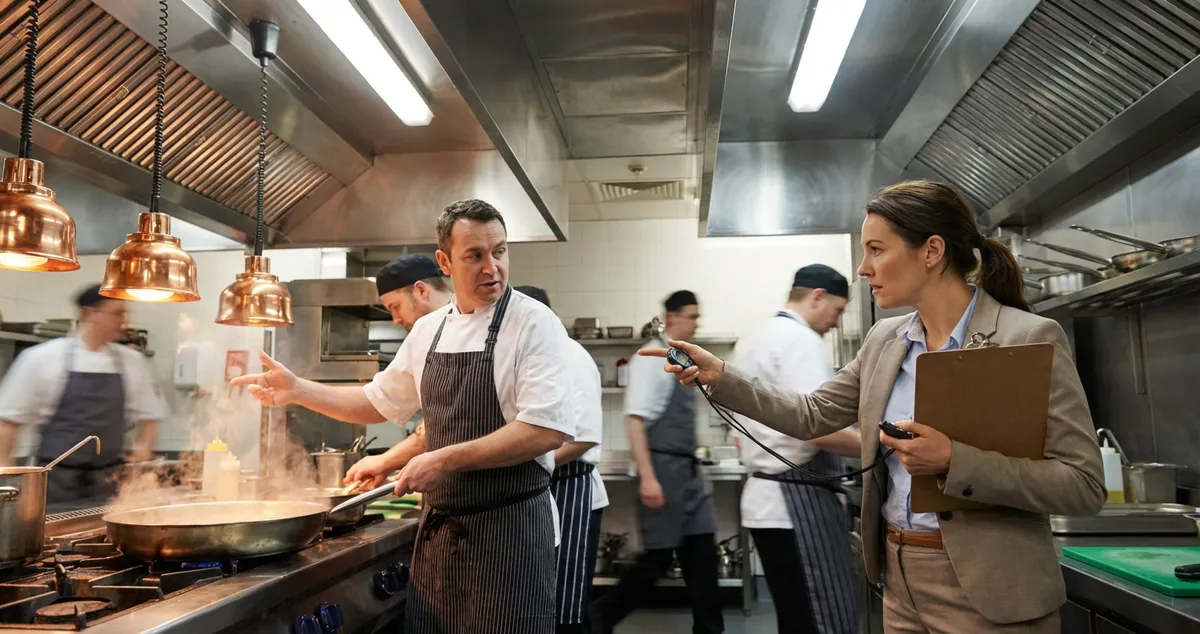
What does a restaurant operations consultant do? Covers UK pricing, real examples, a practical hiring checklist, and expected ROI for restaurant owners.
You're standing at the pass on a Friday night. Tickets are piling up. Your head chef is shouting. A server just came back with a complaint about a 40-minute wait for mains. The restaurant looked fine on paper. In practice, it feels like chaos.
Ask yourself: are your kitchen systems holding up under pressure, or falling apart every weekend?
A restaurant operations consultant fixes the internal mechanics of how a restaurant runs. Kitchen workflow, scheduling, inventory, costs, and service delivery. Unlike a general restaurant consultant who covers broad strategy, an operations consultant digs into daily processes. With UK margins at just 3-5% (UKHospitality, 2025), getting operations right is survival.
Info
This guide covers what a restaurant operations consultant does, how they differ from a restaurant management consultant, and how to tell if hiring one fits your situation.
What You'll Learn
- What restaurant operations consultants focus on and what they leave to other specialists
- The typical engagement process from initial audit to implemented changes
- How operations consulting differs from general restaurant consultancy
- Realistic UK costs and expected return on investment
- Warning signs that your restaurant operations need outside help
What Does an Operations Consultant Do?
Let's start with the basics. An operations consultant looks at how work flows through a business. They find waste. They fix bottlenecks. They build systems that stick. In a restaurant, that means looking at everything behind the scenes: how food gets ordered, how the kitchen runs, and how staff get scheduled.
A restaurant operations consultant spends most of their time on the floor. They watch service. They time each step. They talk to staff. They map out how things really work, not how you think they work. The gap is where problems hide.
How it works in practice
For example, a gastropub in Surrey brings in a restaurant operations consultant after food costs keep rising. The consultant finds the prep team is over-portioning protein: no portion guides, just habit. Adding controls and prep sheets brings costs back in line within six weeks.
A restaurant operations consultant is not about cutting corners. It is about making your staff, ingredients, and time work harder.
Info
A good restaurant operations consultant does not tell you what to cook. They tell you why the food you already cook costs more than it should.
What Does a Restaurant Consultant Do?
Here's the broader picture. "Restaurant consultant" is a general term. It covers anyone who advises on running a restaurant: concept, menu, marketing, finance, or operations.
The key difference is specialism:
- Operations consultant: kitchen efficiency, workflow, staffing systems, and service delivery
- Management consultant: financial performance, strategy, and structure (see our guide to restaurant management consultants)
- Marketing consultant: branding, digital marketing, and getting customers through the door
- Concept consultant: new restaurant concepts, design, and launch planning
For example, a busy wine bar in Manchester might hire a marketing consultant for social media strategy while separately bringing in an operations consultant to fix kitchen bottlenecks. Different problems need different specialists. If marketing is the gap, it is worth comparing an agency with a DIY approach before you commit to a monthly retainer.
UK day rates range from £400 to £1,000 (Consultancy.uk, 2025). For operations work, expect £500-£800. Always ask for references from similar restaurants.
Key Areas a Restaurant Operations Consultant Covers
Now let's get practical. Here is where a restaurant operations consultant spends their time. Not every engagement covers all these areas. A good consultant zeroes in on whatever costs you the most money or causes the most disruption.
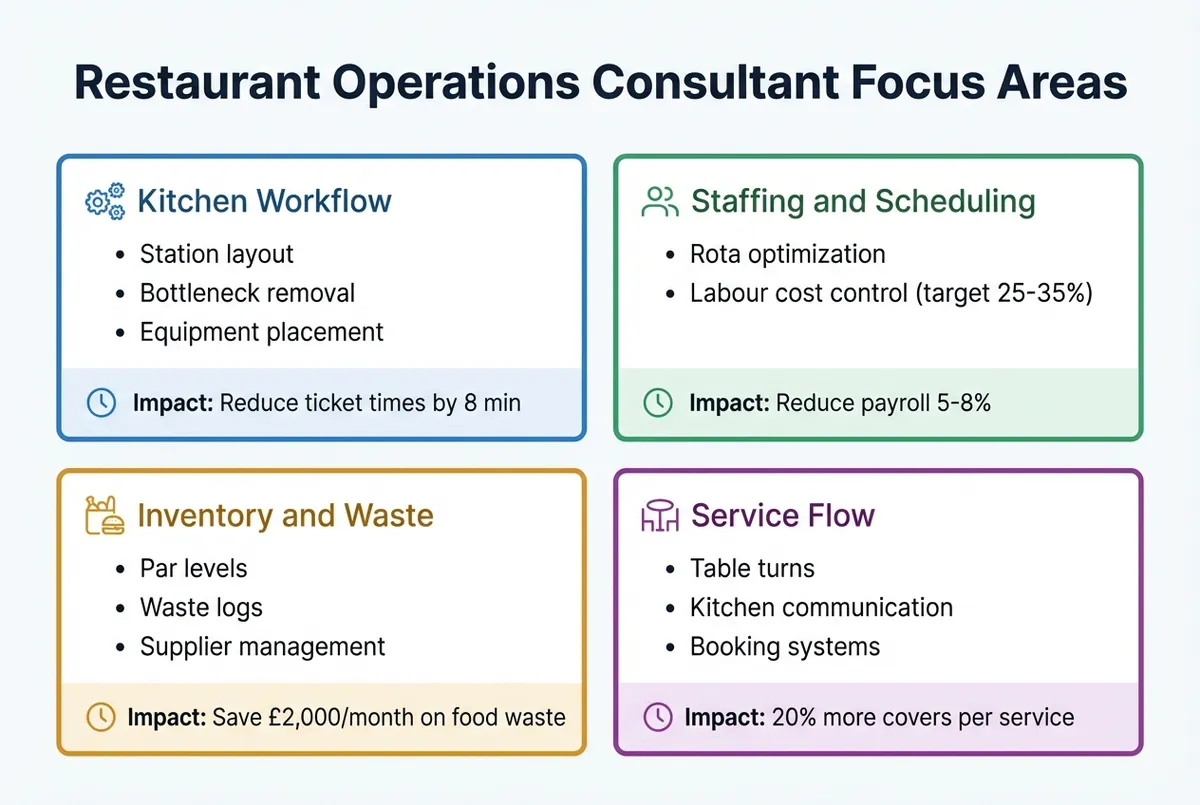
Key focus areas for a restaurant operations consultant
Kitchen Workflow and Layout
Your kitchen layout decides how fast food moves from prep to plate. A restaurant operations consultant maps the flow, spots jams, and suggests changes. Sometimes it's moving one piece of kit. Sometimes it's a full station reshuffle.
For instance, an Italian in Edinburgh has the pasta station and grill sharing a single pass. Peak service becomes chaos. The consultant splits it into two zones. Ticket times drop.
Staffing and Scheduling
Labour typically takes 25-35% of a UK restaurant's revenue (Fourth Analytics, 2025). A restaurant operations consultant checks your rota against actual demand. The aim: match staff to covers so you're not overspending on quiet shifts or short-staffed on busy ones.
If you're only scheduling staff based on gut feel you'll always lose to competitors who use data to match labour costs to actual demand. Better scheduling often pays for the entire engagement.
Inventory and Waste Management
Food waste costs the UK sector billions a year (WRAP, 2025). A restaurant operations consultant sets up tracking, sets par levels, and creates waste logs. The goal: know where money goes, then stop it going there.
Service Flow and Guest Experience
Operations don't stop at the kitchen door. The consultant looks at table turns, bookings, front-of-house comms with the kitchen, and the full guest journey. Smooth service isn't about rushing people. It's about removing friction.
Standard Operating Procedures
The most lasting thing a restaurant operations consultant does is write things down. SOPs for opening, closing, prep, service, and cleaning mean your restaurant runs the same way no matter who's on shift. It sounds basic. But many independents still rely on word of mouth.
When Your Restaurant Needs an Operations Consultant
Next, let's talk about the warning signs. If you're reading this after another 14-hour shift thinking "something's got to give," this section is for you. Not every problem needs outside help. But certain patterns suggest your operations have outgrown what you can fix alone.
Strong signals you need help:
- Ticket times regularly pass 25 minutes during peak service
- Food cost percentage stays above 34% despite pricing changes
- Kitchen staff turnover is high and climbing
- Complaints keep pointing to wait times, consistency, or wrong orders
- You have expanded (new menu items, longer hours, delivery) without adding systems
- Your best staff are burning out and your weakest are hiding
Weaker signals to watch but not panic about:
- The odd slow service night (every restaurant has them)
- One or two underperforming menu items
- Minor supplier issues that sort themselves out
A real-world example
A burger restaurant in Bristol might see complaints double after adding delivery. An operations consultant finds the kitchen was built for dine-in only. The delivery staging area blocks the pass during busy periods. Moving the delivery station and adding a dedicated packer fixes the bottleneck.
Operational problems compound. A slip that costs 10 minutes during prep becomes a 30-minute delay during service. Then a one-star review. Then a lost customer. A restaurant operations consultant fixes root causes before the fallout gets worse.
If you're reading this thinking "I've been dealing with this for months but haven't had time to fix it," you're not alone. That's the most common reason restaurant owners call in outside help. If you can't tell whether your kitchen problems are getting better or just shifting around, that's usually a sign you need a restaurant operations consultant.
How Much Do Restaurant Consultants Charge in the UK?
Here's the cost breakdown. Fees vary by scope, but these are typical UK ranges:
| Engagement Type | Typical UK Cost | Duration | Suited For |
|---|---|---|---|
| Half-day observation | £300-£500 | 4-5 hours | Quick pulse check, one specific problem |
| Full operational audit | £2,000-£4,000 | 1-2 weeks | Full review with written report |
| Audit + implementation | £4,000-£10,000 | 4-8 weeks | Audit plus hands-on system building |
| Retained advisory | £1,000-£2,500/month | Ongoing | Regular site visits and monitoring |
Operations consulting often pays for itself faster than other types because the savings are direct. Cut food waste by a few points and the savings add up fast. Factor in better scheduling and the payback is often under three months.
Pro Tip
Before hiring a restaurant operations consultant, estimate what your current inefficiencies cost per month. Most owners are surprised how quickly the numbers justify the fee.
For a full breakdown of pricing models, see our guide to restaurant consultant cost.
Restaurant Operations Consultant vs General Consultancy
Finally, let's compare options. Large firms like Deloitte and PwC have hospitality practices, but they serve enterprise clients. Boutique firms and independents are where most UK restaurants find their match.
| Factor | Operations Specialist | General Consultant | Large Firms |
|---|---|---|---|
| Focus | Kitchen, systems, workflow | Finance, ops, marketing | Enterprise strategy |
| Day rate | £500-£800 | £400-£1,000 | £2,000-£5,000+ |
| Typical client | Single-site or small chain | Independent to mid-size | Multi-site chains |
| Hands-on? | Very, on the floor with your team | Varies | Usually report-based |
| Implementation | Often included | Sometimes extra | Rarely included |
For example, a two-site fish and chip group in Leeds might get a written strategy from a large firm, but an operations specialist would actually stand in the kitchen and fix the workflow in person. That hands-on approach is what makes the difference for independents.
Info
For most UK independent restaurants needing operational improvements, a specialist operations consultant often delivers the most practical help: they are on the floor with your team, not behind a desk writing theory.
For the full range of services, see our guide to restaurant consultant services.
Actionable Checklist
Now let's put this into action. Use this to check whether your restaurant operations need professional help:
- Time your average ticket from order to plate during a busy service (target: under 20 minutes for mains)
- Calculate your actual food cost percentage from last month's P&L
- Review your staff rota against covers per hour: are quiet shifts overstaffed?
- Check whether you have written SOPs for opening, closing, and prep procedures
- Measure food waste for one week using a simple log (ingredient, amount, reason)
- Ask three kitchen staff what frustrates them most during service
- Compare your table turn time to your target (75 minutes for casual dining is a common benchmark)
- Review customer complaints from the past three months for operational patterns
- Estimate how much money you lose monthly to waste, overtime, and rework
- Contact two restaurant operations consultants for initial conversations
If You Only Have 30 Minutes This Week
If you only have 30 minutes a week to work on this, that's enough to start:
This Week's Action Plan
Find your single biggest operational bottleneck:
- Day 1-2: During your next busy service, stand at the pass for 20 minutes. Note where tickets queue longest. Write down the station and the cause.
- Day 3-4: Pull your food cost percentage from last month. If it is above 33%, check your top three ingredients for portion consistency.
- Day 5-7: Ask your head chef one question: "If you could change one thing about how this kitchen is set up, what would it be?" Write down the answer.
That is your starting point. You do not need a consultant to spot the first problem. You need one when you have spotted the problem but cannot build a system to fix it for good. If the same issues keep coming back month after month, that's usually a sign the fix needs to go deeper than a quick conversation.
FAQ
What is the difference between a restaurant operations consultant and a restaurant management consultant?
The difference is a framework that splits by focus area. An operations consultant works on how work flows through your restaurant: kitchen, staffing, inventory, service. A restaurant management consultant takes a broader view covering strategy and planning. If your problems live in the kitchen and during service, an operations specialist is the better fit.
How long does it take to see results?
Most restaurants see changes within four to six weeks. Quick wins like portion control and scheduling tweaks show up on the P&L within the first month. Bigger changes such as kitchen layout work or new SOPs take 8-12 weeks to bed in because staff need time to learn new habits.
Can an operations consultant help with delivery and takeaway?
Yes. Many UK restaurants added delivery but never properly fitted it into their kitchen workflow. An operations consultant can design a dual-flow system so dine-in and delivery orders do not clash. This often means dedicated staging areas and staff role changes during peak delivery times.
Do I need to close the restaurant for the audit?
No. Most of the audit happens during live service: that is when problems show up. The consultant needs to see your restaurant under real conditions. They typically watch two to three services (including at least one peak period), review paperwork during quieter hours, and talk to staff before or after shifts.
What qualifications should a restaurant operations consultant have?
There is no formal requirement in the UK. What matters is hands-on experience. Look for documented hospitality background, food safety certifications (Level 3 or 4 is a good signal), and membership of bodies such as the Institute of Hospitality or Foodservice Consultants Society International (FCSI). The strongest indicator is a track record of results in similar restaurants.
If you run a restaurant and want to see how Local Brand Hub can support your marketing, explore our restaurant marketing tools.
Key Takeaway
Key Takeaway
- A restaurant operations consultant fixes the internal mechanics of how your restaurant runs: kitchen workflow, cost control, and staffing systems
- UK operations consulting typically costs £2,000-£10,000 for project work, with day rates of £500-£800
- The right time to hire is when your problems are about efficiency, consistency, and costs, not concept, branding, or marketing
- Choose a consultant with hands-on hospitality experience, not just business credentials
- Calculate the cost of your problems before judging consulting fees: many owners underestimate how much inefficiency costs them each year
Your restaurant does not need to be perfect. It needs to be consistent. An operations consultant builds the systems that make consistency possible, so your food, your service, and your team perform the same whether you are at the pass or taking a rare day off.
For restaurants, salons, and local businesses
Need help with your marketing?
We help UK businesses turn social media into real results, not busywork.
Start freeGet More Marketing Tips
Practical marketing tips for UK business owners, straight to your inbox. No spam, unsubscribe anytime.
About the Author
Local Brand Hub
Empowering UK Businesses
Local Brand Hub provides comprehensive business management tools designed specifically for UK local businesses to streamline operations, automate marketing, and grow revenue.
More articlesRelated Articles
 Business Growth
How to Become a Restaurant Consultant: A Practical UK Guide
Learn how to become a restaurant consultant in the UK. Qualifications, experience paths, building your practice, and landing your first clients.
 Business Growth
Restaurant Consultant: What They Do, Cost & How to Hire
Learn what a restaurant consultant does, how much they charge in the UK, and how to hire the right one. Pricing table, hiring checklist, and FAQ.
 Business Growth
Restaurant Consultant Services: What They Offer
Every restaurant consultant service in the UK explained. Menu engineering, operations, turnarounds, openings and more. Costs, scope and expected outcomes.