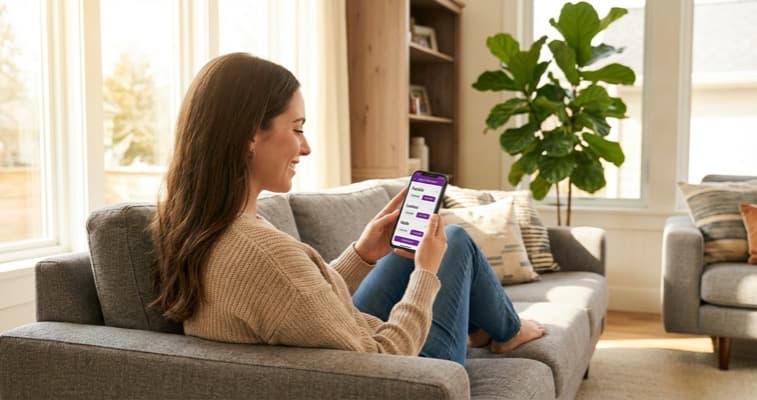
Does your beauty salon need a booking app? Compare app vs mobile website, Treatwell commission rates, push notifications, and what works for UK salons.
You've spent an afternoon looking for a beauty salon booking app and ended up more confused than when you started: Treatwell commission, Fresha's new fees, someone selling a custom app for £8,000. The right answer is simpler than any of that. For most UK salons, it isn't a custom app at all.
Related: Beauty Salon Booking System: the complete guide to booking platforms for UK salons.
What You'll Learn:
- Whether a dedicated app or a mobile website serves your clients better
- What the major marketplace apps (Treatwell, Fresha, Booksy) actually cost salons
- What push notifications can and can't do for your rebooking rate
- How to decide the right booking setup for your salon's size and budget
Does Your Beauty Salon Need a Booking App?
First, let's define what we mean. A beauty salon booking app is any mobile-first tool that lets clients find, schedule, and manage beauty appointments from their phone. That covers everything from a £0 booking widget on your website to a £15,000 custom-built branded app, and everything in between.
The confusion starts because "booking app" means two very different things:
- A marketplace app like Treatwell or Fresha, where clients browse and discover salons
- A branded salon app: your own app, built for your regular clients, with your logo on it
For the vast majority of UK salons, neither is necessary in the early stages. What is necessary is mobile-optimised booking that works flawlessly when a client taps a link, clicks your Instagram bio, or finds you on Google.
The question that matters: Are you trying to attract new clients, or serve your existing ones better? The answer determines everything about which kind of beauty salon booking app is right for you.
A beauty salon with 50 regular clients needs something different from a salon chasing 500. Start there.
App vs Mobile Website: What Your Clients Actually Prefer
Before choosing any platform, it's worth understanding how most clients actually book. The vast majority of online salon bookings are made through mobile phones. That tells you clients are booking on their phones. It does not tell you they want to download a dedicated beauty salon booking app to do it.
Most clients prefer not to download apps for businesses they visit monthly. The friction of downloading, creating an account, and granting permissions is real, especially for a first-time booking. A mobile website wins on accessibility: it's findable on Google, works instantly, and requires nothing from the client except a working browser.
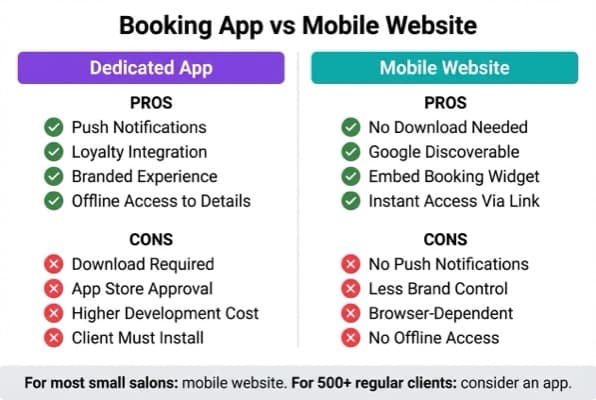
Comparing a dedicated booking app with a mobile website for beauty salons
| Feature | Dedicated App | Mobile Website |
|---|---|---|
| Client download required | Yes | No |
| Google discoverable | No | Yes |
| Push notifications | Yes | No (unless PWA) |
| Loyalty integration | Often built-in | Via third-party |
| Branded experience | Fully branded | Customisable |
| Booking widget embedding | Not applicable | Easy via Timely, Fresha etc. |
| Setup cost | High (£3,000-£15,000+) | Low (£0-£150/month) |
| Client adoption friction | High | Low |
Note: This comparison covers general platform capabilities. Costs vary by provider. Always verify current pricing directly with any platform you're considering.
Which Is Right for Your Salon?
For most small UK salons: a mobile booking website or booking widget is the right call. Your clients don't need to install anything. You don't need to budget for app development or worry about App Store approvals.
The case for a dedicated branded app emerges when you have a large, loyal client base (typically 500+ regular clients) where the push notification and loyalty features outweigh the barrier to downloading.
For example, a nail salon with 600 active clients who visit every 3 weeks might find that in-app rebooking and loyalty tracking genuinely justifies a branded app investment. A two-chair beauty studio still building its regulars base probably won't.
For an in-depth look at the full range of booking platforms, see our guide to beauty salon booking systems.
Booking Apps Available for UK Beauty Salons
When most salon owners search "beauty salon booking app," they're looking at one of three categories:
1. Marketplace Apps (Treatwell, Fresha, Booksy)
These let clients discover your salon and book directly via the platform's app. You get access to their client base. You pay commission. The right choice for acquisition, not necessarily for retention.
2. Booking Software with a Client-Facing App
Platforms like Timely, Phorest, and Vagaro offer your own booking system with a branded or white-label client app. Clients download it and rebook easily. A good middle ground between marketplace and fully custom.
3. Booking Widgets on Your Own Website
No app at all, just a mobile-optimised booking button that lives on your site, social profiles, and Google. Often the right answer for salons under 200 regular clients.
For a fuller comparison of software options, our salon booking software guide covers pricing tiers across the major platforms. And if budget is a factor, our free salon booking system UK guide covers what you can get at no cost.
The Client App Experience: What Good Looks Like
Now that you know the categories, it's worth understanding what the client experience needs to deliver, regardless of which platform you choose.
Good looks like:
- Instant treatment browsing: clients see what's available without scrolling a PDF menu
- Real-time availability: no back-and-forth messages ("are you free Thursday?")
- Automated confirmation and reminders: SMS or email, 24 to 48 hours before the appointment
- One-tap rebooking: returning clients rebook their last appointment in under 30 seconds
- Simple payment: card saved, deposit taken, no awkward payment chases at checkout
Bad looks like:
- A booking journey that requires four pages of forms
- Mandatory account creation before seeing a single available time
- A confirmation email that takes 20 minutes to arrive
Test Your Own Booking Journey
Open your Google listing and try to book as a new client would. Count the number of steps. If it takes more than 4 taps to confirm a time slot, you've already lost bookings you didn't know about.
The No-Show Problem
The difference in no-show rates between salons with automated reminders and those without is significant. Salons that have implemented automated reminder systems consistently report meaningful reductions in missed appointments. For a beauty salon with eight appointments a day, that's real revenue recovery.
If you're only following up on no-shows after they happen rather than preventing them with reminders, that's usually a sign your booking system isn't working hard enough for you.
For more on building a robust online booking experience, see salon online booking and our overview of salon online booking systems.
Hidden Marketplace Costs: Treatwell, Booksy, and Commission
Once you've got the client experience right, you need to understand what the platform will actually charge. Marketplace commission is the hidden cost nobody talks about, until you receive your first monthly statement and realise a significant chunk of your new-client revenue went to a platform.
Here's what the three major UK marketplace apps actually charge:
| Platform | New Client Commission | Repeat Client Fee | Monthly Fees |
|---|---|---|---|
| Treatwell | 35% on first bookings via marketplace | 0% | 2.5% payment processing on prepaid bookings |
| Fresha | Commission on marketplace new clients (see fresha.com) | 0% | Monthly per-calendar fee introduced 2025 + card transaction fees |
| Booksy | Subscription-based | No marketplace commission model | Monthly subscription (contact for UK pricing) |
Commission rates and platform fees change. Always verify current pricing directly on each platform's website before committing.
Understanding Treatwell's 35% Commission
Treatwell's model is straightforward: they take 35% of the booking value for every new client they send you. On a £60 gel manicure and brow appointment, that's £21 off the top before you've factored in product costs.
The maths: A salon booking 40 new clients/month via Treatwell at £70 average pays roughly £980/month in commission. A direct booking system might cost £100 to £150/month total.
For example, a nail and brow bar might find after six months that its Treatwell commission costs significantly more than its entire direct booking and marketing stack combined. At that point, the question becomes: is Treatwell bringing clients who wouldn't find you otherwise, or is it just taking commission on bookings you'd have received anyway?
If you're only relying on marketplaces you'll always lose margin to platforms designed to keep clients booking through them, not through you.
Fresha's Pricing Shift
Fresha's recent shift is worth noting. Previously marketed as "free for salons," Fresha moved to a subscription model in 2025, charging a monthly fee per staff calendar alongside its marketplace commission and card processing fees. For a multi-stylist salon, those fees compound quickly. Always check fresha.com for current pricing before committing.
The Strategic Play
This doesn't mean marketplace apps aren't valuable. Treatwell and Fresha are genuine discovery tools: they put your beauty salon in front of clients who wouldn't find you otherwise. The question is whether you're using them strategically (to fill slow periods, attract first-timers) or habitually (because you haven't built any direct booking capability).
The smartest salons use a marketplace to acquire new clients, then migrate them to direct booking for repeat visits. The platforms know this, which is why repeat bookings carry 0% commission on most. They've already won the discovery battle.
Push Notifications: Do They Actually Work for Salons?
If you're considering a dedicated app mainly for push notifications, here's what the data actually looks like. Push notifications are the one thing a dedicated beauty salon booking app offers that a mobile website can't (without Progressive Web App technology). The premise is appealing: send a notification, client opens it, client books. Frictionless.
Info
Push notification open rates in the health and beauty sector are typically low. Email open rates in the same sector are consistently much higher. Notifications aren't a silver bullet: they're a tool that works only when used correctly.
When Push Notifications Work
- Last-minute availability: "We have a cancellation this afternoon at 3pm" converts reliably
- Seasonal reminders: "Book your pre-summer brow tint before the rush"
- Loyalty milestones: "You're one visit away from a free treatment"
When They Don't
- Generic "we miss you" messages clients have learned to ignore
- Daily or weekly send frequencies (clients disable notifications fast)
- Any notification that feels like a promotion rather than useful information
For example, a nail salon using Phorest might send a push notification on a quiet Tuesday: "Cancellation at 2pm today, click to grab it." That kind of message, sent once a week at most, genuinely converts. Sending a "check out our new menu" notification every Monday? That's how you lose a client's permission to reach them at all.
If you're considering a beauty salon booking app purely for push notifications, the numbers rarely add up for salons under 300 active clients. Email marketing (a simpler, cheaper, higher open-rate channel) will serve you better at that stage.
For salons with larger client bases, systems like Phorest and Timely include automated SMS and email marketing within their subscription, giving you much of the "push" benefit without requiring clients to download anything.
Our Recommendation
If you're still deciding which way to go:
You do not need to build a branded beauty salon booking app. The cost (£3,000 to £15,000+ for development, plus ongoing maintenance) is prohibitive for most independent salons, and client uptake is rarely strong enough to justify it.
You probably need a marketplace presence, used strategically. Treatwell or Fresha can fill your books faster than most channels when you're starting out. Go in eyes-open about commission, have a plan to migrate regulars to direct booking, and review marketplace spend quarterly: it helps to work out the numbers rather than guess at what each new client really costs you.
You definitely need mobile-optimised direct booking. Whether that's a booking widget on your website, a link in your Instagram bio, or a system like Fresha's direct booking, your existing clients should be able to rebook without opening a marketplace app.
In short: Booking isn't about apps. It's about removing friction for clients who already want to visit you. A mobile-friendly booking link does that. An app might, once you've got the clients to justify it.
Pick this one if you're just getting started: A free or low-cost booking system like those in our salon booking systems UK guide with a mobile-optimised widget. Add a Treatwell listing to attract new clients. Review marketplace commission after 3 months and consider direct booking as you build your regular client base.
Frequently Asked Questions
What is the best beauty salon booking app for UK salons?
The best beauty salon booking app approach for UK salons is a strategy that combines a direct booking system (like Timely or Fresha's direct booking tool) for existing clients with a marketplace listing for new client discovery. You don't need a custom-built app. The right solution depends on your salon size, existing client base, and how much you rely on new client discovery.
How much does Treatwell charge salons in commission?
Treatwell charges 35% commission on the first booking from each new client they introduce via their marketplace, 0% on repeat bookings from those clients, and a 2.5% payment processing fee on prepaid bookings. Always check treatwell.com for current rates as pricing can change.
Do beauty salon clients actually use booking apps?
Yes, the vast majority of online salon bookings happen via mobile phones. However, most clients book through a website or booking widget rather than a downloaded beauty salon booking app. Requiring clients to download an app before they can book creates friction, particularly for first-time visitors.
Is Fresha free for beauty salons?
Fresha was previously marketed as free for salons, but introduced a subscription model in 2025. There is now a monthly fee per staff calendar, plus marketplace commission on new clients and card transaction fees. Always check fresha.com for current pricing before signing up.
Are push notifications worth it for salons?
Push notifications can be effective when used sparingly: last-minute cancellations and loyalty milestone reminders tend to convert well. However, push notification open rates in the beauty sector tend to be low, while email open rates are consistently much higher. For most salons under 300 active clients, email marketing delivers better results at lower cost than investing in a dedicated app for notifications alone.
Weekly Action
This week, audit your current booking setup:
- Day 1 to 2: Test your booking journey as a new client. Open your Google listing and book a treatment from scratch. Count the steps. Target: 4 taps or fewer to confirm a slot.
- Day 3 to 4: If you're on Treatwell or Fresha, check your last 3 months of commissions. Calculate what you paid per new client acquired. Compare to what a direct booking system would cost monthly.
- Day 5 to 7: Identify your top 20 most frequent clients. Are they booking via marketplace or direct? If via marketplace, is there a path to move them to direct rebooking?
For the full picture on how booking systems compare across salon types, see the hair salon booking system and nail salon booking system guides. For everything from platform choice to pricing, our salon booking systems UK overview is the place to start. And for the digital stack that supports all of this, see our beauty salon booking systems hub, because a booking app only works if clients can find you first.
If you're a beauty salon owner exploring how to grow your online presence beyond just booking, our beauty salons industry page covers the full picture.
For restaurants, salons, and local businesses
Need help with your marketing?
We help UK businesses turn social media into real results, not busywork.
Start freeKey Takeaway
Most UK beauty salons don't need a dedicated booking app. A mobile-optimised booking widget on your website gives clients the frictionless experience they want, without the £3,000+ development cost or the barrier of asking people to download yet another app. Use marketplace platforms like Treatwell strategically for new client discovery, but build direct booking capability to keep your regulars (and your margins). The right setup depends on your salon size and stage: start simple, upgrade when the numbers justify it.
Get More Marketing Tips
Practical marketing tips for UK business owners, straight to your inbox. No spam, unsubscribe anytime.
About the Author
Local Brand Hub
Empowering UK Businesses
Local Brand Hub provides comprehensive business management tools designed specifically for UK local businesses to streamline operations, automate marketing, and grow revenue.
More articlesRelated Articles
 Industry Insights
Salon Software Pricing UK 2026: What It Actually Costs
Compare salon software pricing in the UK. Per-staff, flat rate and commission models explained with Fresha, Timely, Phorest and Square plus hidden costs.
 Industry Insights
Beauty Salon Booking System: Complete UK Guide
Everything UK beauty salons need to know about booking systems: key features, no-show protection, top platforms, and choosing the right one.
 Industry Insights
Beauty Salon Booking Systems: 6 Platforms Compared
Compare 6 beauty salon booking systems for UK salons. Fresha, Timely, Treatwell, Booksy and more: real pricing, deposit handling, and our top pick.