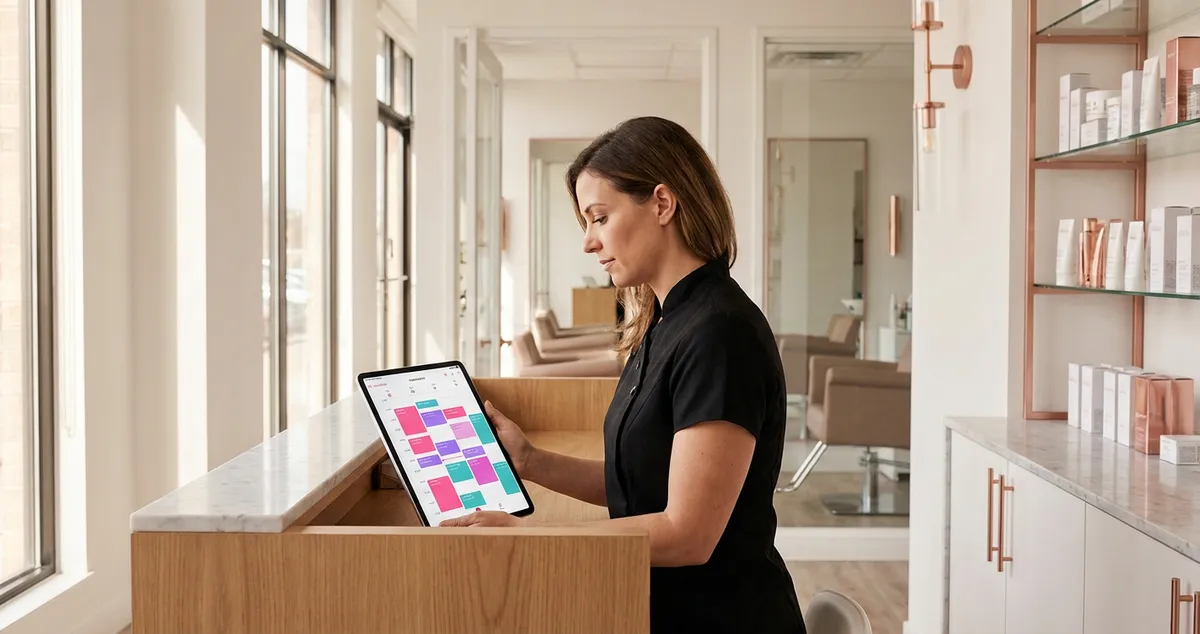
Everything UK beauty salons need to know about booking systems: key features, no-show protection, top platforms, and choosing the right one.
You're managing bookings between clients, answering the phone while mid-treatment, and trying to remember who confirmed Saturday's appointments. A beauty salon booking system is a platform that automates this: clients book online, reminders go out automatically, and deposits protect your time, all from one place.
What You'll Learn:
- Why no-shows are costing your salon significantly more than you think
- The six features every booking system should have
- How booking connects to your wider marketing strategy
- How to compare UK platforms including Fresha, Timely, Treatwell, Booksy, and Phorest
- How to choose the right platform this week
Why Your Beauty Salon Needs a Booking System in 2026
The phone rings. You're mid-colour with a client who can't wait, the receptionist is on lunch, and whoever's calling, a potential booking, goes to voicemail. They don't leave one. They book somewhere else.
If that sounds familiar, you're not alone. Only 8% of UK salons, spas, and grooming businesses report never experiencing cancellations or no-shows (Fresha, December 2025). The other 92% are managing it constantly: some losing between 5% and 20% of monthly revenue to appointments that simply don't happen.
If you're building out a broader marketing strategy for your salon, see our guide to beauty salon marketing, booking systems are one piece of a much larger picture.
This isn't a staffing problem. It's a systems problem. And a booking system is the fix.
If you're thinking "my clients are fine calling in", that may be true for your regulars. But the question isn't whether existing clients tolerate the phone process. It's whether new clients who land on your Instagram page at 11pm on a Sunday will wait until Monday morning to ring. Most won't.
Beyond client experience, there's a hard financial case. For example, a nail salon turning over £8,000 per month that loses 7% to cancellations is writing off roughly £560 every single month without ever seeing it on a report.
Info
A mid-career salon owner turning over £12,000 per month loses approximately £960 to no-shows and late cancellations every single month (Fresha, December 2025). That's nearly £11,500 a year.
A good system doesn't just recover that lost revenue. It makes the whole operation calmer.
What a Beauty Salon Booking System Actually Does
Most salon owners think of a booking system as a digital appointment diary. However, it handles quite a bit more than that.
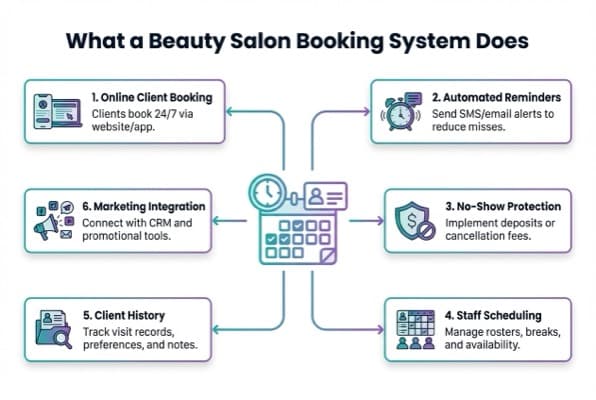
The six core functions of a modern beauty salon booking system
At its core, it handles the full appointment lifecycle: from the moment a client decides to book through to post-visit follow-up. Here's what that looks like in practice:
1. Online Client Booking
Clients book 24/7. No phone calls required. They choose the service, therapist, and time slot, and receive instant confirmation. Many clients now actively prefer online booking over calling, specifically because they can check real availability without waiting on hold or playing phone tag.
For example, a beauty salon specialising in gel manicures and brow treatments might let clients self-select from a live service menu, including add-ons like nail art or lash tint, without ever needing to call. That self-service flow, running while the salon sleeps, is doing active work.
2. Automated Reminders
The system sends SMS or email reminders at set intervals: typically 48 hours and 24 hours before the appointment. Automated reminders directly address the main cause of no-shows: clients simply forget. A two-stage sequence (48h + 24h) is widely used by platforms like Phorest, Timely, and Fresha.
3. No-Show Protection
Deposits, card-on-file requirements, and cancellation policies are enforced automatically. No awkward conversations. No chasing payments. The policy is built into the booking flow.
4. Staff Scheduling
Rotas, shift patterns, and treatment room availability are managed in one view. Staff can see their schedules without checking in with you.
5. Client History
Every visit is logged: services received, products used, skin or hair notes, allergy records, spend history. A repeat client who moves from one therapist to another shouldn't have to explain their entire history again.
6. Marketing Integration
Booking data feeds your marketing: you know which clients haven't visited in 90 days, which services see higher demand in certain months, and who your highest-value regulars are.
For a step-by-step walkthrough of getting your first system live, see salon online booking: step-by-step setup.
For a detailed head-to-head comparison of the main UK platforms, see beauty salon booking systems compared.
Key Features Every Salon Booking System Should Have
Now that you know what a booking system does, the next question is: which features actually matter for beauty salons specifically?
Info
Not all scheduling tools are built for salon workflows. Generic systems won't know your treatments need patch tests, or that your colour service runs 3.5 hours.
Not all booking systems are built for salons. A generic scheduling tool will handle basic bookings, but it won't know that a balayage appointment needs 3.5 hours, or that a patch test is required 48 hours before a colour service, or that your nail technician only does gel extensions on Thursdays. Additionally, beauty-specific workflows require features that general business tools simply don't offer.
Here are the non-negotiables to look for:
| Feature | Why It Matters |
|---|---|
| Service duration + buffer time | Prevents double-booking and five-minute gaps |
| Deposit + cancellation controls | Enforces your policy without awkward calls |
| Multi-staff / multi-room support | Scales with your salon |
| Patch test reminders | Compliance and client safety |
| Client notes + contra-indications | Allergy records surfaced automatically |
| Waitlist management | Turns cancellations into filled slots |
| Mobile-first booking flow | Captures bookings made on phones |
Service duration and buffer management. Each treatment should have its own time slot, plus optional buffer time for room changeover.
For example, an aesthetics clinic offering microneedling followed by LED therapy needs treatment time plus a setup gap built in automatically, not managed manually in a shared diary.
Deposit and cancellation policy control. You should be able to set different deposit thresholds for different services. A full set of acrylics warrants a larger deposit than a brow tint.
Beauty-Specific Requirements
Patch test and consultation reminders. For salons offering chemical treatments, tinting, or extensions, automated pre-treatment communications are essential, and increasingly important from a compliance perspective.
Waitlist management. When a slot frees up, the system should automatically notify clients on the waitlist. Manual waitlists managed via text message don't scale.
For a full breakdown of software categories and what each one handles, see salon booking software.
How Online Booking Reduces No-Shows and Late Cancellations
With the features covered, the next question is: what difference does online booking actually make to your no-show rate?
The data from the UK market is stark. 62% of clients give less than 24 hours' notice when cancelling, and one in five cancellations arrive with less than 12 hours' notice (Fresha, December 2025). At that point, filling the slot from scratch is almost impossible.
Warning
No-shows are a salon's most expensive operational problem: not because each individual missed appointment costs much on its own, but because of the cumulative effect over months and years.
Here's what an automated system does that a phone-based process can't:
- Automated reminders: Most missed appointments aren't deliberate. Clients forget. A well-timed reminder, sent by the system without effort from your team, typically resolves this. Platforms like Phorest, Timely, and Fresha offer two-stage reminder sequences as standard.
- Deposits: When a client has paid £20 towards a £90 treatment, they're far less likely to not show up. The system collects the deposit at booking and deducts it automatically on the day.
- Automated cancellation fees: If a client cancels within 24 hours, the system charges the fee automatically. You don't have to make an awkward phone call or decide whether to let it slide. The policy is the policy.
- Waitlists: When a slot opens up, automated waitlist notifications mean you're filling it from a warm list of clients who want to come in, not scrambling through old texts.
For example, a nail salon using card-on-file requirements can significantly reduce late cancellations simply by having that payment commitment in place. The booking tool makes the policy the path of least resistance, and that changes behaviour.
If you're only managing bookings manually you'll always lose revenue to salons that have automated this process. That's not a criticism: it's just how the maths works when 62% of cancellations give you less than 24 hours to respond (Fresha, December 2025).
For specific considerations around managing high-volume short appointments, see nail salon booking system.
Booking Systems and Marketing: The Connection Most Salons Miss
Furthermore, most salon owners who invest in booking software miss its most powerful secondary benefit: the data it generates.
Every appointment that runs through your system is a data point. You know which clients book regularly and which ones went quiet. You know which services see higher demand in certain months. You know which therapists retain clients best.
Most salons let this data sit unused.
Pro Tip
If you can't tell whether a client is drifting away or just overdue for a reminder, that's usually a sign your booking system and marketing aren't connected.
A system with marketing integration, or one that connects to tools like Mailchimp or your CRM, lets you act on it:
- Lapsed client campaigns. Filter clients who haven't booked in 90+ days and send a targeted re-engagement offer. These aren't cold contacts. They've been to your salon. The conversion rate is dramatically higher than cold outreach.
- Seasonal service promotion. Your booking history tells you which treatments see higher demand in autumn and December. Run pre-emptive seasonal promotions before your slots fill up.
- Loyal client rewards. Identify your top clients by visit frequency or spend. Give them early access to new services or priority booking during busy periods.
For example, a beauty salon using Phorest might trigger a "we miss you" email to every client who hasn't booked in three months, automatically, from booking data, without anyone manually compiling a list. That's the connection most salons miss.
Your booking system fills slots. Your marketing strategy fills the pipeline that gets people to your booking page, and that's a separate discipline entirely.
For more on using booking data to run effective email campaigns, see beauty salon email marketing. For offers and promotions that drive repeat bookings, see salon promotion ideas.
The platforms with the strongest marketing integration in the UK market include Phorest (native email marketing and loyalty tools), Fresha (marketplace exposure plus CRM), and Timely (strong third-party integrations). See salon booking systems UK for a UK-focused platform comparison.
How to Choose the Right Booking System for Your Salon
Finally, the practical question: which platform is actually right for you?
There's no single "best" option, but there is a right system for your specific situation. Here's how to work it out.
Start with your size and setup. A solo nail technician has different needs from a five-treatment-room beauty salon with six therapists. Solo operators often find free-tier platforms like Fresha or Booksy more than sufficient. Multi-therapist salons typically need staff management, room scheduling, and reporting, which points toward Timely or Phorest.
Check what you're currently losing. If no-shows are your primary problem, prioritise deposit management and automated reminders. If client retention is the issue, look for platforms with built-in marketing and loyalty tools. If you're overwhelmed by admin, focus on calendar and scheduling automation.
Understand the pricing model.
Info
Fresha operates on a commission model (free software, percentage of card payments). Timely and Phorest charge monthly subscription fees. Treatwell takes a percentage of bookings made through their marketplace. There's no universally "cheapest" option: it depends on your volume and whether you value marketplace exposure.
Consider the Treatwell marketplace carefully. Treatwell brings new clients to your door, but those clients belong to Treatwell, not to you. Your own direct booking system builds your client base. Many salons use both: Treatwell for acquisition, a direct system for repeat bookings.
If cost is your main constraint, free salon booking system UK covers the genuine free options and their limitations.
If you want clients to book via a branded app rather than a web browser, see beauty salon booking app. If your salon covers both hair and beauty services, see hair salon booking system.
For salons building out their full digital presence alongside online booking, see salon website and SEO: your booking system and website need to work together to convert traffic into appointments.
Questions to ask any platform before signing up:
- Can I import my existing client list?
- What happens to my data if I leave the platform?
- Does the reminder system support both SMS and email?
- Can I customise my cancellation and deposit policy per service type?
- What does the client-facing booking page look like on mobile?
- Is there a setup fee or contract lock-in?
For a technical breakdown of what "online booking" actually means and which setup suits which salon type, see salon online booking system.
If You Only Have 30 Minutes This Week
If you're reading this between appointments and thinking "I know I need to sort this, I just don't have time", that's exactly why this section exists.
If you only have 30 minutes a week to move forward on this, follow this structure:
Your 30-Minute Action Plan
Day 1-2: Audit what you're losing. Count the no-shows and late cancellations from the last four weeks. Multiply those gaps by your average treatment price. That number, your monthly no-show cost, is your business case for acting.
Day 3-4: Trial one platform. Sign up for a free trial on Fresha or Timely (both have no-commitment trials). Upload your service menu and create a test booking as if you were a client. You'll know within 20 minutes whether the client-facing experience is good enough.
Day 5-7: Set your deposit policy. Decide which services require a deposit, what percentage, and what your cancellation window is. Write it down, then set it in the system. This single decision will have more impact on your no-show rate than anything else you do this month.
For example, a nail bar owner doing this audit for the first time might find she's losing £400-600 per month to no-shows, at which point a £30/month subscription to a dedicated system pays for itself in the first week.
If you genuinely can't find 30 minutes, start smaller: book a 15-minute demo with Fresha or Phorest. Both offer them. That's your Day 1.
Frequently Asked Questions
What is the best beauty salon booking system in the UK?
The best one is a platform that matches your salon's size, services, and budget. There is no single universal answer. Fresha is popular for its free entry-level tier; Phorest is widely used by established multi-therapist salons; Timely suits salons that want clean design and strong integrations. See beauty salon booking systems compared for a full UK platform comparison.
How much does a salon booking system cost?
Costs vary by model. Fresha is free at entry level but charges a percentage of card payments. Timely and Phorest charge monthly subscriptions (typically £30-£120/month depending on team size). Booksy and Treatwell take a percentage of bookings made through their marketplace. For details on genuinely zero-cost options, see free salon booking system UK.
Can online booking reduce no-shows?
Yes, primarily through automated reminders (SMS/email) and deposit requirements. According to Fresha's December 2025 survey of over 200 UK beauty businesses, 62% of clients cancel with less than 24 hours' notice. Automated reminders and card-on-file policies address both forgetting and low commitment directly.
Do I need a booking system if I work alone?
If you're taking bookings by phone or text and managing a paper diary, the right software will save you time even as a solo therapist. Most platforms offer free tiers for single-user accounts. The no-show protection alone, deposits enforced automatically, typically justifies the switch.
What's the difference between a booking system and a marketplace like Treatwell?
A booking system is software you own and control. Clients book directly with you, and you own the client relationship. A marketplace like Treatwell brings new clients to you, but those clients are Treatwell's, not yours. Many salons use both: Treatwell for new client acquisition, a direct booking system for repeat business and client retention.
The best system isn't the one with the most features. It's the one your clients will actually use to book, and the one you'll actually use to run your business.
This week, do one thing: calculate your no-show cost. Take last month's missed appointments, multiply by your average treatment price, and write the number down. Most salon owners have never done this. Once you see it, the case for a booking system stops being theoretical.
Then pick one platform, beauty salon booking systems compared has the full comparison, and book a trial or a demo.
If you're also thinking about your salon's wider digital presence, explore our beauty salons industry page for tools and resources designed specifically for salon owners.
For restaurants, salons, and local businesses
Need help with your marketing?
We help UK businesses turn social media into real results, not busywork.
Start freeKey Takeaway
A beauty salon booking system automates the full appointment lifecycle: from online client booking and automated reminders through to deposit collection, no-show protection, and marketing integration. The right system for your salon depends on your team size, budget, and which problem you're solving first. Start by calculating your monthly no-show cost, trial one platform this week, and set your deposit policy. That single change will have more impact on your revenue than anything else you do this month.
Get More Marketing Tips
Practical marketing tips for UK business owners, straight to your inbox. No spam, unsubscribe anytime.
About the Author
Local Brand Hub
Empowering UK Businesses
Local Brand Hub provides comprehensive business management tools designed specifically for UK local businesses to streamline operations, automate marketing, and grow revenue.
More articlesRelated Articles
 Industry Insights
Salon Software Pricing UK 2026: What It Actually Costs
Compare salon software pricing in the UK. Per-staff, flat rate and commission models explained with Fresha, Timely, Phorest and Square plus hidden costs.
 Industry Insights
Beauty Salon Booking App: Do Your Clients Need One?
Does your beauty salon need a booking app? Compare app vs mobile website, Treatwell commission rates, push notifications, and what works for UK salons.
 Industry Insights
Beauty Salon Booking Systems: 6 Platforms Compared
Compare 6 beauty salon booking systems for UK salons. Fresha, Timely, Treatwell, Booksy and more: real pricing, deposit handling, and our top pick.