
Christmas flower sales for florists: set your festive range, workshop and pre-order dates, price against current stock costs, and pick your December hours.
Christmas flower sales are decided in October and November, not December. Agree your greenery quantities early, put workshop and pre order dates on sale before the end of November, publish a firm cut off, and price your wreaths from the invoices in front of you. December then becomes production instead of decision making.
Somewhere around the second week of November, a florist looks at the diary and realises the season is half spent. The greenery is not booked. The workshop dates are not up. The wreath price on the website is a year old, typed in when eucalyptus cost something different. None of it feels urgent yet, and that is the trap.
December does not run out of customers. It runs out of you. That is why this is a plan with dates on it, not a list of nice ideas. It covers the six weeks that pay for January.
Why your ceiling is the bench, not the demand
Ask a florist what limits their Christmas and you will hear about footfall, or the high street, or people spending less. Then watch the same shop on 20 December, turning away orders it cannot physically make.
For a shop that ends December turning orders away, the scarce thing was never demand. It was bench hours. A wired door wreath is a fixed lump of skilled time that cannot be compressed by wanting it more, and each competes with the table centre behind it. See the month as a fixed number of making hours rather than an open selling season and the awkward decisions get easier: what to sell, what to cap, what to stop offering.
The question worth answering before November: how many finished wreaths can your shop actually build in a working day?
Picture a two person shop that can build roughly 12 wreaths a day alongside its other orders. Across the first three weeks of December, that is the ceiling. Selling 400 wreaths is not ambition, it is an apology waiting to happen.
Those numbers are invented; the arithmetic is not. Work out your own honest daily figure first.
What to sell when hours are the limit
Rank the range by what it returns per hour at the bench, not by how Christmassy it feels to make.
- Door wreaths. The signature product and the biggest time cost. Fix two or three sizes and let the trim do the varying.
- Table centres. Fast to build, sold in multiples for one dinner, easy to tier.
- Gift bouquets. Your ordinary skill in festive dress, with delivery attached.
- Wreath making workshops. Fixed tickets, known material cost, an evening you choose. You sell teaching time instead of making time.
- Office and party flowers. Booked weeks ahead by people who plan, and repeatable.
Workshops carry a cost that hides in the evening rather than the tray. Someone preps the frames, teaches, and sweeps up the spruce afterwards, so price the whole evening before you price a ticket. The florist pricing formula is the tool for that.
Price from the invoices in front of you
Your festive stock sits in a moving market, and the direction is worth knowing before you copy an old price list across.
Defra's horticulture statistics put UK flower and bulb production at an estimated £158 million in 2025, a 7.5% decrease in value on the year before. Over the same year, the value of UK ornamental imports rose 6.4% to £1.6 billion.
Why this matters: home grown flowers and bulbs lost value last year while imported ornamentals gained it, which is a reason to check your own costs rather than a forecast of them.
Those figures measure the national market, not your invoice, and neither predicts what your wholesaler charges in week 49. What they do show is the home grown flower and bulb side losing value while imported ornamentals gain it, and imported stock is priced by people who have never heard of your shop. The working rule is unglamorous: build the wreath price from your own current invoices, then re-check once the first festive delivery lands.
The six dates that decide the season
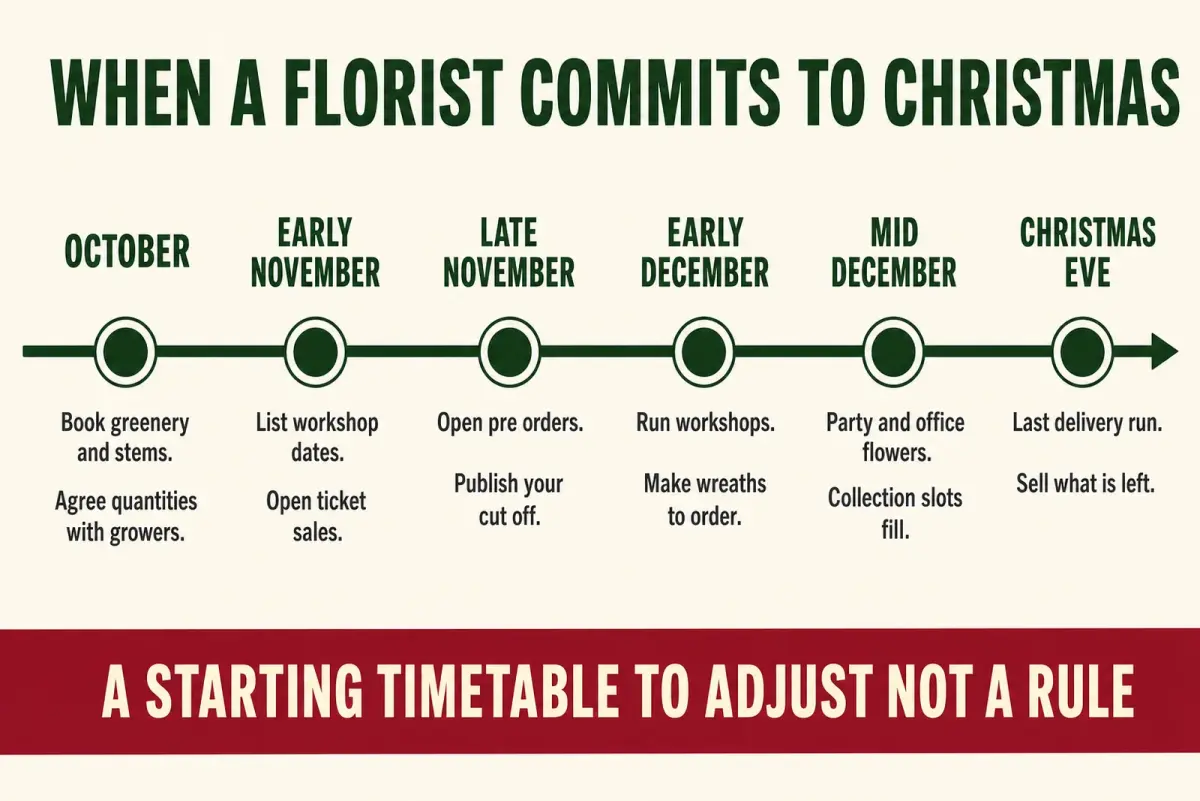
A starting timetable for the six points where a florist actually commits, from booking greenery in October to the last delivery run on Christmas Eve.
Six moments carry the season, and each closes quietly whether or not you act on it.
- October. Agree greenery and stem quantities with growers and wholesalers.
- The first week of November. List workshop dates and open ticket sales.
- The last week of November. Open pre orders and publish the cut off alongside them.
- The opening days of December. Run the workshops and start making to order.
- Mid way through December. Party and office flowers land, collection slots fill.
- Christmas Eve itself. Last delivery run, then sell down what is left.
Treat that as a starting timetable to adjust, not a proven minimum. Your own booking pattern is better evidence than anybody's calendar: if tickets sold out in four days the season before, move them earlier. LocalBrandHub includes a social media calendar and a library of ready made seasonal campaigns if you would rather not build the marketing side of that calendar from scratch.
The Sundays the big shops cannot use
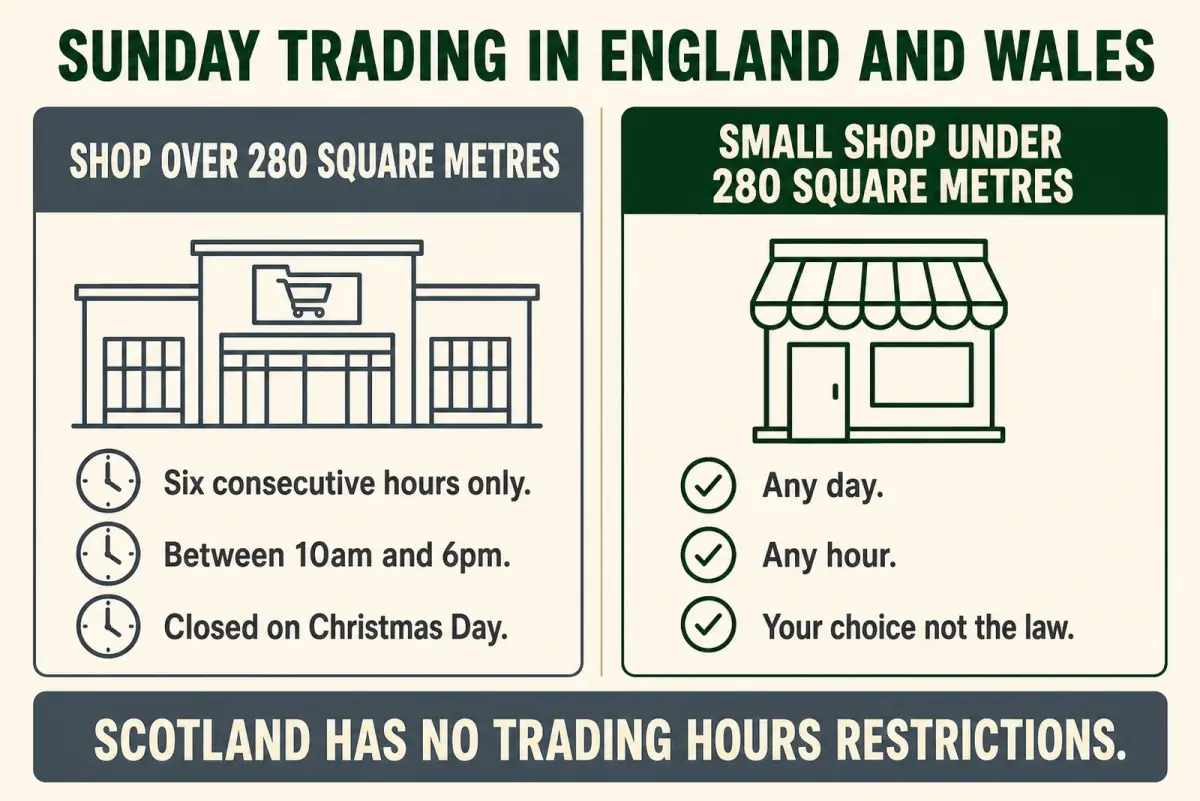
In England and Wales the Sunday hours limit and the Christmas Day closure apply to shops over 280 square metres, not to a small florist.
There are four Sundays in the run up to Christmas, and the rules governing them are not the same for everyone on your high street.
GOV.UK guidance on trading hours states that shops over 280 square metres in England and Wales can open on Sundays for only 6 consecutive hours between 10am and 6pm, and must close on Easter Sunday, and on Christmas Day. Small shops in England and Wales can open any day or hour, and there are no trading hours restrictions in Scotland.
The asymmetry, plainly: if your shop is under 280 square metres, the law caps their Sunday, not yours.
That entitles you to nothing except the option. Their closed door is not the same thing as demand at yours. Whether an extra hour on a December Sunday pays depends on your local demand and your wage bill. Open once, measure the takings against the wages, and decide. The useful part is knowing the option exists on a December Sunday evening in England or Wales, when the big shops must already be shut.
Pre orders, and the risk you are not carrying
Pre orders are the closest thing December has to a cheat code. They turn a guess about wreath demand into a list of names.
They also come with a legal position worth understanding. Regulation 28 of the Consumer Contracts (Information, Cancellation and Additional Charges) Regulations excludes two categories of goods from the Part 3 right to cancel. Those are goods made to the consumer's specifications or clearly personalised, and goods which are liable to deteriorate or expire rapidly.
Scope matters here: the exclusion is from the cancellation right, not from your other duties to the customer.
Fresh flowers and a wreath built to order sit comfortably in that description. What is excluded is the 14 day cancellation right and nothing else: your other obligations stand, and any goodwill policy you offer is your own commercial decision. Plenty of florists offer one anyway, because a reputation outlasts a wreath.
In practice you can ask for a deposit, publish a cut off date and hold collection slots with reasonable confidence. Put those terms in plain words on the order page, and if a particular contract worries you, speak to a qualified adviser rather than a blog post.
Four ways December goes wrong
- Waiting for December to feel urgent. By then you are buying whatever greenery is left.
- Selling more making hours than you own. Cap the numbers before a customer caps them for you.
- Old prices on new stock. Fifteen minutes with the invoices, once, in November.
- A cut off you never published. An open ended order book loads everything onto 23 December.
Frequently Asked Questions
How do florists make money at Christmas?
Across income streams that peak at different points in December: door wreaths, table centres, festive gift bouquets, office and party flowers, and paid wreath making workshops. The profitable ones share a trait. They were priced and scheduled before December started.
When should a florist start planning Christmas?
Order greenery in the autumn, put workshop dates on sale in early November, and open pre orders in late November with a published cut off. Treat that as a starting timetable to adjust against your own order book.
Are Christmas wreath workshops worth running?
They sell a fixed number of tickets at a known material cost on an evening you choose, which is why the honest comparison is against the same hours spent making to order. They are not free money, so cost the whole evening of prep, teaching and clearing up before pricing a ticket.
Can a florist open on Christmas Day?
GOV.UK guidance on trading hours says shops over 280 square metres in England and Wales must close on Christmas Day. They may open on Sundays for only 6 consecutive hours between 10am and 6pm, while small shops in England and Wales can open any day or hour. Scotland has no trading hours restrictions, and whether opening pays is a separate question about staffing and demand.
Do I have to let customers cancel a Christmas flower pre order?
The Consumer Contracts Regulations exclude goods made to the consumer's specifications or clearly personalised, and goods liable to deteriorate or expire rapidly, from the Part 3 right to cancel. That covers much of festive floristry. It removes the cancellation right and nothing else; any goodwill policy you offer is your own choice.
Why are supermarket Christmas flowers cheaper than mine?
A supermarket buys in volumes no independent shop can match and sells a pre wrapped range with no making time in it. You are not selling the same product: a wired door wreath and a table centre built to a room carry skilled labour, which a bucket by the checkout is not selling.
The Short Version
Key Takeaway
Christmas flower sales reward the florist who decided in October what December would look like.
- December runs out of you before it runs out of customers.
- A published cut off is a kindness to yourself.
- Price the wreath from the invoice in front of you, not the one from a year ago.
Weekly Action
- Work out your honest daily wreath capacity and cap the numbers
- Agree greenery and stem quantities with your suppliers
- List workshop dates and open ticket sales
- Rebuild festive prices from your current costs
- Open pre orders with a published cut off and collection slots
- Decide which December Sundays you will actually open
For restaurants, salons, and local businesses
Need help with your marketing?
We help UK businesses turn social media into real results, not busywork.
Start freeSources
Get More Marketing Tips
Practical marketing tips for UK business owners, straight to your inbox. No spam, unsubscribe anytime.
About the Author
Local Brand Hub
Empowering UK Businesses
Local Brand Hub provides comprehensive business management tools designed specifically for UK local businesses to streamline operations, automate marketing, and grow revenue.
More articlesRelated Articles
 Marketing Tips
Florist Pre Orders: Run One Round Without the Panic
Florist pre orders for UK flower shops: when to open the round, what the order page has to settle, how to date the cut off, and how to fill the list.
 Marketing Tips
Wedding Flower Consultation: The Florist's Question Sheet
How to run a wedding flower consultation that ends in a quotable list of pieces, with a copyable question sheet to send couples before you meet.
 Marketing Tips
Mothers Day Florist Marketing: A Countdown That Holds
Mothers day florist marketing run as a countdown: what to publish and when, what your order page must say before an order, and when to close orders.