
A seasonal flower calendar for UK florists: what is at its best each month, the trade date sitting in it, and the buying decision that month forces.
A seasonal flower calendar tells a florist what is at its best each month, which trade dates fall where, and what has to be decided before each one. Treat it as a buying and marketing schedule rather than a chart of British blooms, because most of what the UK buys each week was grown somewhere else.
Search for a seasonal flower calendar and you get charts written for whoever is buying the bouquet or filling the flower bed. Yours has to survive a Tuesday: the order form is open, the wholesaler's list is on the screen, and you have a few minutes to commit before the cut off.
That is a different document. A calendar that tells you what is blooming is a poster. A calendar that tells you what to decide, and by when, is a rota.
The florist year, month by month
The UK florist year has a repeating shape. The middle column below is what British growers and the market are typically strongest on. The right column is the part those charts leave out.
| Month | At its best | The decision this month forces |
|---|---|---|
| January | Anemones, hellebores, forced hyacinths, early narcissi | Commit Valentine's rose quantities and prices while the shop is quiet |
| February | Tulips, ranunculus, mimosa, forced blossom | Trade 14 February, then open Mother's Day pre orders the week after |
| March | Daffodils, hyacinths, muscari, early blossom | Staff and fulfil Mothering Sunday; book Easter stock around it |
| April | Ranunculus, tulips, lilac, cherry and pear blossom | Confirm summer wedding stems; photograph the sample bouquets |
| May | The first peonies, alliums, lily of the valley | Set your peony window and tell customers it is coming before it lands |
| June | Peonies at peak, garden roses, sweet peas, delphiniums | Protect the wedding book and hold your peony pricing |
| July | Dahlias starting, hydrangea, cosmos, phlox | Sort holiday cover and write the content August will need |
| August | Sunflowers, dahlias, zinnias, amaranthus, gladioli | Reprice from current invoices and book your autumn growers |
| September | Dahlias at peak, early chrysanthemums, berries, grasses | Pitch autumn and corporate contracts, put workshop tickets on sale |
| October | Chrysanthemums, antique hydrangea, rosehips, foliage | Book Christmas greenery and wreath rings before the rush |
| November | Amaryllis, anemones, berried ilex, evergreens | Run the workshops, close wreath orders, staff December properly |
| December | Paperwhites, hyacinths, spruce, eucalyptus, mistletoe | Publish the last order date; plan January while it is fresh |
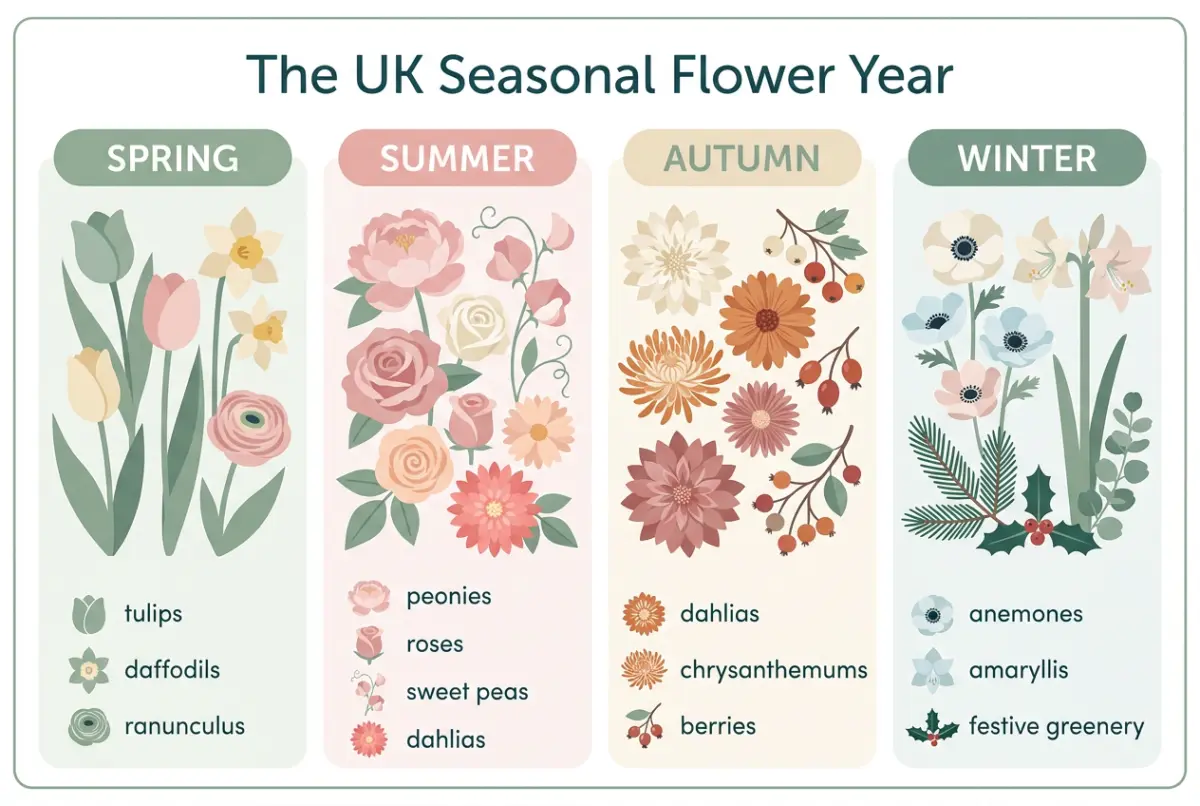
The florist year as a ring: what peaks when, and where the three big trading dates fall.
Read the right column first. Every month on that list is quietly asking you for one commitment, and the ones you skip all come due in the same fortnight in December.
Why every printed flower calendar drifts
A calendar of British seasonality is a forecast, and the forecast has been moving. Analysis of UK first flowering records found that community wide first flowering advanced by almost one month on average when comparing observations before and after 1986 (Proceedings of the Royal Society B).
That record measures when plants across the UK first flower, not when a Lincolnshire grower cuts and grades a crop, so it does not tell you your tulips will land four weeks early. What it does tell you is that any fixed chart of British availability describes a year which no longer sits still. The correction is not a better chart, it is the grower actually cutting the stems.
One question, once a season: ask your two best growers whether they are running early or late. It beats a printed chart, because it describes the crop you will actually be buying rather than a national average.
So use the calendar for sequence, not for dates. Sequence barely changes: narcissi before tulips, tulips before peonies, peonies before dahlias, dahlias before chrysanthemums. Only the windows on either side move, and a phone call the month before closes them.
Most of what you sell was not grown here
The other reason a British bloom chart cannot be your buying calendar is arithmetic. A report published by the NFU in 2016, Backing British Blooms, put homegrown flowers at around 12% of those sold in the UK. Defra put the value of UK flower and bulb production at an estimated £175 million in 2024, a 3.1% decrease on the year before. The first is the share; the second is the size of the British crop behind it, and it shrank that year.
Unless you have deliberately built the shop around British growers, British seasonality is real, worth selling, and a minority of what goes through your buckets.
Run two layers. Imported supply is available almost year round and moves on price and freight: dependable, unremarkable. British stems are narrow and genuinely scarce, which is what makes them worth naming and pricing on their own terms.
Label the British stems and nothing else. A named grower and a cutting day is a specific a customer can picture. "Fresh flowers" is not.
Treat them as one calendar and you do neither well: you promise British stems you cannot reliably get, or you never mention the six weeks when your sweet peas are the best thing in town.
Work the calendar backwards from the date
Every peak date sits at the end of a short chain of decisions, and it is the chain that belongs in the diary. Write down only the date and you have recorded the day you run out of options.
Peak dates rarely hurt because of volume. They hurt because every decision lands in the week you have least room.
Publish the cut off early. A cut off nobody can see only works against you: it becomes the reason you say no on the day, not the reason to order early.
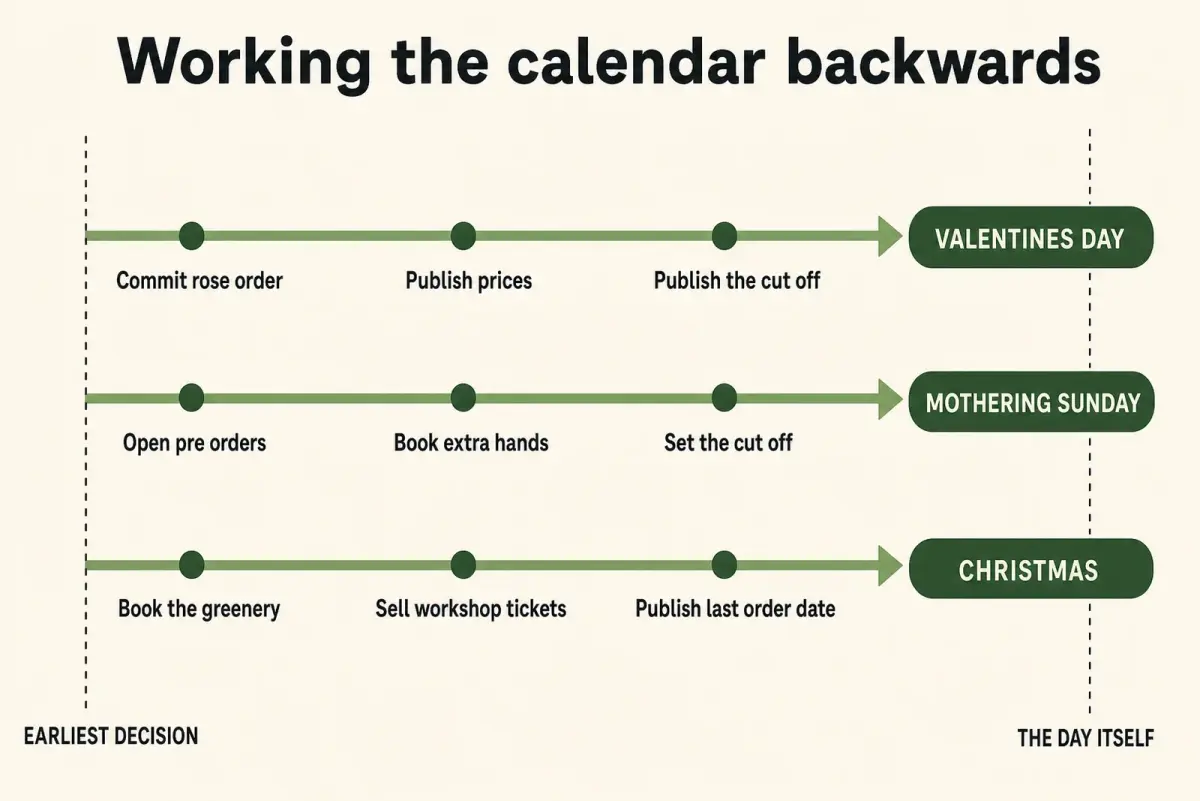
Each peak date is the end of a chain: commit stock, publish prices, then set the cut off.
Imagine a two person shop planning Mothering Sunday. Working backwards, they open pre orders three weekends out, book a freelance florist two weekends out, and publish a Thursday cut off in the final week. That shop is invented and the gaps are yours to tune, but the shape is the point: three decisions, three dates, all earlier than felt necessary.
Do that for the three peaks and the rest of the year mostly runs itself. Each has its own guide: Valentine's Day, Mother's Day and Christmas. For the mechanics, florist pre orders covers cut offs and deposits.
Turn the calendar into next month's marketing
The calendar that governs your buying will write most of your posting schedule, because the two answer the same question a month apart.
Take next month's row. The middle column is your subject: the flower arriving, photographed at its best, teased a fortnight before it lands and sold hard the week it does.
What sits in the right column is your timing: pre orders open, cut off published, tickets on sale. A month of content, decided from a table you built once. LocalBrandHub is built for exactly that habit, with a social calendar you can schedule from and a library of ready made seasonal campaigns for the UK dates already in it. Pricing the season is a separate discipline, and florist pricing is where that starts.
Frequently asked questions
What flowers are in season in the UK each month?
Broadly: anemones and hellebores in January, tulips and mimosa in February, daffodils and hyacinths in March, blossom and ranunculus in April, the first peonies in May, roses and sweet peas in June, dahlias and hydrangea in July, sunflowers and zinnias in August, dahlias at their peak in September, chrysanthemums and berries in October, amaryllis and berried ilex in November, and spruce and paperwhites in December. Those are typical British windows, and they move with the weather.
How much of what a UK florist sells is British grown?
The NFU's Backing British Blooms report, published a decade ago, put homegrown flowers at around 12% of those sold in the UK. That share is why a florist's seasonal calendar has to cover imported supply as well as British seasonality. The British season is the part you can build a story and a premium around, not the part that fills every bucket.
Do seasonal flower calendars still work now the weather is less predictable?
They work as an order of events rather than as a set of dates. Analysis of UK first flowering records found community wide first flowering advanced by almost one month on average when comparing observations before and after 1986. That record covers first flowering across UK plant species rather than commercial cropping, so treat it as a reason to ring your growers each season instead of a number to plan against.
How far ahead should a florist commit to a peak date order?
Work backwards from the date and put the decisions in the diary rather than the deadline. A workable starting point is to commit peak stem quantities several weeks out, publish prices once those costs are known, and set a public cut off before the making week begins. Adjust every gap against your own order book after the first year, because a shop with a large wedding book needs longer than one trading mostly on the day.
Which dates in the florist year move?
Valentine's Day is fixed at 14 February and Christmas is fixed. Mothering Sunday falls on the fourth Sunday of Lent, so it lands anywhere from early March to early April, and Easter moves with it. Check both when you build next year's calendar, because a Mothering Sunday at the early end arrives while your tulips are still short and your ordering window is a fortnight tighter.
Key takeaways
Key Takeaway
A seasonal flower calendar is only worth building if it tells you what to decide, not just what is blooming.
- Put a decision in every month. The middle column sells; the right column is what stops December hurting.
- Trust the order, check the dates. Narcissi before tulips before peonies is stable. The windows are not.
- Ring two growers a season. Early or late in your postcode is the only version of the calendar you are buying from.
- Run two layers. Imported supply keeps the shop stocked; the British season is what you name and charge for.
- Work backwards from the peaks. Commit stock, publish prices, set the cut off, in that order and earlier than feels necessary.
For restaurants, salons, and local businesses
Need help with your marketing?
We help UK businesses turn social media into real results, not busywork.
Start freeSources
Get More Marketing Tips
Practical marketing tips for UK business owners, straight to your inbox. No spam, unsubscribe anytime.
About the Author
Local Brand Hub
Empowering UK Businesses
Local Brand Hub provides comprehensive business management tools designed specifically for UK local businesses to streamline operations, automate marketing, and grow revenue.
More articlesRelated Articles
 Marketing Tips
Florist Seasonal Marketing: How to Win the Peak Days
Florist seasonal marketing for UK flower shops: which peak dates move and why, when to open pre-orders, and how to set peak promotion in the quiet week.
 Business Growth
How Florists Compete with Bloom and Wild (and Interflora)
How florists compete with Bloom and Wild starts by reading its delivery pages. What the post cannot carry, where Interflora fits, the result you can win.
 Business Growth
Florist Marketing Plan: A Simple Template for UK Shops
A florist marketing plan you'll actually use: a simple UK template and seasonal calendar to plan your flower shop's marketing around the peaks.