Florist marketing for UK flower shops: the three inputs Google says local results rest on, which tasks feed them, and why peak days start weeks early.
It is half past seven on a Tuesday and you are conditioning forty stems of tulips before the shop is even warm. Somewhere in the same postcode, someone is opening Google to find a florist for Thursday. Florist marketing is the work of being the shop they find, and then the shop they choose.
That second job is the one that falls off the bench. The craft never does: nobody who can wire a funeral tribute before opening has a talent problem. They have a visibility problem, and the maddening part is that it is solvable in the gaps between deliveries, once you know which gaps to spend.
What You'll Learn
- The three inputs local search results are built on, in Google's own words
- Which everyday tasks feed those inputs, and which quietly feed none
- Why a national brand struggles to compete on the input you already own
- How to schedule peak day work so it is finished before the peak
- What to stop doing, and the half hour that replaces it
What is florist marketing, actually?
Florist marketing is everything that moves a local buyer from "I need flowers" to your bench instead of a courier's warehouse. The part of that journey you can influence happens in search, and search is unusually honest about what it wants. Florist local SEO covers the mechanics; this is the layer above, deciding what to do first.
Google publishes the criteria. Its Business Profile help documentation sets local results out under three headings: relevance, distance and prominence. Three inputs, not an algorithm to reverse engineer over a bucket of chrysanthemums. In the language of a shop rather than a search engine, that list asks three questions about you:
- Relevance: does your profile actually say the thing they typed?
- Distance: are you near them, and does Google know it?
- Prominence: does the rest of the web behave as though you exist?
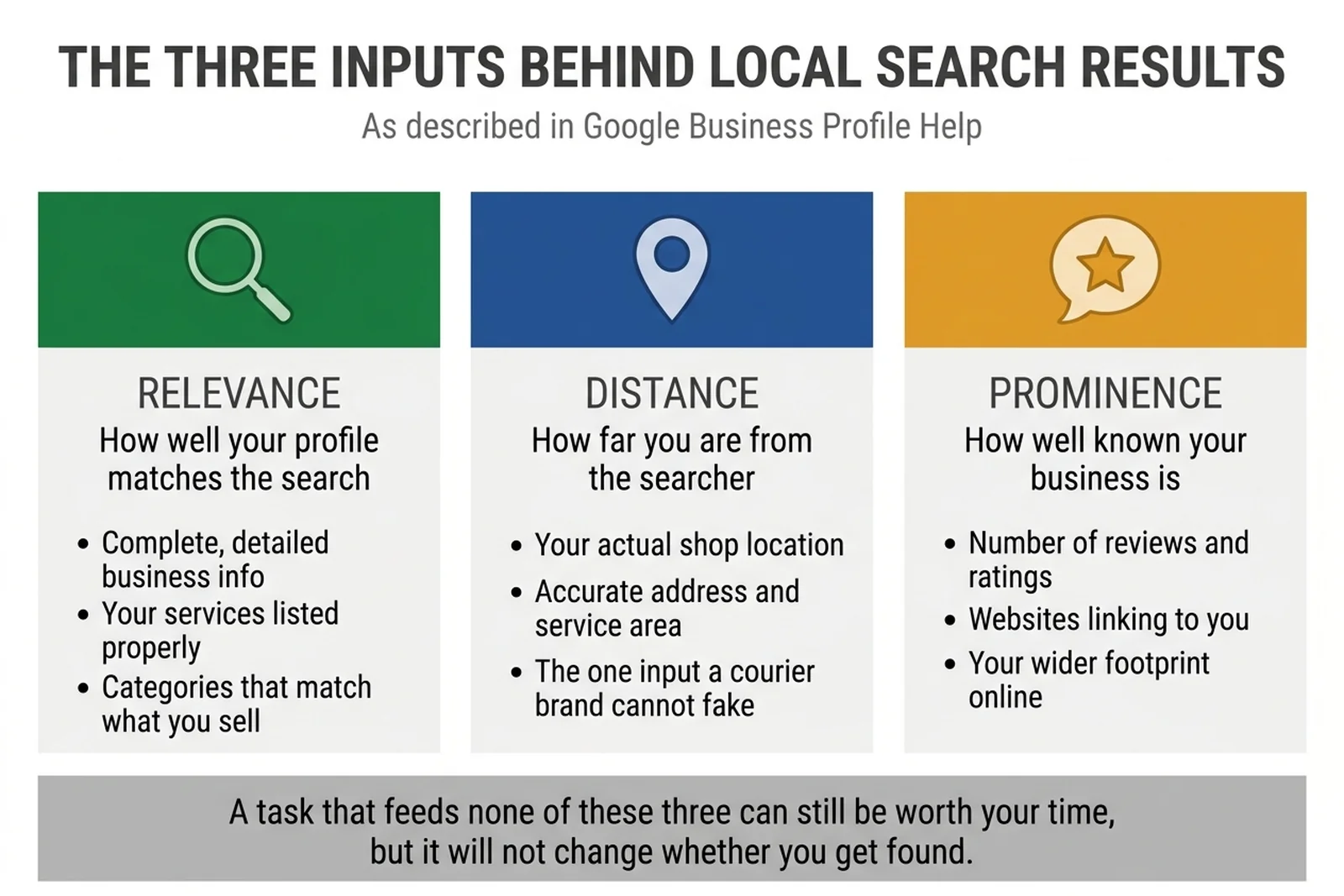
Relevance, distance and prominence: the three inputs Google's own documentation names, and what each one is fed by.
That list is the spine of everything below. A task that feeds none of the three can still be worth your time, because some of it sells beautifully, but it will not change whether you get found. Telling those two apart is most of the job.
Why the chains cannot follow you home
Bloom & Wild and Interflora are fighting a national war over the words "flower delivery". You never have to win it. You have to win the half mile around your own door, and one of the three inputs is on your side before you do anything.
Google defines distance as how far each business is from the customer who is searching, and says that when a customer does not share their location, it uses what it knows about where they are. Distance is not a lever you pull harder. It is a slot you either occupy or you do not. A brand shipping boxes from a distribution shed has nothing to put in it for a searcher two streets from your shop.
You cannot outspend a national brand. You can be nearer than one, and nearness is on the list.
One honest caveat, because it changes who you are up against. Interflora works largely through local member florists, so the shop above you in the map results is often another bench and another van, not an app. A fairer fight, and a closer one. How florists compete with Bloom and Wild goes further into it.
Which leads somewhere dull and important: distance only counts if Google knows exactly where you are. The input nobody can take off you quietly stops working when:
- the address is mangled, so the pin lands down the road
- the delivery area was never set, so nobody knows how far you go
- the hours are left over from two Christmases ago, so you read as shut
Picture two shops a mile apart, equally good. One has an address Google can pin and hours it trusts. The other moved premises in March and never said so. On a wet Thursday, only one of them is nearby.
What are some effective marketing ideas for florists?
The effective ones feed a documented input. If you are reading this at eleven at night with the van still to unload, the reality is that only one of them needs an uninterrupted hour. Here is the whole shortlist, sorted by that test rather than by how impressive it sounds.
| What you do | Input it feeds | Roughly what it costs you |
|---|---|---|
| Complete every Google profile field | Relevance | An hour, once |
| Keep address, hours and radius exact | Distance | Twenty minutes, then vigilance |
| Ask for a review after a good order | Prominence | Half a minute each |
| Name your town in titles and headings | Relevance | An afternoon |
| Get listed by venues and suppliers | Prominence | Three emails |
| Post your real work on social | None Google documents | Minutes, twice weekly |
That last row is the one people argue with, so let me be precise. Google says prominence is based on information such as how many websites link to your business and how many reviews you have, and that more reviews and positive ratings can help your local ranking. It does not say your Instagram grid does.
That is not an argument for abandoning social media, because photographs of your work sell flowers and win weddings. It is an argument for not filing it under SEO, and for not being surprised when a year of daily posting leaves your map position where it was. Social media for florists treats it as a shop window rather than a ranking lever.
Why this matters: it is easy to feel you are "doing marketing" while doing the row Google does not count and none of the rows it does. If you have ever finished a busy week feeling productive and invisible at once, that gap is the reason.
The searches you cannot see
Ofcom measured Google reaching 83% of UK online adults in May 2024, down from 86% a year earlier. That is reach of a search engine, not demand for flowers.
So it does not tell you your town is out hunting for bouquets. It tells you the front door is not in question. Whether people search is settled. Who they find when they do is the entire game.
They are also not all searching for the same thing. "Florist near me" is the query everyone optimises for, and only the loudest. In a single week your town also produces:
- "funeral flowers" plus your town name, from someone with a date they cannot move
- "wedding florist" plus your county, from someone with eleven months to plan
- "flowers delivered" typed at ten to four, with a card still to write
Three customers, three urgencies, and a page called Flowers answers none of them well. Give each errand its own page. Your florist website is where they live.
Peak days are won in the quiet weeks
Your year is not a flat line. It is a handful of enormous dated spikes with long stretches between them, which makes florist marketing a scheduling problem as much as a creative one.
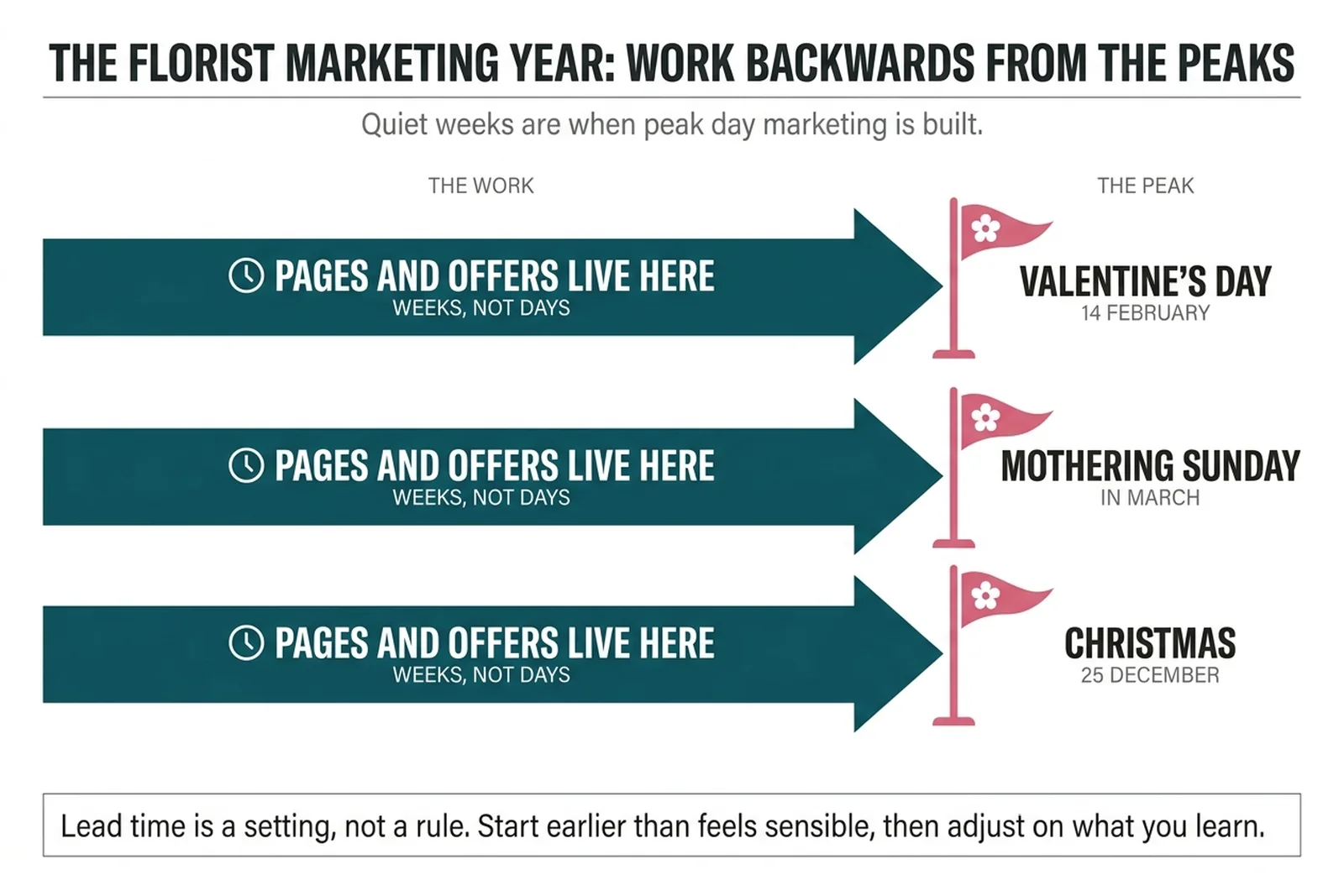
The peaks are fixed. The only variable you control is how far ahead of them you do the work.
Britweb, the digital agency that works with The Brighton Flower Company in Brighton and Hove, says it published search optimised Valentine's Day content ahead of the day so the pages would already be ranking when demand arrived, and reports online sales up 52% year on year for that period.
Take that for exactly what it is: one agency's account of one client, no control group, an obvious interest in the result. What travels is not the number. It is the sequencing. A page that must earn traffic on 14/02/2026 has to exist, and be findable, well before it.
How far ahead? Far enough that the page has been crawled and settled before demand arrives, which is weeks rather than days. Any figure you read, here or anywhere, is a starting setting to adjust after one season, not a minimum that works.
Imagine a shop that puts its Mother's Day page up in the third week of February, opens pre orders on it, then emails the list twice: when it goes live, and before the cut off. Nothing about it is clever. It simply happens while there is still time to work.
A list you own is the audience least exposed to someone else's algorithm, and peak days are what it is for. If you have never built one, start today with a notebook by the till: email marketing for florists covers the rest.
What to leave alone
Half of good marketing is refusing work. These four eat a florist's Tuesday and give back least.
- Counting followers. A follower is not a customer and a save is not a delivery booked. If a post cannot be traced to an order, an enquiry or a name on your list, it is a nice photograph.
- Posting daily because someone said the algorithm rewards volume. Nobody outside the platform can see the current rules, and a cadence you cannot hold through wedding season is worse than a slower one you can.
- Paying for ads before the free inputs are finished. Ads rent attention. A complete profile and a steady flow of reviews keep it.
- Chasing national keywords. "Flower delivery UK" is a budget contest you cannot enter. Your town plus your product has a handful of entrants.
The cheapest prominence you will ever buy happens here, in the ten seconds after the bouquet leaves your hands.
Ask yourself the question that diagnoses the problem: if a neighbour needed flowers this afternoon, would they find you before a chain? Search it now, from the shop, on your own phone. A florist marketing plan is really just what you do about the answer.
Frequently Asked Questions
What is the 3-5-8 rule for florists?
The 3-5-8 rule is a floral design convention, not a marketing one. It describes grouping stems and focal points in odd numbers, on the reasoning that asymmetric groupings read as more natural than even ones. It says nothing about how anyone finds your shop.
How do florists compete with Bloom and Wild and Interflora?
Locally, on the input a courier brand struggles to buy: it has no shop near the searcher, so distance tends to work for you. Complete your Google Business Profile, keep your address and hours exact, gather reviews and name your town everywhere. Our guide to competing with the chains has the longer version.
How profitable is a florist business?
It varies with your mix: weddings, sympathy work, corporate contracts and walk in trade carry very different margins and very different demands on your time. Rather than quote a number that will not be yours, work it out using florist profit margins.
Is a florist a good side hustle?
It can start as one, particularly from home with a small occasion and wedding list. What it is not is passive: the flowers wilt whether or not you are busy elsewhere. Starting a florist business from home has the honest version.
How much should a florist spend on marketing?
Spend time before money. The highest return work here costs nothing but attention: your profile, your accuracy, your reviews, your own photographs. When you do spend, spend on the peaks rather than thinly across a quiet year.
How do I attract people to buy flowers when nobody has a birthday?
Give them a reason that is not an occasion. Post the flowers that arrived this morning rather than a generic bouquet, name the price, and make buying a two tap job. Non occasion trade is a habit, not a campaign you run once.
Your Next Step
Pick one input and finish it this week. For most florists that is prominence, because reviews move fastest and Google says outright they can help.
Weekly Action
- Ask two customers who were pleased with an order to leave a review
- Check your opening hours and delivery area are still correct
- Add one photograph of this week's real work to your profile and your feed
- Add any new customer emails to your list
- Search your main term from your phone at the shop and note who sits above you
If you only have half an hour a week, spend it on reviews and accuracy. That is the half hour that decides whether you appear at all.
Keeping that habit alive through a wedding install is the hard part. That is what LocalBrandHub is built for: a social calendar you fill in advance, ready made seasonal campaigns for the peaks, and your Google rating and review count on the same screen. Its visibility score tells you in one number how easy you are to find nearby.
Key Takeaways: Florist Marketing
Key Takeaway
- Local results rest on three inputs. Relevance, distance and prominence. Sort every task by which it feeds.
- Distance is yours by default, but only while your address, hours and service area are exact.
- Reviews are the fastest input to move, and Google names them outright as something that can help.
- Social media sells; it does not rank. Do it for the shop window, not the map pack.
- Build peak day pages in the quiet weeks. No page earns traffic on the date it was published.
For restaurants, salons, and local businesses
Need help with your marketing?
We help UK businesses turn social media into real results, not busywork.
Start freeSources
Get More Marketing Tips
Practical marketing tips for UK business owners, straight to your inbox. No spam, unsubscribe anytime.
About the Author
Local Brand Hub
Empowering UK Businesses
Local Brand Hub provides comprehensive business management tools designed specifically for UK local businesses to streamline operations, automate marketing, and grow revenue.
More articlesRelated Articles
 Business Growth
How Florists Compete with Bloom and Wild (and Interflora)
How florists compete with Bloom and Wild starts by reading its delivery pages. What the post cannot carry, where Interflora fits, the result you can win.
 Business Growth
Florist Marketing Plan: A Simple Template for UK Shops
A florist marketing plan you'll actually use: a simple UK template and seasonal calendar to plan your flower shop's marketing around the peaks.
 Industry Insights
Seasonal Flower Calendar: The UK Florist's Buying Year
A seasonal flower calendar for UK florists: what is at its best each month, the trade date sitting in it, and the buying decision that month forces.