
A florist marketing plan you'll actually use: a simple UK template and seasonal calendar to plan your flower shop's marketing around the peaks.
A florist marketing plan is a simple, one-page guide to what you'll promote, where, and when, built around the peak days that drive a flower shop's year. It isn't a 40-page document; it's a calendar and a handful of decisions that stop your marketing being whatever you remembered to post that week.
You keep meaning to "get on top of marketing" and then Valentine's arrives and you're improvising again. Sound familiar? The reality for most florists is that they don't need a bigger marketing effort. They need a small plan so the effort they do make lands at the right time. 8 min read.
What You'll Learn
- Why florists need a plan (and why it can be one page)
- A simple florist marketing plan template
- The seasonal calendar every UK florist should map
- How to turn the plan into a 30-minute weekly habit
- The planning mistakes that leave florists improvising
Related: Florist Marketing: A UK Guide
Why One Page Is Enough
First, forget the corporate marketing plan. A florist doesn't need market-analysis chapters; you need to know what you're promoting, to whom, and when. One page beats a document you'll never reopen.
The whole point is to plan around the peaks so you're never improvising in the busiest weeks. For example, a florist who sketched a single-page plan in 1 afternoon stopped scrambling before every occasion and started preparing 3 to 4 weeks ahead, same shop, far less stress. Just 2 peaks, Valentine's and Mother's Day, can drive a large share of the year, so getting those right matters more than any clever tactic.
Rule of thumb only: if your marketing plan doesn't fit on one page, it's too complicated to survive a busy florist's week.
Your One-Page Marketing Plan Template
Next, here's the template. Answer these and you have a working plan.
- Goal: e.g. more local orders, more weddings, more repeat customers.
- Customers: which buyers (occasion, sympathy, wedding, corporate, regulars)?
- Channels: your top two or three (local SEO, social, email).
- Message: your edge: same-day, local, hand-tied, fresh.
- Calendar: the peak days and when to start each.
- Check: how you'll know it worked (orders, enquiries, reviews).
For example, a florist whose goal was "more weddings" chose Instagram and local SEO as channels, "bespoke local wedding florist" as her message, and set 3 reminders a year to post wedding work every January when couples start planning. Five short answers and a calendar: that's the whole plan.
Related: Email Marketing for Florists
Map Your Seasonal Calendar
Now that you have the structure, the calendar is the heart of it. A UK florist's year has a clear rhythm, and planning around it is most of the battle.
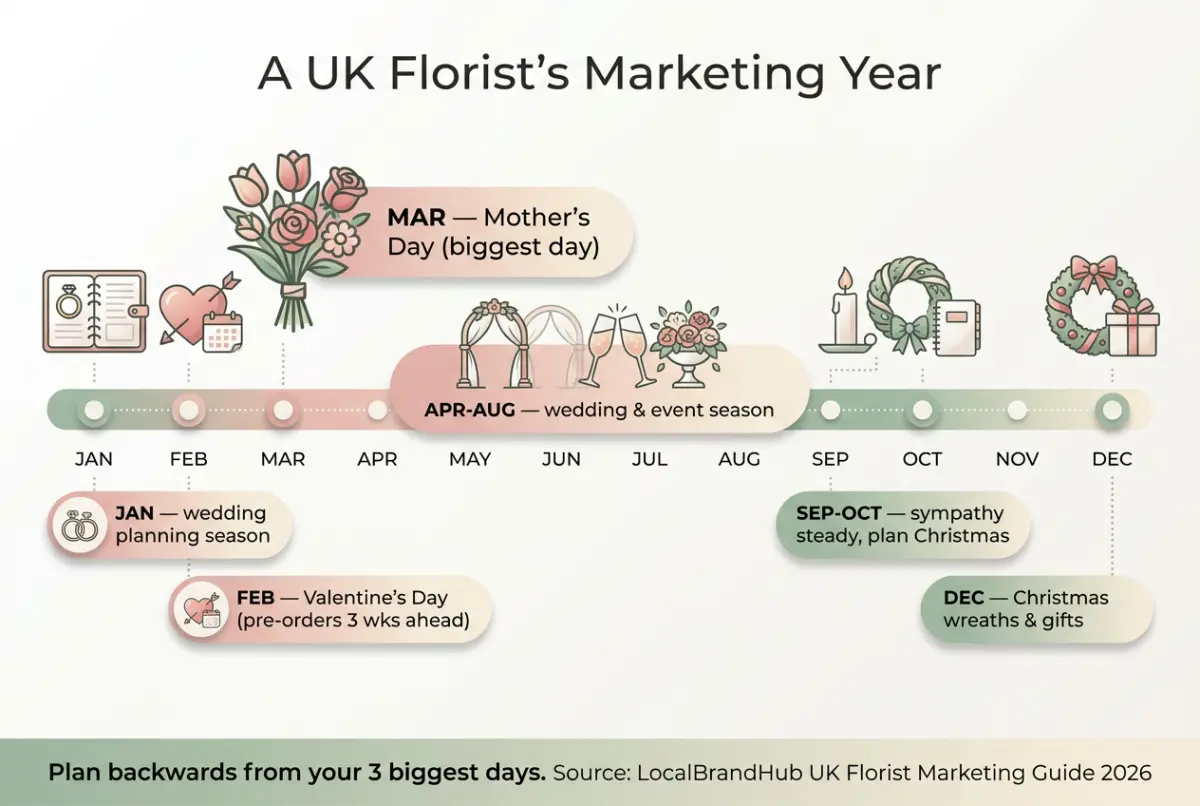
- January: wedding planning season begins; post wedding work.
- February: Valentine's Day; pre-orders open 3 weeks ahead.
- March: Mother's Day; the florist's biggest day.
- Spring to summer: weddings and events in full swing.
- Autumn: sympathy steady; plan Christmas.
- December: Christmas wreaths, gifts and parties.
If you can't tell where to focus, mark the 3 biggest days for your shop and plan backwards from each, starting roughly 3 weeks out. For example, a florist who marked just her top 3 dates and set a reminder 21 days before each never missed a pre-order window again. That's usually a sign of where your effort belongs. To save building each peak from scratch, you can start from a library of ready-made seasonal campaigns.
Why this matters: Valentine's and Mother's Day alone can be a huge share of a florist's annual takings. Planning them weeks ahead, not days, is the difference between a calm, sold-out peak and a frantic one.
Turn the Plan Into a Weekly Habit
However, a plan in a drawer does nothing. The trick is shrinking it to a 30-minute weekly check that keeps you ahead.
Each week, glance at the calendar, see what's coming, and do the one or two actions it calls for: open pre-orders, post the seasonal range, email the list. For example, a florist who spent 20 minutes every Monday lining up the week's marketing never got caught out by a peak again: that's under 18 hours across a whole year to stay permanently ahead. Small and steady beats big and sporadic.
Florist Marketing Planning Mistakes
Knowing what to skip keeps the plan alive. The biggest mistake is making it so elaborate you abandon it by February.
- Over-planning. If you're only writing a perfect 40-page plan you'll always lose to the florist with a scrappy one-pager she actually follows.
- Ignoring the peaks. Missing the Mother's Day run-up is missing the year.
- No review. A plan you never check can't improve.
- Planning channels you'll never feed. Pick two, not five.
The question isn't how detailed your plan is. It's whether it's simple enough that you'll actually use it.
Frequently Asked Questions
What should a florist marketing plan include?
A goal, your target customers, your top two or three channels, your core message (same-day, local, bespoke), a seasonal calendar of peak days, and how you'll measure results. Keep it to one page so it survives a busy week.
What are the steps of a simple marketing plan?
Set a goal, pick your customers, choose your channels, define your message, map your calendar of peak days, then review results. For a florist, the calendar step (planning around Valentine's, Mother's Day and Christmas) matters most.
How do florists plan around Valentine's and Mother's Day?
Work backwards. These peaks drive a huge share of the year, so open pre-orders and start promotions about three weeks ahead via email, social and ads. Mapping them on a one-page calendar stops you improvising in the busiest weeks.
Does a small florist really need a marketing plan?
Yes, but a simple one. It's not about doing more marketing; it's about making sure the marketing you do lands at the right time. For example, just 30 minutes a week against a one-page plan is enough to keep a florist permanently ahead of the peaks. A one-page plan turns scattered effort into a calm, seasonal rhythm.
Your Next Step
A florist marketing plan only works if it's simple enough to revisit every week.
Weekly Action
Work this planning checklist into your week:
- Glance at your calendar for what's coming next
- Do the one or two marketing actions this week calls for
- Check if any peak day is 3 to 4 weeks away (start prepping)
- Note what worked last week and what didn't
- Keep the plan to one page
If you only have 30 minutes a week, do this: sketch your three biggest peak days and one action to prepare the nearest one. That's enough to start: the one-page plan grows from there.
Ask yourself: do you know what you're promoting three weeks from now? If not, that's where the work starts. Running this kind of always-ahead marketing calendar (so no peak catches you out) is exactly what LocalBrandHub handles for independent florists.
If you run a florist and want to see how Local Brand Hub can support your marketing, explore our florist marketing tools.
For restaurants, salons, and local businesses
Need help with your marketing?
We help UK businesses turn social media into real results, not busywork.
Start freeKey Takeaway
Key Takeaways: Florist Marketing Plan
A florist marketing plan should be one page, peak-focused, and simple enough to actually follow.
- One page beats a document you'll never reopen.
- Use the template: goal, customers, channels, message, calendar, check.
- Map your seasonal calendar around Valentine's, Mother's Day and Christmas.
- Shrink it to a weekly habit: 30 minutes keeps you ahead.
- Keep it simple so it survives a busy florist's week.
Get More Marketing Tips
Practical marketing tips for UK business owners, straight to your inbox. No spam, unsubscribe anytime.
About the Author
Local Brand Hub
Empowering UK Businesses
Local Brand Hub provides comprehensive business management tools designed specifically for UK local businesses to streamline operations, automate marketing, and grow revenue.
More articlesRelated Articles
 Business Growth
How Florists Compete with Bloom and Wild (and Interflora)
How florists compete with Bloom and Wild starts by reading its delivery pages. What the post cannot carry, where Interflora fits, the result you can win.
 Business Growth
Florist Marketing: How to Out-Local the Flower Chains
Florist marketing for UK flower shops: the three inputs Google says local results rest on, which tasks feed them, and why peak days start weeks early.
 Industry Insights
Seasonal Flower Calendar: The UK Florist's Buying Year
A seasonal flower calendar for UK florists: what is at its best each month, the trade date sitting in it, and the buying decision that month forces.