
Florist seasonal marketing for UK flower shops: which peak dates move and why, when to open pre-orders, and how to set peak promotion in the quiet week.
Florist seasonal marketing means working backwards from a few dated occasions, and not all of them keep to the same date. Valentine's Day sits still. Mothering Sunday is dated from Easter, so it lands in a different week each year. Build the calendar, then set a promote by date and a pre-order cut off against every dated line.
Every spring the same shop tells the same story. Valentine's went fine, then Mother's Day arrived out of nowhere. It did not. It arrived exactly where the church calendar had put it, a different week from the one before.
"Plan early" is not advice, it is a mood. Early is a date, and for the one occasion in the year that refuses to stay put, that date was not the same one twelve months ago.
Why last year's diary will not do for the year ahead
Two of your three biggest occasions are fixed and the third is not. Mothering Sunday is pinned to Easter rather than to a date in March, which is why it lands in a different week every year and last spring's plan cannot be repeated.
Common Worship, the calendar the Church of England publishes for its own year, dates Mothering Sunday as the fourth Sunday of Lent. Easter moves, Lent moves with it, and so does the Sunday your whole spring is built around. Whatever week you were flat out last March is not the week you will be flat out next.
Christmas and Valentine's Day do sit still, and they still move in the way that costs money: the day of the week. The same date is two different shops.
- On a Saturday it is an afternoon of leisurely collections
- On a Tuesday it is a delivery run against office hours, some of your casual help stuck at their day jobs
Why this matters: the first job of the florist year is not a campaign, it is a lookup. Find the moveable dates, write them down, and only then plan anything against them.
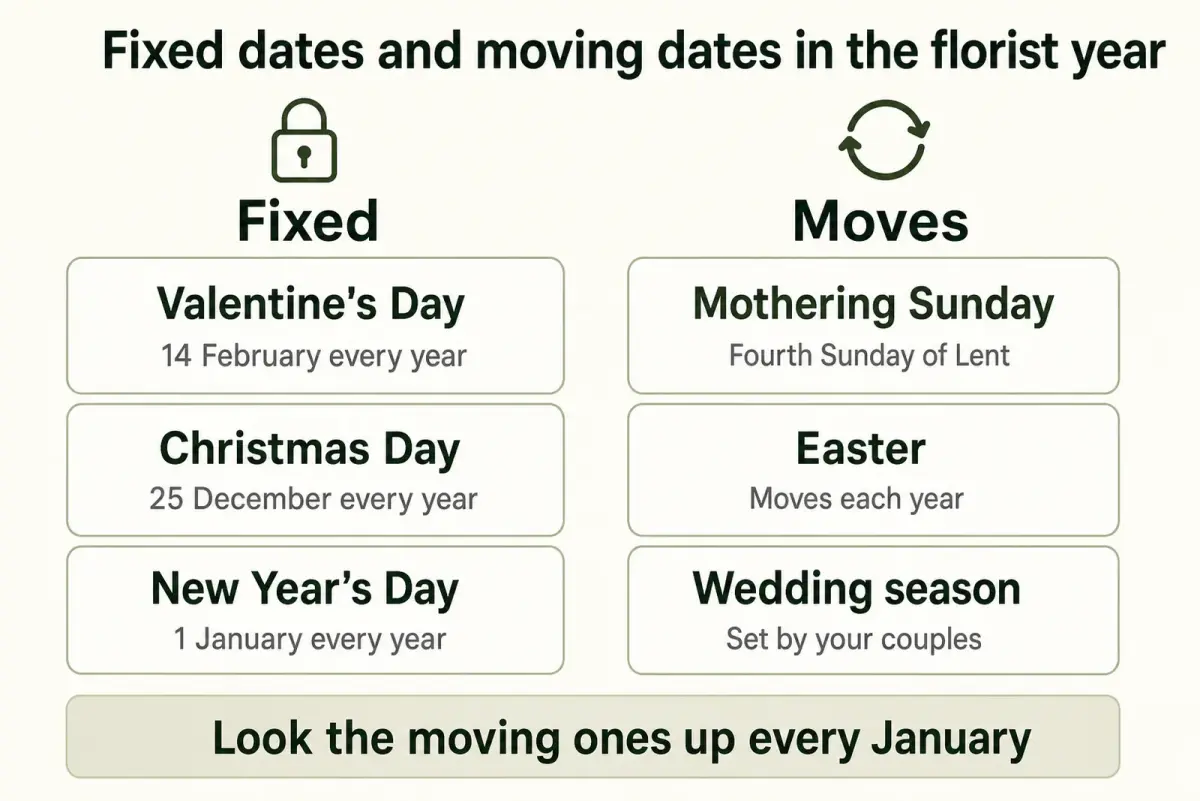
Fixed dates you can print once. Moving dates you look up every single year.
What does a florist marketing calendar actually look like?
A florist marketing calendar is three columns, not twelve boxes: the occasion, the date you start promoting it, and the date you stop taking orders. The third is the one shops skip, and the one that decides whether the day is calm or chaotic.
| Month | What is in it | The date you set |
|---|---|---|
| January | Valentine's build up, quiet bench | Pre-order opening date |
| February | Valentine's Day, fixed on 14 February | Wholesale and delivery cut off |
| March or April | Mothering Sunday, then Easter | Look it up, then count backwards |
| Late spring | Wedding consultations, proms, leavers | Consultation slots, not a campaign |
| Summer | Weddings, anniversaries, thank yous | Your own holiday cover |
| September | Term starts, autumn stock turns over | Wreath workshop dates |
| November | Remembrance, Christmas promotion | Christmas order cut off |
| December | Christmas, festive tables, New Year | Delivery cut off, closing days |
| All year | Sympathy work, funerals, birthdays | None. It rarely waits for a campaign |
Work each row backwards from its date, not forwards from where you stand.
- The occasion is fixed by the calendar or by the church
- The cut off is fixed by how much you can physically make
- The promote by date is the only one you choose, and the only one worth arguing about
A cadence you read online is somebody else's shop. Three weekends ahead is a reasonable place to start and a poor place to stop, so adjust it rather than treating it as a minimum that works. The empty rows earn their place too: a January with nothing in it is where February gets built.
The detail for each occasion lives elsewhere: Valentine's Day, Mother's Day and Christmas each need their own run up.
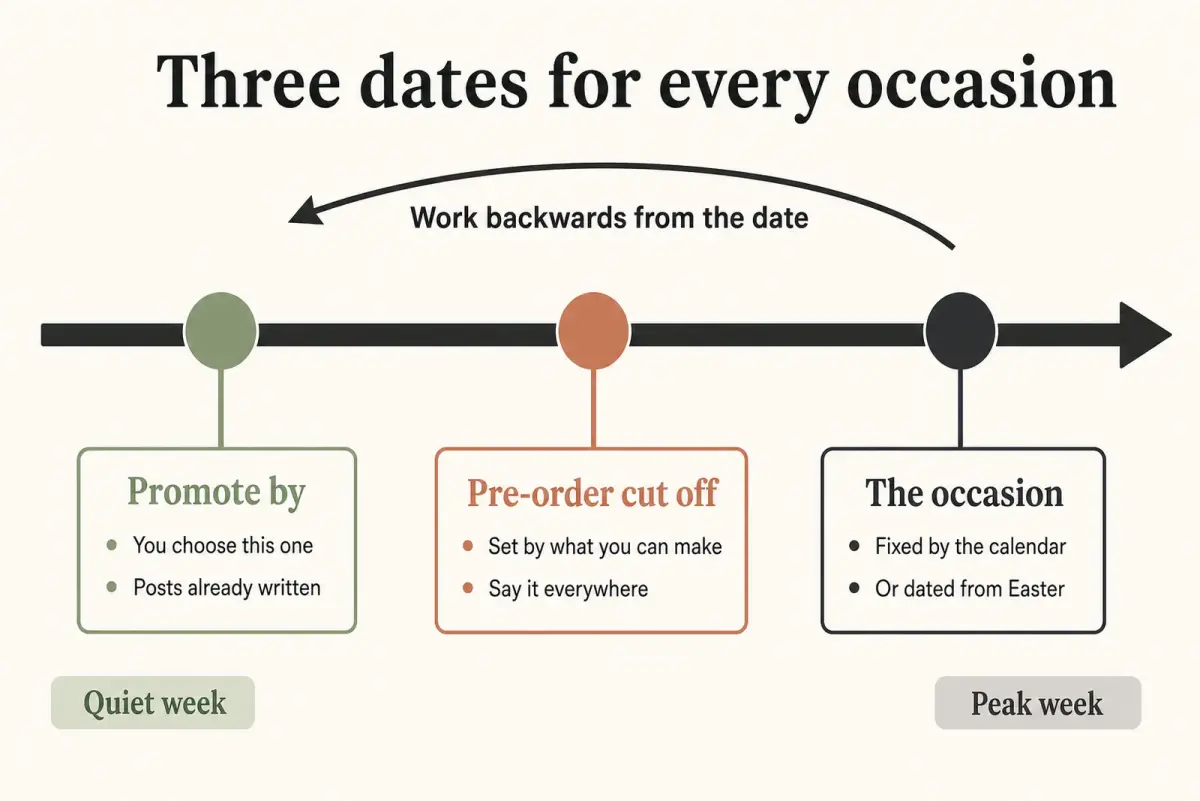
Every occasion carries three dates. Only the first of them is yours to choose.
When should you open pre-orders, and what are you promising?
Open them once you know the date and can commit to a cut off you could staff on the worst possible day. A pre-order is not a marketing gesture. It is a contract for perishable goods on a fixed date, and the law treats those differently.
Orders taken in advance do three things:
- Smooth the rush, because the making moves into the quiet week
- Tell you what to buy, instead of guessing at the wholesaler
- Settle the sale while the customer is still choosing, not on the day, when whatever is left in the bucket chooses for them
What deserves care is how you describe what you sell.
The cancellation right in question belongs to Part 3 of the Consumer Contracts Regulations, which covers contracts made at a distance or off premises. Regulation 28 lists the supply of goods which are liable to deteriorate or expire rapidly among the circumstances in which that Part does not apply.
Read what that turns on. The test is about the goods, not about your shop or your terms.
Fresh cut flowers are the sort of goods that wording is written for, while a vase or a box of dry goods in the same order is a separate question for your own adviser.
So say three things on the order page:
- What is being made, in enough detail that a substitution is not a surprise
- Which date it is for, and whether that is delivery or collection
- What happens if they change their mind
A cancelled bouquet the night before is then a goodwill decision you are choosing to make, not an argument at the counter. Order mechanics are in florist pre-orders.
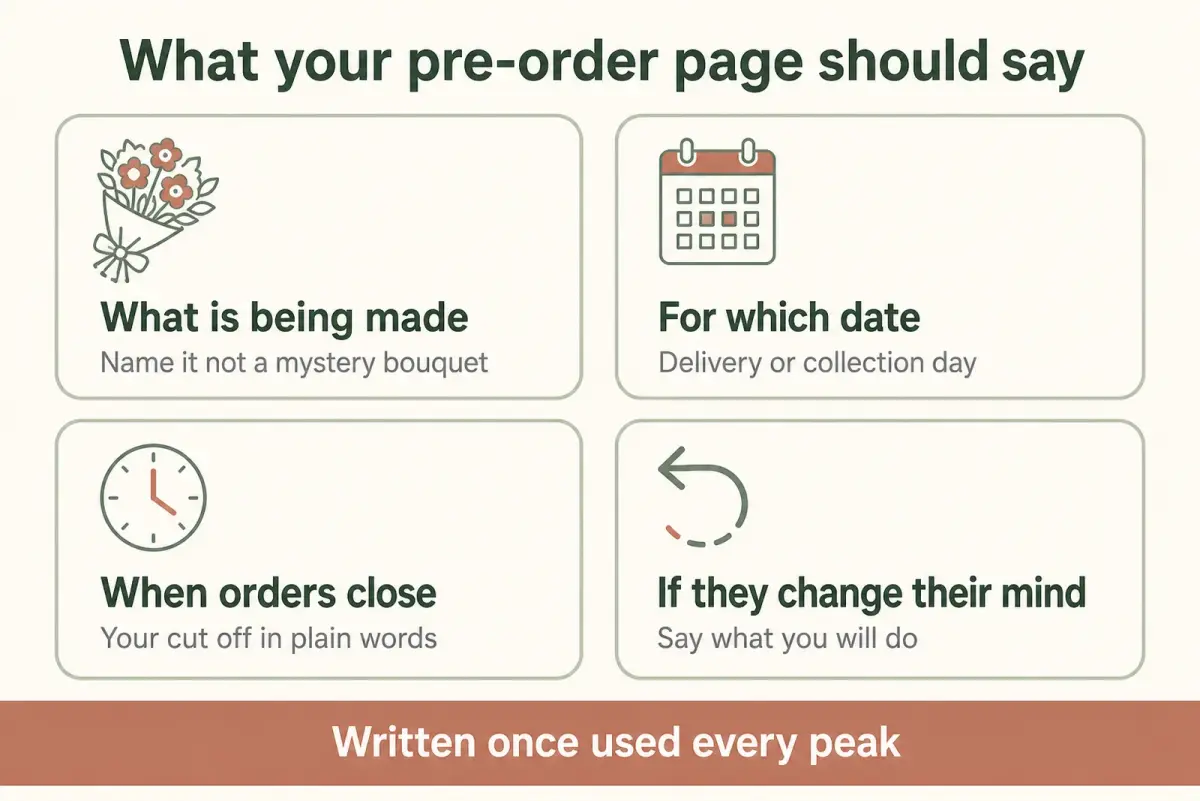
The four things worth saying on the order page before the first pre-order lands.
How do you promote a peak without living on Instagram?
You do not promote a peak week during the peak week. You build it in the quiet week before, using tools that already carry dates, then spend the peak making flowers.
Google's Business Profile Help says offer posts require a title as well as start and end dates and times, and that a View offer action button is added automatically. An offer with an end date is a pre-order cut off wearing different clothes. Set the end to your cut off and the promotion expires when the orders do, whether or not you remember to pull it down.
The rest of the peak fortnight is the same job in a different window. Write the posts in the quiet week, and queue them if whatever you post from will schedule. Be precise about what that buys you.
Scheduling does not make a post better. It makes the post exist on a Thursday when you are wrist deep in roses.
Picture the fortnight before Mothering Sunday in a two person shop. Six posts are written on a wet Tuesday in January and scheduled. The offer on the Business Profile is set to end at the cut off. The only marketing decision taken in the rush is whether to extend the cut off by a day.
Keeping that calendar and a set of ready made seasonal campaign posts in one place, rather than in your head and three notebooks, is what LocalBrandHub's social calendar and seasonal campaigns are for.
The pair of hands you book in advance
Extra hands are a dated line on the calendar like everything else, and the paperwork that comes with them has a deadline of its own. Book the help against the occasion, not against the panic.
GOV.UK states that you must check that a job applicant is allowed to work for you in the UK before you employ them. The duty is to do it before they start, not to do it early. Doing it early is simply the version that survives a peak week. A check squeezed in on the morning of the fourteenth, three hundred stems behind you, is a check you will do badly.
The weekday problem bites hardest here. Ask early which of your extra hands can work the day the occasion falls on, because a Saturday and a Tuesday do not draw on the same people.
Frequently Asked Questions
What is florist seasonal marketing?
Planning and promoting around the dated occasions that carry a flower shop's year: chiefly Valentine's Day, Mothering Sunday and Christmas, with Easter, weddings and sympathy work around them. The work is calendar work. Fix the date, set a promote by date, set a pre-order cut off, then repeat.
When should a florist start marketing for Valentine's Day and Mother's Day?
Before your wholesaler's allocation closes, and that date belongs to your supplier rather than to any marketing calendar, so ask for it. No published number fits every shop, so treat your first opening date and cut off as an experiment. Record what sold and when, then move both on your own figures.
Can you give me an example of seasonal marketing?
A florist looks up Mothering Sunday for the coming year, counts back three weekends, and marks that Saturday as the day pre-orders open. An offer goes on the Google Business Profile with an end date matching the cut off, and the week's social posts are written and scheduled beforehand. Nothing is invented on the day.
What is the 3-5-8 rule for florists?
A floral design convention about proportion inside an arrangement, quoted in several versions and usually concerning odd numbers and staggered heights. It is a rule of thumb for the vase rather than the diary, and says nothing about pre-orders.
Is running a florist business profitable?
It varies too much by shop for an honest single answer: the mix of walk in, funeral, wedding and gift work differs enormously, and so does rent. What is specific to floristry is the shape of the income rather than its size. Perishable stock, a few dated occasions carrying an outsized share of takings, quiet stretches between.
Do customers have the right to cancel a flower pre-order?
For fresh flowers bought at a distance, the usual cancellation right may not apply. Regulation 28 of the Consumer Contracts Regulations lists the supply of goods which are liable to deteriorate or expire rapidly among the circumstances excluding the Part that contains that right. The test is about the goods, so a vase is a separate question.
Where to start
Key Takeaway
The calendar is not a project. It is one afternoon a year that takes the same panic out of every peak that follows.
Weekly Action
- Look up Mothering Sunday and Easter for the year ahead and write both down
- Note which day of the week each fixed occasion falls on
- Add a promote by date and a pre-order cut off to every dated occasion
- Check the order page says what is made, for which date, and what happens on a cancellation
- Put one Business Profile offer in the diary, its end date set to your next cut off
Fixed dates you print once. Moving dates you look up every year, and the shops that win the peaks are not the better florists. They are the ones who looked it up in January.
For restaurants, salons, and local businesses
Need help with your marketing?
We help UK businesses turn social media into real results, not busywork.
Start freeSources
- Church of England, Common Worship: The Calendar
- legislation.gov.uk: The Consumer Contracts (Information, Cancellation and Additional Charges) Regulations 2013, regulation 28
- Google Business Profile Help: About posts for your Business Profile
- Meta Business Help Centre: Create and manage posts in Meta Business Suite on desktop
- GOV.UK: Checking a job applicant's right to work
Get More Marketing Tips
Practical marketing tips for UK business owners, straight to your inbox. No spam, unsubscribe anytime.
About the Author
Local Brand Hub
Empowering UK Businesses
Local Brand Hub provides comprehensive business management tools designed specifically for UK local businesses to streamline operations, automate marketing, and grow revenue.
More articlesRelated Articles
 Industry Insights
Seasonal Flower Calendar: The UK Florist's Buying Year
A seasonal flower calendar for UK florists: what is at its best each month, the trade date sitting in it, and the buying decision that month forces.
 Business Growth
How Florists Compete with Bloom and Wild (and Interflora)
How florists compete with Bloom and Wild starts by reading its delivery pages. What the post cannot carry, where Interflora fits, the result you can win.
 Business Growth
Florist Marketing Plan: A Simple Template for UK Shops
A florist marketing plan you'll actually use: a simple UK template and seasonal calendar to plan your flower shop's marketing around the peaks.