
Florist pre orders for UK flower shops: when to open the round, what the order page has to settle, how to date the cut off, and how to fill the list.
Florist pre orders are orders taken, and normally paid for, before a peak day, against a short menu of set bouquets with a published closing date. The page they are taken on is a contract rather than a poster: it settles the price, the date and the terms before the customer buys, so the wholesale order stops being a guess.
A calm peak day looks like almost nothing from the outside. A bench of finished work, a printed list, a delivery run grouped by postcode, somebody putting the kettle on at half past nine. The panic did happen. It happened three weeks earlier, in a quiet hour, in the form of decisions nobody watched you make.
Opening them and promoting them is the easy half. What decides whether a round works is the dates you choose, the page you take the orders on, and what you can do when somebody rings on the Wednesday wanting their money back.
How far ahead should you open florist pre orders?
Open the round the day you can name a delivery date and mean it. Not when you feel organised, not when a competitor posts: the opening date is set by the first morning you could honestly commit to making and delivering that bouquet on that date.
The date on the page is doing more work than it looks. Section 28 of the Consumer Rights Act provides that, unless there is an agreed time or period, a sales contract is treated as including a term that the trader must deliver the goods without undue delay and in any event not more than 30 days after the day on which the contract is entered into. An order taken in the first week of January for 14/02/2027 sits outside that default precisely because the date is agreed and written down. Take the same order with a vague soon and there is no agreed date to point at.
Nobody can hand you the right number of weeks, so treat your first one as an experiment with a reading at the end:
- Write down the opening date you chose, and why
- Count the list a week before it closes, and again at the close, because the gap between those two numbers tells you whether the round ran on the runway or on the deadline
- Move the date next time on what those two numbers say, not on anybody's rule of thumb, mine included
What does a florist pre order page have to say?
Everything the sale turns on, in one place, before the customer commits. The information duty in the Consumer Contracts Regulations lands at that exact moment, and the shop floor version is simple: if you would have to explain it in a message afterwards, it belonged on the page.
Regulation 13(1)(a) of the Consumer Contracts (Information, Cancellation and Additional Charges) Regulations provides that, before the consumer is bound by a distance contract, the trader must give or make available to the consumer the information listed in Schedule 2 in a clear and comprehensible manner, and in a way appropriate to the means of distance communication used. Schedule 2 is that list, and it repays one read before your first round rather than after your first complaint.
On a florist's order page, a customer should see without asking:
- The menu, three sizes at most, each with a photograph of what actually arrives
- The total price in £, including tax, with delivery charged on its own line
- The date, written as a date, plus delivery or collection and the area you cover
- The money, taken now or held as a deposit, with the balance date spelled out
- The closing date, on the same screen as the buy button
Only some of that list is the law's business. The menu of three and the closing date are mine, and they earn their place for a different reason.
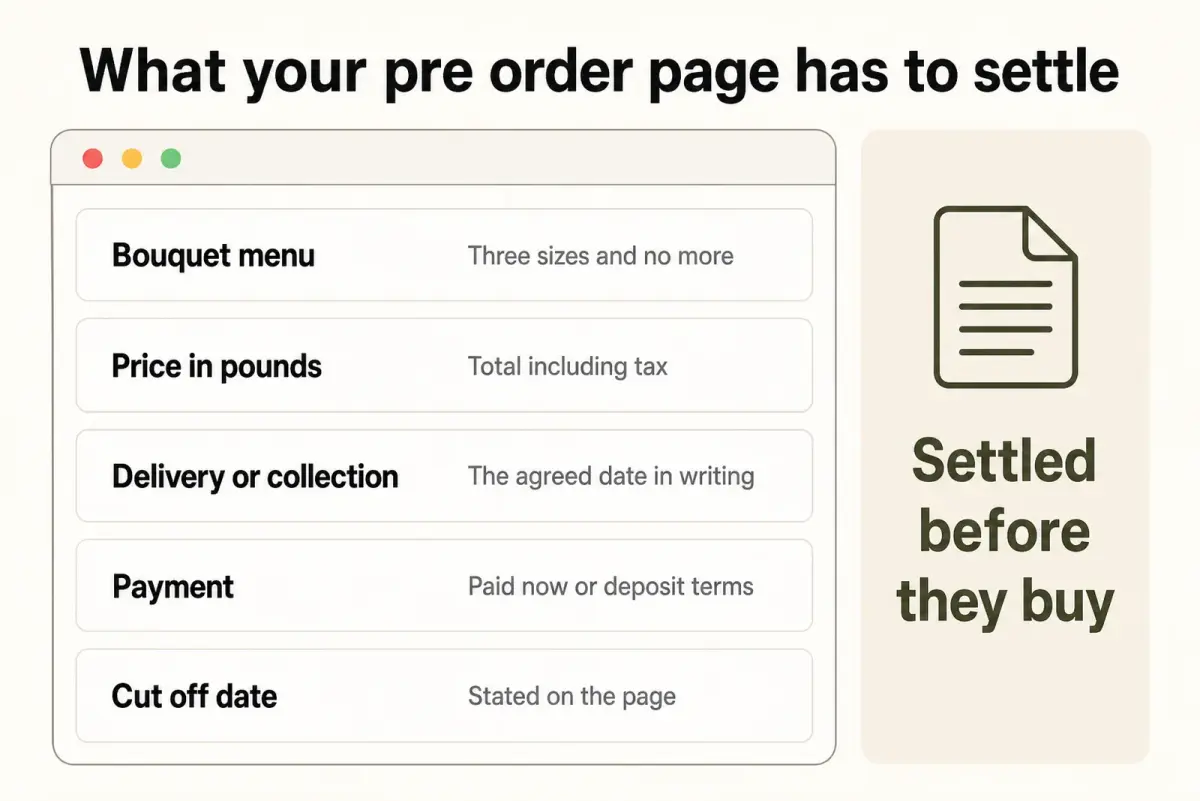
Everything on this page is settled before the customer buys. Everything settled later is an argument.
A menu of three is not modesty. It is your stock order in disguise, because every option with its own flowers in it is another bucket bought on a hunch. Making those three numbers hold up is its own job: see flower bouquet pricing.
How do you set the pre order cut off?
Ring your wholesaler and ask for the ordering deadline covering that week. Count back from the peak day through the days you need on the bench. Set the closing date before whichever of those two dates falls first, because a cut off is a stock decision wearing a marketing hat.
The easy mistake is to date the closing from the wrong end. You look at 14 February, guess at three days, and announce it. The date that governs the round belongs to your supplier, because it is the last moment your list can still change what you buy.
Why this matters: a cut off is not a marketing deadline. It is the moment your guess turns into an order, and it can only sit where your supplier lets it sit.
Its second job is capacity. Cap the round at what you could make on the worst version of that week, one pair of hands short and the van running late, and say sold out cheerfully when you get there. Then hold the date, because a closing date that moved once is a closing date nobody believes twice. The seasonal flower calendar runs the same countback across the year.
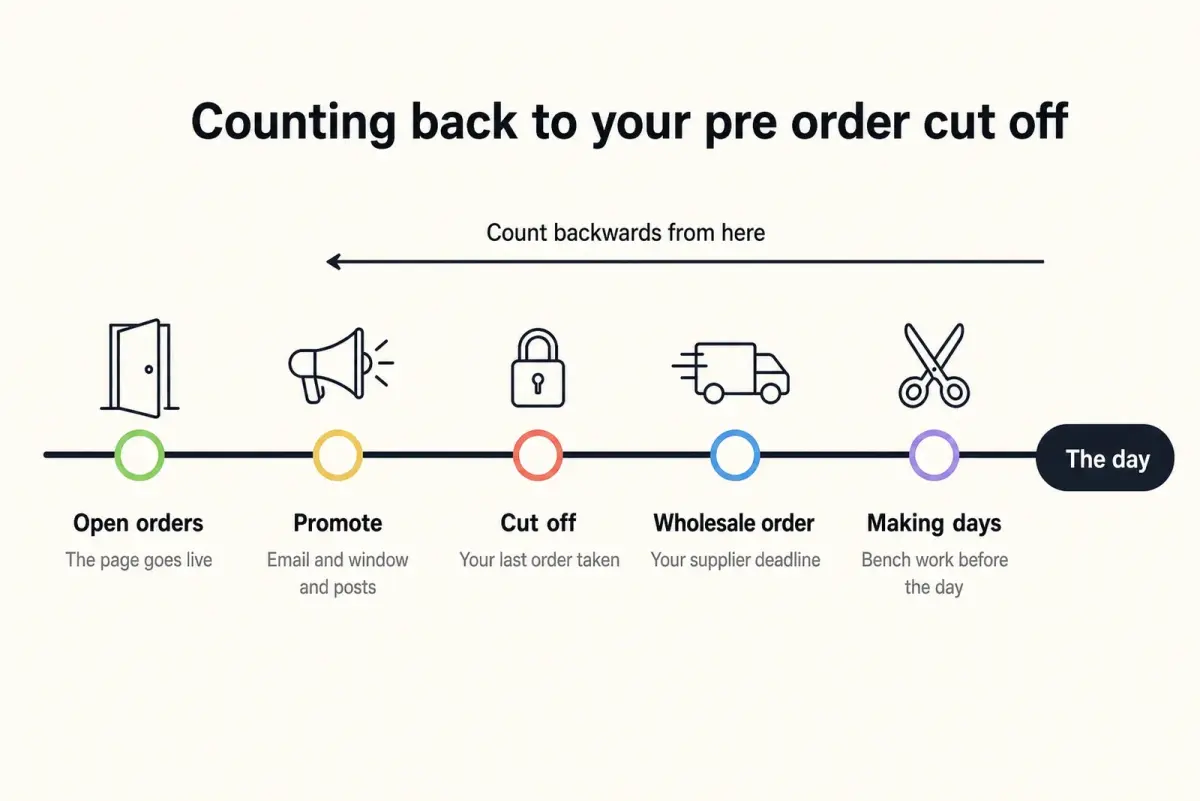
Read it left to right to run the round. Plan it right to left, from your supplier's deadline.
Can a customer cancel a florist pre order?
Usually not in the way they assume, and the reason is the flowers rather than your terms. The cancellation right covering most distance sales does not reach goods that are liable to deteriorate rapidly, and a bouquet cut and made up for a named date is about as square a fit as that description gets.
Regulation 30(3) of the same regulations sets the position your customer already knows: for a sales contract to which none of that regulation's other cases applies, the cancellation period ends at the end of 14 days after the day on which the goods come into the physical possession of the consumer. That is the rule they have in mind, because it governed the jumper they sent back last week.
Which is where the flowers part company with the jumper. Regulation 28(1)(c) lists the supply of goods which are liable to deteriorate or expire rapidly among the circumstances in which that Part, the one containing the cancellation right, does not apply, and regulation 28(1)(b) does the same for goods made to the consumer's specifications or clearly personalised.
Read what that turns on. It is a statement about the goods, not a reward for writing no refunds on your page.
Faulty, wrong or never delivered stays yours to put right whatever the page says. Beyond that, the everyday cases are judgement calls better made in January than on the day: the wrong address, nobody in, a customer calling off a fortnight early before you have bought a stem. Write those answers down and you never invent a policy holding a phone in one hand and a bunch of ranunculus in the other.
How do you fill the list before it closes?
Promote the deadline, not the bouquet. A pre order round contains one genuinely persuasive fact, which is that the list closes on a date, and every reminder is a variation on that sentence.
Google Business Profile Help states that an Offer post requires a title, dates and a time, automatically includes a View offer button, and can also carry a description, photo, video, coupon code, link and terms and conditions. That shape suits a round like this, because the deadline is built into the format instead of living in a line of copy you hope somebody reads to the end.

The window reaches the people who walk past you every day and follow you nowhere.
Around it, a starting rhythm to adjust once you have watched one round land:
- The window, which is doing the work for everyone who never sees a post
- An email when the round opens, with the closing date in the subject line
- A reminder at the halfway mark, then one on the final morning
If you export customers into an email tool for that, send only what the send needs: a name and an address to write to. Leave order history and delivery addresses out of the file. Check what the account's settings currently say about how that data is used and kept. The sending itself is covered in email marketing for florists.
Weeks of reminders written while the bench is full is the part that quietly does not happen, which is why it is worth setting up once. LocalBrandHub keeps ready made seasonal campaigns and a social calendar you can schedule the run up into, so the countdown goes out whether or not the shop is quiet enough to write it.
What goes wrong with florist pre orders
Pre order rounds fail in a handful of recognisable ways. The ones you can prevent are not about the flowers. Each one is a decision somebody left vague: an unnamed date, an unbounded menu, an unheld deadline, money never actually taken.
- The page that never names a date. Everything after that is guesswork for both of you.
- The menu that grew to eleven. Each new flower on the list is stock bought on a hunch.
- One announcement, no reminders. The round was open. Nobody was reminded it would close.
- A closing date that moved. You taught your customers the deadline is decorative.
- A list longer than the bench. Capacity is a decision, not a surprise.
- Money collected on the day. A promise is not a sale, and the day is a terrible time to learn the difference.
If the list is thin a week out, the diagnosis is nearly always reach rather than price. Count how many people saw the closing date, not how many posts you made.
Where to start
Key Takeaway
One round, run properly, teaches more than a year of general marketing. Take the next occasion in your diary and build it backwards.
This week
- Ring your wholesaler and write down their ordering deadline for that week
- Count back from the day itself through your bench days, and set the closing date before whichever of the two comes first
- Cut the menu to three bouquets with real photographs and prices in £
- Put the date, the delivery area, the charge and the payment terms on the order page
- Set an Offer post whose end date is the closing date, and diary the reminders
The shops that stay calm on 14 February are not braver or faster. They stopped buying flowers for a day they had not yet sold, and started buying them for a list they had.
For restaurants, salons, and local businesses
Need help with your marketing?
We help UK businesses turn social media into real results, not busywork.
Start freeFrequently Asked Questions
What are florist pre orders?
Orders taken, and normally paid for, before a peak day, against a short menu of set bouquets with a published closing date. The point is not the money arriving early. It is that the wholesale order stops being a guess, because you buy against sales already made.
How far in advance can I order flowers for delivery?
That is your customer's question, and the answer belongs on your page rather than in their imagination. Give them two dates, the day your list closes and the day the flowers arrive, and they stop having to guess how early is early enough.
What is the 3:5:8 rule for flowers?
A design convention about proportion inside an arrangement, quoted in several versions and usually described as odd numbers of stems at staggered heights. Whichever version you have met, it is a rule of thumb for the bench rather than the diary, and says nothing about when you close a list.
Can I just walk into a florist and buy flowers?
Yes, and a pre order round does not change that. What it changes is what is left in the buckets on a peak day, because the list gets made first. The fix is to buy a deliberate walk in margin on top of the list.
Should florists take payment upfront for pre orders?
Payment at the point of order behaves like a sale rather than an intention, and settles the takings before the week starts. If you would rather hold a deposit, say on the page what it does, when the balance falls due, and what happens if the order is called off.
When should a florist close pre orders?
Work backwards. Ask your wholesaler for the ordering deadline covering that week, count back from the day itself through the days you need on the bench, and set the closing date before whichever of the two comes first. Publish it, then hold it.
Sources
- legislation.gov.uk: Consumer Contracts (Information, Cancellation and Additional Charges) Regulations, regulation 13 (Information to be provided before making a distance contract)
- legislation.gov.uk: Consumer Rights Act, section 28 (Delivery of goods)
- legislation.gov.uk: Consumer Contracts (Information, Cancellation and Additional Charges) Regulations, regulation 30 (Normal cancellation period)
- legislation.gov.uk: Consumer Contracts (Information, Cancellation and Additional Charges) Regulations, regulation 28 (Limits of application: circumstances excluding cancellation)
- Google Business Profile Help: Create and manage posts on your Business Profile
Get More Marketing Tips
Practical marketing tips for UK business owners, straight to your inbox. No spam, unsubscribe anytime.
About the Author
Local Brand Hub
Empowering UK Businesses
Local Brand Hub provides comprehensive business management tools designed specifically for UK local businesses to streamline operations, automate marketing, and grow revenue.
More articlesRelated Articles
 Marketing Tips
Christmas Flower Sales: The Florist's December Plan
Christmas flower sales for florists: set your festive range, workshop and pre-order dates, price against current stock costs, and pick your December hours.
 Marketing Tips
Wedding Flower Consultation: The Florist's Question Sheet
How to run a wedding flower consultation that ends in a quotable list of pieces, with a copyable question sheet to send couples before you meet.
 Marketing Tips
Mothers Day Florist Marketing: A Countdown That Holds
Mothers day florist marketing run as a countdown: what to publish and when, what your order page must say before an order, and when to close orders.