
Valentines day florist planning for UK flower shops: work out how many orders your bench and van can handle, then set your cut off, prices and staffing.
Your Valentine's ceiling is not set by demand, it is set by arithmetic: the number of bouquets your bench can build and your van can drop before closing time on the 14th. Work that number out first, and the cut off, the range, the pricing and the extra pay all follow from it.
Preparing early is only half an instruction for a valentines day florist. The half that decides your day is what you are preparing for, which is the moment at about half past ten on the 14th when the orders stop being a blessing and start being a queue you cannot clear.
You have never once locked up on 14 February wishing more people had wanted flowers. What you have wished is that you had known, three weeks earlier, exactly where to stop. Demand on Valentine's is the weather. Capacity is the roof.
Related: Florist Pre-Orders: How to Run Them
Why Valentine's is a capacity problem, not a demand problem
On an ordinary Tuesday the thing holding your takings down is how many people want flowers. On 14 February it is how many finished bouquets exist by four o'clock. Once orders pass what you can physically produce, extra interest stops being worth much to you.
That flip changes what your marketing is for. Below your ceiling, a post or an offer brings in trade you would not otherwise have had. At your ceiling it cannot, because there is nothing left to sell. What it can still do is decide who gets served, in what order, and at what price. On your biggest day, marketing is triage rather than acquisition.
It is easy to run that sequence backwards, promoting first and counting later, then meeting the ceiling by hitting it, with a phone in one hand and somebody's disappointment coming out of it.
How many Valentine's orders can you actually make?
Two numbers, then the lower one. Turn your makers' usable bench hours into minutes and divide by the minutes an average bouquet takes: that is what you can build. Turn your vans' hours on the road into minutes and divide by the minutes a drop takes: that is what you can move. Your ceiling is whichever runs out first.
Both halves need honest inputs, and honest is the hard part.
- Usable bench hours are not opening hours. Take out conditioning, wrapping, the till, the phone and the delivery that comes back.
- Minutes per bouquet is measured, not remembered. Time the actual Valentine's line, not a leisurely bouquet in July, and time it more than once: the build you remember is the one that went well, so plan on the slowest of the runs you timed.
- Minutes per drop comes off your own run sheet. Buzzers, one way systems and the recipient who is out are already inside that figure.
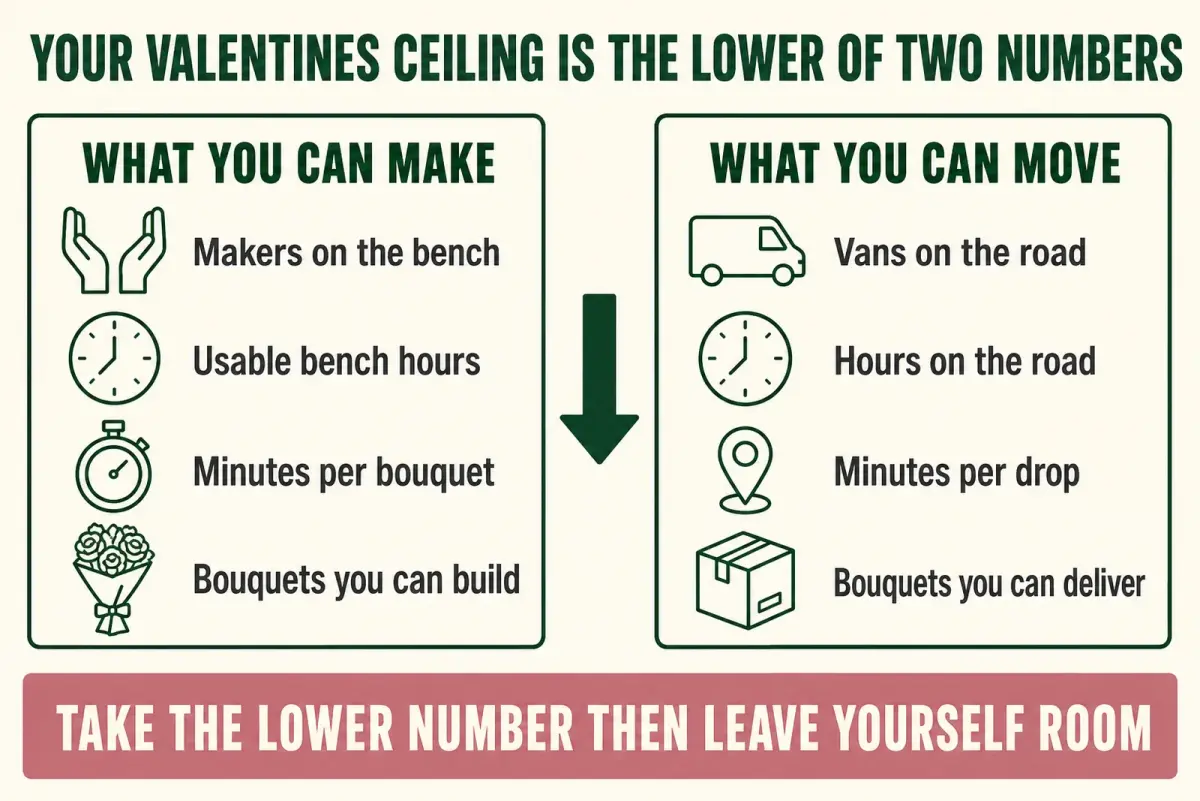
Build the two ceilings separately, take the lower one, then leave yourself room.
Run the two sums on your own figures
Imagine a two person shop working the 13th and the 14th. Two makers with ten usable bench hours each per day gives 40 maker hours. At twelve minutes a hand tied, that is 200 bouquets, which sounds like plenty. Then the van: one driver, seven hours on the road each day, ten minutes a drop, so 42 drops a day and 84 across the two. If four out of every five orders want delivering, that shop cannot sell 200. It can sell about 105 before the van becomes the wall.
The bench is parallel. The van is a queue. A second pair of hands builds two bouquets at once, but one driver still does one drop at a time.
So in a shop where most orders need delivering, expect the van to be the lower of your two numbers, and expect the lever that raises your ceiling to be something other than working faster. It is one of these:
- a second driver for the 14th
- a tighter delivery radius
- a collection slot priced to be worth choosing
- a delivery charge honest enough to shift the mix
Which one you pull is a pricing decision as much as a logistics one, and flower bouquet pricing is where to work it through.
The make side has a dial of its own, and it is your range. Minutes per bouquet include the deciding, the fetching and the second look, so a Valentine's list of a few set designs plus a florist's choice is a different build from an open menu: the bench gets set up once and then repeats. Pick a range narrow enough to set the bench up for, run it this year, and widen or tighten it next year on what your own timings say.
Then take a slice off whatever number you land on, because stems arrive wrong, someone calls in sick, and one address will be a farm you cannot find in the dark.
When should you close Valentine's orders?
When accepted orders reach your ceiling, or when your last buy lands, whichever comes first. A published date is a useful proxy and a poor master: the number closes the book, the date only tells customers when to expect it shut.
It is tempting to keep the cut off vague, half from optimism and half from a worry that a firm one invites cancellations you would have to honour. Regulation 28 of the Consumer Contracts (Information, Cancellation and Additional Charges) Regulations provides that the cancellation rights in that Part do not apply to the supply of goods made to the consumer's specifications or clearly personalised, or to the supply of goods liable to deteriorate or expire rapidly.
Read that narrowly, because it is narrow.
It removes one thing, the statutory cancellation right on a distance sale, for those categories of goods. It says nothing about flowers that arrive wilted, late or nothing like the photograph, and whether a given order sits inside the exclusion turns on the order rather than on the word Valentine's.
So it is your own published terms that do the work, and three lines cover most of it:
- when the book closes, in a date customers can see before they pay
- what you will do if you cannot fulfil an order you accepted
- what a customer can change, and by when
A cut off nobody was told about is not a cut off. It is an argument with a date on it.
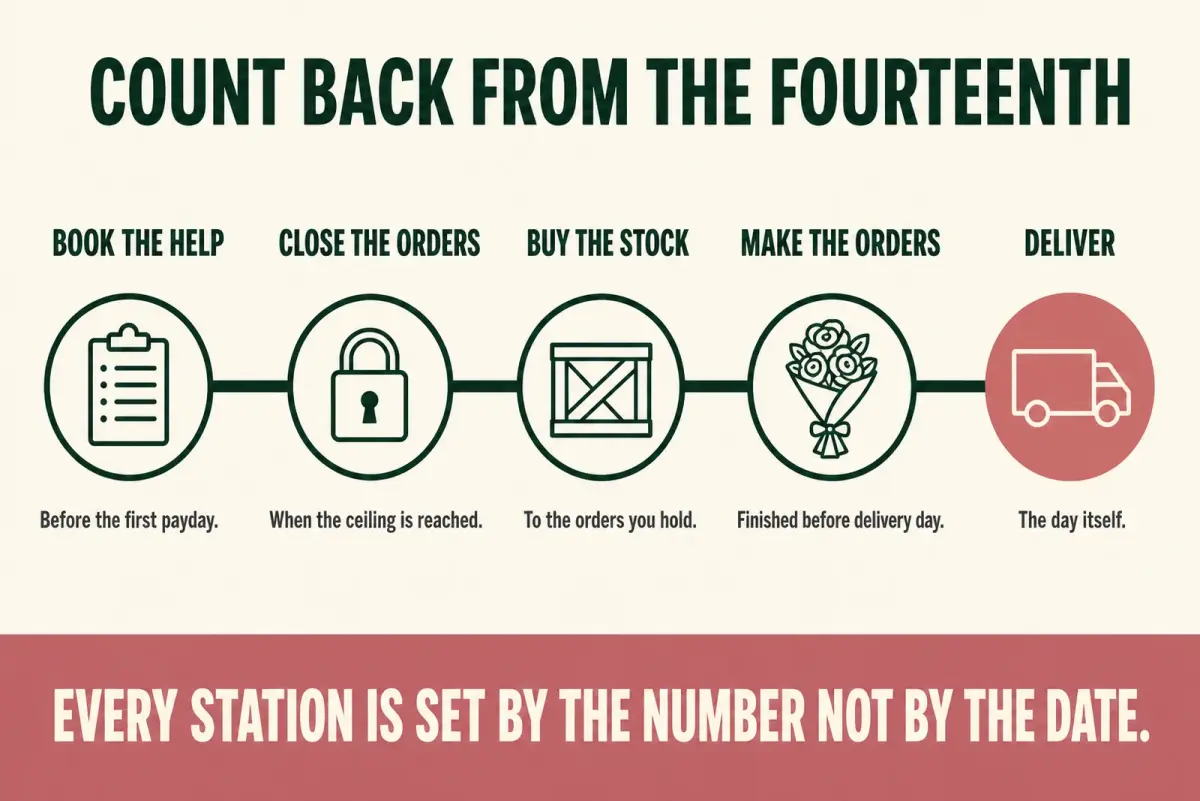
Each stage is triggered by the number you are working to, not by a date in the diary.
What does an extra pair of hands actually cost?
Less than it feels like at the moment you are deciding, and the awkward part is the timing rather than the rate. From April 2026 the minimum hourly rate is £12.71 for workers aged 21 and over and £10.85 for workers aged 18 to 20, and the rates change on 1 April every year.
Imagine paying one extra maker for twenty hours across the 13th and the 14th at the 21 and over rate. That is a little over £254 in wages alone, before anything you pay on top, and if those hours produce a hundred bouquets the wage works out near £2.54 a bouquet. Hold that against what a hand tied leaves you once the flowers are paid for, and the decision usually makes itself.
What catches people out is not the money. It is that two duties fall due before the flowers do.
- Register as an employer. GOV.UK says you normally need to register with HM Revenue and Customs when you start employing staff, that you must register before the first payday to get your employer PAYE reference number, and that you cannot register more than 2 months before you start paying people.
- Hand over the written statement. An employer must give employees and workers a document stating the main conditions of employment when they start work, known as a written statement of employment particulars, with the principal statement provided on the first day of employment.
Neither asks you to buy anything. Both are deadlines you can only meet in advance, and the PAYE reference comes back to you in a letter, so January is the month that leaves room. Those are the GOV.UK employment pages for England, Wales and Scotland; if you trade in Northern Ireland, read the guidance published there before assuming the same applies.
What do you do with the orders you turn away?
Turn them into the next one. A ceiling means you will say no to people who were trying to give you money, and the thirty seconds after that no is the most valuable half minute of your Valentine's.
A flat "sorry, we're full" closes the conversation at its warmest point. A no with a date attached does not:
- the 13th instead of the 14th
- a collection instead of a delivery
- first in the queue for Mother's Day

The most valuable half minute of the day is the one where you say no properly.
"We're full" ends the conversation. "Not the 14th, but I can do the 13th" keeps it.
You are not rescuing the sale, you are keeping the customer. Take down only what you would need to ring them back about the next occasion, and nothing more, because what you never hold cannot go wrong. Turning that into an order in March is what florist reminder marketing is for.
Staying visible through the week you have no time to be is the other half. LocalBrandHub's ready made seasonal campaigns and month view social calendar are built for that: you write the run up on a quiet January afternoon and put each post on the day it belongs, so the week is mapped out before it starts rather than drafted with roses in your hands.
Frequently Asked Questions
How far ahead should a florist plan for Valentine's Day?
Far enough back that nothing has to be rushed, and if you are taking on help there is a payroll deadline to plan around as well as a flower one. GOV.UK says you must register as an employer with HMRC before that person's first payday. The reference comes back by letter, so work back from that and January becomes your planning month.
How many Valentine's Day orders should a florist take?
As many as the lower of your two ceilings, minus a deliberate margin. The make ceiling is your makers' usable bench hours, in minutes, divided by the minutes a bouquet takes. The move ceiling is your vans' hours on the road, in minutes, divided by the minutes a drop takes.
When should a florist stop taking Valentine's Day orders?
When accepted orders reach that ceiling, or when your final wholesale order goes in, whichever comes sooner. Publish a date so customers know when the book shuts, but close on the number. A shop selling past its ceiling is not busier. It is choosing which customers to let down.
Can a customer cancel a Valentine's Day flower order?
The distance selling cancellation right is narrower for flowers than many assume. Regulation 28 of the Consumer Contracts (Information, Cancellation and Additional Charges) Regulations provides that those cancellation rights do not apply to goods made to the consumer's specifications or clearly personalised, or to goods liable to deteriorate or expire rapidly. Faulty or misdescribed flowers are untouched by that, and your published terms settle the rest.
What does extra help cost a florist at Valentine's?
The hourly floor is published. From April 2026 the minimum hourly rate is £12.71 for workers aged 21 and over and £10.85 for workers aged 18 to 20, and the rates change on 1 April every year. Judge it per bouquet against your margin, using the bouquets those hours actually produce.
Should a florist charge more for Valentine's Day flowers?
Work out what the day itself costs you before you answer: the extra hours on the bench and in the van are hours you do not pay for in July, and a price that ignores them comes quietly out of your own margin. The sharper question is what your price does to demand you cannot serve anyway. At your ceiling, price is the only tool left for choosing which orders you take.
Key takeaways
Key Takeaway
A Valentine's plan is two sums and four decisions, and the sums come first.
- Your ceiling is arithmetic. Makers, bench hours and minutes per bouquet on one side; vans, road hours and minutes per drop on the other.
- Take the lower number. In a shop where most orders need delivering, expect that to be the van.
- Close on the number, publish the date. The book shuts when orders reach the ceiling.
- Book help in January. Registration falls due before the first payday.
- Say no with a date attached. The order you turn away on the 14th can still be an order in March.
Ready to build the rest of your florist year on the same logic? Start with florist seasonal marketing.
For restaurants, salons, and local businesses
Need help with your marketing?
We help UK businesses turn social media into real results, not busywork.
Start freeSources
Get More Marketing Tips
Practical marketing tips for UK business owners, straight to your inbox. No spam, unsubscribe anytime.
About the Author
Local Brand Hub
Empowering UK Businesses
Local Brand Hub provides comprehensive business management tools designed specifically for UK local businesses to streamline operations, automate marketing, and grow revenue.
More articlesRelated Articles
 Marketing Tips
Mothers Day Florist Marketing: A Countdown That Holds
Mothers day florist marketing run as a countdown: what to publish and when, what your order page must say before an order, and when to close orders.
 Marketing Tips
Social Media for Florists: Run It on the Occasion Year
Social media for florists, run on the occasion calendar: which platform your buyers use, when to open each run-up, and why Instagram forgets Mother's Day.
 Marketing Tips
Marketing to Engaged Couples: A Wedding Florist Guide
Marketing to engaged couples for wedding florists: aim at the dates your diary still needs, work local venues, and log where every enquiry came from.