
Research competitor menus, benchmark your prices against local rivals, and set restaurant prices that protect your margins.
It's 11pm after a long Saturday service. You're staring at your till receipts, wondering why covers are down again. The new place three streets over is packed every night, and you've heard their prices are lower. Competitive pricing restaurants get right isn't about being cheapest. It's about understanding where you sit locally.
Here's a telling statistic: 29% of UK diners actively compare prices before choosing where to eat. That number rises to 32% for families. Your customers are already doing competitive analysis: the question is whether you are too.
What You'll Learn
- How to identify which competitors actually matter to your pricing decisions
- A step-by-step system for gathering and comparing competitor menu prices
- Industry benchmarks for food cost percentages and prime costs in UK restaurants
- Three strategic approaches to positioning your prices competitively
- When and how to raise prices without triggering customer backlash
Info
Related: Restaurant Menu Pricing - the complete hub guide for all pricing strategies
Here's the uncomfortable truth: getting competitive pricing restaurants wrong doesn't just cost you a few covers. Price too high without the perceived value to match, and customers drift elsewhere. Price too low, and you're working harder for margins that barely cover your rising costs. With UK restaurant food costs hitting 28-35% of menu prices and labour costs consuming another 31% of revenue on average (Tableo, 2025), mastering competitive pricing restaurants use successfully requires both data and strategy.
What Competitive Pricing Restaurants Need to Understand
So what does competitive pricing restaurants actually involve? It doesn't mean matching whatever your neighbours charge. It means understanding where your prices sit within your local market and making deliberate decisions about whether to sit above, below, or alongside competitors based on your positioning.
The goal isn't to be the cheapest. It's to be priced appropriately for what you offer. A gastropub serving locally-sourced beef can justify higher prices than a high-street chain. A quick-service lunch spot needs to stay within touching distance of supermarket meal deals, which now range from £3.00 to £6.00 and compete directly for the same customers (Simon-Kucher, 2025).
Why Competitor Awareness Matters More in 2025-2026
Competition in UK full-service restaurants is high and increasing (IBISWorld, 2025). At the same time, 29% of UK consumers actively look for discounts when eating out, rising to 32% among families. Over 35% of dining occasions involved a promotion in recent years (Mintel, 2025).
If you're reading this thinking "I don't have time to track competitors," you're not alone. But the reality is that your customers are already comparing. They scroll through menus on their phones before choosing where to eat. If your prices feel off, they'll notice before they walk through your door.
How Competitive Pricing Restaurants Gather Intelligence
Now that you understand positioning, let's get practical. Effective competitive pricing restaurants analysis isn't about obsessing over every restaurant in town. It's about identifying your actual competitive set and tracking the right data.
Step 1: Identify Your True Competitors
Your competitors aren't every restaurant nearby. They're the ones fighting for the same customer at the same time.
Consider these factors:
- Cuisine match - A Thai restaurant competes more with other Thai restaurants than with the Italian next door
- Price tier - Fine dining doesn't compete with fast casual
- Occasion - A quick-lunch spot competes with sandwich shops, not date-night restaurants
- Location radius - For most independents, this means 1-2 miles in urban areas, 5-10 miles in rural settings
A gastropub might identify three direct competitors (similar menu style and price tier) plus two indirect competitors (chains that compete on convenience rather than experience).
Step 2: Collect Pricing Data Systematically
If you're only tracking competitor prices when covers drop you'll always lose to restaurants that make monitoring a habit.
Once you've identified your competitive set, gather pricing data methodically:
| Data Point | Where to Find It | Update Frequency |
|---|---|---|
| Full menu with prices | Their website, delivery apps, physical visit | Quarterly |
| Portion sizes | Physical visit, customer photos | Twice yearly |
| Specials and promotions | Social media, email lists, window displays | Monthly |
| Customer perception | Google reviews mentioning value | Monthly |
Track competitor promotions
Sign up for competitors' email lists under a personal email. You'll see exactly how they communicate promotions and price changes.
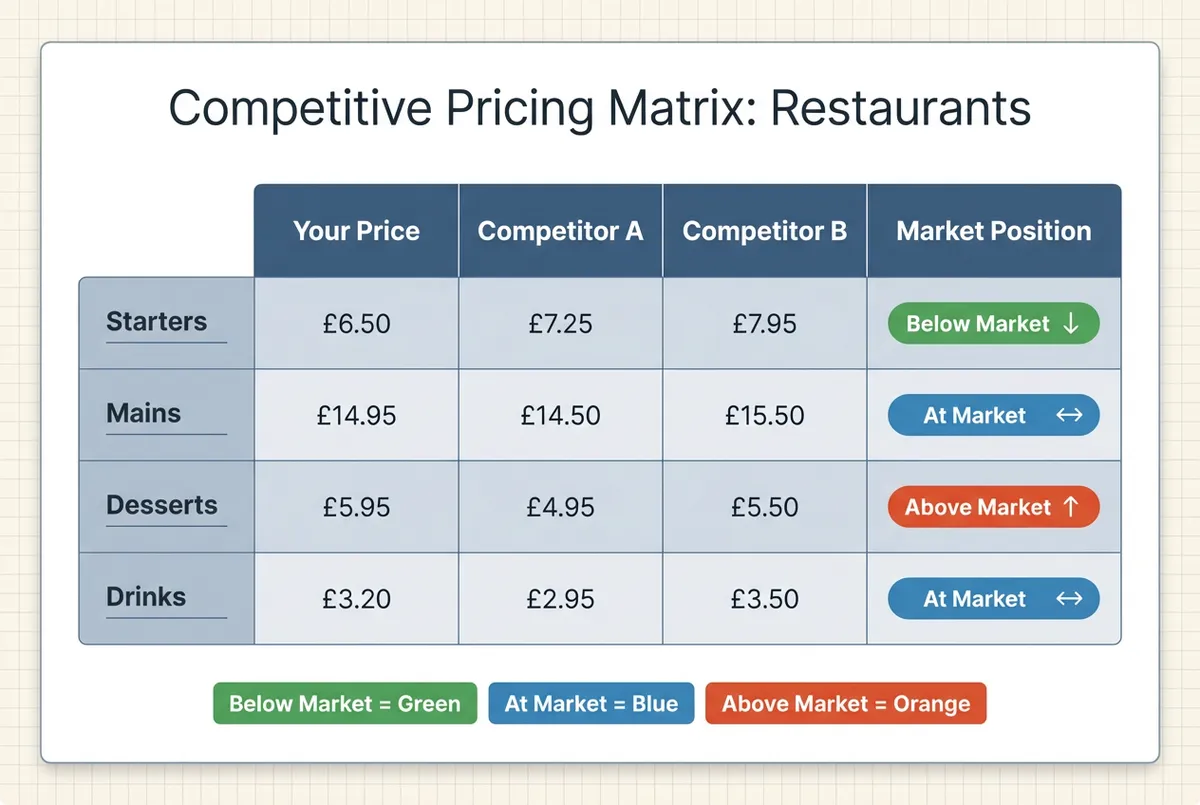
A competitive pricing matrix helps you visualise where you sit against local rivals
Step 3: Build a Category-by-Category Comparison
US consultancy Aaron Allen recommends professional competitive menu analysis that compares price, portion, preparation, and presentation for comparable items (Aaron Allen & Associates, US consultancy). Here's a simplified version you can use:
Starter example:
| Your Item | Your Price | Competitor A | Competitor B | Gap |
|---|---|---|---|---|
| Soup of the day | £6.50 | £5.95 | £7.25 | Middle |
| Bread and olives | £5.95 | £4.95 | £6.50 | Middle |
| Seasonal salad | £8.50 | £7.95 | £8.95 | Middle |
For each category (starters, mains, desserts, drinks), identify where you sit: consistently higher, lower, or mixed.
Benchmarking Your Prices Against Industry Standards
With your competitive data gathered, the next step is context. Competitor prices tell you where you sit locally. Industry benchmarks tell you whether your overall pricing structure is healthy.
Food Cost Percentage Benchmarks
Most UK restaurants target a food cost percentage of 28-32% (Lightspeed, 2025). This varies by format:
| Restaurant Type | Target Food Cost | Notes |
|---|---|---|
| Quick service | 20-30% | Higher volume compensates for lower margin |
| Casual dining | 30-35% | Balance between quality and value |
| Fine dining | 35-40% | Premium ingredients justify higher costs |
To calculate your food cost percentage: (Ingredient Cost / Menu Price) x 100
For example, if your fish and chips uses £4.20 in ingredients and sells for £14.50, your food cost is 29%, right in the healthy zone for casual dining. A Birmingham chippy found their bestseller was running at 42% food cost, leaving almost no margin after labour. A 50p price increase brought them back to 35%.
Prime Cost Reality Check
Your prime cost (food + labour) should stay below 60-65% of total sales (GetJelly, 2026). Above this threshold, there's not enough left for rent, utilities, and profit.
With the National Living Wage rising to £12.71/hour from April 2026, labour cost pressure isn't going away. If your prime cost is creeping up, pricing adjustments may be necessary just to maintain current margins.
Info
Related: Restaurant Menu Pricing Strategy - deep dive into pricing frameworks
Strategic Approaches to Competitive Pricing Restaurants Use
You've got the data. You know where you sit. But what should you actually do about it? Here's where strategy comes in.
Option 1: Premium Positioning
Price above competitors and justify the premium through quality, experience, or uniqueness.
Works when:
- Your ingredients or preparation are demonstrably better
- Your atmosphere or service creates memorable experiences
- You have strong brand recognition or loyal following
Watch out for: Customers who struggle to perceive the difference between your offering and a cheaper alternative.
Real example: A Manchester gastropub prices its burgers at £18.50, £4 more than the nearby chain. They justify it through visible sourcing (local farm name on menu), premium presentation, and better quality chips. Their Google reviews consistently mention "worth the extra."
If you're taking this approach, you'll also want to think about how to communicate a restaurant menu price increase without alienating loyal customers.
Option 2: Value Positioning
Price at or below competitors while protecting margins through efficiency.
Works when:
- You can achieve lower food costs through volume purchasing or menu simplification
- Your location or format naturally supports higher turnover
- You're building market share in a new location
Watch out for: Racing to the bottom. Cutting prices without cutting costs is a path to closure.
Option 3: Strategic Parity
Match competitor pricing on comparable items while differentiating on unique offerings.
Works when:
- Your menu has items competitors don't offer
- You can compete on experience rather than price
- Customers choose you for reasons beyond price (location, atmosphere, cuisine)
For most independents, this third approach to competitive pricing restaurants use offers the best balance. You stay competitive where customers compare directly, while margin-protecting items fly under the radar.
If you're only checking competitors when you're worried about losing customers you'll always lose to restaurants that make it a regular habit.
How to Adjust Prices Without Losing Customers
Strategy chosen, now comes the tricky part: implementation. US data shows the restaurant industry saw menu prices rise by 24% over the past five years (National Restaurant Association, US data). UK trends have been similar (customers have absorbed significant increases), but the way you implement changes matters enormously.
The Psychology of Price Perception
US research shows that removing currency symbols and words like "pounds" from menus can reduce psychological resistance to spending (Cornell University, US study). A menu showing "14.50" feels different from "£14.50" or "Fourteen pounds fifty."
However, the same research found that larger operational factors (party size, dining duration, table location) have greater impact on spend than pricing typography. Don't overthink formatting while neglecting fundamentals.
Increment Pricing: The Safer Approach
If you're thinking "how often should I raise prices?", the answer is more frequently but more modestly.
US pricing experts suggest increasing prices incrementally, such as 3-5% quarterly, rather than making large annual jumps. Frequent small changes condition customers to accept them more readily (IRIS Pricing Solutions, US data via Restaurant.org).
The risk of big jumps: A 1% price increase can drop customer ratings by up to 5% when implemented abruptly. Multiply that for a 10% jump, and you're risking serious backlash.
Transparency vs. Silence
Should you communicate price increases? It depends on magnitude and relationship.
Consider transparency when:
- Increases exceed 5% on popular items
- You have a loyal customer base who'll notice
- You can tie increases to visible improvements (new menu, better ingredients, living wage commitment)
Communication example: "From 1st April, we're paying the new living wage to all team members. Our prices have increased by 4% to support this, which means £0.50-£1.00 per dish."
Surcharges: Proceed with Caution
US data shows 91% of restaurant operators have raised menu prices, while only 16% have added surcharges (National Restaurant Association, US data). UK trends mirror this pattern. Research suggests surcharges trigger more negative reactions than equivalent direct price increases because they feel like hidden fees.
If you do use surcharges, prior disclosure through signage or menu notes helps set expectations. But pricing strategists generally advise increasing plate prices instead.
Your Weekly Competitive Pricing Restaurants Monitoring System
If you only have 30 minutes a week, here's how competitive pricing restaurants track competitors without it becoming a second job.
Week 1: Check two competitors' online menus. Note any changes.
Week 2: Scan competitors' social media for promotions or new dishes.
Week 3: Read new Google reviews mentioning value, prices, or competitors.
Week 4: Update your competitive pricing spreadsheet with any changes.
This rotation keeps you informed without overwhelming your schedule. Set a recurring 30-minute slot, perhaps during the 3pm lull, and treat it like stocktaking for your pricing strategy. If even that becomes a chore, competitor tracking software keeps an eye on local rivals' prices and promotions for you, so the data is always current.
Common Competitive Pricing Restaurants Mistakes to Avoid
Before you dive in, a word of caution. These are the competitive pricing restaurants mistakes that catch even experienced operators.
Mistake 1: Matching everyone's prices If you're running a quality-focused independent, matching chain restaurant prices leaves no margin for what makes you different. A Bristol bistro owner learned this the hard way: "I undercut everyone for six months and nearly went under. The customers I attracted were just looking for cheap, not loyal."
Mistake 2: Ignoring delivery app pricing Your prices on Deliveroo or Uber Eats are visible to everyone. Make sure they're consistent with your positioning, or deliberately higher to offset commission.
Mistake 3: Pricing reactively instead of strategically If you're only adjusting prices when you're worried you'll always lose to restaurants with a proactive pricing calendar. Strategic pricing requires a plan, not firefighting.
Mistake 4: Forgetting portion adjustment Sometimes the answer isn't changing the price; it's adjusting the portion. A slightly smaller side dish at the same price protects margin without the price-change signal.
For calculating exactly what your dishes should cost, check out our guide on how to price a restaurant menu.
Quick self-check
Ask yourself: Would I choose my restaurant at these prices? If you can't honestly answer yes, that's usually a sign your pricing needs work.
Info
Related: How to Price a Restaurant Menu - step-by-step calculation guide
Your Competitive Pricing Restaurants Checklist
Use this checklist to audit your competitive pricing restaurants position:
- Identify 3-5 direct competitors (same cuisine, price tier, occasion)
- Collect current menu prices from each competitor's website
- Build a category-by-category comparison table (starters, mains, desserts)
- Calculate your food cost percentage for your top 10 sellers
- Compare your prime cost against the 60-65% benchmark
- Decide your positioning strategy (premium, value, or parity)
- Set up a 30-minute weekly competitor monitoring routine
- Plan any price adjustments in 3-5% increments
For instance, a Leeds curry house used this checklist and discovered they were 15% cheaper than equivalent competitors on main courses but 20% higher on starters, exactly the wrong way round for customer perception.
If you run a restaurant and want to see how Local Brand Hub can support your marketing, explore our restaurant marketing tools.
Key Takeaways
Competitive pricing means positioning, not copying. Decide whether you're premium, value, or parity-positioned.
Identify your true competitors by cuisine, price tier, occasion, and location, not just proximity.
Benchmark against industry standards: 28-35% food cost, under 65% prime cost (food + labour).
Implement increases incrementally (3-5% quarterly) rather than large annual jumps to reduce customer resistance.
Avoid surcharges where possible: direct price increases are better received.
Monitor competitors systematically with a 30-minute weekly rotation, not occasional panic-checking.
Your competitive pricing restaurants strategy doesn't exist in isolation. Prices are constantly compared against competitors, delivery platforms, and customers' expectations. The restaurants that thrive aren't necessarily the cheapest; they're the ones whose prices match the value customers perceive. Get that alignment right, and the margin follows.
Frequently Asked Questions
How often should I check competitor prices?
Quarterly for full menu analysis, monthly for key items. A quick scan of competitors' websites during a quiet Wednesday shift takes 30 minutes and keeps you informed.
What if all my competitors are pricing lower than me?
Don't panic-match. First check whether they're actually comparable (same cuisine, quality tier, location). If they are, identify what justifies your premium (better ingredients, service, or atmosphere) and communicate it. If you can't justify the gap, you may need to adjust.
Should I match competitor promotions?
Rarely. Matching every discount trains customers to wait for deals. Instead, create your own distinct promotions that highlight your strengths rather than playing price-matching games.
Can I just copy the most successful competitor's prices?
No. Their cost structure, lease, and labour costs differ from yours. Use competitor prices as market data, not a template. Your prices need to work for your margins, not theirs.
How do I know if my prices are too high or too low?
Track two things: conversion rate (are browsers becoming diners?) and customer feedback mentions of "value" or "expensive" in reviews. If your tables are empty during peak times, pricing may be part of the issue. If you're always full but margins are thin, you may be underpriced.
What's the biggest mistake with competitive pricing restaurants make?
The biggest mistake is reactive pricing: only checking competitors when sales drop. Competitive pricing restaurants succeed at requires consistent monitoring and strategic positioning, not occasional panic-matching. The second biggest mistake is copying competitor prices without understanding their cost structure.
How does competitive pricing differ for different restaurant types?
Quick-service competitive pricing restaurants focus on means lower margins but higher volume: staying within £1-2 of nearby competitors matters more. Fine dining competitive pricing allows more differentiation since customers expect premium pricing for superior experiences. Casual dining sits in the middle, where competitive pricing restaurants need balances value perception against quality positioning.
For UK restaurants
Track Competitor Prices Automatically
LocalBrandHub's competitive intelligence tools help you monitor local rivals, compare menu prices, and stay ahead of the competition, without spending hours on research.
Start freeGet More Marketing Tips
Practical marketing tips for UK business owners, straight to your inbox. No spam, unsubscribe anytime.
About the Author
Local Brand Hub
Empowering UK Businesses
Local Brand Hub provides comprehensive business management tools designed specifically for UK local businesses to streamline operations, automate marketing, and grow revenue.
More articlesRelated Articles
 Business Growth
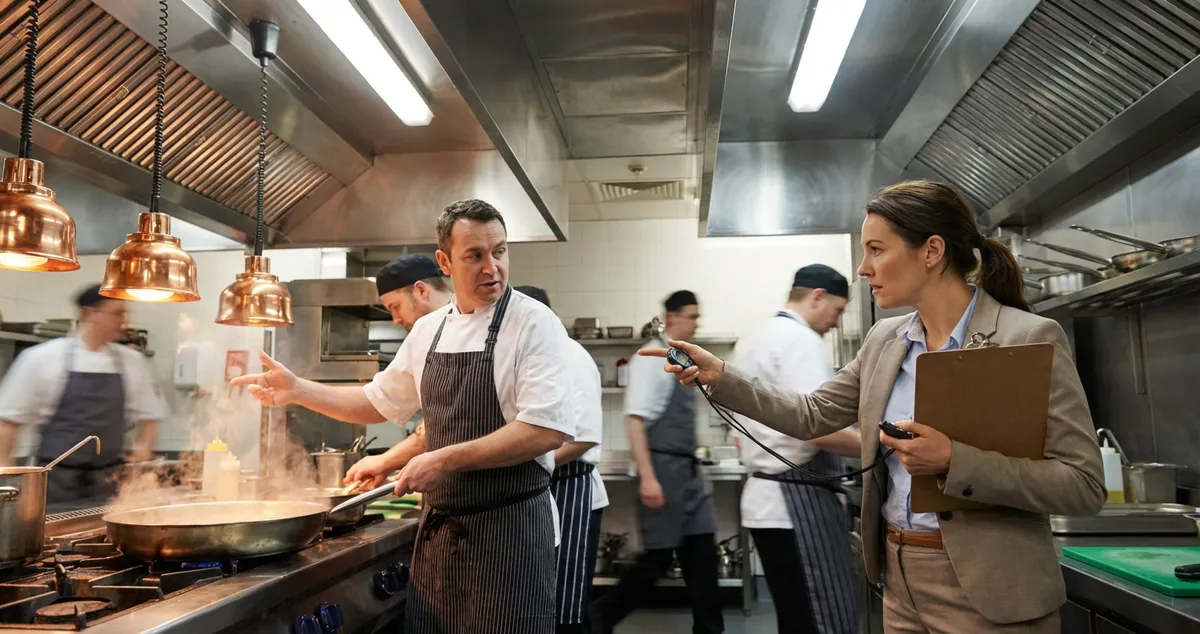
Restaurant Operations Consultant: UK Costs and Guide
What does a restaurant operations consultant do? Covers UK pricing, real examples, a practical hiring checklist, and expected ROI for restaurant owners.
 Business Growth
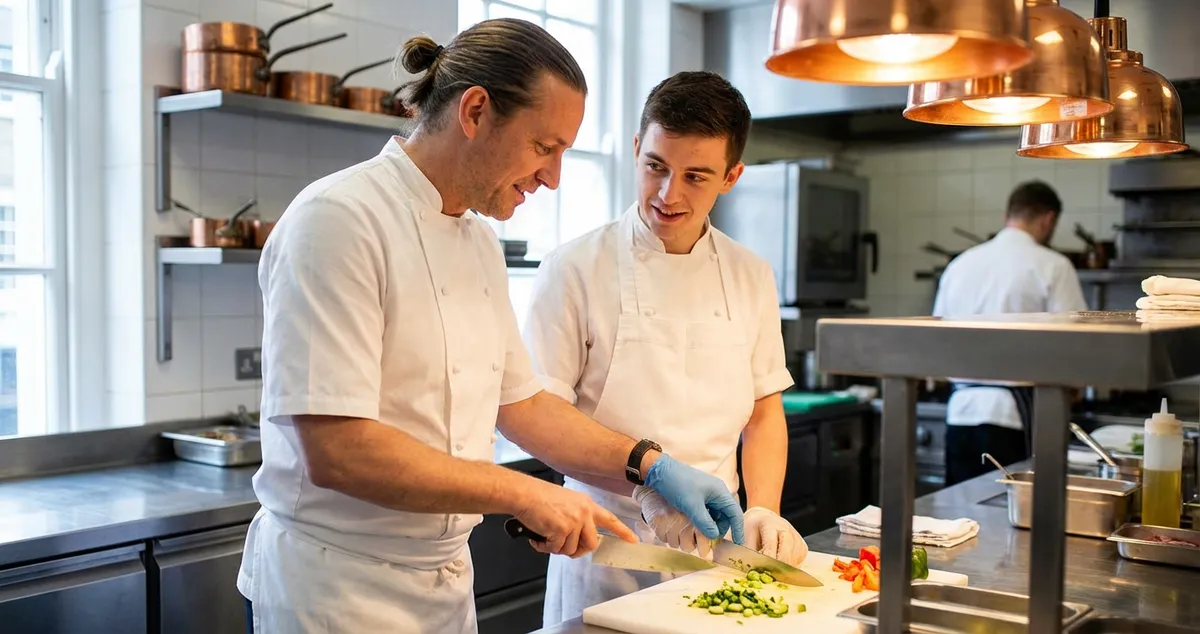
How to Train Restaurant Staff: A Practical UK Guide
How to train restaurant staff effectively with proven frameworks, the 7 steps of service, and budget-friendly methods. Practical guide for UK operators.
 Business Growth
Restaurant Staff Onboarding Checklist: Complete UK Template
Use this restaurant onboarding checklist to boost new hire retention by 82%. Covers the 5 C's of onboarding, stage-by-stage process and printable template.