
Calculate food costs, set healthy margins, and apply the 30/30/30 rule to price every dish on your restaurant menu correctly.
You spent three hours perfecting your new lamb shank recipe. The flavour is spot on. Your team loves it. But when someone asks what you'll charge, you freeze. Pick a number that feels right? Check what the place down the road charges? Hope for the best?
If you're reading this after a 12-hour shift, wondering whether your menu prices actually make sense, you're not alone. Most independent restaurant owners price their menus based on gut feeling rather than actual numbers. The result? Dishes that sell well but lose money, and profitable items that never get ordered.
Info
Related: Restaurant Menu Pricing - Complete hub guide
This guide will show you exactly how to price a restaurant menu using proven formulas and real calculations. Based on working with UK restaurant operators, you'll learn what successful establishments use to cover costs and deliver healthy margins, step by step.
What You'll Learn About Menu Pricing
- The food cost percentage formula every restaurant needs to price a restaurant menu
- How to calculate the true cost of each dish
- The 30/30/30 rule and whether it works for your restaurant
- Step-by-step approach to price a restaurant menu with real UK examples
- Pricing psychology techniques that influence customer ordering
What Is the Pricing Strategy of a Menu?
The pricing-strategy approach is a framework that helps restaurant owners set prices based on actual costs, target profit margins, and market position. Put simply, this approach replaces guesswork with data-driven decisions about what each dish should cost.
The most common approach when learning how to price a restaurant menu is cost-plus pricing. You calculate what each dish costs to make, then add a markup to ensure profit. A healthy gross profit margin for UK restaurants typically falls between 65-75%, according to UK restaurant finance experts.
But here's what many owners miss: your pricing strategy should vary by dish type. A steakhouse running 35% food costs is completely normal. A pasta-focused restaurant might aim for 28%. Desserts often run as low as 20% food cost.
If you're only pricing based on what competitors charge you'll always lose to those who understand their actual costs. That approach is a recipe for working harder while making less.
For a deeper dive into menu pricing strategies, including psychological techniques, check our complete restaurant menu pricing hub guide.
Now that you understand the strategic foundation, let's move to the practical formulas.
How Do I Calculate the Price Per Item?
With that foundation in place, let's look at the core formula. To calculate the price per item, divide your dish's ingredient cost by your target food cost percentage. This gives you the minimum menu price needed to hit your margin targets.
The formula:
Menu Price = Ingredient Cost ÷ Target Food Cost Percentage
Step 1: List all ingredients
Add up every ingredient in the dish (including garnishes, sauces, accompaniments).
Step 2: Set your target food cost
Choose your target food cost percentage (around a third for most UK restaurants).
Step 3: Apply the formula
Divide the ingredient cost by your target percentage.
Real example: Your chicken Caesar salad costs four pounds in ingredients. Targeting 30% food cost:
Four pounds divided by 0.30 gives you a minimum menu price of around thirteen pounds.
For detailed breakdown techniques, see our guide on the restaurant food cost formula.
If you're thinking "I don't have time to calculate every single ingredient," start with your top ten sellers when learning how to price a restaurant menu. These likely represent most of your sales. Get those right first.
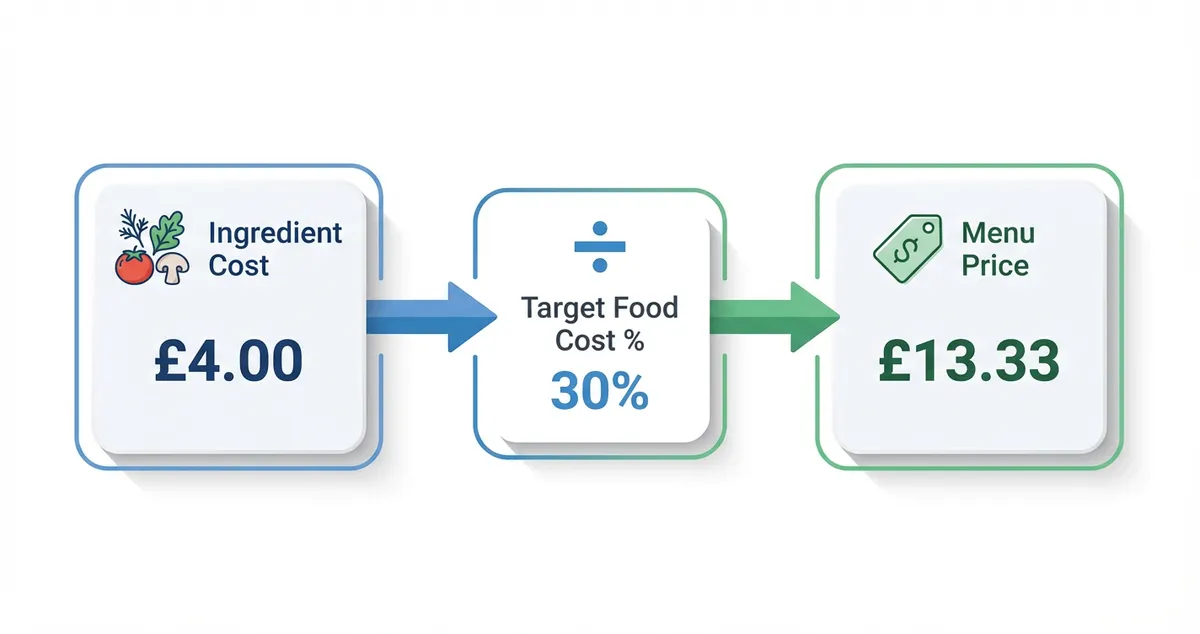
Menu Price Calculation Formula
What Is the Formula for Calculating the Margin of a Menu Item?
The margin-calculation method is a framework that reveals what percentage of each sale goes toward overheads and profit: (Menu Price - Ingredient Cost) ÷ Menu Price.
Example calculation:
Your burger sells for just under fifteen pounds with ingredient costs around four pounds.
Using the formula: (Menu Price - Ingredient Cost) ÷ Menu Price gives you roughly 70% gross profit margin. That means 70p of every pound goes toward paying rent, staff, utilities, and profit.
Margin vs. Markup: A Critical Distinction
Many restaurant owners confuse these terms when setting prices. Markup is the percentage added to cost. Margin is the percentage of the selling price that represents profit.
A dish with costs doubled (100% markup) yields only half as a margin. Understanding this difference prevents menu pricing mistakes that seem profitable on paper but aren't.
For more on calculating margins across your menu, explore our menu pricing psychology guide.
With the margin formula clear, the next step is costing each dish accurately.
How to Calculate Cost Per Dish
Now for the detailed work. Accurate dish costing requires tracking every ingredient, including the small ones you might forget. Here's a systematic approach that works whether you're pricing a simple pasta or a complex tasting menu course.
Step 1: List Every Ingredient
Include main proteins, vegetables, starches, oils, butter, seasonings, garnishes, and any sauces. The small garnishes and drizzles of oil add up across many covers.
For example, a casual Italian restaurant calculating their carbonara might list: pasta, guanciale, eggs, pecorino, black pepper, and the parsley garnish most customers don't notice.
Step 2: Calculate Ingredient Costs
When calculating menu prices, convert bulk purchase prices to per-unit costs.
| Ingredient | Purchase Price | Quantity Used | Cost Per Dish |
|---|---|---|---|
| Chicken breast | £8.50/kg | 180g | £1.53 |
| Romaine lettuce | £1.20/head | 1/4 head | £0.30 |
| Parmesan | £18/kg | 30g | £0.54 |
| Caesar dressing | £4.50/L | 40ml | £0.18 |
| Croutons | £3/bag | 25g | £0.15 |
| Total | £2.70 |
Step 3: Account for Waste and Yield
Raw ingredient weights aren't usable weights. A 200g chicken breast might yield 180g after trimming. Factor this into your calculations when setting menu prices.
Expect varying yields by ingredient type:
- Beef tenderloin yields around three-quarters usable weight
- Fish fillets from whole fish yield about half
- Vegetables typically yield most of their purchased weight after prep
Step 4: Add Preparation Labour (Optional)
Some restaurants build labour time into dish costs. If a dish requires 20 minutes of skilled prep and your chef earns £15/hour, that's £5 in labour per dish.
For comprehensive costing methods, read our restaurant portion costing guide.
Info
Related: Restaurant Food Cost Formula - Detailed costing calculations
Once you've costed individual dishes, you need a framework for your overall budget. That's where the 30/30/30 rule comes in.
What Is the 30/30/30 Rule for Restaurants?
Moving from individual dishes to overall budgeting, let's examine the 30/30/30 rule. This framework (sometimes called 30/30/30/10) allocates revenue across major expense categories: 30% food costs, 30% labour, 30% overhead, leaving 10% as profit.
The breakdown:
| Category | Target % | What's Included |
|---|---|---|
| Food Costs | 30% | Ingredients, inventory, waste |
| Labour | 30% | Wages, benefits, taxes for all staff |
| Overhead | 30% | Rent, utilities, insurance, marketing, licenses |
| Profit | 10% | What remains after expenses |
Does the 30/30/30 rule still work?
Honestly? It's a useful starting point, but it's showing its age. According to Paperchase Hospitality Accountancy, rising labour costs and energy prices have shifted these ratios for many UK operators.
A fast-casual spot might run higher food costs but lower labour. A fine dining restaurant might flip those numbers entirely. Your local market, concept, and customer base all influence what's realistic.
If you're consistently hitting the 10% profit target, your ratios are working. If not, the 30/30/30 rule helps identify which category is out of balance.
Watch for Margin Creep
If your labour costs have crept too high, you're likely overstaffed or underpriced. If food costs exceed your target, check for waste, portion creep, or supplier price increases you haven't passed on.
You've got the theory. Now let's put it into practice with a structured approach.
Step-by-Step: How to Price Your Full Menu
With the theory covered, here's how to price a restaurant menu in practice. What happens when it's a quiet Wednesday night and you're staring at a menu that hasn't been properly costed? Understanding how to price a restaurant menu starts with small, manageable steps.
If you only have 30 minutes a week, do this:
| Day | Task | Time |
|---|---|---|
| Day 1-2 | Calculate ingredient costs for top sellers | 15 min |
| Day 3-4 | Check margins using the formula | 10 min |
| Day 5-7 | Adjust one underperforming price | 5 min |
This is the fastest way to learn how to price a restaurant menu without getting overwhelmed.
Day 1-2: Calculate Your Top 5 Sellers
Pull your sales data. Which five dishes sell the most? Calculate the true ingredient cost for each using the method above.
Day 3-4: Check Your Current Margins
Use the gross margin formula on those five dishes. Are you hitting 65-70%? If any dish falls below 60%, flag it for immediate repricing.
Day 5-7: Adjust and Test
- Below 60% margin: Price increase needed
- 60-65% margin: Acceptable, monitor closely
- 65-75% margin: Healthy range
- Above 75% margin: Consider if pricing feels fair to customers
A real-world scenario:
Your fish and chips sells for £14.95 but costs £5.80 to make. That's a 61% margin. Workable, but tight.
Options to improve it:
- Raise the price by a pound (reaching a healthier margin)
- Reduce portion slightly (check it still feels generous)
- Source fish from a different supplier
- Accept lower margin but ensure high-profit sides are paired with it
If you can't tell whether your bestseller is making money or just keeping you busy, that's usually a sign your menu hasn't been properly costed.
If you're only updating prices when customers complain you'll always lose to competitors who review their margins monthly. That reactive approach never works. Once your numbers are right, keeping your menu and prices current and clearly presented means every costing tweak actually reaches customers.
Remember: customers understand costs are rising. According to the Toast Consumer Preferences Survey 2025, 73% of UK consumers prefer restaurants that show cost transparency. The UK Competition and Markets Authority guidance on pricing also emphasises transparent pricing practices. If you need to raise prices, communicate value clearly.
Beyond formulas, there's another dimension to how you price a restaurant menu effectively: psychology.
Menu Pricing Psychology That Works
Beyond the numbers, psychology plays a key role. Strategic pricing isn't manipulation. It's presenting options in ways that help customers make decisions they're happy with.
Charm Pricing (Odd-Number Endings)
Pricing at £9.95 instead of £10 triggers what researchers call "the left-digit effect." Our brains anchor to the first number we see.
For example, a casual bistro might price their burger just under the next whole pound rather than on it. Premium restaurants often use round numbers to signal quality.
Price Anchoring
Place a premium item at the top of each category. When customers see the expensive wine first, the mid-range option feels reasonable by comparison.
For instance, a steakhouse might lead their menu with their most expensive ribeye. Suddenly the moderately priced sirloin looks like excellent value.
The Decoy Effect
Offer three sizes where the middle choice looks best. Two bottles of wine at the low and high end make the expensive one seem steep. Add a premium third option and suddenly the middle choice looks sensible.
This isn't about tricking people. It's about providing context that helps customers choose confidently. These techniques are essential for effective menu pricing.
Info
Related: Menu Pricing Psychology - Deep dive into customer decision-making
Now let's bring everything together.
Key Takeaways: How to Price a Restaurant Menu
If you run a restaurant and want to see how Local Brand Hub can support your marketing, explore our restaurant marketing tools.
Key Takeaways: How to Price a Restaurant Menu
To wrap up, here's everything you need to remember. You've now got the formulas, frameworks, and psychology behind how to price a restaurant menu. Here's what matters most:
Essential Menu Pricing Points
- Food cost percentage formula: Ingredient Cost ÷ Menu Price = Food Cost %
- Menu price formula: Ingredient Cost ÷ Target Food Cost % = Menu Price
- Target food costs: 28-35% for most restaurants, with variation by dish type
- Gross profit margin target: 65-75% across your menu
- The 30/30/30 rule: Useful benchmark, but adapt it to your reality
- Start with your top sellers: Get your most popular dishes priced correctly first
If you're feeling overwhelmed, remember: learning how to price a restaurant menu doesn't require repricing everything today. Start with your five best-selling dishes. Get those margins right first.
Ask yourself: Would I confidently show my current pricing calculations to an accountant? If that question makes you uncomfortable, start with the formulas in this guide.
For more detailed strategies, explore our complete restaurant menu pricing hub, or dive deeper into portion costing and pricing psychology.
Weekly Action
This week, complete these steps:
- Pull your sales data and identify your top-selling dish
- Calculate the true ingredient cost using the costing table method
- Apply the gross margin formula to check your current margin
- If margin is below 65%, adjust the price or portion
One dish. One calculation. One decision. That's how to price a restaurant menu properly.
For UK restaurants
Need help with your restaurant marketing?
LocalBrandHub helps UK restaurant owners manage their online presence, promotions, and marketing in one place.
Start freeGet More Marketing Tips
Practical marketing tips for UK business owners, straight to your inbox. No spam, unsubscribe anytime.
About the Author
Local Brand Hub
Empowering UK Businesses
Local Brand Hub provides comprehensive business management tools designed specifically for UK local businesses to streamline operations, automate marketing, and grow revenue.
More articlesRelated Articles
 Operations
Restaurant Food Cost Formula: A Step-by-Step Guide
Master the restaurant food cost formula to protect margins. Step-by-step COGS calculation, portion costing examples, and 28-35% benchmarks.
 Operations
Restaurant Menu Pricing: UK Guide to Profitable Menus
Master restaurant menu pricing with proven formulas, food cost calculations, and psychology. Boost your profit margins with UK strategies.
 Operations
Restaurant Pricing Calculator: Set Menu Prices That Work
Use a restaurant pricing calculator to set menu prices that protect your margins. Step-by-step examples, free tools, and UK-specific guidance.