
Master the restaurant food cost formula to protect margins. Step-by-step COGS calculation, portion costing examples, and 28-35% benchmarks.
You just signed off on another delivery invoice. The lamb costs more than it did six months ago. So does the butter, the oil, and seemingly everything else. Yet when someone asks what your actual food cost percentage is, you pause. You know it matters. You just have no idea what the number actually is.
If you are thinking "I will work it out when things calm down," you are not alone. But here is the uncomfortable truth: most UK restaurants that struggle with margins are not bad at cooking. They are bad at knowing their numbers.
The restaurant food cost formula is the single most important calculation for protecting your profit margins. Most UK restaurants aim for food costs between 28-35% of revenue, according to The Caterer. Fall outside that range without knowing it, and you are giving money away with every plate that leaves the kitchen.
This guide breaks down the restaurant food cost formula step by step. You will learn how to calculate food costs, set menu prices that actually work, and spot problems before they drain your bottom line.
What You'll Learn
- The core restaurant food cost formula and how to apply it
- How to calculate your Cost of Goods Sold (COGS) accurately
- Step-by-step portion costing for individual dishes
- Industry benchmarks for different restaurant types
- Practical ways to lower food costs without sacrificing quality
How Do You Calculate Food Cost Percentage?
Let us start with the foundation. Food cost percentage tells you what portion of your revenue goes toward ingredients. The formula is straightforward:
Food Cost Percentage = (Total Food Costs / Total Food Revenue) x 100
For example, if your restaurant spent £14,000 on ingredients last month and generated £45,000 in food sales:
(£14,000 / £45,000) x 100 = 31.1% food cost
That percentage sits comfortably within the typical range that most full-service UK restaurants target. According to Orderable, this benchmark helps ensure operational sustainability while remaining competitive.
If you are pricing your menu correctly, you should already have a rough idea of what to expect before running this calculation. If the number surprises you, that is usually a sign something needs attention: whether it is supplier creep, portion drift, or waste you have not spotted yet.
For a complete guide on setting prices, see our restaurant menu pricing hub.
Food Cost Benchmarks by Restaurant Type
Not every restaurant should aim for the same percentage. Your target often depends on your concept:
| Restaurant Type | Target Food Cost |
|---|---|
| Quick Service | 20-30% |
| Casual Dining | 30-35% |
| Fine Dining | 35-40% |
| Traditional Pub Grub | 30-35% |
| Gastropub Premium | 38-40% |
Many pubs accept higher food cost because drinks compensate. The blended margin across food and beverage is what matters for your overall profitability.
So you have the percentage formula. But what happens when you need the actual pound figure you spent last month?
What is the Formula for Cost of Goods Sold?
Now that you understand food cost percentage, here's the next piece of the puzzle. The COGS formula is a framework that calculates the total value of ingredients consumed during a specific period, not just what you purchased.
While the restaurant food cost formula shows your efficiency as a percentage, COGS (Cost of Goods Sold) reveals the actual pound amount spent on ingredients during a specific period. According to Sculpture Hospitality, COGS includes everything that ends up on a customer's plate: meat, vegetables, dairy, spices, and even garnishes.
The formula requires inventory tracking:
COGS = Beginning Inventory + Purchases - Ending Inventory
Here is a worked example for January:
- Beginning Inventory (1 January): £20,000
- Purchases during January: £9,000
- Ending Inventory (31 January): £16,000
COGS = £20,000 + £9,000 - £16,000 = £13,000
This amount represents what you actually used during the month, not just what you bought. The difference matters because purchases alone do not account for what is sitting on your shelves.
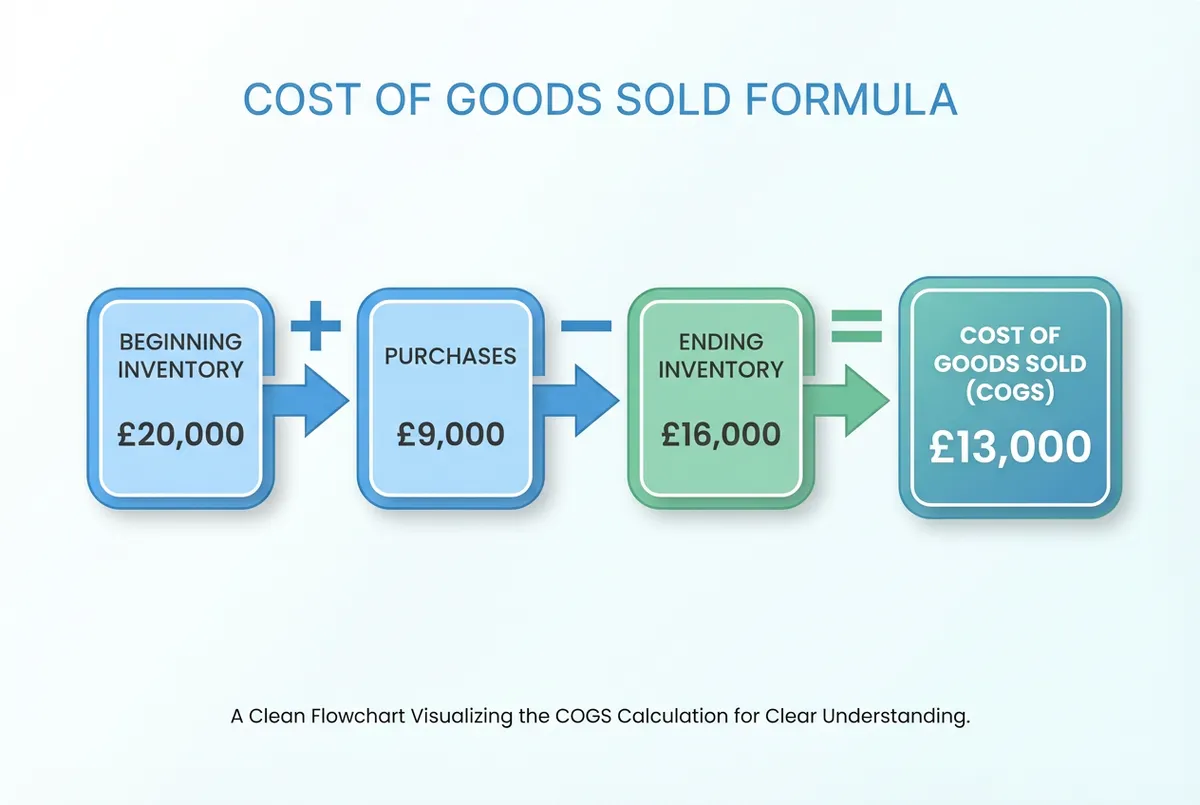
COGS Calculation Diagram
Related: How to Price a Restaurant Menu
Why Accurate Inventory Counts Matter
If you are reading this thinking "I do not have time for monthly inventory counts," you are not alone. The reality for most independent restaurants is that time is already stretched thin.
But here is the thing: even small inventory errors compound quickly. According to 7shifts, consistency and accuracy are critical because even minor miscounts lead to significant COGS miscalculations.
If you only have 30 minutes a week for food cost management, do this:
- Day 1-2: Count your five most expensive ingredients (proteins usually)
- Day 3-4: Compare purchase invoices against actual usage
- Day 5-7: Update your recipe costs for any ingredients with price changes
This minimal approach catches the biggest problems without requiring a full inventory overhaul.
With your COGS figured out, you can drill down to individual dish costs, and that is where the real insights often hide.
How Do You Calculate Portion Cost for a Dish?
Moving from the big picture to the plate level, food cost percentage works at the restaurant level, but you also need to know what each dish costs to make. This is where recipe costing comes in, and it is essential for proper menu cost calculation.
According to The Culinary Pro, recipe costing itemises every ingredient in a dish, adjusts for portion size, and sums these to find your total plate cost.
Portion Cost Formula:
Portion Cost = Recipe Cost / Number of Servings
Here is how to calculate it step by step:
- List every ingredient in the recipe, including small items like oil, seasoning, and garnishes
- Find current prices from your supplier invoices
- Convert to recipe units (if you buy flour by the 25kg sack but use 200g, calculate the cost per 200g)
- Add up all ingredient costs for the full recipe
- Divide by yield to get your cost per portion
Example: Fish and Chips Portion Cost
| Ingredient | Recipe Amount | Cost |
|---|---|---|
| Cod fillet | 200g | £2.40 |
| Chips | 250g | £0.45 |
| Batter mix | 80g | £0.20 |
| Oil (frying) | 50ml | £0.15 |
| Peas | 60g | £0.10 |
| Lemon wedge | 1 | £0.08 |
| Tartar sauce | 30g | £0.12 |
| Total Portion Cost | £3.50 |
If you sell this dish for £14.00, your food cost percentage for this specific item is:
(£3.50 / £14.00) x 100 = 25%
That is well within healthy margins. But if your cod supplier raises prices by 20%, that same dish suddenly costs £3.98 to make, pushing food cost to 28.4%. You would need to adjust portions, pricing, or sourcing to maintain profitability.
Related: Restaurant Portion Costing
The Q Factor: Do Not Forget the Extras
According to Restaurant Food Costing research, the Q Factor represents costs of extras that are easy to overlook: salt, pepper, condiments, bread baskets, garnishes, and waste from overproduction.
The Q Factor typically adds 5-10% to your food costs and can reach £3 per plate in sit-down restaurants. If your recipe costs look perfect but your overall food cost percentage is still too high, untracked extras are often the culprit.
For instance, a neighbourhood Italian might find that the complimentary bread basket, olive oil, and Parmesan shavings add £0.85 per cover. Over 200 covers a week, that is £170 in uncounted food cost.
Once you know your true portion costs, setting prices becomes straightforward rather than guesswork.
How to Set Menu Prices Using Food Cost
With your portion costs in hand, you can now work backwards to set profitable menu prices using the restaurant food cost formula in reverse:
Menu Price = Portion Cost / Target Food Cost Percentage
If your portion cost is £5.17 and you want a 33% food cost:
£5.17 / 0.33 = £15.67 minimum menu price
This is your floor, not your ceiling. You can charge more based on perceived value, competition, and demand. The formula simply ensures you do not sell at a loss.
Quick Pricing Multiplier
For a faster approach, many operators use a multiplier. A 3x multiplier gives you roughly 33% food cost:
£5.17 x 3 = £15.51
Close enough for quick pricing decisions, though you should verify with the exact restaurant food cost formula for high-volume dishes.
For example, a casual dining restaurant using the multiplier might price their chicken parmigiana at a healthy margin, giving them target food cost and solid gross profit per plate.
Related: How to Price a Restaurant Menu
Food cost is only half the equation, though. What about labour?
Prime Cost: The Bigger Picture
However, food cost alone does not tell the full story. Industry guidance suggests prime cost (food plus labour) should not exceed 60-65% of total sales, according to Restaurant365. Above this, there is not enough left for rent, utilities, and profit.
Prime Cost Formula:
Prime Cost = Food Costs + Labour Costs
Prime Cost Percentage = (Prime Cost / Total Revenue) x 100
If food costs rise, labour must fall (or vice versa) to maintain prime cost. This is why cost control matters across both areas simultaneously.
For instance, a casual dining restaurant might have weekly revenue of £10,000 with combined food and labour costs of £6,000. That is on the upper edge but still viable. Push labour higher without adjusting food cost, and prime cost exceeds the threshold, squeezing out the margin you need for rent and profit.
With the National Living Wage rising to £12.71 per hour from April 2026, according to UK Government announcements, labour pressures are increasing. Understanding your restaurant food cost formula gives you the data to make smarter trade-offs between food and labour spending.
If you can't tell whether your food cost or labour cost is the bigger problem, that's usually a sign you need to track both weekly rather than monthly.
The restaurant food cost formula gives you the data to make informed trade-offs. Without it, you are just guessing.
Practical Ways to Lower Food Cost Percentage
Now that you understand the formulas, let us turn to action. Knowing your numbers is step one. Improving them is step two. Here are strategies that work without compromising quality:
Reduce Waste
- Conduct weekly waste audits to identify what gets thrown out
- Use FIFO (First In, First Out) stock rotation
- Repurpose trim and off-cuts into specials or staff meals
Optimise Portions
- Weigh ingredients during prep to ensure consistency
- Train kitchen staff on exact portion sizes
- Use portion control tools (scoops, ladles with known volumes)
Negotiate with Suppliers
- Compare prices across 2-3 suppliers quarterly
- Consolidate orders to qualify for volume discounts
- Ask about seasonal promotions or case-break pricing
Menu Engineering
- Promote high-margin dishes through menu placement
- Remove or rework consistently low-margin items
- Test price elasticity on popular dishes (small increases often go unnoticed)
Menu engineering is far easier when every dish, its cost, and its price live in one place rather than scattered spreadsheets: you can manage your menu and offers as a single source of truth. For instance, a gastropub that switched from pre-portioned chips to weighing each serving saved £180 per week with no customer complaints.
If you're only checking food costs when margins feel tight, you'll always lose to competitors who treat the restaurant food cost formula as part of daily operations rather than an afterthought.
These strategies work best when you avoid the common pitfalls below.
Common Food Cost Mistakes to Avoid
Additionally, even with the right formulas, these common pitfalls can undermine your restaurant food cost formula calculations.
Not Updating Recipe Costs Regularly
Ingredient prices change constantly. If you last calculated your fish and chips cost more than six months ago, your margins have almost certainly shifted. This sounds obvious in theory. In practice, when you are down two staff and trying to get through a busy Friday, updating a spreadsheet feels like a luxury.
Review recipe costs quarterly at minimum, or whenever supplier prices change significantly.
Ignoring Theft and Pilferage
If your calculated food cost percentage does not match your actual numbers, the gap might not be waste. Staff meals, over-portioning, and theft add up. Inventory controls and spot-checks help identify problems.
Mixing Food and Beverage Revenue
Always calculate food cost percentage using food revenue only, not total sales. Including bar takings artificially lowers your food cost percentage and masks problems. That never works in the long run because you cannot fix what you cannot see.
Assuming All Dishes Should Have the Same Margin
A higher-priced steak generates more absolute profit than a lower-priced pasta, even at the same food cost percentage. Volume and absolute margins matter alongside percentages.
The reality for most independent restaurants is that some dishes will always be loss leaders while others carry the margin. The restaurant food cost formula helps you see which is which.
Key Takeaways: Restaurant Food Cost Formula
If you run a restaurant and want to see how Local Brand Hub can support your marketing, explore our restaurant marketing tools.
Restaurant Food Cost Formula Summary
Finally, let's summarise everything we have covered. The restaurant food cost formula is your foundation for profitable menu pricing. Here is what to remember:
- Food Cost Percentage = (Total Food Costs / Total Food Revenue) x 100
- Target range: 28-35% for most UK restaurants (varies by concept)
- COGS = Beginning Inventory + Purchases - Ending Inventory
- Portion Cost = Recipe Cost / Number of Servings
- Menu Price = Portion Cost / Target Food Cost Percentage
- Track the Q Factor (5-10% extras) to avoid hidden cost creep
- Keep prime cost under 60-65% to leave room for profit
If you take nothing else from this guide, start calculating your food cost percentage monthly. That single number tells you whether your pricing, portions, and purchasing are working together or fighting each other.
For the complete framework on menu pricing strategy, return to our restaurant menu pricing guide.
LocalBrandHub helps independent restaurants build consistent marketing systems that bring in more customers every week. Start with the fundamentals, like knowing your numbers, and you will have the confidence to price your menu for profit.
Get More Marketing Tips
Practical marketing tips for UK business owners, straight to your inbox. No spam, unsubscribe anytime.
About the Author
Local Brand Hub
Empowering UK Businesses
Local Brand Hub provides comprehensive business management tools designed specifically for UK local businesses to streamline operations, automate marketing, and grow revenue.
More articlesRelated Articles
 Operations
How to Price a Restaurant Menu: A Step-by-Step UK Guide
Calculate food costs, set healthy margins, and apply the 30/30/30 rule to price every dish on your restaurant menu correctly.
 Operations
Restaurant Menu Pricing: UK Guide to Profitable Menus
Master restaurant menu pricing with proven formulas, food cost calculations, and psychology. Boost your profit margins with UK strategies.
 Operations
Restaurant Pricing Calculator: Set Menu Prices That Work
Use a restaurant pricing calculator to set menu prices that protect your margins. Step-by-step examples, free tools, and UK-specific guidance.