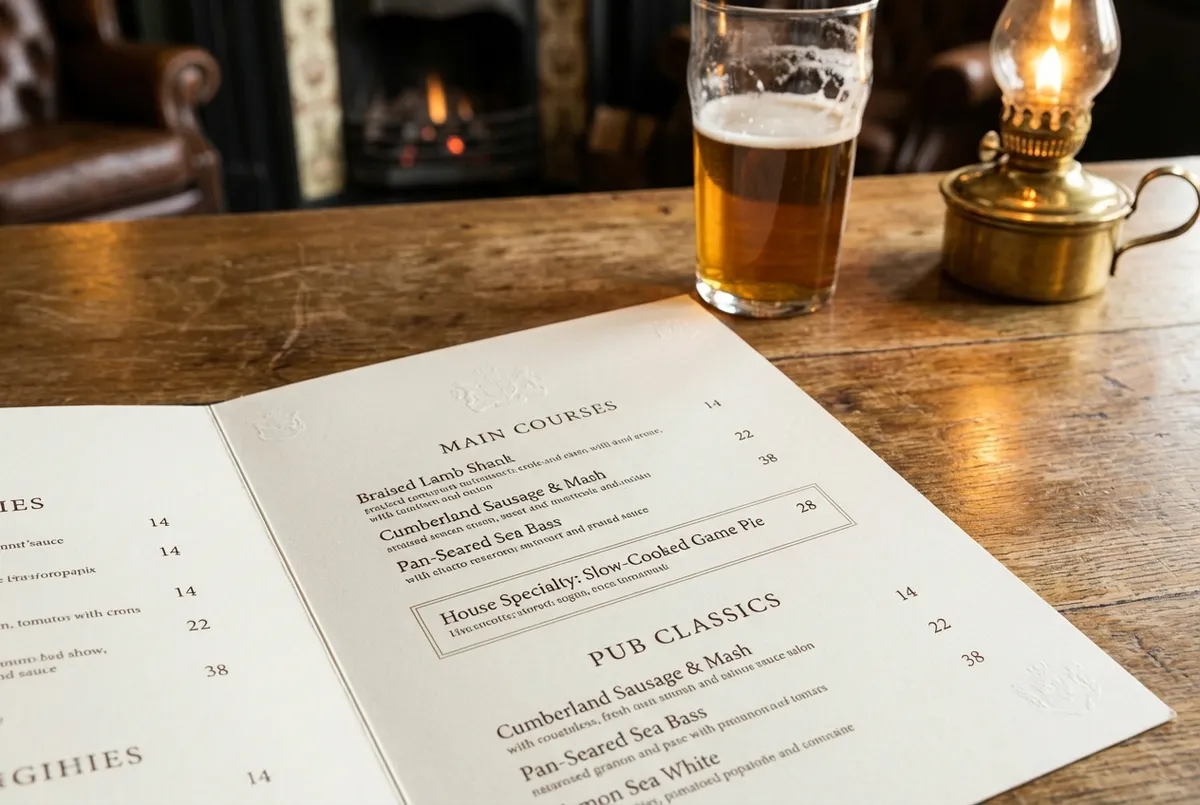
Master menu pricing psychology with anchoring, charm pricing, and the golden triangle. Proven Cornell techniques to boost restaurant profits.
You have spent hours perfecting your recipes and calculating food costs down to the penny. Yet somehow, customers keep ordering the lowest-margin dishes on your menu while ignoring the items that actually make you money. The problem is not your food. It is how you present your prices on the page.
Menu pricing psychology is the science of how visual cues, number formatting, and strategic placement influence what customers order. Research from Cornell University shows that diners given menus without pound signs spent significantly more than those who saw traditional pricing formats. A single design choice changed customer behaviour and boosted average spend.
Info
Related: Restaurant Menu Pricing
In this guide, you will learn the specific psychological techniques that influence ordering decisions, from charm pricing to the golden triangle. These are the same principles used by restaurant chains to boost average spend.
What you'll learn:
- Why customers perceive £8.99 as closer to £8 than £9
- How the decoy effect guides diners toward higher-margin items
- Where to place dishes for maximum visibility
- Practical changes you can make to your menu this week
If you find yourself wondering whether any of this actually applies to your restaurant, you have likely been focused on food quality while overlooking presentation.
What Is the Psychology Behind Menu Design?
The psychology behind menu design is a framework that uses visual cues, price formatting, and strategic item placement to guide customer purchasing decisions. It combines behavioural economics with practical restaurant operations to create menus that naturally direct diners toward profitable choices without feeling manipulative.
This approach works because human brains take mental shortcuts when making decisions. When faced with dozens of options and unfamiliar prices, customers rely on contextual cues to determine value.
Menu Engineering Insight
Menu engineers deliberately structure these cues to influence behaviour in predictable ways.
William Poundstone, author of Priceless: The Hidden Psychology of Value, calls menu engineers "masters of misdirection" who offer the shortcuts our brains naturally seek. Rather than manipulating customers, effective menu psychology helps them navigate choices more easily while increasing your margins.
For example, a bistro in Manchester repositioned its highest-margin main course from the bottom of the menu to the centre-right position and saw orders for that dish increase noticeably within two weeks, without changing the recipe or price.
The Role of Anchoring
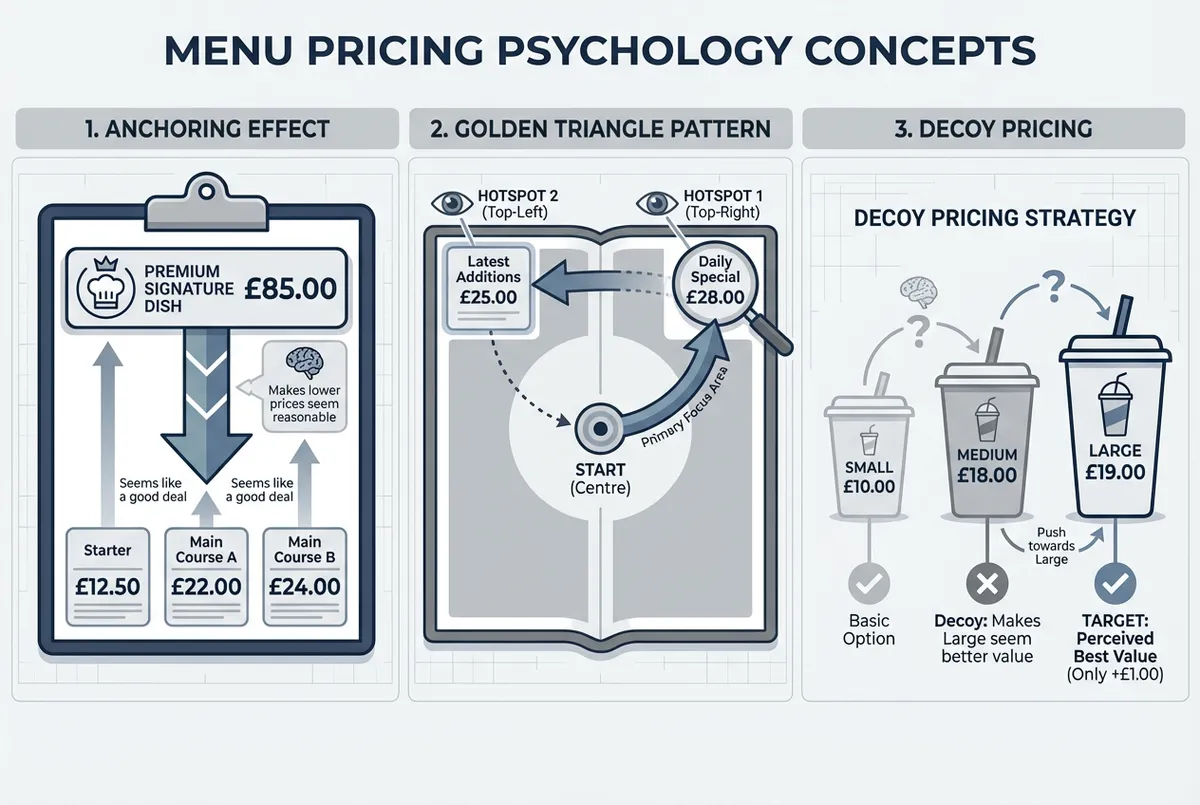
With that foundation in mind, let us explore the first key technique. When customers first open your menu, the initial price they see becomes their reference point for everything that follows. This is called anchoring.
Research from Emerald Publishing found that when promotional materials contain a more expensive option offering higher value than a decoy alternative, consumers tend to choose the pricier option in greater percentages. The high anchor makes mid-range prices seem reasonable by comparison.
Poundstone describes this perfectly: "The main role of that £115 platter, the only three-digit thing on the menu, is to make everything else near it look like a relative bargain."
What Is the Psychology of Pricing?
Moving on from design principles, the psychology of pricing is a framework that examines how numbers, formatting, and presentation affect perceived value. In restaurants, small changes to how prices appear can shift customer behaviour significantly, often without customers realising why they made a particular choice.
Info
Related: Restaurant Menu Pricing Strategy
Charm Pricing: The Power of 9
As a result of how our brains process numbers, charm pricing has become one of the most widely used techniques. Charm pricing involves ending prices with 9, such as £9.99 instead of £10. This technique works because our brains process numbers left to right, giving disproportionate weight to the first digit we see.
According to research from the Journal of Consumer Research, charm pricing works when the leftmost digits differ. Customers perceive £4.99 as meaningfully cheaper than £5.00, even though the difference is just one penny.
Charm Pricing Impact
Capital One Shopping research found that charm pricing can increase sales by as much as 60 percent, with a minimum lift of 24 percent when implemented correctly.
A fish and chip shop using £8.99 rather than £9.00 for a cod meal could see meaningful order increases simply from this one-penny adjustment. If you are developing your first pricing approach, our guide on how to price a restaurant menu covers the fundamentals.
When to Avoid Charm Pricing
However, charm pricing is not always the right choice. In upmarket restaurants, prices like £9.99 can undermine the premium positioning you are trying to create.
Warning
Research suggests overusing this technique reduces its effectiveness.
If you are thinking "I could just price everything at .99," you are not alone, but balance matters. For fine dining or establishments focused on quality perception, round numbers (£25, £30) signal confidence in your offering. Match your pricing format to your brand positioning.
What Is the Pricing Strategy of a Menu?
Building on these pricing principles, let us examine how to combine them into a cohesive strategy. A menu pricing strategy is a framework that combines cost-based calculations with psychological positioning to maximise both revenue and profit margins. Effective strategies use multiple techniques together rather than relying on a single approach.
The Decoy Effect
In addition to anchoring and charm pricing, the decoy effect is another powerful technique.
Decoy Effect Explained
The decoy effect involves introducing a third option that makes your preferred choice more attractive.
Research published in the International Hospitality Review confirms that consumers use decoys as anchor points to make choices that benefit hospitality businesses. Here is how it works in practice:
| Size | Price | Purpose |
|---|---|---|
| Small | £10 | Entry option |
| Medium | £18 | Target (highest margin) |
| Large | £19 | Decoy (makes medium look sensible) |
The large option at £19 is only £1 more than medium but seems like poor value. Customers gravitate toward the medium, which happens to carry your best margin. According to studies cited by industry sources, when a decoy is present, customers are significantly more likely to choose higher-margin items.
Testing Your Menu
If you can't tell whether your current menu drives orders or just looks attractive, that's usually a sign the design needs testing.
Strategic Category Ordering
Furthermore, the order in which you present menu categories matters significantly. Research from Cornell University's Hospitality Research centre found that when higher-priced menu sections appear first, spending in subsequent categories increases by an average of 8.2 percent.
This works because the expensive items set expectations. After seeing £45 steaks, a £22 pasta suddenly feels affordable.
Menu Pricing Psychology Framework
What Influences Menu Pricing?
With pricing techniques covered, let us turn to the visual and structural factors that shape customer responses. Multiple elements influence how guests respond to menu prices, from layout design to currency formatting.
Remove Currency Symbols
Cornell University research demonstrated that diners at upscale restaurants spent 8 percent more when menus displayed prices as standalone numbers without pound signs or the word "pounds."
The psychology is straightforward: currency symbols trigger associations with spending money. An appetiser listed as 14 rather than £14 is not immediately perceived as a purchase. For instance, a wine bar might list a glass of Chablis simply as "12" rather than "£12.00": the number feels less like a transaction.
Even writing out "fourteen pounds" reduced spending compared to just using the number. The goal is removing friction between the customer and the order.
Know Your Audience
This technique often works well in mid-range to upmarket settings. For casual dining where customers expect clear pound signs, removing them may cause confusion rather than increased spending.
The Golden Triangle
Consequently, where you place items matters as much as how you price them. Eye-tracking research reveals a consistent pattern in how guests navigate menus. Known as the "golden triangle," this pattern starts at the centre of the menu, moves to the top right, then shifts to the top left.
Items placed within this triangle receive significantly more attention than those positioned elsewhere. According to menu design research, restaurants have only a brief window before customers decide what to order. Your most profitable dishes need to be visually apparent within that window.
Applebee's reportedly saw their average order value increase by placing high-profit items in these visual hotspots combined with price anchoring. A curry house applying this principle might position their signature lamb biryani (high margin, crowd favourite) in the centre-right rather than burying it among side dishes.
Visual Isolation
Similarly, the space around menu items influences attention. If a menu is crowded with text, eyes naturally gravitate to open spaces. Menu designers use this by giving high-margin items room to breathe: boxes, borders, or simply more white space around the description.
If you are planning price increases, our guide on restaurant menu price increase strategies explains how to implement changes without losing customers.
Menu Pricing Psychology in Practice
With the fundamentals covered, let us turn to real-world application. Understanding theory is useful. Applying it during a quiet Wednesday night after a 12-hour shift is another matter entirely.
If you are thinking "I don't have time for a complete menu redesign," you are not alone. The reality for most independent restaurants is that margins are tight and hours are long. Here is a practical approach that respects your constraints.
Real-World Example: The Gastropub Test
A gastropub might apply these principles by:
- Anchoring: Adding a premium sharing board at £45 to make £24 mains seem reasonable
- Decoy: Offering a 175ml wine pour at £7.50 and 250ml at £8.50 (the larger glass suddenly looks like better value)
- Golden triangle: Positioning the signature pie (high margin, popular) in the centre-right of the main menu
This is not about tricking customers. It is about presenting your menu in a way that helps them make decisions while ensuring your business stays profitable.
Track item-level sales data before and after any changes to understand whether your design is working.
Colour Psychology
Menu colours influence ordering behaviour. Research suggests:
- Green implies freshness
- Orange stimulates appetite
- Yellow attracts attention
- Red encourages action and is often used for high-margin items
Consider whether your current design supports or undermines your pricing strategy.
Info
Related: How to Price a Restaurant Menu
If You Only Have 30 Minutes This Week
Now that you understand the principles, here is how to apply them with minimal time investment. Not everyone has time for a complete menu overhaul. This is a minimum viable approach.
If you only have 30 minutes a week, do this:
[ ] Day 1-2: Audit your current menu
- Check where your highest-margin items sit. Are they in the golden triangle?
- Count how many prices end in .99 versus round numbers
[ ] Day 3-4: Make one strategic change
- Add a premium anchor item to your highest-value category
- OR remove pound signs from your prices
- OR create white space around your best-margin dish
[ ] Day 5-7: Monitor the results
- Track orders for your target items
- Note any customer comments on the changes
For example, a pizzeria owner might spend Tuesday evening reviewing their current menu layout, Wednesday adjusting the position of their highest-margin Quattro Formaggi pizza, and then track orders through the weekend rush.
Small, tested changes beat a dramatic redesign you never get around to implementing. If you're only updating prices when suppliers force you to, you'll always lose to competitors who treat their menu as a living document, and keeping your menu and offers in one place makes those small tweaks painless.
Key Takeaways: Menu Pricing Psychology
If you run a restaurant and want to see how Local Brand Hub can support your marketing, explore our restaurant marketing tools.
Key Takeaways: Menu Pricing Psychology
To summarise what we have covered, menu pricing psychology is not about manipulation. It is about understanding how customers make decisions and presenting your offerings in a way that works for both parties.
The research is clear: small formatting changes influence behaviour. Removing currency symbols, using charm pricing appropriately, and positioning items strategically can meaningfully impact your average order value.
Here is what every restaurant owner should remember: your menu is not just a list of dishes. It is a sales tool that works for you 24 hours a day.
Summary:
- Anchoring sets price expectations: lead with premium items
- Charm pricing (£9.99) works best when left digits differ
- The decoy effect guides customers toward your preferred options
- The golden triangle determines where eyes focus first
- Currency symbols trigger spending associations
- Visual isolation draws attention to key dishes
Would you order from your own menu based purely on how it looks? Would I follow my own pricing strategy? If those questions make you uncomfortable, you already know where to start.
If you are serious about restaurant menu pricing strategy, these psychological principles should inform every design decision you make.
Weekly Action
This week, pick one technique from this guide and apply it to your menu:
- Move your highest-margin dish to the golden triangle position
- Test charm pricing on three items and track results
- Remove pound signs from your printed menu for one week
Start with one change. Test it. Measure the results. Then build from there.
Last updated: February 2026. This article was fact-checked using research from Cornell University, the International Hospitality Review, and industry pricing studies.
Get More Marketing Tips
Practical marketing tips for UK business owners, straight to your inbox. No spam, unsubscribe anytime.
About the Author
Local Brand Hub
Empowering UK Businesses
Local Brand Hub provides comprehensive business management tools designed specifically for UK local businesses to streamline operations, automate marketing, and grow revenue.
More articlesRelated Articles
 Operations
Restaurant Menu Pricing Strategy: 7 Methods for 2026
Master restaurant menu pricing strategy with the 5 C's framework and 7 proven pricing methods. UK guide to maximise your margins and profits.
 Marketing Tips
Menu Pricing Calculator: Set Restaurant Prices for Profit
Menu pricing calculator guide for UK restaurants. Set profitable dish prices, target 65-75% margins with proven formulas.
 Operations
Restaurant Menu Pricing: UK Guide to Profitable Menus
Master restaurant menu pricing with proven formulas, food cost calculations, and psychology. Boost your profit margins with UK strategies.