
How the Boss Your Salon pricing calculator by Maddi Cook works, what inputs it needs, and the DIY treatment pricing formula every salon owner needs.
You're charging £35 for a gel manicure. Your products cost £4. You're busy most days. So why does the end of the month feel tight? Because that £35 covers your polish, not your time, your rent, or the clean-up. The boss your salon pricing calculator builds price from actual costs up.
What you'll learn:
- What a salon pricing calculator is and how it works
- How the Boss Your Salon pricing calculator structures your costs
- Alternative pricing tools worth knowing
- The DIY pricing formula you can use without any tool
- The four most common calculator mistakes, and how to avoid them
- How to calculate one real treatment price this week
What Is a Salon Pricing Calculator?
A salon pricing calculator is a tool, usually a spreadsheet or web-based form, that works out the minimum price you need to charge for each treatment to cover your costs and make a profit. The salon pricing calculator is a framework that helps you build prices from four real inputs:
- Product cost: the actual materials used per treatment
- Labour cost: your time, priced at your target hourly rate
- Overhead allocation: a proportional share of rent, utilities, insurance
- Profit margin: the percentage you add on top to grow or reinvest
Without all four components, you're not pricing a treatment. You're guessing at it. Most beauty salon owners who underprice do so because they're only counting products, not time or fixed costs.
A nail bar owner, for instance, might price a gel set based on the cost of gel and base coat, completely overlooking 50 minutes of labour, a share of the salon's rent, and the UV lamp that needs replacing periodically. That's not a minor oversight. That's the difference between a treatment that earns money and one that quietly loses it.
A solid beauty salon pricing strategy starts with understanding what each treatment actually costs to deliver. A pricing calculator is the fastest way to get there.
How the Boss Your Salon Calculator Works
Now that you understand what a pricing calculator does, here's how the boss your salon pricing calculator specifically is structured. It was created by Maddi Cook, a UK-based salon business coach (available at bossyoursalon.com and maddicook.com). It's built specifically for beauty salon and nail bar owners who feel confident with clients but less confident with numbers.
The calculator is a structured spreadsheet that guides you through four cost layers for each treatment.
1. Product cost per treatment
You enter the cost of every product used: the gel polish, prep solution, acetone, wipes. Not the bottle price. The per-treatment cost, calculated by dividing the total bottle cost by the number of treatments it covers.
- A nail technician might find a £18 bottle of gel covers 30 sets
- That makes the product cost roughly £3 per appointment
- Add base coat, wipes, and prep solution, and the total product cost is typically £3.50 to £5 for a gel manicure
2. Labour cost
You enter how long the treatment takes and your target hourly wage. The calculator multiplies these together. This is the uncomfortable realisation for many salon owners: if a gel manicure takes 60 minutes and you want to earn £20 per hour, that's £20 in labour alone, before a single product is counted.
3. Overhead allocation
You enter your total monthly overhead costs, rent, utilities, software, insurance, professional memberships, and the calculator divides that across your available treatment hours. This gives each treatment a fair share of your fixed costs to carry.
- A beauty therapist with £900 per month in overheads and 90 booked hours carries £10 overhead per treatment hour
- A 45-minute treatment carries £7.50 in overhead
4. Profit margin
Once the three costs are totalled, you apply a profit percentage on top. This isn't bonus money in your pocket. It's what funds equipment upgrades, training courses, marketing, and the slow rebooking periods.
The output is your minimum viable price: what you need to charge to break even with a margin. The boss your salon pricing calculator is particularly useful when reviewing your beauty salon pricing after a period of working from intuition rather than numbers.
Other Salon Pricing Calculators Worth Trying
However, Boss Your Salon isn't the only option. Depending on how you prefer to work, these alternatives may suit you:
- NHBF: annual pricing benchmarks for member salons
- Fresha / Treatwell: market rate comparison vs local salons
- BABTAC: pricing guidance for members
- DIY spreadsheet: fully customisable, free to build
Quick comparison: All four options work. The key difference is whether you want a ready-made framework (Boss Your Salon, NHBF) or want to build your own from scratch.
| Tool | Suited To | Cost |
|---|---|---|
| Boss Your Salon calculator | UK salon owners wanting a guided spreadsheet | Paid |
| NHBF benchmarks | Market rates by treatment type and region | Members |
| Fresha / Treatwell | Competitive positioning vs local salons | Free |
| BABTAC resources | Independent therapists, aesthetics clinics | Members |
| DIY spreadsheet | Full customisation for your product mix | Free |
NHBF Price Guide Tools
The National Hair and Beauty Federation (nhbf.co.uk) publishes annual pricing benchmarks and guidance for member salons. It gives useful context for UK market rates by treatment type and region.
- A beauty therapist unsure whether her lash lift prices are competitive could use NHBF benchmarks as a sanity check against her calculated minimum
Salon-Specific Booking Software
Platforms like Fresha and Treatwell include pricing analysis features that compare your treatment prices against local market rates. They won't run a cost-building formula, but they show you where you sit competitively. See our guide to salon software pricing for how these tools work.
BABTAC Resources
The British Association of Beauty Therapy and Cosmetology (babtac.com) offers business support for members, including pricing guidance for independent beauty therapists and aesthetics clinics.
- If you're already a BABTAC member, the pricing guidance section is a useful starting point before building your own calculator
Free Spreadsheet Templates
Search "salon treatment pricing spreadsheet" and you'll find free Google Sheets templates that replicate the same four-cost formula. Building your own gives you full control and lets you adapt it for your specific product mix.
None of these replace the need to sit down and work through your own numbers, but they reduce the barrier to starting. For instance, a nail technician who uses Boss Your Salon alongside NHBF benchmarks gets both the cost-building formula and the market context, a more complete picture than either gives alone.
The DIY Pricing Formula Every Salon Owner Should Know
Here's the thing: you don't need the boss your salon pricing calculator specifically to price correctly. You need the formula. Here it is:
Treatment Price = Product Cost + Labour Cost + Overhead Contribution + Profit Margin
Why this matters: Most salon owners have never added up all four components. The result is often surprising: treatments that feel profitable are running at thin or negative margins.
Let's run through a worked example: a 45-minute gel manicure at a nail bar.
- Product: Gel polish, prep solution, wipes, roughly £3.50 per treatment
- Labour: 45 minutes at £18/hr = £13.50
- Overhead: £5.00 (based on £800/month overheads, 120 booked hours)
- Subtotal before margin: £22.00
| Component | Calculation | Amount |
|---|---|---|
| Product cost | Gel polish, prep, wipes per treatment | £3.50 |
| Labour cost | 45 min × £18/hr target wage | £13.50 |
| Overhead contribution | £800/month ÷ 120 booked hours × 0.75 hr | £5.00 |
| Subtotal | £22.00 | |
| Profit margin (20%) | £22.00 × 0.20 | £4.40 |
| Minimum price | £26.40 |
If you're charging £27 for a gel manicure, you're marginally above the minimum. If you're charging £20, you're losing money on every booking, not making it.
How to calculate your overhead contribution, step by step:
- Add up all monthly fixed costs: rent, utilities, insurance, software, professional memberships
- Calculate your available treatment hours per month (working days × daily hours)
- Apply a realistic utilisation rate: a practical planning figure for a busy independent beauty salon is 70 to 75% (not every hour is booked)
- Divide your monthly overhead by your utilised hours to get the overhead cost per hour
- Multiply by the treatment time to get the overhead contribution for that specific service
For a deeper look at building a complete pricing structure, see our beauty salon business plan guide, which covers how pricing fits into your overall revenue model.
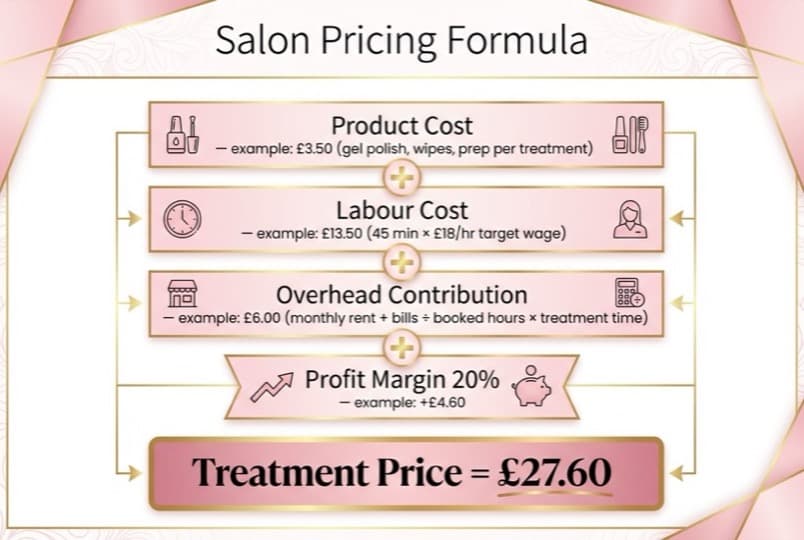
The four-component salon pricing formula with a worked example
When a Calculator Gets It Wrong
Additionally, pricing calculators are only as good as the numbers you put in. There are four ways the output commonly misleads:
Using aspirational hours, not actual hours
If you're only ever calculating from your best weeks you'll always undercharge the rest of the time. That's usually a sign your pricing review needs to start with your real average booking rate. If you tell the boss your salon pricing calculator you're booked 35 hours a week but you're actually booked 20, each treatment carries less overhead than it should, and your prices end up too low.
Forgetting hidden product costs
A gel manicure doesn't just use polish and base coat. It uses:
- Wipes and cotton pads
- Nail files (replace regularly)
- A UV lamp that wears out and needs replacing
- Gloves and foil for removal
A beauty salon that prices only from visible products may find real margins are significantly lower than expected once all consumables are counted.
Pro tip: Create a consumables list for each treatment. Include every item used, even if it feels minor. The small things add up quickly.
Setting the wrong target wage
The tricky part is this: many beauty therapists set their target hourly rate at what they used to earn as an employee, without accounting for their own tax, National Insurance, and pension contributions.
- If you're self-employed, your target rate needs to be meaningfully higher than your employed equivalent to achieve the same take-home pay
- As a rough guide, add 20 to 25% to your old employed hourly rate to cover self-employed tax obligations
If you're thinking "this sounds complicated," you're not alone. Most salon owners were trained in beauty, not bookkeeping.
Not revisiting prices as costs change
If you're only repricing treatments you'll always be behind on margin. Product prices rise. Rent increases. A pricing review every six months keeps your margins where they should be. For example, a beauty salon that set its prices in spring and reviewed again in autumn might find that product costs alone have risen by 8 to 12%, eating into every margin calculation it made six months earlier. Our hair salon pricing guide shows how this same formula applies across a broader range of service types.
Calculate One Treatment Price This Week
You don't need to reprice your entire menu this week. Here's a structured approach for a busy beauty therapist who has 30 minutes spare:
If you only have 30 minutes this week, do this:
- Day 1-2: Choose your most booked treatment. Write down every product you use: bottle cost and rough number of treatments per bottle. For example, a lash tint: tint tube costs £8, covers 20 appointments = £0.40 product cost per treatment.
- Day 3-4: Add up your monthly fixed costs: rent, insurance, software, utilities. Divide by your realistic booked hours this month to get your overhead per hour.
- Day 5-7: Apply the boss your salon pricing calculator formula: Product Cost + Labour + Overhead + 20% margin. Compare the result to what you charge.
If your current price is lower than the calculated minimum, that's useful information, not a crisis. You know exactly how much of a gap exists and can plan how to close it.
Options for closing a pricing gap:
- Raise prices gradually (10 to 15% increments) with existing clients
- Apply new prices to new clients only for 3 to 6 months
- Reposition the treatment: add a premium element to justify the increase
Pricing is also part of your beauty salon marketing strategy. Once the numbers behind each treatment stack up, you can work out how much time you'd save on your marketing too. A price increase handled thoughtfully rarely loses the clients worth keeping. The ones who leave for a cheaper option weren't valuing your skill; they were valuing the discount.
Ask yourself: would I book a treatment at my own salon knowing what it actually costs to deliver? If your answer is "only because it's cheap," that's the clearest sign a pricing review is overdue.
The boss your salon pricing calculator is a well-built starting point for UK salon owners. But the formula behind it is simple enough to run in a spreadsheet or on paper. What matters isn't the tool. It's that you use your real numbers, not guesses.
For restaurants, salons, and local businesses
Need help with your marketing?
We help UK businesses turn social media into real results, not busywork.
Start freeKey Takeaway
Key takeaways:
- A salon pricing calculator is a framework that builds treatment prices from four inputs: product cost, labour, overhead, and profit margin
- The boss your salon pricing calculator by Maddi Cook is a structured spreadsheet tool designed for UK beauty and nail salon owners
- The DIY formula (Product + Labour + Overhead + Profit Margin = Treatment Price) works without any specific tool
- Common errors include using optimistic booked hours, missing hidden product costs, and not revisiting prices as costs change
- Start with your most popular treatment this week and compare the calculated minimum against what you currently charge
Ready to build a complete pricing structure? Our beauty salon pricing strategy guide covers menu design, competitor positioning, and how to raise prices without losing clients.
Get More Marketing Tips
Practical marketing tips for UK business owners, straight to your inbox. No spam, unsubscribe anytime.
About the Author
Local Brand Hub
Empowering UK Businesses
Local Brand Hub provides comprehensive business management tools designed specifically for UK local businesses to streamline operations, automate marketing, and grow revenue.
More articlesRelated Articles
 Marketing Tips
Salon Pricing List: Create One That Sells
How to create a salon pricing list that wins clients. Templates, layout tips, digital vs printed formats, and mistakes that cost bookings. UK guide.
 Industry Insights
Hair Salon Pricing UK 2026: Complete Guide
UK hair salon pricing benchmarks for 2026. Average costs for cuts, colours, blow-dries, plus junior vs senior tiers and regional price differences.
 Industry Insights
Nail Salon Pricing UK 2026: Gel, Acrylic, BIAB & More
UK nail salon pricing benchmarks for 2026: gel manicure, acrylic nails, BIAB, dip powder and nail art prices. What to charge and why it matters.